
A Universe of Pure Imagination

TM


(L to R) Generalissimus, Soviet Guardian (IV), Comrade Ivan, Mystyck; Soviet Guard Troops in Ceremonials (back)

(L to R) Black Boris, Dospehi (III), Count of Garlawa (and Army of Garlawa troops in back), Red Nikita, Chernobyl

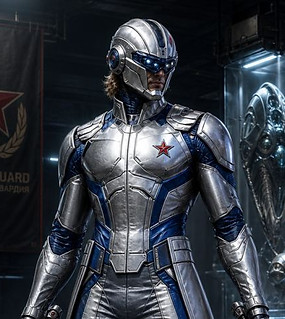
(L to R) Generalissimus, Soviet Guardian (IV), Comrade Ivan, Mystyck; Soviet Guard Troops in Ceremonials (back)
Soviet Guard TEAM
(Current)
Leader




The Red Guard
(1941-2010)
The Soviet Guard's history goes back as far as 1941 when it was known as the "Red Guard". Generalissimus has been in charge of both the Red Guard and the Soviet Guard throughout the existence of both teams. Over the decades, members of the Red Guard, as well as those that would eventually be part of the newer Soviet Guard, would be praised for their heroic acts to the Soviet Union and to Soviet Guard unto itself. For the story of the Red Guard, see our "History" subsection.
The following is a list of members of the Red Guard that are no longer with us (but are forever remembered in the "Red Guard Hall of Heroes" at the Soviet Guard's secret Greenland base (or were part of the Red Guard once, but never returned or never went on to the Soviet Guard in their listed identity).
BORDER LEGEND
Gray = deceased Gold = still alive Orange = Alive but maybe under different name/title




History
Revised: 3 May 2026
OVERVIEW
The Soviet Guard is the surviving legacy of the Soviet Union’s most dangerous metahuman military program. Born from the wartime Red Guard, hardened under Stalin, expanded during the Cold War, and reborn after the Soviet collapse, the Guard has endured purges, alien invasion, failed campaigns, internal betrayals, and generational trauma. To the world, it is a villainous paramilitary faction. To its members, it is homeland, family, army, and destiny. Its story stretches from World War II battlefields to the frozen Greenland base, from the first Soviet Guardian to the rise of Micah Milovovich, and from the old Red Guard to a new generation still fighting beneath a banner that refuses to fall.
The Long Red Shadow
The Soviet Guard did not begin as a team. It began as a weapon, a myth, and a state secret.
Across the twentieth century, the organization known first as the Red Guard and later as the Soviet Guard evolved from wartime necessity into Cold War terror, from state-controlled metahuman force into exiled ideological army, and finally into a hardened legacy faction whose members are bound together by loyalty, trauma, propaganda, survival, and blood.
To outsiders, the Soviet Guard is a villainous military organization: authoritarian, dangerous, secretive, and responsible for decades of global conflict. To its own members, it is something more complicated. It is homeland, army, family, prison, religion, and graveyard.
Its history is not clean. It is not heroic in the traditional sense. It is a history of soldiers ordered into darkness, monsters raised as patriots, idealists manipulated by stronger wills, and survivors who refused to let their banner die.
I. Origins of the Red Guard: War, Myth, and State Power
The roots of the Red Guard stretch back to the era of Soviet wartime mobilization, when the Soviet state began identifying, recruiting, controlling, or weaponizing extraordinary individuals. Some were mutants. Some were mystics. Some were enhanced soldiers. Some were relic-bearers tied to forces far older than the Soviet Union itself.
During World War II, figures such as Viktor Antonovich Sokolov, the first Soviet Guardian, became battlefield symbols of Soviet resistance. Known later as The Frontline Guardian, Sokolov fought from 1939 to 1945 as a respected military hero. He wore armored protection beneath his red-and-gold battlefield uniform and became a living emblem of Soviet endurance.
But Sokolov’s popularity became dangerous. He was respected by the army, admired by soldiers, and increasingly unwilling to remain a silent tool of Stalin’s regime. After the war, he planned resistance against Stalin’s tightening grip. He vanished during the postwar purges, quietly murdered or disappeared by the very state he had served.
His fate set the pattern for the Guardian legacy: honor and sacrifice wrapped inside political control.
II. Stalin’s Red Sentinel and the Birth of the Controlled Metahuman State
After Sokolov’s disappearance, the Soviet state did not abandon the Guardian symbol. It refined it.
The second Soviet Guardian, Mikhail Sergeyevich Morozov, became Stalin’s Red Sentinel. Active from 1946 through 1989, he was a mutant powerhouse encased in red-and-gold armor and protected by both physical resilience and mystical wards. His role was not merely battlefield defense. He became an enforcer, deterrent, symbol, and weapon of internal and external Soviet power.
During this era, the Red Guard became more than a collection of special operatives. It became a structured state apparatus. Mutants, mystics, assassins, intelligence specialists, soldiers, and relic-bearers were organized into a force that could serve openly when propaganda demanded it and covertly when reality required it.
Figures such as Mystyck, Molotok, and Serp gave the Guard a deeper and stranger foundation. Mystyck connected the Guard to Russian occult power. Molotok carried the weight of ancient warrior tradition through his mystical warhammer. Serp wielded alien sickles with almost mythic significance. Together, they helped transform the Red Guard from a political military project into a force surrounded by legend.
The Red Guard’s public face was strength. Its private reality was fear, obedience, and control.
III. The Cold War Red Guard
During the Cold War, the Red Guard became one of the most feared metahuman instruments in the world. It operated as a Soviet answer to Western superheroes, intelligence agencies, and military special programs. Its members were soldiers, spies, assassins, commanders, and living propaganda pieces.
The organization developed a layered structure: standard Red Guard troops, hardened Starshina, and elite officers, all serving beneath powerful metahuman leaders and political commanders. Its uniforms, ranks, ceremonial culture, and base rituals reinforced a single message: the Guard was not merely a unit, but a state within the state.
The Cold War era also produced many of its most dangerous specialists.
Radioson became a signal intelligence and radio-warfare operative, using old-school communications equipment, psychological manipulation, and covert broadcasts to turn information itself into a weapon.
Red Shadow, Sergei Viktorovich Orlov, became one of the Guard’s master spies: cold, disciplined, and capable of operating inside enemy structures before anyone realized he was there.
Karatel represented the darker disciplinary culture of the Guard. His presence changed the tone of the organization, replacing ordinary military obedience with something closer to fear-based submission.
Zhivitel reflected another side of the Guard: the healer, the preserver, the one who kept soldiers alive even when the cause itself was morally compromised.
The Red Guard was not one thing. It was battlefield command, espionage, occult defense, psychological warfare, assassination, propaganda, and military doctrine fused into one machine.
IV. The Late Soviet Fracture
By the late 1980s, cracks had formed inside the Soviet system and inside the Red Guard itself.
The first major symbolic fracture came through the Guardian title. In 1989, Mikhail Morozov, Soviet Guardian II, renounced the title and disappeared. Whether out of disillusionment, exhaustion, political calculation, or regret, his withdrawal marked the end of one age.
The title passed to Alexei Grigorievich Volkov, Soviet Guardian III, known as The Red Guard’s Banner. Volkov had once been a Starshina and became a powerful symbol of late-Soviet and post-Soviet continuity. He was brave, loyal, historically knowledgeable, and deeply committed to the Red Guard’s ideals. He was also manipulated by stronger political forces, especially Generalissimus, who understood the value of symbols better than anyone.
This same era also saw the fall of Pietre Vostol, later known as Silver Sabre. Once a disgraced 1988 Olympic sabre fencing gold medalist stripped of his medal after metahuman DNA testing, Vostol was pulled into the machinery of Soviet and post-Soviet intelligence. His transformation from athlete to operative to armored Soltan War fighter would become one of the Guard’s most morally complex stories.
The Soviet Union was collapsing, but the Red Guard did not collapse with it.
It adapted.
V. From Red Guard to Soviet Guard
After the Soviet Union’s fall, the Red Guard could no longer function as a conventional state instrument. But Generalissimus and his loyalists refused to let the old project die.
The organization gradually transformed into what became known as the Soviet Guard: a post-collapse successor force built from exiles, loyalists, surviving metahumans, intelligence networks, military remnants, ideological hardliners, and family legacies.
Its center of gravity shifted away from Moscow and into hidden strongholds, most notably the remote Greenland base. There, the Guard preserved its symbols, rituals, command structure, old grudges, and military culture.
This was the era when the Guard became more isolated, more mythic, and in some ways more dangerous. It was no longer merely serving a state. It was serving an idea of a state that no longer existed.
That made it harder to defeat.
VI. Zenith Labs, the Soltan Invasion, and the Remaking of the Guard
The turn of the millennium became one of the defining moments in Soviet Guard history.
On January 1, 2000, the Soltan Invasion changed the world and changed the Guard with it. The chaos of the invasion allowed Pietre Vostol to escape Zenith Labs, where he had been tortured and sensor-destroyed in 1999. In the aftermath, he claimed Soltan silver armor and paired energy sabres, becoming Silver Sabre.
The invasion also hardened the Guard’s identity. Against alien forces, old Red Guard survivors and new Soviet Guard loyalists fought not as a relic of the Cold War, but as a brutal military faction defending its own survival.
Characters such as Red Shadow became central during this crisis, operating in the damaged corridors of the Greenland base as Soltan forces breached its defenses. The Soltan War gave the Guard new weapons, new scars, and new myths.
Silver Sabre became one of the most important figures of this period. He was not innocent, but he was not a one-note villain. He was brutal, loyal, damaged, and capable of private mercy. He fought for the Guard, loved his family, and carried the shame of what had been done to him.
The Soltan War did not redeem the Soviet Guard. But it gave the organization a survival story powerful enough to bind a new generation.
VII. The Greenland Base Era
In the 2000s, the Greenland base became the heart of the Soviet Guard.
It was fortress, barracks, command center, prison, sanctuary, memorial hall, and ideological shrine. Children were raised there. Soldiers were trained there. Relics were stored there. Wounded members were repaired there. Dead members were honored there.
The Guard’s culture became increasingly familial and dynastic. Children of operatives inherited old grudges and old responsibilities. Some were trained from birth to serve the cause. Others were shaped by trauma, duty, or propaganda before they ever understood the outside world.
This period helped define later figures such as Red Nikita, whose family history through Red Lynx complicated her own identity and sharpened the generational cost of Soviet Guard service.
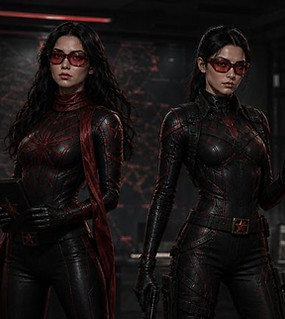
The Red Spider legacy also grew from this intelligence culture. Yelena Arkadyevna Morozova, Red Spider I, became part of the Guard’s shadow network. Her successors, including Katerina “Silk” Morozova and her twin legacy counterpart, carried the Red Web forward as a refined, dangerous intelligence lineage.
The Soviet Guard was no longer merely recruiting soldiers.
It was raising heirs.
VIII. Monsters, Outcasts, and Living Weapons
As the Guard evolved, it became a refuge for figures the outside world feared or rejected.
Snegovik became one of the Guard’s most visually terrifying members, bound to ancient blue crystalline ice power and transformed into a frost-armored warrior. His existence connected the Guard to relics and curses beyond ordinary Soviet science.
Cold Warrior, Piotr Nemchek, inherited or became entangled with the Snegovik-style helmet and its unstable ice power. His story represents the Guard’s willingness to place unbearable burdens on loyal soldiers, turning pain into service and suffering into duty.
Volchitsa, a Bodark werewolf hybrid, brought another layer of tragedy to the Guard. She was not simply a monster in uniform. She was a living symbol of exile, animal instinct, persecution, and survival. Her place in the Guard shows how the organization often embraces those the world tries to cage or destroy—then binds them to its own cause.
The Soviet Guard’s greatest strength became its greatest moral danger: it gave broken people a home, then asked them to kill for it.
IX. Lithuania, 2010: The Catastrophe
The 2010 Lithuania invasion became one of the Soviet Guard’s defining disasters.
By this time, Generalissimus had pushed the Guard into a campaign that exposed both its ambition and its internal rot. The invasion ended in failure and death. It also shattered the illusion that loyalty alone could preserve the old dream.
Soviet Guardian III, Alexei Volkov, died heroically during the Lithuania Incursion, holding a collapsing gate or position long enough for Red Guard troops to escape. In death, he became something more tragic than he had been in life: a brave man who had served a cause that manipulated him.
Silver Sabre also died on August 30, 2010, delaying heroes from reaching Generalissimus. Under Karatel’s fear-and-obedience influence, he participated in the invasion, though he privately helped civilians where he could. His death sealed him as one of the Guard’s most morally conflicted warriors: guilty, loyal, brutal, protective, and ultimately tragic.
The failed invasion left the Soviet Guard weakened, bloodied, and symbolically exposed. It also left the Guardian title vacant.
For six years, the Guard had no Soviet Guardian.
That absence mattered.
X. The Lucky Guardian and the 2016 Revival
In 2016, Generalissimus restored the Guardian title by choosing Lieutenant Micah Milovovich as Soviet Guardian IV, known as The Lucky Guardian.
Micah had been born and raised at the Greenland base. Cambridge-trained under false credentials in military armoring and building construction, he represented a new generation: young, charismatic, impulsive, talented, and deeply shaped by the Soviet Guard’s closed world.
His anointing was also personal and political. Generalissimus arranged Micah’s marriage to Korina Kosoff in a remote Moscow-area park. When Russian Federation forces attacked the wedding, Micah and the Guard fought them off without losing a single Soviet Guard member. The event became instant internal legend.
Micah’s rise gave the Guard what it had lacked since Lithuania: a new symbol. Unlike earlier Guardians, he was not a relic of Stalin, the Cold War, or the Soviet collapse. He was born from the Soviet Guard itself.
That makes him powerful.
It also makes him dangerous to Generalissimus.
Micah may eventually become the very thing Generalissimus cannot fully control: a popular successor with genuine loyalty from the younger Guard.
XI. Legacy, Bloodlines, and the Modern Soviet Guard
By the modern era, the Soviet Guard is no longer simply a Cold War villain team. It is a legacy organization built from overlapping generations.
The old guard includes mystics, relic-bearers, intelligence veterans, and Cold War survivors such as Mystyck, Molotok, Serp, Red Shadow, Radioson, and others whose lives are inseparable from the Soviet project.
The middle generation includes figures shaped by collapse, captivity, espionage, and the Soltan War: Silver Sabre, Red Spider I, Red Nikita, Red Lynx, Karatel, Zhivitel, and the hardened officers and Starshina who held the organization together through exile.
The younger generation includes Micah Milovovich, Korina Kosoff, the Red Spider successors, and the children of fallen members such as Silver Sabre’s Dmitri and Natalia. These heirs represent the unanswered question at the heart of the Soviet Guard:
Will the next generation repeat the old sins, reform the organization, or fight for control of its future?
The Soviet Guard survives because it turns memory into doctrine. Every death becomes a memorial. Every failure becomes a lesson. Every betrayal becomes proof that the outside world cannot be trusted. Every child born inside the Guard inherits not just a family name, but a war.
XII. The Meaning of the Guard
The Red Guard was created to serve the Soviet state.
The Soviet Guard survived after that state was gone.
That distinction defines the organization.
The Red Guard was a weapon of government power. The Soviet Guard is a weapon of memory. It fights for a lost nation, a mythologized past, and a future only its leaders claim to understand.
Its members are villains, soldiers, victims, patriots, zealots, survivors, and symbols. Some are monsters by choice. Some were made into monsters. Some still believe they are protecting their people. Some know better and continue anyway.
The Soviet Guard’s story is the story of a banner that should have fallen but did not.
It is the story of a military family that cannot decide whether it is defending history or being consumed by it.
It is the story of the long Red shadow stretching from World War II, through Stalin, through the Cold War, through the fall of the Soviet Union, through alien invasion, through Lithuania, and into a new generation that may either inherit the Guard…
…or finally break it.
BASE
Secret location in Greenland


