
A Universe of Pure Imagination

TM




History
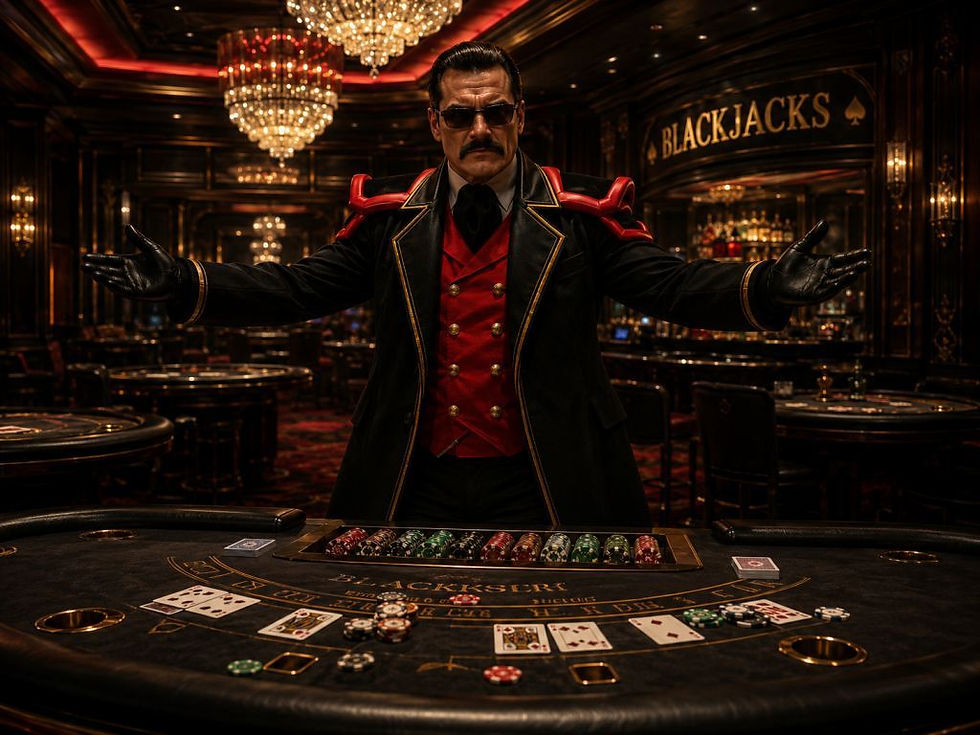
The Blackjacks began long before anyone wore a title, carried a themed weapon, or stood beside Blackjack Bruno as part of a criminal court. In the beginning, there were only gambling rooms, private card tables, illegal bookmakers, casino security contracts, and a growing network of debts that all seemed to lead back to one man.
Bruno understood gambling better than most. He knew that the cards mattered less than the people holding them. A losing player might be reckless, desperate, corrupt, ambitious, frightened, or simply too proud to walk away. Each weakness created an opportunity. Each unpaid marker created leverage. Each secret overheard at a private table could become more valuable than the money changing hands.
From those early operations, Bruno built something far larger than a chain of illegal casinos. He created a system that watched people before they entered, studied them while they played, and remembered them after they left. Winners were observed. Losers were encouraged. Debtors were sorted by what they owed, what they owned, and what they might still be useful for. Some were offered more time. Others were offered work. A few were given one final warning.
The casinos became the public face of the organization, but the real empire grew behind them. Money moved through private accounts and shell companies. Smugglers used Blackjacks routes. Politicians and executives met in protected rooms. Criminals borrowed money, sold information, and paid for silence. Fugitives found temporary shelter. Corrupt officials found reasons not to look too closely.
Bruno did not expand through chaos. He expanded through terms.
Regional gambling operators were offered access to Blackjacks security, financing, legal protection, intelligence, and high-value clientele. In return, they paid a percentage, shared information, and acknowledged Bruno’s authority. Those who accepted often prospered. Those who refused usually discovered that their staff had been bought, their debts had changed hands, or their private business had become public knowledge.
That was how the Blackjacks became more than a gambling syndicate. They became an institution built on obligation.
As the network spread, Bruno’s problems changed. Street enforcers could collect from ordinary debtors, but they were not enough against advanced security, superhuman rivals, occult threats, or people protected by wealth and influence. Bruno needed specialists,
but he had no interest in assembling a team of equals. He chose people who could each control a different part of his empire and gave them card-derived titles that reflected their place in his hand.
Aesa Hartz entered the organization through the world of psychology, behavioral technology, and psi-influence. Her value was not measured by how loudly she could threaten someone, but by how precisely she could understand them. She helped test loyalty, evaluate recruits, expose concealed fear, and pressure targets whose defenses were mental rather than physical. Bruno gave her access because he needed her abilities, but never enough access to become comfortable.
Cindi Su, the Diamond Queen, became the answer when an operation required precision. She could enter secure spaces, track valuable targets, recover stolen assets, and remove problems without creating the public spectacle that followed other Blackjacks operations. Her methods were clean, efficient, and controlled. She was trusted with jobs that depended on timing rather than intimidation.
Jack Soren came later, after Bruno’s growing empire began to suffer from inconsistent enforcement. Too many collectors were destroying what they had been sent to recover. Too many security teams treated violence as proof of strength. Jack changed that. Under his command, collection became a procedure rather than a tantrum. The debtor was identified, the debt was confirmed, and one final opportunity was offered. If the warning failed, Jack delivered the consequence.
His Clubs Division gave the Blackjacks a disciplined enforcement arm capable of protecting casinos, controlling crowds, recovering assets, and handling internal discipline. Where other criminals used force to display power, Jack used it to finish business.
The Wild Jokers were created for a very different purpose.
Bruno needed operatives who could frighten rivals, sabotage operations, abduct targets, and create public confusion without revealing the structure behind them. The Wild Jokers became that weapon. Their masks, theatrical movements, altered voices, and apparent instability made them look like costumed lunatics.
They were anything but.
Beneath the laughter and staged madness were rehearsed escape routes, specialist roles, encrypted communications, and strict mission priorities. They learned how to turn violence into spectacle and spectacle into cover. Witnesses remembered the jokes, the masks, and the chaos. They rarely remembered who gave the orders.
Then came the King of Spades.
Marcus Munchen had existed long before the Blackjacks. Once a cruel German nobleman, he had been transformed in the nineteenth century by a death-magic curse that bound his soul to the Sword of Spades. The curse made him nearly impossible to kill, but it also chained him to the bloodline responsible for his punishment.
When Marcus reemerged in the modern era, the sword drew him across Europe toward the surviving Völkner line. That line ended, as far as anyone knew, with Blackjack Bruno.
Marcus tried to defy him.
The curse would not allow it.
Bruno ordered him to kneel, and the immortal nobleman obeyed.
By naming him King of Spades, Bruno gave Marcus the title he had always desired while making certain that everyone understood the truth. Marcus was a king only in name. His crown belonged to the man who controlled him.
With King of Spades under his command, Bruno possessed something no ordinary crime syndicate could match: an immortal executioner who could pursue a target without rest, survive injuries that would kill other operatives, and tear through supernatural defenses that stopped conventional enforcers. Among lower-ranking Blackjacks, his name became a warning reserved for betrayal.
The organization continued to expand around these figures, but it never became a family. It remained a system of competing personalities held together by Bruno’s authority. Diamond Queen distrusted Aesa’s ability to influence the mind. Jack of Clubs despised the Wild Jokers’ wastefulness. Marcus regarded nearly everyone around him with contempt. Aesa studied Marcus with dangerous curiosity, wondering whether her technology could affect a soul already divided by magic.
Bruno encouraged enough tension to keep them alert, but not enough to threaten the organization.
That balance became one of the Blackjacks’ greatest strengths.
It also became one of their most serious weaknesses.
The empire now stretches far beyond its original gambling rooms. Blackjacks casinos operate as luxury venues, intelligence centers, safe meeting grounds, and fortified criminal assets. Behind public gaming floors are surveillance rooms, private vaults, restricted suites, secure elevators, hidden corridors, and command spaces known only to trusted personnel. Some properties are mostly legitimate.
Others are criminal strongholds wearing the face of entertainment.
The Blackjacks have survived investigations because no single authority sees the entire picture. Financial crimes are handled separately from disappearances. Wild Joker attacks appear disconnected from casino ownership. Occult authorities understand King of Spades but may lack proof linking him to Bruno. Local police see individual crimes while the Blackjacks see the table.
Bruno survives in those gaps.
Today, the Blackjacks are no longer merely a gang and no longer simply a supervillain team. They are an international criminal institution built on gambling, finance, information, fear, and dependence. Their power comes from the number of people who owe them money, owe them favors, or cannot afford for their secrets to be exposed.
The empire appears stable, but the risks beneath it continue to grow. The Wild Jokers become bolder with every successful operation. Diamond Queen’s loyalty remains professional rather than emotional. Jack of Clubs believes violence should serve business, not replace it. Aesa continues to test the limits of influence. King of Spades waits for the day the curse weakens or another Völkner descendant appears.
For now, the casinos remain open. The lights remain bright. The tables remain full.
And when the Blackjacks place a marker on the table, someone always pays.

THE BLACKJACKS CASINOS
Located in Las Vegas, Nevada, USA, The French Riviera...and many more locations!


MDUverse Data:
Created in MDU on 7 August 2013.