
A Universe of Pure Imagination

TM


OCEANIA OVEVIEW
OCEANIA
“Goodwork Brings Goodlife!”
Capital: Goldtown, Main Oceania Island
Head of State: Governor Sir George Winston Goldstein
Government: Centralized, authoritarian executive government
Population: Approximately 2.4 million (2026)
Location: South Atlantic Ocean
Established: 1990
Principal Territories: Oceania, Ascension, Equality, Freedom, Liberty, Justice, Inaccessible and Winston's Folly
Once a scattered collection of British-administered South Atlantic islands, Oceania has become one of the world's most unusual and formidable nations.
Since declaring independence in 1990 under Sir George Winston Goldstein, the country has undergone an extraordinary transformation. Its remote volcanic islands now support densely populated cities, advanced manufacturing complexes, protected artificial harbors, sophisticated military installations and extensive underground infrastructure.
Oceania is internationally recognized for its remarkable technological capabilities, including advanced robotics, aerospace engineering, naval construction, precision manufacturing and sophisticated defense systems. Its industries export equipment around the world, while a tightly managed national economy supports housing, employment, healthcare, education and modern civilian services.
The nation's guiding philosophy is expressed in its familiar motto: “Goodwork Brings Goodlife!”
To many citizens, this promise is more than political messaging. Oceania offers modern homes, career opportunities, recreation, family life and public services that compare favorably with those available in many other countries.
Yet Oceania's prosperity exists alongside an uncompromising political system.
Goldstein, publicly revered as Big Brother, exercises supreme executive authority through a thirteen-member National Directorate and four powerful ministries: Love, Peace, Plenty and Truth. Employment, housing, citizenship, public information and political activity remain subject to extensive government oversight.
Ordinary residents may enjoy comfortable lives, successful careers and substantial personal freedoms in their daily routines. However, political dissent, unauthorized organizing and challenges to the governor's authority can carry severe consequences.
For foreign governments, Oceania presents an equally complicated picture: a valuable source of advanced industrial technology, an increasingly significant commercial partner, a powerful military presence in the South Atlantic, and a nation whose most sensitive activities remain concealed behind formidable security measures.
Oceania is a land of extraordinary achievement, impressive opportunity and carefully controlled freedom.

GEOGRPAHY OF Oceania

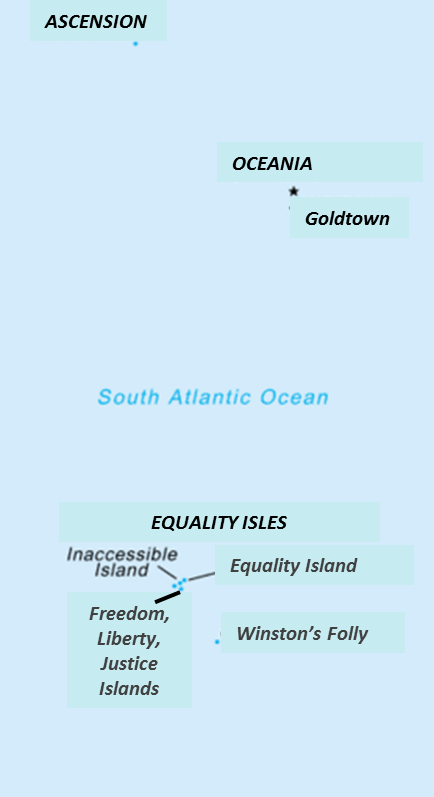

Oceania occupies a widely dispersed network of volcanic islands in the South Atlantic Ocean. Its principal territories were formerly associated with Saint Helena, Ascension Island and the Tristan da Cunha island group.
Despite their geographic separation, the islands function as a single nation through maritime transportation, aviation, advanced telecommunications and an extensive industrial logistics network.
Oceania's geography has shaped virtually every aspect of its development. Limited natural land area, rugged volcanic terrain and great distances between territories have encouraged the construction of high-density cities, artificial coastlines, underground installations, protected harbors and vertically integrated residential districts.
Each island has developed a distinct national role.
An Engineered Island Nation
Oceania's transformation has required extraordinary engineering.
Protected floating residential communities, coastal extensions, underground transportation systems, high-rise urban developments, specialized utility networks and artificial harbors have allowed the country to accommodate a population far larger than these islands historically supported.
The result is a nation whose physical landscape has been extensively reshaped by industrial ambition, advanced technology and the priorities of Governor Goldstein's government.
OCEANIA (MAIN ISLAND)

CAPITAL: Goldtown
Formerly Saint Helena, Main Oceania Island is the country's political and administrative center.
Goldtown, developed from the historic settlement of Jamestown, serves as the national capital and headquarters of Governor Goldstein's government.
The island contains the principal ministry complexes, important financial and commercial institutions, residential districts, advanced research facilities, major transportation infrastructure and substantial military installations.
Its rugged volcanic terrain accommodates an unusual combination of mountain developments, engineered coastal communities and underground facilities.
Goldstein Point and Tradesman's Isle are among its notable specialized industrial and maritime districts.

ASCENSION ISLAND
Ascension Island
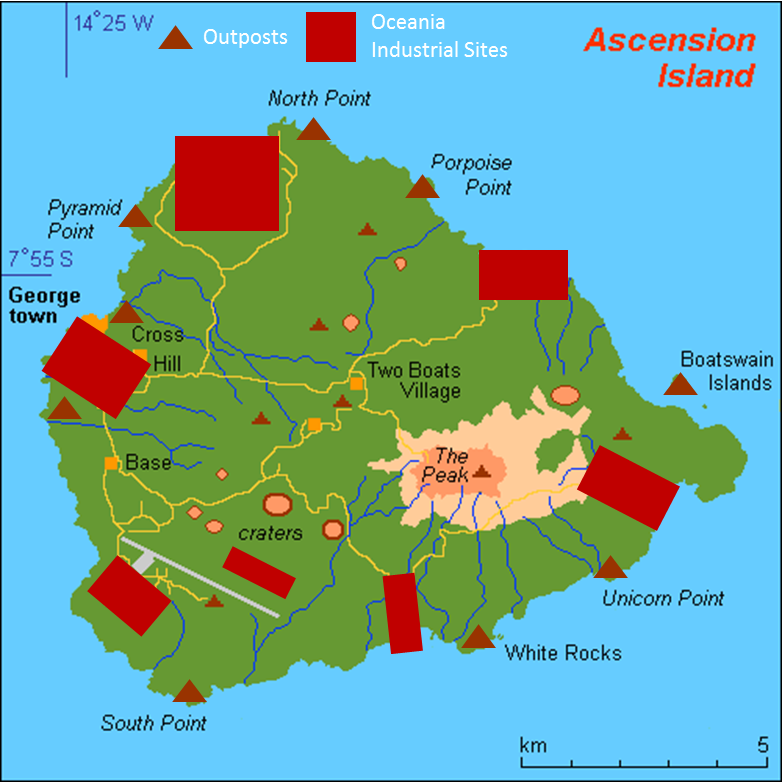
Ascension is Oceania's principal naval and aerospace-industrial center.
Its facilities support advanced shipbuilding, naval maintenance, aircraft production, robotics, military research and commercial manufacturing.
The Georgetown and Wideawake regions contain major transportation and technical infrastructure, while large protected harbors and drydock facilities support the nation's maritime industries.
Ascension is also one of Oceania's principal centers for international freight, specialist employment and technical education.
EQUALITY ISLAND

Formerly Tristan da Cunha, Equality is Oceania's largest center of heavy manufacturing.
Its industries produce machinery, armored vehicles, major structural components, industrial equipment and materials used throughout the country's manufacturing network.
Equality's remarkable industrial productivity has come at a serious environmental cost. Pollution, industrial waste and degraded coastal waters remain major concerns, despite continuing government modernization and remediation initiatives.
The island's large residential population includes industrial workers, engineers, technical specialists and their families.
Liberty, Freedom & Justice Islands

Liberty, Freedom & Justice Islands
Freedom Island
Formerly Nightingale Island, Freedom supports specialized agriculture, aquaculture, environmental research and selected utility operations.
Its comparatively small population lives in compact communities designed around the island's limited land area and sensitive environment.
Liberty Island
Developed from the Middle Island and adjacent islet area, Liberty specializes in precision technology, advanced electronics, research and selected high-value manufacturing.
Its small population primarily supports these specialized facilities and associated services.
Justice Island
Formerly Stoltenhoff Island, Justice serves as a smaller southern support territory, accommodating designated logistical, technical and national-defense functions.
Its residential population is correspondingly limited.
INACCESSIBLE ISLAND
Inaccessible Island - National Environmental and Wildlife Preserve
Inaccessible Island is one of Oceania's most treasured natural conservation areas.
Renowned for its dramatic volcanic cliffs, remote coastal habitats and extraordinary birdlife, the island supports species found in few other places on Earth.
Among its most remarkable inhabitants are:
-
Inaccessible Island rail: The world's smallest living flightless bird, found exclusively on Inaccessible Island.
-
Northern rockhopper penguin: Distinctive yellow-crested penguins that nest along the island's rocky coastline.
-
Spectacled petrel: A rare seabird whose only known breeding grounds are located on Inaccessible Island.
-
Atlantic yellow-nosed albatross: A remarkable South Atlantic seabird associated with the surrounding island group.
-
Sooty albatross, great shearwater and broad-billed prion: Additional members of the island's rich seabird community.
Oceania's government maintains strict conservation regulations designed to protect sensitive breeding habitats, prevent invasive-species introductions and preserve the island's ecological integrity.
Landing permits are required for all visitors. Access is extremely limited, and ordinary tourist applications are generally declined.
Seasonal nesting restrictions, environmental conditions and biosecurity requirements may further limit authorized activities.
Educational photographs, nature documentaries and approved ecological materials allow residents to appreciate the island without disturbing its wildlife.
Over the years, occasional allegations have suggested that Inaccessible conceals industrial or military installations.
Oceania's government dismisses these claims as baseless speculation, emphasizing the island's internationally significant wildlife, protected landscape and absence of visible industrial development.
Inaccessible Island: A living sanctuary for Oceania's extraordinary natural heritage.
WINSTON'S FOLLY ISLAND
Winston's Folly - National Biosecurity and Environmental Health Centre
Winston's Folly is one of Oceania's most specialized government-administered territories.
Formerly known as Gough Island, the remote South Atlantic location supports the Winston's Folly National Biosecurity & Environmental Health Centre, a restricted institution associated with environmental monitoring, medical isolation and national biosecurity activities.
Its facilities include research buildings, specialized medical infrastructure, staff accommodations, transportation support and dedicated maritime logistics installations.
The government's stated mission includes environmental-health research, infectious-disease preparedness, specialized isolation services and scientific monitoring.
Because of the facility's sensitive operations, access is prohibited to the general public.
Only authorized staff, approved medical transfers and designated support personnel may enter the restricted territory.
The government maintains that these measures are necessary to protect public health, preserve operational safety and prevent interference with specialized research.
Winston's Folly has periodically attracted speculation concerning the nature and scope of its activities. Oceania officials maintain that its restrictions reflect legitimate national health and biosecurity responsibilities.
Winston's Folly: Protecting Oceania through advanced environmental-health research and national biosecurity.
Oceania Society
By 2026, Oceania's population has grown to approximately 2.4 million residents, an extraordinary increase from the small communities that inhabited the islands before independence.
This expansion has been driven by intensive urban development, international recruitment, family settlement and the country's extensive scientific and industrial programs.
The population is concentrated primarily on Main Oceania Island, Ascension and Equality, with smaller communities occupying the remaining territories.
Oceania is a multicultural society. Its residents include people and families originating from Europe, Africa, Asia, the Americas and Oceania, alongside citizens born and raised within the country.
English is the principal administrative and commercial language. Residents also speak numerous family and community languages, while government-promoted Oceania-speak terminology appears throughout public life.
The Three Social Classes
Oceania retains a formal three-class political structure.
Proles make up the broad foundation of society, including industrial workers, service employees, technicians, tradespeople, business owners and many other citizens. Their living conditions range from modest working communities to comfortable, prosperous households.
Outer Party members occupy many professional, technical, managerial and administrative positions. Their responsibilities often provide additional privileges, accompanied by increased expectations of political loyalty and institutional compliance.
Inner Party members form the country's small governing elite, occupying its highest political offices and selected positions of exceptional national authority.
The classes influence access to government, residential opportunities, professional advancement and political privilege. They do not determine every aspect of an individual's income, occupation or personal lifestyle.
Families & Community Life
Marriage, family households, parenting and ordinary social relationships are recognized parts of Oceania's society.
Residents attend schools, participate in sports, enjoy restaurants and entertainment, celebrate community events and pursue professional careers.
Modern residential developments include high-rise apartments, mountain communities, underground districts and the nation's distinctive floating residential pods.
Public services include healthcare, education, transportation, utilities and community recreation, with the quality and availability of certain privileges varying by location and social standing.
The Gateway of Opportunity
The Gateway of Opportunity is Oceania's national immigration and settlement program.
Prospective residents are offered reception services, medical assessments, vocational guidance, language preparation and assistance with employment and housing.
The program has helped attract workers, specialists and families seeking opportunity within Oceania's expanding economy.
However, successful settlement also brings extensive government obligations. Employment, permanent residence, travel and citizenship remain subject to national regulation.
Goodwork Brings Goodlife
Oceania's familiar motto reflects the government's belief that productive work and civic participation should be rewarded.
Its Community Merit program evaluates participating residential communities, recognizes accomplishments and awards additional amenities and privileges.
For many residents, Community Merit is a genuine source of neighborhood pride and celebration.
For others, its constant evaluations and consequences represent another form of government control.
In Oceania, prosperity and opportunity are real—but political independence is limited.
HISTORY OF Oceania
The Road to Independence
Before 1990, the islands that would become Oceania formed part of Britain's scattered South Atlantic territories. Political dissatisfaction, economic hardship and growing resentment over the islands' relationship with Britain created conditions for an independence movement.
At the center of that movement stood Sir George Winston Goldstein, a former British MI6 intelligence officer and native of Saint Helena.
Goldstein's experience in intelligence, political organization and strategic planning proved instrumental in uniting supporters around the prospect of an independent nation.
The independence movement soon escalated into a violent confrontation with British authorities. In 1990, Goldstein declared the formation of Oceania, with himself as its governor.
The Independence Conflict
Britain attempted to reestablish control over its former territories, expecting to confront a comparatively small and isolated independence movement. Instead, British forces encountered an unexpectedly capable and heavily equipped military organization. Advanced weapons, naval vessels, aircraft and disciplined ground forces appeared in quantities that confounded foreign intelligence estimates.
The ensuing conflict ended without Britain restoring its former authority.
Questions remain regarding how Goldstein assembled such substantial military resources in so little time. Oceania's official history attributes the victory to extraordinary leadership, national determination, technological preparation and the courage of its founding defenders. Outside observers have long suspected that powerful international interests supplied equipment, personnel and support behind the scenes. Whatever the full circumstances, the events of 1990 established Oceania as a fiercely independent and increasingly militarized South Atlantic nation.
The Industrial Transformation
Following independence, Goldstein launched an ambitious program of industrial construction, military modernization and national development.
Factories, port facilities, research centers, transportation infrastructure and residential districts rapidly expanded across the islands. Military production was particularly prominent, with naval construction, advanced machinery, aircraft and defense technologies becoming major national priorities. Oceania also began developing sophisticated civilian applications for its growing technological capabilities. During the 1990s, the government established the institutions and policies that would eventually become its modern administrative and industrial system. The country was increasingly characterized by centralized political authority, rapid development and unusually strict national-security arrangements.
The Soltan Invasion and a Changing World
In 2000, the Soltan Star Empire's invasion of Earth dramatically disrupted international affairs. Oceania's apparent lack of direct invasion became the subject of speculation, adding to the mystery surrounding its military capabilities and foreign relationships. The global upheaval also reshaped the political and commercial environment in which Goldstein's government operated.
During the years that followed, Oceania continued expanding its infrastructure, industries and international economic relationships.
Expansion and Modernization
Through the 2000s and 2010s, Oceania underwent a second transformation. Its industrial economy increasingly supported civilian prosperity as well as military strength. Advanced housing, extensive public utilities, vocational education, healthcare, transportation and commercial services accompanied the expansion of its cities and manufacturing centers. The nation's population grew substantially as international workers, specialists and families arrived through increasingly organized immigration programs.
Robotics became a highly visible part of everyday life, particularly through the Oceania Social Units and other automated systems. At the same time, the government retained its centralized political structure and formidable internal-security institutions. International relationships remained complicated. Foreign governments valued Oceania's advanced products and commercial opportunities while questioning its human-rights record, military secrecy and treatment of political opponents.
Oceania in 2026
By 2026, Oceania has become a densely populated, highly industrialized technological power. Its cities, artificial harbors, military installations, research facilities and advanced manufacturing enterprises represent an extraordinary achievement for a nation built from geographically isolated volcanic islands.
Governor Goldstein continues to exercise supreme executive authority through four ministries and the National Directorate.
The government promotes a vision of prosperity, productivity, national unity and collective achievement under the motto “Goodwork Brings Goodlife!”
For many citizens, Oceania offers genuine opportunities and material security. For political dissidents, including the resistance organization known as the Liberators, Goldstein's government remains an oppressive authoritarian regime whose apparent prosperity cannot justify its restrictions on individual freedom. Oceania's story is therefore one of extraordinary accomplishments and unresolved contradictions: a nation that has transformed its physical world while maintaining some of the most restrictive political institutions on Earth.
OCEANIA NATIONAL CITIZEN BADGE & RANK SYSTEM

RANK GUIDE
This guide provides you positional rankings in Oceania's Society for a doubleplusgood understanding of our roles!
Click on the PDF of links to open the Rank Guide!

“Your Identity. Your Responsibility. Your Place in Oceania.”
Every recognized citizen of Oceania is required to wear an official National Citizen Badge, a distinctive identification device representing the individual's occupational rank, recognized status and relationship to the nation's governing institutions.
The badge system is one of Oceania's most recognizable traditions, appearing on civilian clothing, workplace uniforms, professional attire, military dress and government service garments.
What appears to be a simple rank insignia is also a sophisticated technological device integrated into Oceania's national identification, public-safety and administrative networks.
THE PURPOSE OF THE NATIONAL BADGE
The badge fulfills several functions within Oceania's highly organized society.
Citizenship and Identification
Each badge is associated with an authorized individual identity, helping government systems establish the wearer's recognized status, occupational affiliation and approved credentials.
Rank and Authority
The badge's design identifies the wearer's professional field and corresponding level within Oceania's occupational hierarchy.
Citizens are expected to recognize official badges and respect the authority associated with government, military, security and other designated positions.
Public Safety
Integrated sensors provide information supporting medical emergencies, civilian assistance and authorized security operations.
Workplace and Facility Access
The badge may function as a credential for approved workplaces, residential areas, transportation facilities and restricted government installations.
National Services
Authorized systems use badge information to support public assistance, emergency response, administrative services and selected community programs.
OCCUPATIONAL FIELDS AND RANKS
Oceania's rank system recognizes a broad range of professional fields, including government, administration, military service, aviation, commerce, education, industry, medicine, policing and corrections. Each field possesses distinctive insignia designs and a structured progression of responsibility.
Most fields use five principal levels, beginning with entry-level or junior positions and progressing through senior professional and executive appointments.
Specialized categories also exist for the Champions of Oceania, Oceania Social Units and individuals held under correctional authority.
The insignia system allows citizens and government organizations to identify professional responsibilities without relying exclusively on written titles or conventional uniforms.
A person's occupational rank does not necessarily correspond directly to their political classification as a Prole, Outer Party or Inner Party member.
INTEGRATED HEALTH AND SAFETY TECHNOLOGY
National Citizen Badges incorporate advanced sensors capable of monitoring selected physiological indicators. Depending on their model, approved functions and operating environment, these indicators may include heart rate, respiratory patterns, physical activity and signs of physiological stress. Some badge systems interface with additional sensors to provide more detailed health information.
During a medical emergency, authorized responders may receive alerts indicating that a citizen requires assistance. An Oceania Social Unit may recognize an elevated wellness concern and offer practical support, such as contacting medical personnel or suggesting an approved recreational activity.
These capabilities are promoted by the government as an important contribution to public health, safety and personal wellbeing.
THE BADGE AND OCEANIA SOCIAL UNITS
Oceania Social Units are equipped to recognize authorized badge information during normal civilian-assistance duties. An OSU may use permitted data to confirm a resident's identity, provide directions, identify approved public services or respond to an emergency.
The system may also support personalized recommendations.
For example, an OSU encountering a resident experiencing elevated stress may suggest a recreational activity, relaxation program or approved Goodvent session.
To many citizens, these interactions demonstrate the benefits of Oceania's advanced technology.
CIVIL SECURITY AND EMERGENCY RESPONSE
The Oceania Civil Security Service uses authorized badge information to assist with identification, public safety and emergency response.
Officers may receive relevant alerts concerning immediate medical risks or elevated physiological stress during an encounter. Such information can help personnel recognize circumstances that may call for medical intervention, additional assistance or a calmer approach.
However, physiological stress is not proof of deception, criminal intent or political disloyalty. Miniluv's specialized security organizations also possess access to designated information systems for authorized investigations.
The scope and oversight of these capabilities remain subjects of significant controversy.
COMMUNITY MERIT AND PUBLIC SERVICES
The National Citizen Badge can interact with Oceania's administrative and community-service systems. Authorized participation in educational activities, approved employment programs, public-service events and selected recreational experiences may contribute to individual service records or applicable Community Merit activities. Badges also support identity verification when accessing certain benefits, facilities and government services. Community Merit remains a separate system of civic recognition and discretionary rewards. The badge itself is not a form of currency.
THE RESPONSIBILITY OF RECOGNIZING RANK
Oceania's government considers the recognition of official rank an important civic responsibility.
Citizens are expected to understand the visual distinctions between ordinary occupational levels, senior administrators, military officers, law-enforcement personnel and recognized government officials. The rank system is intended to reduce confusion regarding official responsibility and facilitate appropriate interactions between citizens and public institutions. However, rank alone does not grant unlimited access to private residences, government installations or civilian property.
Actual authority depends upon the wearer's office, assigned responsibilities and applicable authorization.
THE PRICE OF CONSTANT IDENTIFICATION
For many citizens, the badge system provides genuine convenience, improved emergency assistance and practical access to public services. Yet its technology also enables extensive identification, monitoring and the collection of personal information.
Location records, physiological alerts, access histories and interactions with government systems may generate information that remains available to authorized institutions.
Critics argue that this creates an environment in which personal privacy is increasingly difficult to separate from government oversight. In Oceania, the same device that can summon medical assistance may also provide information used in an investigation.
The National Citizen Badge symbolizes membership in Oceania, recognition within its social order and participation in its technologically advanced society.
It also serves as a constant reminder that, in Oceania, identification and observation are never entirely separate.
GOVERNMENT OF Oceania
Oceania is governed through a centralized authoritarian executive system established under Governor Sir George Winston Goldstein, the nation's founder and supreme political authority.
Since independence in 1990, Goldstein's government has evolved from a revolutionary administration into a complex national institution overseeing approximately 2.4 million residents, a substantial industrial economy, eight island territories and one of the South Atlantic's most formidable military establishments.
The country's governmental structure is defined by the National Charter of Oceania, which formalizes executive authority, national administration, citizenship procedures and the responsibilities of its principal institutions. The Charter establishes a functioning system of government, but it does not provide for unrestricted political opposition or popular elections capable of replacing the governor.
The Governor
Widely known as Big Brother, Governor Goldstein serves as Oceania's head of state, chief executive and supreme military authority. He appoints the members of the National Directorate, approves major government policies, determines national strategic priorities and exercises final authority over exceptional matters of security and defense.
To his supporters, Goldstein is the leader responsible for transforming neglected and isolated islands into a technologically advanced nation offering employment, housing, education, healthcare and substantial material prosperity. To his critics, he is the central figure in an authoritarian system that restricts political expression, controls citizenship and employs powerful institutions to suppress opposition. Both interpretations are fundamental to Oceania's national identity.
The National Directorate
Goldstein governs with the assistance of a thirteen-member National Directorate, consisting of the governor, the leaders of Oceania's four ministries and eight additional senior executive officials. Directorate members coordinate national policy, supervise major public institutions and provide professional advice concerning the economy, security, science, infrastructure, diplomacy and public administration. Although members may disagree over policy and present competing recommendations, the Directorate is not an independent parliament. Its authority ultimately derives from Goldstein.
The Four Ministries
Oceania's government is organized around four principal ministries:
-
Ministry of Love (Miniluv): Civil security, law enforcement, citizenship regulation, legal administration and corrections.
-
Ministry of Peace (Minipax): National defense, military organization, strategic readiness and the Oceania Defensive Forces.
-
Ministry of Plenty (Miniplenty): Economic development, industry, housing, employment, immigration, utilities and community services.
-
Ministry of Truth (Minitru): Education, public information, broadcasting, national culture, historical records and government communications.
Each ministry maintains its own administrative and professional organizations. Their responsibilities frequently intersect, but their operating authority remains distinct.
Territorial Administration
Oceania's geographically separated territories are administered through appointed regional officials coordinated by the Chief Regional Administrator. Major population centers operate extensive civilian administrative systems, while smaller islands maintain appropriately scaled local institutions. Inaccessible Island and Winston's Folly are subject to exceptional national-security arrangements and more restrictive administration.
Citizenship and Public Administration
Oceania maintains professional government services, administrative tribunals and procedures through which citizens may challenge ordinary errors or service decisions. Many disputes involving housing, commercial activity, employment and public services are resolved through established administrative processes. However, the government's political-security powers extend far beyond those of most democratic nations. Cases involving prohibited political activity, alleged disloyalty or exceptional national-security concerns may be handled under procedures offering considerably fewer protections.
The result is a government capable of genuine administrative competence and extraordinary political coercion.
Oceania's institutions are extensive, technologically sophisticated and often effective—but none operate independently of Governor Goldstein's ultimate authority.
A NOTE ON OCEANIA'S OFFICIAL RECORDS
Oceania's government maintains extensive control over public information, historical records and access to restricted territories. Certain descriptions of national facilities reflect official government statements and may not represent the complete nature of their operations.
THE NATIONAL DIRECTORATE
The National Directorate is Oceania's highest standing executive council. Its thirteen members include Governor Goldstein, the four ministry leaders and eight senior officials responsible for coordinating the country's principal administrative and strategic functions. All members are appointed under the authority of the governor.
Executive Authority
National Directorate members possess significant professional and administrative responsibilities, but they do not constitute an independent legislature. Goldstein retains the final decision on major executive matters.
The Directorate's effectiveness depends heavily on its members' expertise and their ability to balance competing national priorities without directly challenging the governor's supremacy.
Executive Leadership


Sir George Winston Goldstein
Governor of Oceania
Founder and supreme executive authority of the nation. Goldstein determines national policy, appoints senior officials and exercises ultimate authority over the country's government and military.

Margaret Ashcombe
Executive Secretary
One of Goldstein's longest-serving administrative associates. Ashcombe coordinates executive schedules, government directives, National Directorate proceedings and official administrative correspondence.
Eleanor Wycliffe
Governor's Special Advisor
A veteran political strategist and longtime confidante of Goldstein. Wycliffe provides confidential advice on national policy, political stability and the potential long-term consequences of executive decisions.
MINISTRY OF LOVE (miniluv)

Dr. Celia Whitcombe
Minister of Love
Oversees Oceania's internal-security, citizenship, law-enforcement and correctional institutions. Whitcombe presents her ministry as a protector of national stability and public welfare, although its political-security powers remain deeply controversial.
“Security Through Unity. Stability Through Loyalty.”
The Ministry of Love, commonly known as Miniluv, is one of Oceania's four principal ministries and the nation's highest civilian authority for internal security, law enforcement, citizenship regulation, judicial administration and corrections. Responsible for maintaining public order throughout a nation of approximately 2.4 million residents, Miniluv exercises considerable influence over the relationship between Oceania's citizens and the government of Governor Sir George Winston Goldstein.
Under the leadership of Minister Dr. Celia Whitcombe, the ministry coordinates professional law-enforcement institutions, national security investigations, citizenship enforcement, administrative justice, correctional programs and authorized public-safety technologies.
Officially, Miniluv exists to preserve a peaceful, productive and secure society in which citizens can enjoy the benefits of Oceania's considerable national achievements. Yet its responsibilities extend well beyond conventional public safety. Miniluv also possesses extraordinary authority to investigate political dissent, regulate ideological conduct and enforce the legal and social boundaries established by Goldstein's government.
To many residents, the ministry provides security and stability. To others, it represents the constant possibility that ordinary disagreement may eventually become a matter of political suspicion.
PUBLIC SAFETY AND THE PROTECTION OF SOCIETY
Miniluv supervises Oceania's principal civilian law-enforcement and internal-security organizations.
These institutions protect residential communities, investigate criminal activity, maintain public order and coordinate with emergency responders throughout the nation's geographically separated territories. Civilian officers and specialized support systems provide practical assistance during emergencies, investigate conventional offenses and protect the public from everyday criminal threats. Oceania's extensive use of advanced technology has substantially enhanced its public-safety capabilities.
Automated assistance systems, forensic resources, modern communications and the familiar Oceania Social Units support professional personnel in delivering services. However, Miniluv distinguishes between ordinary criminal behavior and conduct considered threatening to the political order.
Suspected offenses against national loyalty, prohibited political organization and ideological violations may be referred to specialized security authorities. This distinction creates two different experiences of law enforcement within the same country: familiar community protection and far more restrictive political supervision.
CITIZENSHIP, LAW AND ADMINISTRATIVE JUSTICE
Miniluv maintains the legal framework through which citizenship standing, residency obligations and authorized national conduct are regulated and enforced.
Oceania operates government-appointed tribunals and administrative review procedures for ordinary civil, criminal and citizenship matters.
Citizens may challenge certain penalties, seek correction of administrative errors and pursue authorized appeals. These processes can produce meaningful outcomes in ordinary disputes involving property, public services, employment arrangements or administrative decisions.
Nevertheless, Oceania's judicial institutions do not possess independence from the governor comparable to that found in constitutional democracies.
Political-security cases may involve exceptional procedures, restricted hearings and limitations on ordinary rights of review. Miniluv's authority also extends to the enforcement of citizenship restrictions, compulsory administrative reassignment and legal revocation of recognized citizenship. Although minor misconduct or disappointing Community Merit performance does not ordinarily justify severe sanctions, persistent serious violations or politically classified offenses may place a citizen's legal standing in jeopardy.
THE UNPERSON DESIGNATION
Among the most feared consequences of Oceania's citizenship system is the designation of unperson.
The government may apply this classification following the formal revocation of citizenship under exceptional legal or security proceedings. Official terminology describes affected individuals as having been removed or released from Oceania's recognized citizenry. The actual consequences can be considerably more severe than those words suggest.
An individual designated as an unperson may lose the protections, privileges and recognized legal standing ordinarily associated with Oceania citizenship. Such individuals may be placed under compulsory state custody or transferred into restricted government systems whose operations are not subject to ordinary public scrutiny. Information regarding their subsequent circumstances may become difficult or impossible for family members and acquaintances to obtain.
The existence of this designation reinforces the extraordinary power Miniluv possesses over the boundary between recognized membership in Oceania and exclusion from its society.
CORRECTIONS AND RE-EDUCATION POLICY
Oceania's correctional system includes ordinary detention, structured rehabilitation, vocational programs and exceptional national-security confinement.
Miniluv officially presents corrections as a means of preserving public safety, addressing unlawful behavior and returning eligible individuals to productive participation in society. Ordinary correctional programs may include education, supervised employment, counseling and formal rehabilitation requirements. However, the ministry also maintains highly restricted correctional procedures associated with political detention, coercive re-education and exceptional security cases.
Critics of Goldstein's government have alleged severe psychological abuse, forced labor, prolonged detention and other troubling practices within its most secretive institutions. The government provides limited information concerning these activities and frequently disputes allegations made by political opponents. The result is a correctional system in which ordinary rehabilitation and extraordinarily harsh punishment can exist under the same institutional authority.
SURVEILLANCE AND TECHNOLOGICAL OVERSIGHT
Miniluv benefits from Oceania's sophisticated identification, communications, monitoring and information-management technologies.
The nation's universal citizen badge system provides recognized identification and occupational rank information while also supporting selected health, safety and administrative functions. Authorized systems can receive physiological indicators, emergency alerts, identity-verification information and other data relevant to public services. These capabilities can help emergency responders identify medical distress, support civilian security personnel and improve coordination during public-safety incidents. However, access to personal information also creates opportunities for intrusive monitoring and politically motivated investigation.
Miniluv's specialized security organizations possess broader investigative authorities than ordinary public-service personnel. Information generated through civilian technology, public facilities and approved recreational systems may become relevant to authorized inquiries.
The government maintains that such capabilities are essential to public protection.
Critics argue that the same systems permit surveillance extending far beyond legitimate security requirements. A significant concern is the interpretation of behavioral information. Physiological stress, unusual activity or emotional responses may be treated as suspicious even when they have entirely innocent explanations.
In Oceania, technological sophistication does not guarantee impartial judgment.
PROFESSIONAL STANDARDS AND ACCOUNTABILITY
Miniluv maintains professional rules, investigative procedures and internal administrative controls intended to preserve organizational discipline.
Authorized review mechanisms examine misconduct, corruption, procedural violations and failures to follow government regulations. Some investigations result in corrective action, personnel discipline or changes to operational procedures. These mechanisms contribute to the ministry's ability to provide dependable everyday services. Nevertheless, they remain subject to political authority and restrictions concerning classified operations.
Oversight that is effective in ordinary administrative matters may have considerably less influence when a case involves sensitive national-security interests. This creates a recurring contradiction between Miniluv's professional obligations and its ultimate responsibility to protect Goldstein's government.
RELATIONSHIPS WITH OTHER MINISTRIES
Miniluv cooperates extensively with Oceania's other principal ministries.
Miniplenty administers economic development, employment, housing, immigration and Community Merit. Miniluv becomes involved when matters require law enforcement, citizenship action or security investigation.
Minitru supervises national information, education, official history and cultural messaging. Its communications reinforce approved civic conduct, while Miniluv enforces applicable legal and political-security restrictions.
Minipax oversees Oceania's military establishment and national defense. Military support to civilian authorities requires appropriate authorization and does not replace ordinary policing.
These relationships allow the government to coordinate public services, emergency response and national-security priorities while maintaining distinct institutional responsibilities.
SECURITY, LOYALTY AND THE PRICE OF ORDER
Miniluv represents one of the most profound contradictions within Oceania.
Its officers protect residents, investigate genuine crimes, assist during emergencies and provide important public services.
Its administrative institutions help maintain social stability, resolve ordinary disputes and protect the benefits of living in a modern technological nation. Yet those same institutions ultimately serve a government that restricts political opposition and reserves extraordinary powers to determine acceptable beliefs, conduct and citizenship standing.
For citizens who support Oceania's political order, Miniluv can be a respected guardian of safety and national prosperity.
For those who challenge that order, it can become an instrument of surveillance, intimidation, punishment and disappearance.
In Oceania, the Ministry of Love promises to protect its citizens. But the government ultimately determines who remains worthy of that protection.
OCSS

Naiomi Calder
Director-General OCSS
Professional civilian law enforcement and public protection.
The Oceania Civil Security Service (OCSS) is the principal civilian law-enforcement organization of Oceania.
Operating under the Ministry of Love, the service is responsible for maintaining public safety, investigating ordinary criminal activity, assisting residents and supporting the orderly operation of the nation's extensive residential, commercial and industrial communities. Its personnel provide familiar police services throughout the country, including neighborhood patrols, criminal investigations, traffic enforcement, emergency assistance, public-event security and coordination with other civilian response organizations.
PROFESSIONAL ORGANIZATION
The OCSS maintains trained officers, investigators, supervisors and specialist teams equipped to operate within Oceania's technologically advanced environment. Major metropolitan areas support substantial permanent police operations, while smaller territories receive appropriately scaled civilian-security services. The organization uses modern forensic resources, automated reporting systems, secure communications and specialized equipment. Personnel are expected to resolve ordinary criminal matters professionally and maintain public confidence.
OSU SUPPORT
OCSS officers frequently work alongside Oceania Social Units, whose public-assistance capabilities can supplement emergency response and authorized law enforcement. OSUs may assist with identification, information, public warnings, emergency access and selected enforcement duties. Their operation remains subject to approved government protocols and does not replace human command responsibility.
PUBLIC INTERACTION
The OCSS is often the most visible and approachable part of Miniluv. Its officers help residents during emergencies, respond to complaints, investigate offenses and maintain safety within Oceania's cities and residential communities. The service may also use authorized citizen-badge information to identify immediate medical concerns or indicators of elevated physiological stress. Such information can inform an officer's situational awareness, but does not independently establish criminal intent or deception.
RELATIONSHIP WITH THINKPOL
The OCSS is institutionally distinct from THINKPOL.
Ordinary criminal matters remain principally within the responsibility of civilian law enforcement. Political-security investigations fall within THINKPOL's specialized jurisdiction. The organizations may cooperate under authorized procedures, although the boundaries between conventional law enforcement and political security remain a source of concern.
THE OCSS IN OCEANIAN SOCIETY
For many residents, the OCSS represents dependable public protection and professional emergency assistance. However, its ultimate obligation to Oceania's political system means that civilian policing is not entirely separated from the government's broader authority. The OCSS exists to protect Oceania's communities—within the limits established by the government those communities serve.
THINKPOL

The Ministry of Peace, commonly known as Minipax, administers Oceania's national defense policy and oversees the country's military establishment. Despite its comparatively small land area, Oceania maintains a formidable military supported by advanced industrial production,
sophisticated defense technology, protected naval facilities and a large professional force.
Internal Review
The Ministry of Peace, commonly known as Minipax, administers Oceania's national defense policy and oversees the country's military establishment. Despite its comparatively small land area, Oceania maintains a formidable military supported by advanced industrial production,
sophisticated defense technology, protected naval facilities and a large professional force.
Corrections
The Ministry of Peace, commonly known as Minipax, administers Oceania's national defense policy and oversees the country's military establishment. Despite its comparatively small land area, Oceania maintains a formidable military supported by advanced industrial production,
sophisticated defense technology, protected naval facilities and a large professional force.
MINISTRY OF Peace (minipax)
The Ministry of Peace, commonly known as Minipax, administers Oceania's national defense policy and oversees the country's military establishment. Despite its comparatively small land area, Oceania maintains a formidable military supported by advanced industrial production,
sophisticated defense technology, protected naval facilities and a large professional force.

Victor Halden
Minister of Peace
Responsible for national defense policy, military administration, procurement priorities and strategic planning. Halden is a strong advocate for Oceania's technologically sophisticated military-industrial capabilities.
Admiral Mara Keating
Chief of Defense Staff
Responsible for national defense policy, military administration, procurement priorities and strategic planning. Halden is a strong advocate for Oceania's technologically sophisticated military-industrial capabilities.
Oceania Defensive Forces (ODF)
The Oceania Defensive Forces (ODF) constitute the nation's armed forces.
In 2026, the ODF maintains approximately 300,000 active human military personnel, supported by a trained reserve establishment of approximately 200,000. Its personnel serve through four principal military organizations.
-
Oceania Defense Army (ODA)
-
Oceania Naval Forces (ONF)
-
Oceania Coast Guard (OCG)
-
-
Oceania Aerospace Forces (OAF)
-
Skyknights
-
Oceania Defense Army (ODA)
The ODA provides ground and territorial defense, mechanized forces, armored units, combat engineering, military logistics and protection of major national installations.
Commanded by General Adriana Saldanha, the Army is organized around the country's unusual geography and extensive engineered infrastructure.
Oceania Naval Forces (ONF)
The Naval Forces protect Oceania's maritime territories, commercial sea connections and naval installations.
Under Admiral Nkiru Adebayo, the service operates a powerful fleet that includes aircraft carriers, modernized battleships, cruisers, destroyers, corvettes, submarines and autonomous vessels.
The Oceania Coast Guard forms a specialized maritime-security and rescue organization within the wider naval establishment.
Ascension Island remains the country's principal naval-industrial center, while other protected installations support maintenance, submarines and logistics.
Oceania Aerospace Forces
Commanded by Air Marshal Anika Rao, Oceania's Aerospace Forces provide air defense, military aviation, transportation, surveillance and specialist aerospace capabilities.
The Oceania Air Patrol (OAP) operates hundreds of aircraft and helicopters supported by advanced aviation infrastructure, particularly on Ascension Island.
Its unusual Skyknights organization consists of highly trained personnel equipped with advanced, rechargeable personal-flight systems.
The title of Skymaster is determined through an annual competition, with the winner holding a distinguished position within Oceania's extraordinary aerial-defense establishment.
Joint Strategic Command
Led by General Thabo Maseko, Joint Strategic Command coordinates strategic defense capabilities, joint intelligence, specialized operations, military communications, national logistics and continuity planning.
Certain strategic programs remain among Oceania's most heavily classified military activities.
Military Technology and National Industry
Oceania's military is closely connected to its advanced industrial economy.
Domestic manufacturers produce sophisticated naval vessels, aircraft, armored equipment, electronics, robotics and other defense technologies.
Automated systems supplement military operations but are not counted as human personnel.
Oceania also exports selected military equipment and technical systems to approved international customers.
The Champions of Oceania
The Champions of Oceania serve as an exceptional national super-powered organization closely associated with Governor Goldstein.
Their activities and authority differ from those of ordinary military formations, although they may cooperate with Minipax during national emergencies.
National Security
Minipax presents Oceania's armed forces as essential to preserving the independence won in 1990.
To other nations, the scale, sophistication and secrecy of Oceania's military remain sources of strategic concern.
The Ministry of Peace exists to ensure that Oceania's sovereignty is protected—and that any potential adversary understands the cost of challenging it.
MINISTRY OF PLENTY (miniPLENTI)
Named the exact opposite of what it does, since the Ministry of Peace is in charge of maintaining a state of war.
As one of the obvious phrases, the meaning of peace has been equalized with the meaning of war in the slogan of the party, which is "War is Life ".
The military is over 2 million strong, which is amazing since in 2000, the combined populations of St. Helena, Ascension and Tristan da Cunha were no more than 5,000 people. There is rumor that illegal cloning practices are being used to create Oceania's military.
MINISTRY OF TRUTH (miniTRU)
Named the exact opposite of what it does, since the Ministry of Peace is in charge of maintaining a state of war.
As one of the obvious phrases, the meaning of peace has been equalized with the meaning of war in the slogan of the party, which is "War is Life ".
The military is over 2 million strong, which is amazing since in 2000, the combined populations of St. Helena, Ascension and Tristan da Cunha were no more than 5,000 people. There is rumor that illegal cloning practices are being used to create Oceania's military.
Dr. Evelyn Sorell — Minister of Truth
Responsible for public information, education, broadcasting, government historical records and national cultural policy. Sorell is an exceptionally skilled communicator whose ministry plays a central role in shaping Oceania's public identity.
Ministry of Plenty (miniplenty)
Miniplenty oversees public access to food, supplies, and goods. It is also in charge of rationing these goods. The populace of Oceania are kept in a perpetual state of poverty, yet they will get 'perks' as required to keep out dissension and unhappiness.
Food is distributed at work areas only, and not homes. Homes are allowed to grow gardens only 10' x 10', but there are rules to how many items can be grown; all remainders must be provided to miniplenty, as it is called, within 24 hours, or they will forfeit the contents of their whole garden.
Everyone is allowed one apartment as a home, with children taken from the parents at birth, and educated by Oceania. There is no marriage system. Oceania's Ministry of Love tells you who can mate with who every three months. No emotional connections are allowed.

Governor Goldstein is watching you.

Ministry of Truth (minitru)
Oceania's propaganda ministry. It is responsible for any necessary falsification of historical events.
It basically is the willful fooling of posterity using "historical" archives to show "in fact" what "really" happened. Minitru, as it is newspeaked, also provides education for youth and adults using their screens.
Children 1 to 15 receive this 'education' for 12 hours a day, with skills training for four hours a day.
For adults (16 and older), they must watch screens each morning, then go to work, then watch in the evening. Watching is mandatory and monitored.

Governor Goldstein is watching you.
World View of Oceania
The truth behind Oceania and Governor Goldstein is the ultra-secretive world dominating organization covertly known as [REDACTED]. [REDACTED] aided in creating Oceania as a base of military power, and as such, a place where they can 'test' their policies, practices and manufacture and store enough military power to take on most of the world's nations.
Oceania is a one-party system that to this day is a powerful and dangerous nation. Several dozen North American, South American and European superheroes have gone missing in attempts to help free the island inhabitants of this oppression.
Governor Goldstein is watching you.
Spies and covert underground operatives have also gone missing within hours of their first reported actions. Very little information is ever discovered or seen about the internal operations of Oceania, other than the citizens there are 'staunch' believers in their world and happy, productive workers of Oceania. The rest of the world only receives information about Oceania from propaganda feeds from minitru.
The United Nations has condemned Oceania for its human rights violations, its nuclear capacity, and its unwillingness to work with the world community towards peace, however, over the decades, the U.N. is now beginning to accept Oceania as a nation, and (scarily) as a world power.
As of 2017, Oceania has maintained control of their nation's might with over 2.5 million citizens, most in the military. They have now started spreading their socialism to African and South American nations.
OCEANIA DEFENSIVE FORCES
The ODF is a powerful, high-tech military force located among Oceania's islands in the South Atlantic Ocean. This military force contains over two million troops, airman and sailors. It is believed that these troops were/are clones, since no one is able to amass that many troops unwittingly in a two week period from when Oceania's military force started in 2001.
The ODF is operated by the Ministry of Peace (minipax). This powerful force was strong enough to repel a British military invasion.
The Oceania Air Patrol (OAP), at best estimate, currently contains at least 500 fighters, bombers, attack planes and helicopters. The OAP Auxiliary is also comprised of over 250 Oceania Skyknights.
the Oceania Coast Guard (OCG) currently contains three aircraft carriers, five battleships, five squadrons of destroyers and cruisers, dozens of corvettes, and over one hundred remotely operated gunboats and aerial drones.
The Oceania Defense Army (ODA) is believed to be about two million troops, complete with three battalions of tanks, heavy armored vehicles, mobile missile launchers, anti-aircraft batteries and mobile ESM and radar platforms.
The ODF is also in control of 12 Intercontinental Ballistic Missiles with a 2000 Megaton nuclear yield for each missile. The missile silo locations are relatively unknown except for tow of them.
Thusfar, the ODF has only exhibited defensive combat actions, and have not attacked anyone outside their borders offensively...yet.
The technology of this force is considered at least 10 years ahead of whatever the rest of the world has to offer.
Governor Goldstein is watching you.
Oceania order Patrols

Governor Goldstein is watching you.


NEWSPEAK
Newspeak Words and Definitions
Ante~
A prefix used meaning "pre~" or "before"(ex: antefiling, which means 'before filing').
BB
Code-word for Governor Goldstein AKA "Big Brother", leader of Oceania.
Similar to America's "Uncle Sam", except this individual is the leader of Oceania and is answerable to no one.
He is currently talked and revered about on screens throughout Oceania. He mentions that Oceania's forces are taking actions against 'The West' on the "Western Front", leading Oceania's troops in glory and victory, to conquering the evil western hordes day in and day out.
Bellyfeel
The word means a blind, enthusiastic acceptance of an idea.
Blackwhite
Refers only to that caused by fear, indoctrination, or repression of one's individual critical thinking ("to know black is white"), rather than caused by laziness or gullibility.
Crimestop
To rid oneself of unwanted thoughts, i.e., thoughts that interfere with the ideology of Oceania. This way, a person avoids committing thoughtcrime.
Crimethink
Thoughts that are unorthodox, or are outside the official Oceania platform.
Dayorder
Order of the day
Doubleplus~
A Prefix used to create the superlative form of an adjective or adverb. (i.e. - pluscold and doublepluscold meant, respectively, 'very cold' and 'superlatively cold'.
Doublethink
The act of simultaneously accepting as correct two mutually contradictory beliefs, often in distinct social contexts.
It is related to, but distinct from, hypocrisy and neutrality. Its opposite is cognitive dissonance, where the two beliefs cause conflict in one's mind.
Doublethink is an integral concept of George Orwell's dystopian novel Nineteen Eighty-Four and the word doublethink is part of Newspeak.
Duckspeak
A Newspeak term meaning literally to quack like a duck or to speak without thinking. Duckspeak can be either good or "ungood" (bad), depending on who is speaking, and whether what they are saying is in following with the ideals of Big Brother. To speak rubbish and lies may be ungood, but to speak rubbish and lies for the good of INGSOC may be good.
Equal
Only in the sense of physically equal, like equal height/size, etc. It does not mean politically equal, since there is no such concept in Oceania.
Facecrime
An indication that a person is guilty of thoughtcrime based on their facial expression.
Free
Meaning negative freedom (without) in a physical sense, only in statements like "This dog is free from lice", as the concepts of "political freedom" and "intellectual freedom" do not exist in Newspeak.
Goodsex
Any form of sex considered acceptable by Oceania; specifically, that which refers only to mated heterosexual sex for the exclusive purpose of providing new children for Oceania.
Goodthink
That which is approved by Oceania and Big Brother. Opposite of crimethink. Vaguely translatable to orthodox thought.
Groupthink
A type of thought within a deeply cohesive in-group whose members try to minimize conflict and reach consensus without critically testing, analyzing, and evaluating ideas. It is a second potential negative consequence of group cohesion.
INGSOC
Acronym for English Socialism, as referenced in George Orwell's "1984" Novel.
Issue
Children produced by goodsex
Joycamp
One of two types of camps in Oceania: one is a forced labor camp for those that cannot or will not perform Goodthink (located on the southernmost island of Winston's Folly); the other camp is located in the Behavioral Adjustment and Repair Facility (BARF) on Oceania's Winston's Folly Island, where those that are capable of goodthink will be taken to be re-educated in their respective Room 101s.
Malquoted
Flaws or inaccurate presentations of Oceania or Big Brother-related matters by the press.
Memory Laze
A system of lasers used to destroy documents. A document stuffed in the memory laze would be conveniently disintegrated - quickly & easily wiped from history.
Minluv
Ministry of Love (secret police, interrogation and torture)
Minifo
Ministry of Information (propaganda and altering history).
Minipax
"Ministry of Peace" (Ministry of War). This is the operation responsible for administering production of OSUs and cloned military troops.
Miniplenty
"Ministry of Plenty" (keeping the population in a state of constant economic hardship).
Misprints
Errors or mispredictions which need to be rectified in order to prove that Big Brother is always right.
Newspeak
The official language of Oceania. Newspeak is "politically correct" speech taken to its maximum extent.
Newspeak is based on standard English, but all words describing "unorthodox" political ideas have been removed. In addition, there was an attempt to remove the overall number of words in general, to limit the range of ideas that could be expressed.
Oldthink
Ideas inspired by events or memories of times prior to Oceania.
Ownlife
Refers to the tendency to enjoy being solitary, which is considered subversive.
Physical Jerks
Morning Exercises.
Participation is mandatory for all outer party members, and 'recommended' for Proletarians and below.
These exercises take place every day 3 minutes after the morning wake-up call, which for office workers is at 7:15 am.
Plus~
A prefix used in the sense of very, i.e., to give an adjective or an adverb a stronger meaning (e.g. plusgood means "very good").
Prole
Proletarians.
Prolefeed
The steady stream of mindless entertainment to distract and occupy the masses.
RecDep
"Records Department" (division of the Ministry of Information that deals with the rectification of records).
Rectify
Used by the Ministry of Information as a euphemism for the deliberate alteration of the past.
Room 101
The final punishment for thoughtcriminals in Oceania, conducted at the BARF on Winston's Folly Island.
"The thing is in Room 101 is the worst thing in the world....The worst thing in the world varies from individual to individual. It may be burial alive, or death by fire, or by drowning, or by impalement, or fifty other deaths..... "
Sexcrime
Having sex for enjoyment without permission. This is considered a crime in Oceania.
Also, even having sex in the hope to create a family of your own.
The only time that sex is considered goodsex is when it is performed in producing offspring for Oceania.
Thinkpol
The Thought Police
Two Minute Purge
Daily screen specials in which various elements of crimethink were packaged into a parade of horrible images and sounds, at which, the viewers were expected to boo, hiss, curse. and release any negative emotions upon.
An example of a Two Minute Purge can be seem from the opening credits of the movie, 1984, click here
Un~
Prefix in front of words, meaning 'Bad'.
One of the rules of newspeak is that any word can be turned into its antonym by adding the prefix "un-". This allowed the removal of repetitive words such as horrible, terrible, great, fantastic, and fabulous from the language (i.e., Ungood means "Not good").
Unperson
A person who has been "vapolazed"; who has been not only killed by the state, but effectively erased from existence. Such a person would be written out of existing books, photographs, and articles so that no trace of their existence could be found in the historical record.
Upsub
Submit to higher authority.
Vapolazed
The act of being executed by Oceania, and having all records of your existence erased.
Youth League of Oceania (YLO)
Mandatory children's group under control of the Thought Police. Similar to the "Hitler Youth". Their member's primary task is to monitor the activities of adults.
YP
Year Plan
Governor Goldstein is watching you.
Governor Goldstein is watching you.
Governor Goldstein is watching you.
Governor Goldstein is watching you.
Governor Goldstein is watching you.
Governor Goldstein is watching you.