
A Universe of Pure Imagination

TM


Description
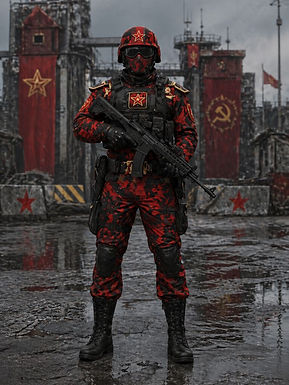
The Soviet Guard Troopers are the primary military arm of the Soviet Guard: disciplined, heavily indoctrinated, well-equipped soldiers who serve as the organization’s occupation force, security corps, assault infantry, and battlefield support network. Unlike ordinary national soldiers, Soviet Guard Troopers operate as a hybrid of paramilitary shock troops, internal security forces, and ideological enforcers. They are trained to function in extreme climates, fortified bases, occupied territories, underground facilities, and high-risk combat zones involving superhuman threats.
Their presence is meant to project control. Whether guarding a remote arctic installation, enforcing Soviet Guard authority in conquered territory, or supporting major figures such as Generalissimus, Dospehi, Black Boris, Molotok, Serp, Snegovik, Mystyck, or Red Nikita, these troops are rarely deployed without clear strategic purpose. They are the visible machinery of the Soviet Guard’s power.
Structurally, the Soviet Guard Troopers are organized into compact, disciplined formations built around three common battlefield levels:
-
Troopers form the rank-and-file infantry. They conduct patrols, security operations, raids, checkpoint control, base defense, and battlefield support.
-
Starshinas serve as squad leaders and non-commissioned officers. They enforce discipline, lead small units, coordinate fire teams, manage field equipment, and keep Troopers focused under pressure.
-
Officers command platoons, detachments, base security sections, assault groups, and specialized missions. They are more politically trusted, tactically trained, and directly tied to Soviet Guard command authority.
While many Troopers are ordinary humans, they are selected for loyalty, endurance, and willingness to obey harsh orders. Some are veterans, mercenaries, political loyalists, or personnel drawn from former Soviet-aligned military structures. Others are younger recruits raised into the Soviet Guard’s ideology through controlled training academies, internal propaganda, and strict discipline.
The organization is designed around obedience, intimidation, and operational resilience. Troopers are expected to hold ground against better-equipped enemies, delay superhuman opponents, protect high-value Soviet Guard assets, and die in place if ordered. Their greatest strength is not individual power, but coordination, numbers, discipline, and the protection of far more dangerous Soviet Guard operatives.
Common Unit Organization
A typical Soviet Guard security or combat deployment may be structured as follows:
-
Fire Team
-
3–5 Troopers, Senior Trooper or Starshina
-
-
Squad
-
8–12 Troopers, Starshina
-
-
Security Section
-
2–3 Squads, Senior Starshina or Junior Officer
-
-
Platoon/Detachment
-
25–40 personnel, Officer
-
-
Base Security Company
-
80–150 personnel, Senior Officer
-
-
Special Deployment Group
-
Variable; Officer under direct Soviet Guard command
-

PERSONNEL
TROOPERS
Role: Standard infantry, guard force, patrol element, checkpoint soldier, assault support.
Soviet Guard Troopers are the most common soldiers within the organization. They are trained as disciplined riflemen and security personnel capable of operating in urban, industrial, arctic, mountain, and fortified environments. A standard Trooper is expected to follow orders without hesitation, maintain formation under fire, and support heavier Soviet Guard assets.
Troopers rarely act independently. They usually operate in fire teams, squads, patrol groups, or defensive posts. Their duties may include perimeter security, prisoner control, convoy escort, facility defense, riot suppression, search operations, and direct infantry support during combat missions.
A typical Trooper is not elite by superhuman standards, but they are better trained and more ideologically conditioned than common thugs or mercenary soldiers. Their danger comes from numbers, military discipline, coordinated fire, and willingness to press an attack despite casualties.
Standard Trooper Duties
-
Base perimeter security
-
Patrols and checkpoint operations
-
Facility guard duty
-
Infantry assault support
-
Prisoner escort and containment
-
Riot suppression and crowd control
-
Search-and-clear operations
-
Convoy and vehicle escort
-
Support for Soviet Guard superhuman operatives

STARSHINA
Role: Sergeant/NCO, squad leader, discipline enforcer, tactical coordinator.
A Starshina is the backbone of Soviet Guard field discipline. These non-commissioned officers command small units of Troopers and are responsible for keeping them organized, obedient, and combat-effective. They are tougher, more experienced, and more trusted than standard Troopers.
Starshinas usually lead squads, patrol sections, base-response teams, or specialized security details. They are expected to make quick tactical decisions while still remaining obedient to officer-level command. In battle, a Starshina coordinates fire, directs movement, manages casualties, and ensures the squad does not break under pressure.
Within the Soviet Guard, Starshinas also serve as ideological enforcers. They watch for hesitation, cowardice, disloyalty, or sympathy toward civilians and prisoners. A capable Starshina can turn a group of ordinary Troopers into a serious battlefield obstacle.
Standard Starshina Duties
-
Squad and patrol leadership
-
Fire-team coordination
-
Discipline enforcement
-
Field communications relay
-
Tactical response to intrusions
-
Supervision of checkpoints and detention areas
-
Training and inspection of Troopers
-
Coordination with Officers during larger operations
-
Maintaining morale through fear, loyalty, and command presence


OFFICERS
Role: Platoon/detachment commander, operations leader, political authority, tactical planner.
Soviet Guard Officers command larger groups of Troopers and Starshinas. They are trained in tactics, military organization, command discipline, and ideological control. Unlike Troopers and Starshinas, Officers often have direct access to Soviet Guard command channels and may receive instructions from senior villains, base commanders, or high-ranking Soviet Guard leadership.
Officers are often politically reliable, ambitious, and ruthless. They are not merely battlefield leaders; they represent the authority of the Soviet Guard itself. In occupied zones or controlled facilities, an Officer may act as commander, interrogator, security chief, or local military governor.
On the battlefield, Officers coordinate multiple squads, vehicle support, heavy weapons, defensive positions, and withdrawal plans. Against superheroes or elite enemy units, Officers are expected to use layered defenses, traps, overlapping fire, hostages, environmental hazards, and delaying tactics rather than simple frontal attacks.
Standard Officer Duties
-
Platoon or detachment command
-
Mission planning and execution
-
Base security command
-
Political enforcement and loyalty checks
-
Coordination with superhuman Soviet Guard operatives
-
Command of armored vehicles and heavy weapons units
-
Oversight of prisoner handling and interrogation support
-
Tactical withdrawal, reinforcement, and containment decisions
-
Control of restricted areas, laboratories, vaults, or command posts


Equipment
Trooper Standard Equipage
Troopers are equipped for practical battlefield use, intimidation, and survival in harsh environments. Their gear varies by theater, but the following represents the standard Soviet Guard loadout.
Standard Trooper Equipment
Uniform
Soviet Guard combat uniform appropriate to environment; urban, arctic, woodland, industrial, or base-security pattern
Headgear
Combat helmet or armored field cap; often marked with Soviet Guard insignia or red star motif
Armor
Light-to-medium ballistic vest with reinforced shoulder, chest, and abdomen protection
Primary Weapon
Assault rifle or carbine with ruggedized optics
Secondary Weapon
Military sidearm or compact machine pistol
Ammunition
Standard rifle magazines, sidearm magazines, and specialty rounds when assigned
Tactical Gear
Load-bearing vest, utility belt, field pouches, gloves, knee protection, and boots
Communications
Short-range encrypted radio or squad comms receiver
Restraints
Flex cuffs, metal restraints, or field detention straps
Utility Items
Combat knife, flashlight, compact field tools, basic first-aid packet
Mission-Specific Gear
Gas mask, cold-weather mask, breaching charge, riot shield, baton, or stun weapon as needed
Notes
Standard Trooper gear should look practical, slightly intimidating, and militarized without appearing overly futuristic. They should visually read as disciplined Soviet Guard infantry rather than random mercenaries.
Starshina Standard Equipage
Starshinas carry upgraded equipment to reflect their squad leadership role. Their gear is more individualized and often includes better communications, reinforced armor, and command tools.
Standard Starshina Equipment
Uniform
Soviet Guard NCO combat uniform with rank markings, heavier trim, or more distinctive field identification
Headgear
Reinforced combat helmet, armored ushanka-style winter cap, or officer-pattern field helmet depending on assignment
Armor
Medium ballistic armor with enhanced chest, shoulder, and forearm protection
Primary Weapon
Assault rifle, battle rifle, compact squad automatic weapon, or tactical carbine
Secondary Weapon
Heavy sidearm or machine pistol
Ammunition
Expanded ammunition load with specialty magazines or armor-piercing rounds
Command Gear
Squad command radio, signal controls, encrypted field tablet or tactical map case
Tactical Gear
Load-bearing harness, reinforced gloves, utility pouches, field binoculars or optic scanner
Discipline Tools
Baton, shock prod, or intimidation weapon depending on assignment
Utility Items
Combat knife, smoke grenades, flashbangs, field medical kit, breaching tools
Mission-Specific Gear
Gas mask, flare pistol, squad-level demolition charge, thermal scanner, or riot-control equipment
Notes
Starshinas should look like hard, veteran field leaders. They should stand out from Troopers through better armor, command markings, heavier posture, and more personalized field equipment.
Officer Standard Equipage
Officers are equipped to command, direct, and survive. Their standard gear is more formal, authoritative, and symbolically tied to Soviet Guard power. Some Officers may wear battlefield armor, while others may appear in command uniforms with armored elements.
Standard Officer Equipment
Uniform
Soviet Guard officer uniform, armored command coat, or battlefield command armor
Headgear
Officer cap, armored command helmet, or ceremonial field cap depending on environment
Armor
Concealed or visible reinforced body armor; often lighter than Starshina armor but more advanced
Primary Weapon
Officer’s carbine, compact rifle, or assigned tactical weapon depending on mission
Secondary Weapon
High-quality military sidearm, often customized or symbolic
Command Gear
Encrypted command radio, tactical display device, access codes, mission documents
Authority Items
Rank insignia, security clearance badge, command baton, ceremonial sidearm, or command medallion
Tactical Gear
Field map case, encrypted data slate, binoculars, laser designator, signal flare system
Security Tools
Facility access keys, detention control codes, remote door controls, or base-defense override device
Emergency Gear
Compact med-kit, distress beacon, smoke grenades, encrypted data wipe device
Mission-Specific Gear
Drone-control device, heavy weapons authorization unit, vehicle command link, or superhuman containment controls
Notes
Officers should appear more polished, dangerous, and politically powerful than the other two ranks. They should visually communicate command authority rather than simple battlefield toughness.
Talents
Trooper Talents
-
Troopers are trained to function as disciplined infantry and security personnel. Their talents should reflect military basics, obedience, and practical combat capability.
-
Standard Trooper Talents
-
Military Training
-
Guns
-
Marksman or Rifle Use
-
Martial Arts B or basic military hand-to-hand
-
Thrown Weapons or Grenade Use
-
Security Procedures
-
Survival, usually Arctic, Urban, or Mountain depending on assignment
-
First Aid, basic battlefield level
-
Intimidation
-
Vehicle Operation, basic military transport
-
Soviet Guard Protocols
-
Team Tactics
-
-
Optional Specialist Talents
-
Some Troopers may also have one of the following based on assignment:
-
Demolitions, basic
-
Heavy Weapons
-
Riot Control
-
Tracking
-
Communications
-
Mechanic, basic field maintenance
-
Hazardous Environment Operations
-
Starshina Talents
-
Starshinas are more capable, disciplined, and experienced than Troopers. Their talents should reflect leadership, squad tactics, and enforcement.
-
Standard Starshina Talents
-
Military Training
-
Leadership
-
Guns
-
Marksman
-
Martial Arts B
-
Martial Arts C or Wrestling
-
Tactics, small unit
-
Command
-
Intimidation
-
Interrogation, basic field level
-
Security Procedures
-
Communications
-
Survival, usually Arctic, Urban, or Mountain
-
First Aid
-
Demolitions, basic
-
Heavy Weapons or Squad Weapons
-
Soviet Guard Protocols
-
Personnel Discipline
-
Team Coordination
-
-
Optional Specialist Talents
-
Some Starshinas may also have:
-
Advanced Riot Control
-
Counter-Insurgency
-
Mechanic
-
Surveillance
-
Tracking
-
Logistics
-
Combat Engineering
-
Vehicle Operations, armored transport
-
Officer Talents
-
Officers should have the strongest command, planning, and authority-based skill set. They may not always be the best individual fighters, but they are the most dangerous organizers.
-
Standard Officer Talents
-
Military Training
-
Leadership
-
Command
-
Strategy
-
Tactics
-
Guns
-
Marksman
-
Martial Arts A or B
-
Political Indoctrination
-
Security Procedures
-
Interrogation
-
Military Law or Internal Discipline
-
Administration
-
Logistics
-
Negotiation, usually coercive
-
Intimidation
-
Communications
-
Surveillance Operations
-
Counter-Insurgency
-
Soviet Guard Protocols
-
Base Security Operations
-
Superhuman Threat Response
-
-
Optional Specialist Talents
-
Some Officers may also possess:
-
Espionage
-
Advanced Interrogation
-
Psychological Warfare
-
Advanced Weapons Systems
-
Vehicle Command
-
Drone Operations
-
Engineering, military systems
-
Intelligence Analysis
-
Occult Threat Awareness, if assigned near Mystyck or supernatural assets
-
Radiation/Hazard Protocols, if assigned near Chernobyl-type assets
-
Cybernetic Systems Awareness, if assigned near Black Boris or Dospehi assets
-