
A Universe of Pure Imagination

TM






HISTORY
Overview
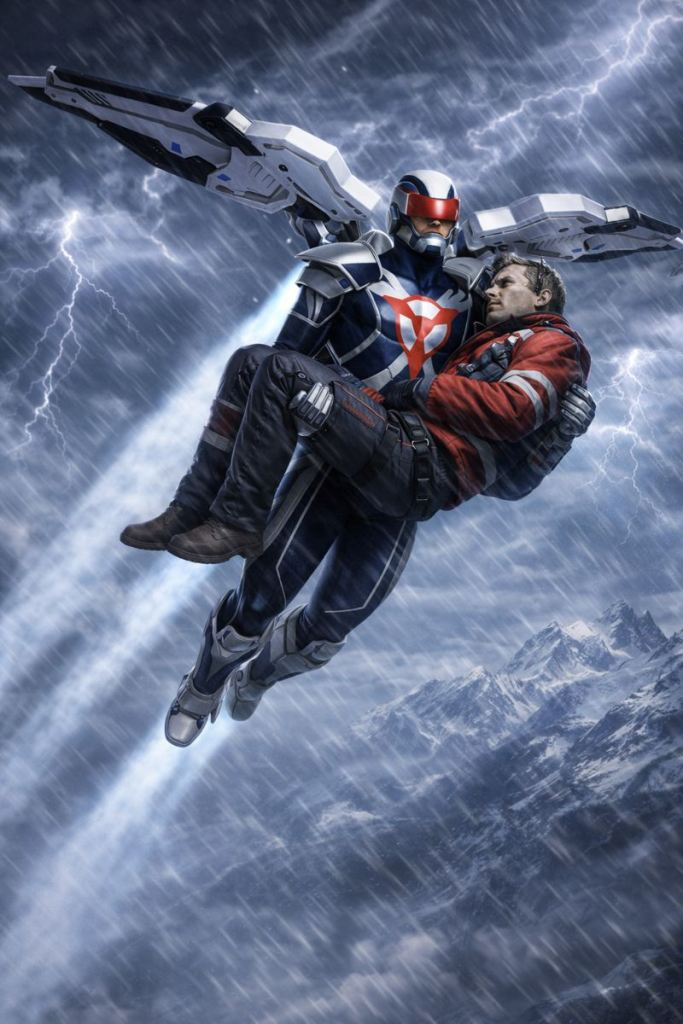
The Aeroguardians are the premier field team of AEROGUARD, a specialized division within G.U.A.R.D. created to answer crises beyond the reach of conventional emergency, military, or superhuman response. Though capable of confronting super-powered threats, the Aeroguardians were never conceived as a strike force in the traditional sense. They were built around a different ideal: rescue first.
Where other teams are known for battle, the Aeroguardians are known for arrival. They reach the lost, the wounded, the trapped, and the dying in conditions that defeat ordinary rescue efforts. They extract civilians from disaster zones, recover agents from hostile territory, pull wounded heroes from collapsing battlefields, and intervene when metahuman events escalate beyond normal control. In the eyes of many, they are not simply heroes—they are the answer that comes when all other answers have failed.
Founding
When G.U.A.R.D. was established, its mission was to create a highly capable international protection agency able to preserve order and apply practical, disciplined judgment against the growing dangers of the modern world. Though it operated outside the formal authority of the United Nations, G.U.A.R.D. still carried an understood responsibility to the global community and often acted in support of international stability when major threats emerged.
For all its strength, however, G.U.A.R.D. faced a major limitation. Its thousands of operatives were exceptionally trained in intelligence, security, emergency coordination, logistics, and field operations, but the organization lacked an effective way to respond to fast-moving super-powered crises. It also lacked a dedicated rapid-response unit capable of operating in extreme environments while simultaneously performing extraction, evacuation, and lifesaving rescue under combat conditions.
G.U.A.R.D. had no desire to become a militarized superhuman institution. Instead, it sought a more disciplined and humanitarian solution: a specialized team built around mobility, rescue expertise, field coordination, and metahuman capability. Internally, incidents requiring such intervention became classified as Condition Alpha responses—events involving extraordinary hazards, metahuman threats, super-villain activity, or large-scale catastrophes requiring immediate deployment by uniquely capable personnel.
The foundation for that solution emerged from an unusual source: a remarkable rescue circle tied to Civil Air Patrol experience and culture. Several future members of the Aeroguardians came from a CAP-connected, super-powered search-and-rescue background that combined advanced technology, flight capability, emergency services expertise, and metahuman talent. Their proven ability to deploy rapidly, function cohesively under pressure, and save lives in impossible conditions made them the natural core of G.U.A.R.D.’s new initiative.
As additional exceptional operatives joined from outside that original rescue framework, G.U.A.R.D. formalized the effort into its own subdivision: AEROGUARD. Its elite operational team would become known as the Aeroguardians.
Aeroguardian and the Team’s Origin
At the center of the Aeroguardians’ creation stands Issac Armstrong, the man who would take the codename Aeroguardian.
A grand-nephew of astronaut Neil Armstrong, Issac Armstrong first served as a U.S. Air Force fighter pilot, flying the F-35 Lightning in dangerous operational environments. His life changed when his aircraft was shot down during an attack carried out by a super-villain faction attempting to seize global power. After ejecting over the forests of northern New England, he survived long enough to be found and rescued by search-and-rescue teams whose courage and persistence left a permanent mark on him. Though he lived, the injuries he sustained forced him out of active Air Force service.
Rather than abandon service, Armstrong redirected his life toward rescue work. Drawing deeply from the ethos of Civil Air Patrol search-and-rescue culture, he devoted himself to emergency operations and became known for daring, disciplined missions involving lost hikers, crash survivors, and downed aircrews. Again and again, he proved willing to go where others could not and endure what others would not.
In 2010, that commitment was tested in tragedy. During a rescue mission, Armstrong and his team were taken hostage by super-villains. The resulting crisis ended with the deaths of several downed pilots the team had been trying to save. The event changed him. Refusing to accept that rescuers should remain powerless in the face of extraordinary threats, Armstrong began working with advanced propulsion engineers and exoskeleton developers on a new concept: a next-generation SAR Suit equipped with high-performance jet and rocket-assisted mobility systems, allowing rescuers to penetrate hostile or inaccessible terrain, carry substantial loads, and extract casualties with unprecedented speed.
The concept was viewed by many as revolutionary. It was also considered too hazardous for conventional institutional adoption. Armstrong refused to let it die. Instead, he founded SAR, Inc., an independent rescue organization built around the new flight-and-recovery platform. Acquiring multiple propulsion systems and training a new generation of specialized responders, Armstrong led operations that saved hundreds of civilians and military personnel in environments previously considered unreachable or unsalvageable.
SAR, Inc. drew the attention of G.U.A.R.D. during a mission in which Armstrong’s team located and extracted a missing G.U.A.R.D. executive after a battle with a super-villain cell. The rescue was completed in record time, and when hostile forces attempted to stop the evacuation, Armstrong’s team fought them off long enough to secure the extraction. That mission proved two things at once: SAR, Inc. could save lives where others could not, and it could survive direct engagement with super-powered enemies when forced to do so.
G.U.A.R.D. moved quickly to bring the organization into its structure. Armstrong agreed on one non-negotiable condition: the team’s rescue mandate would remain central. They would not become mere combatants. Their first duty would always be to preserve life.
From that agreement, the AEROGUARD Division was formally established. Issac Armstrong adopted the codename Aeroguardian, and the original SAR, Inc. framework merged with G.U.A.R.D.’s global intelligence, infrastructure, and logistical reach. From that merger, the Aeroguardians were born.
Mission
The Aeroguardians serve a dual mission, but their priorities are clear.
Their primary mission is lifesaving service: search and rescue, emergency response, evacuation, extraction, disaster intervention, and recovery operations under extreme conditions.
Their secondary mission is Condition Alpha intervention: responding to metahuman threats, super-villain activity, catastrophic attacks, and extraordinary crises when no other unit can reach the scene in time or survive what it finds there.
Under Aeroguardian’s leadership, the team has remained firmly committed to the principle that power exists to protect life, not define status. They are trained to think like rescuers, move like rapid-response specialists, and fight only when fighting is necessary to preserve the innocent.
This philosophy distinguishes them from nearly every other superhuman team in the world.
Operations and Reach
As AEROGUARD expanded, the Aeroguardians established a global support network of operational air stations, coordination sites, refueling points, and rescue-ready deployment hubs. Many of these installations were intentionally positioned in elevated or strategically optimized locations, allowing rapid launch, low-visibility transit, and efficient access to disaster zones, hostile terrain, and remote extraction corridors.
This network gave the Aeroguardians extraordinary reach. Whether answering a mountain rescue, urban collapse, hostile-airspace extraction, wildfire evacuation, or superhuman combat disaster, the team developed a reputation for being able to arrive quickly, organize under pressure, and stabilize impossible situations before they spiraled into mass-casualty events.
Their methods are defined by speed, coordination, discipline, and humanitarian purpose. Even in battle, the Aeroguardians operate less like a glory-seeking hero team and more like an elite airborne rescue command with metahuman capability.
Reputation
Among civilians, first responders, and many heroic circles, the Aeroguardians are admired as one of the most dependable and selfless teams in the world. Their record of pulling survivors from catastrophe—and recovering heroes and operatives from battles others believed unsurvivable—has made them symbols of hope in moments of collapse.
Their arrival has become legendary. In more than one major conflict, the appearance of the Aeroguardians has marked the turning point between overwhelming defeat and hard-won survival. Much like the cavalry of old, they are remembered as the force that comes over the horizon when all seems lost.
In villainous circles, however, the team is viewed with outright hostility. The Aeroguardians are considered one of the most dangerous intervention forces on Earth precisely because they are so difficult to neutralize strategically. They are fast, coordinated, highly adaptive, and morally stubborn. More importantly, they repeatedly deny villains the one outcome they seek most: irreversible human loss. That reputation has earned the Aeroguardians numerous enemies, many of whom regard them as a faction that must be stopped before any larger operation can succeed.
Honors
The Aeroguardians’ record of service has brought them widespread international recognition. Nations, relief organizations, heroic alliances, and humanitarian bodies have all honored the team for courage, sacrifice, and extraordinary rescue work under conditions that would have broken lesser organizations.
Their greatest distinction remains the Nobel Peace Prize, awarded in recognition of their global lifesaving efforts, repeated intervention against large-scale violence, and unwavering defense of civilian life in the face of super-powered catastrophe.
For the Aeroguardians, however, honors have never been the purpose. Their legacy rests not in medals, but in survivors.
Legacy
The Aeroguardians stand as one of G.U.A.R.D.’s finest achievements: a team built not around conquest, intimidation, or military spectacle, but around service. They were created to go where others could not go, endure what others could not endure, and save those others could not save.
That identity has never changed.
Though fully capable of battling super-villains and turning the tide of major conflicts, the Aeroguardians remain, at their core, a rescue-first brotherhood and sisterhood of heroes. Their strength lies not merely in power, but in purpose. In a world filled with champions who fight, they are the ones who arrive to save.

BASE
Castle Rock, Colorado, United States (Publicly Known)


