
A Universe of Pure Imagination

TM


SEAGUARD



OVERVIEW
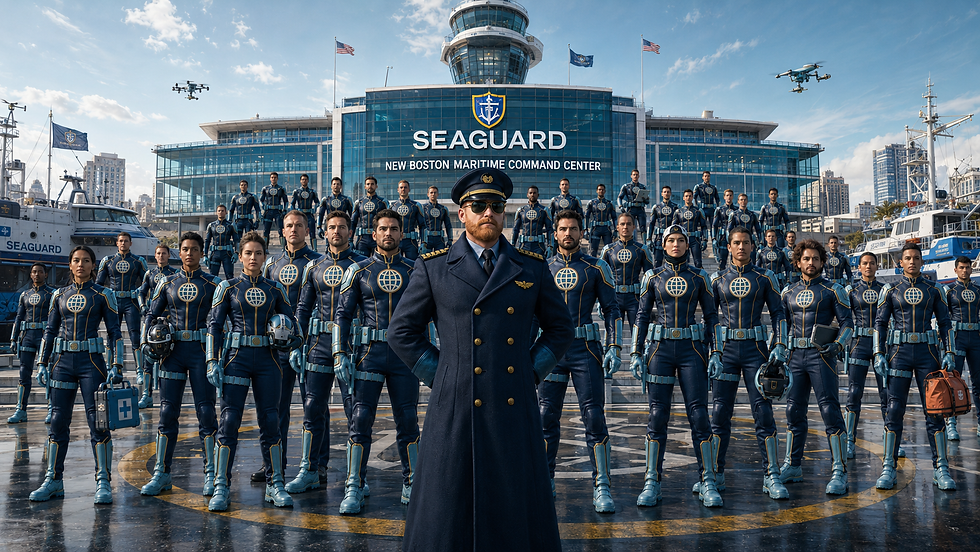
SEAGUARD is GUARD’s global maritime, undersea, and oceanic emergency command. Operating under GUARD’s Global Operations Command and aligned through the Environmental / Theater Command structure, SEAGUARD exists to reach, rescue, supply, evacuate, protect, and sustain people across Earth’s oceans, major waterways, coastal regions, island chains, and undersea environments.
SEAGUARD is not GUARD’s navy. It does not exist to conduct national warfare, seize territory, or project power for any single government. It is a planetary maritime emergency command — part coast guard, part humanitarian sealift service, part undersea rescue authority, part oceanic disaster-response network, and part high-technology lifeline for GUARD operations across the world’s waters.
Its personnel include sailors, mariners, engineers, submariners, rescue swimmers, divers, drone operators, cargo specialists, portal-maritime technicians, medical support crews, environmental recovery teams, undersea base personnel, port operations specialists, and crisis commanders.
When the crisis crosses water, SEAGUARD keeps GUARD moving.
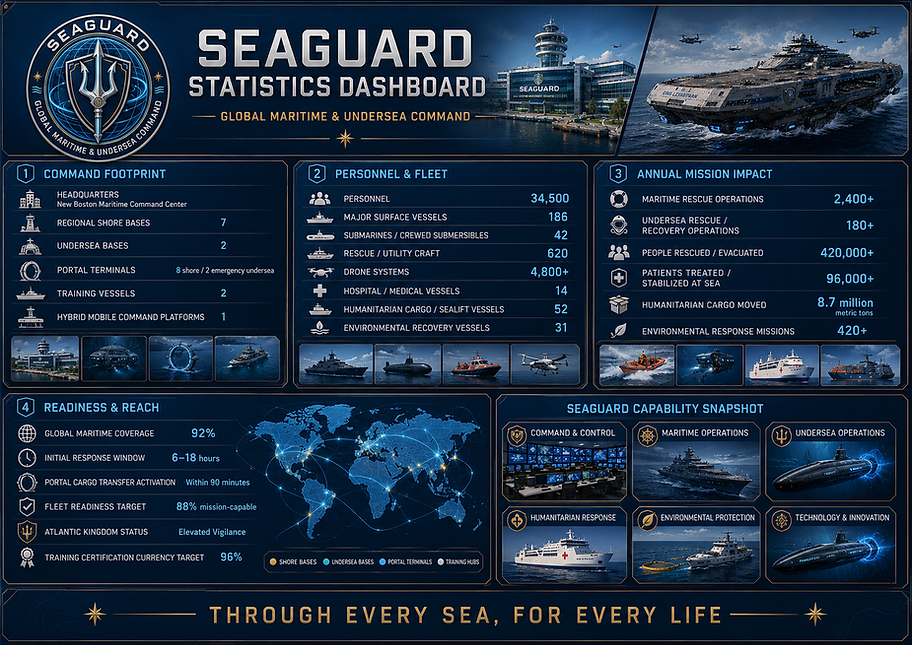
STATISTICS


HISTORY
The history of SEAGUARD begins with a simple failure of imagination.
For generations, the world looked at the oceans as borders, trade routes, military theaters, fishing grounds, and places where storms were endured rather than conquered. Nations built fleets to defend themselves, cargo lines to enrich themselves, and rescue services to respond when disaster struck close enough to reach. But no one built a true planetary maritime rescue command. No one built a force designed to cross every sea for every life, regardless of flag, language, coast, island, depth, storm, or enemy.
That changed after the world learned how small it truly was.
Before SEAGUARD existed as a GUARD command, its first shadow appeared inside one of the most ambitious submarine programs ever imagined: COMSUBRON Alpha. The squadron was born from a belief that the next age of maritime operations would not belong to ordinary submarines, ordinary fleets, or ordinary weapons. It would belong to vessels that could move farther, survive longer, dive deeper, think faster, and operate in a world where alien invasion, metahuman conflict, and hidden undersea powers were no longer fiction.
Jonathan Argough was one of the minds behind that future.
A brilliant submariner and advanced systems designer, Argough began his career in the United States Navy and rose through the submarine service with a reputation that made senior officers both grateful and uncomfortable. He could understand machines at a level that made engineers listen. He could explain impossible systems in plain language. He could see the weakness in a design, a crew process, or a command structure before the first failure occurred.
Argough believed the world’s undersea capability was aging into irrelevance. New threats were coming. He knew it before most governments were willing to admit it. The oceans were no longer protected by distance. They were no longer isolated from the strange, the superhuman, or the extraterrestrial. Something had to be built before the next great disaster arrived.
COMSUBRON Alpha was supposed to be that answer.
It gathered advanced submarine concepts, next-generation power systems, classified undersea technologies, and some of the best submariners available. Among them was Craig Wolfe, the man who would one day become Captain Seawolf. Wolfe and Argough were different men, but they shared the same understanding of the sea: the ocean did not forgive arrogance. It rewarded discipline, nerve, technical mastery, and trust.
Then the Soltan Star Empire invaded Earth.
The invasion shattered the confidence of every navy on the planet. Surface fleets burned. Submarine forces were hunted, damaged, and destroyed. Systems built for human warfare struggled against alien ships, alien sensors, and weapons that did not respect old assumptions. By the end of the invasion, the world’s submarine capability had been devastated so badly that it would take years to recover.
Yet one vessel became a legend in the middle of the catastrophe: the USS Nautilus, SSQ-1.
Refurbished, experimental, and loaded with a quantum energy power plant, the Nautilus could perform something no conventional submarine could match. It could teleport across distances of more than two hundred miles. Under Commander Wolfe, and later Captain Wolfe, the Nautilus survived where other vessels did not. It struck where the enemy thought no submarine could reach. It helped turn the tide in critical battles, including actions against Soltan command ships and operations around the Hawaiian Islands.
The Nautilus proved something that Argough never forgot.
The future of the sea would belong to vessels that could do more than travel through water. They would have to outthink the impossible.
After the Soltan Invasion, the oceans did not become safer. They became more dangerous. The world’s navies were weakened. Ports were damaged. Budgets were exhausted. Nations argued over recovery while new threats surfaced from every direction.
The Atlantic Kingdom became more active and more hostile toward surface-world presence beneath the sea. Oceania and the United Canadian Empire emerged as destabilizing powers. The Pacific Ocean saw violent encounters with god-like beings and oceanic superhuman threats. Maritime raiders, rogue states, alien remnants, damaged war machines, sea monsters, and metahuman criminals discovered what every sailor already knew: the ocean is vast enough to hide almost anything.
The world needed a maritime force that was not tied to one nation’s pride.
It needed a command that could rescue civilians from sinking ships without waiting for diplomatic permission to become convenient. It needed hospital ships that could reach ruined islands. It needed undersea rescue craft that could find trapped crews before oxygen ran out. It needed cargo ships that could carry more aid than aircraft could ever lift. It needed emergency ports, underwater bases, portal-linked logistics, and commanders who understood that a flooded city, a collapsed harbor, a poisoned reef, and a hostile submarine contact could all be part of the same crisis.
That was when Jonathan Argough brought GUARD a proposal that many thought was too large, too expensive, and too bold.
SEAGUARD.
Not a navy. Not a shipping company. Not a coast guard. Not a superhero team.
Something larger.
A global maritime, undersea, and oceanic emergency command.
GUARD saw what national leaders had failed to see: Argough was not asking for a fleet so GUARD could dominate the oceans. He was asking for a fleet so GUARD could reach the people the world kept failing to reach. He wanted ships that could carry cities’ worth of aid. Submersibles that could operate in the blackest water. Drone systems that could search across impossible distances. Emergency sealift capacity that could sustain entire regions. Undersea bases that could support rescue and monitoring where surface response was too slow. Portal-linked maritime stations that could move personnel and cargo across the globe before disaster became famine, disease, or mass death.
The World Court and GUARD approved the foundation of SEAGUARD.
Argough retired from national service and became Commodore Argonaut.
Under GUARD, he began building the ships and submarines he had once imagined for COMSUBRON Alpha, now freed from national hesitation and shaped for planetary service. SEAGUARD’s first years were quiet by design. Hulls were built under heavy security.
Submarine systems were tested far from public shipping lanes. New rescue doctrine was written. Crews were recruited from across the world: submariners, mariners, engineers, divers, medics, pilots, logisticians, port authorities, oceanographers, and emergency responders who understood that SEAGUARD would not be an easy command.
It would be a command for people willing to go where help was needed, not where it was convenient.
One of SEAGUARD’s most important early milestones was the launch of the GSS Paragon City, built from the technological lineage of the USS Nautilus and refined into a new kind of advanced submarine platform. Under Captain Seawolf, the Paragon City became more than a vessel. It became the mobile heart of a new maritime hero team: the Seaguardians.
The Seaguardians were not created to replace SEAGUARD. They were created because SEAGUARD’s leaders were honest about the world they lived in.
Some threats could not be solved by rescue cutters, cargo ships, drones, or ordinary crews. Some threats were superhuman. Some were alien. Some were born in the crushing dark below the continental shelves. Some wore crowns beneath the Atlantic. Some could rip open steel, overwhelm conventional boarding teams, or turn a rescue zone into a battlefield.
For those moments, GUARD needed a special maritime response team.
The Seaguardians became that team.
Administratively aligned under Guardian Corps Command and operationally coordinated with SEAGUARD, the Seaguardians gave GUARD a specialized force capable of countering metahuman and alien activity at sea. They could deploy from the Paragon City, operate in undersea environments, and confront extraordinary threats while SEAGUARD continued doing what it was built to do: command the mission, protect civilians, move aid, manage vessels, and keep the rescue effort alive.
Over time, SEAGUARD expanded from a hidden submarine dream into a planetary maritime system.
Its shore bases rose across the major oceans and the world’s historic “seven seas” regions, each designed not as a symbol of occupation, but as a promise of reach. The Pacific and Atlantic gained SEAGUARD’s two great undersea bases, positioned to support deep-ocean rescue, underwater monitoring, submersible deployment, and strategic response. The Indian Ocean, Arctic waters, Mediterranean routes, Southern Ocean, Caribbean approaches, and other key maritime regions gained shore installations, emergency harbors, cargo staging centers, and portal-linked ports.
The portals changed everything, but not without limits.
At the major SEAGUARD ports, portal systems allowed equipment, medicine, specialized crews, spare parts, food, water, and emergency command staff to move between oceans at unprecedented speed. A damaged port in the Indian Ocean could receive equipment from an Atlantic stockpile. A rescue submersible part manufactured in one hemisphere could be transferred to another before a trapped crew ran out of air. Medical specialists could reach a hospital ship without waiting for international airspace to clear.
But the undersea bases proved a harsher lesson.
Pressure is not politics. Pressure cannot be negotiated with.
Direct portal transfer from deep undersea environments to surface-pressure facilities created unacceptable decompression risks. Personnel moving too quickly from high-pressure environments could suffer decompression sickness, injury, or death. SEAGUARD kept emergency portals at its undersea bases, but only as last-resort evacuation systems leading to controlled receiving chambers where evacuees could be stabilized and decompressed properly.
That decision became part of SEAGUARD’s culture. Technology could be miraculous, but physics still had command authority.
As SEAGUARD’s facilities grew, so did the unease of the Atlantic Kingdom.
To the Atlantic Kingdom, GUARD’s undersea bases represented an intrusion. SEAGUARD viewed them as rescue platforms and monitoring centers. The Atlantic Kingdom viewed them as foreign structures in a realm it considered its own. For a time, the dispute moved dangerously close to open conflict. The Atlantic Guard, the Kingdom’s metahuman maritime force, became a constant concern in SEAGUARD briefings.
A truce eventually held, but no one inside SEAGUARD mistook a truce for peace.
Every sonar anomaly near the Atlantic base is studied. Every border incident is logged. Every Atlantic Guard movement is assessed. SEAGUARD crews are trained to avoid provocation, but also to survive attack. The command’s defensive weapons are not ceremonial. They exist because a rescue command cannot save anyone if it cannot protect its own crews, its patients, its evacuees, and its aid corridors.
Still, SEAGUARD refused to become what its enemies accused it of being.
It did not become GUARD’s navy.
Its commanders rejected conquest as a mission identity. Its ships did not fly as instruments of national power. Its crews did not deploy to intimidate coastlines into submission. SEAGUARD’s defensive systems were built around protection: convoy defense, emergency extraction, anti-boarding measures, undersea base security, portal terminal protection, and the safeguarding of civilians in transit.
That distinction mattered.
When hurricanes destroyed island infrastructure, SEAGUARD arrived with desalination ships, cargo carriers, rescue boats, and medical platforms. When coastal earthquakes collapsed ports, SEAGUARD used floating piers and drone cranes to reopen aid corridors. When refugee populations fled along flooded coastlines, SEAGUARD vessels became temporary shelters. When toxic spills threatened fisheries and reefs, its environmental recovery teams stayed after the cameras left. When submarines, research vessels, or underwater habitats went silent, SEAGUARD went down into the dark to bring people home.
The command’s greatest symbol became its single hybrid mobile command platform, an engineering marvel so expensive that even GUARD could build only one.
Part air station, part surface vessel, part limited-depth submersible, the GMS Leviathan was designed to operate in the air, on the sea, and beneath the surface to a maximum operational depth of roughly six hundred feet. It could not replace deep-ocean bases or true submarines, but it could do something no ordinary command ship could do: arrive above a crisis, land on the water, submerge below hostile surface conditions, coordinate rescue operations, launch drones, receive evacuees, and act as a mobile SEAGUARD command center where no port remained functional.
It became the visible proof of Commodore Argonaut’s philosophy.
Build the impossible only when the impossible saves lives.
Today, SEAGUARD stands as one of GUARD’s most essential operational commands. Its fleets move across the world’s oceans. Its undersea bases watch the deep. Its shore bases hold emergency supplies for nations that may not yet know they will need them. Its portal ports connect oceans that once required weeks to cross. Its rescue teams train for storms, sinkings, floods, wrecks, fires, alien debris fields, metahuman violence, and undersea political crises.
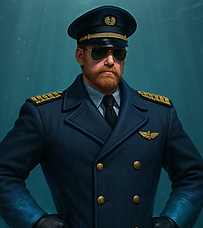
Commodore Argonaut remains at the center of the command he built, supported by his senior officers, his engineers, his crews, and the protector-bots that follow him when danger gets too close. Captain Seawolf and the Seaguardians remain SEAGUARD’s most important extraordinary-response partners, ready to answer when the threat beneath the waves becomes too powerful for conventional action.
The ocean is still dangerous. It always will be.
But before SEAGUARD, too many lives were lost because the sea was too large, too deep, too violent, too political, or too far away.
SEAGUARD changed that.
Now, when the radio breaks through the storm, when the last flare burns out above a sinking ship, when a city floods faster than trucks can reach it, when an undersea habitat goes silent, when the Atlantic grows tense, or when the world needs aid moved across water before hope runs out, SEAGUARD answers.
Through every sea.
For every life.
ORG CHART

SEAGUARD Commander
Regional Commands
SEAGUARD operates globally through regional maritime commands tied to major oceanic operating areas and strategic sea regions.
Pacific Ocean Regional Command
Pacific disaster response, island evacuations, typhoon and tsunami response, deep-ocean operations, Pacific undersea base support, and trans-Pacific humanitarian sealift.
Atlantic Ocean Regional Command
Atlantic sea lanes, hurricane response, Atlantic undersea base support, Atlantic Kingdom vigilance, transatlantic humanitarian movement, Caribbean support, and undersea deconfliction.
Indian Ocean Regional Command
Monsoon response, island nation support, shipping corridor emergencies, humanitarian sealift, piracy-risk evacuation support, and regional disaster logistics.
Arctic Ocean Regional Command
Polar rescue, ice-route monitoring, Arctic shipping emergencies, cold-water survival operations, environmental protection, and emerging northern sea-lane response.
Mediterranean and Black Sea Regional Command
High-density maritime traffic, refugee response, port emergencies, confined-sea rescue operations, political tension deconfliction, and medical sea transport.
Caribbean and Gulf Regional Command
Hurricane response, island evacuation, rapid cargo distribution, flood support, medical sea transport, and emergency port restoration.
Southern Ocean Regional Command
Antarctic support, extreme-weather rescue, polar research support, environmental protection, deep-sea monitoring, and remote vessel emergency response.
Primary SEAGUARD Commands
Fleet Operations Command
Director: Captain Henrik Sato
Surface fleet deployment, maritime routing, vessel tasking, convoy coordination, ship readiness, and blue-water emergency operations.
Shore Base Operations Command
Director: Port Captain Alain Moreau
SEAGUARD port facilities, shore bases, drydocks, emergency harbors, regional maritime hubs, and base readiness.
Undersea Operations Command
Director: Commander Nia Okonkwo
Underwater bases, submersibles, deep-ocean rescue, undersea monitoring, underwater drones, seabed operations, and pressure-environment response.
Maritime Emergency Response Command
Director: Commander Mateo Reyes
Search and rescue, ship evacuation, storm response, flood extraction, rescue swimmers, diving rescue, and mass-casualty maritime incidents.
Humanitarian Sealift and Cargo Command
Director: Captain Priya Menon
Emergency cargo movement, humanitarian aid distribution, sealift operations, refugee support logistics, and long-duration disaster sustainment.
Portal Maritime Systems Command
Director: Dr. Elian Park
Shore-based maritime portals, emergency cargo transfer, portal safety, undersea emergency evacuation portals, and PORTALGUARD coordination.
Marine Engineering and Vessel Systems Command
Director: Master Engineer Sofia Lindholm
Ship design, vessel systems, submersible engineering, hybrid platform integration, drone systems, fleet modernization, and repair doctrine.
Environmental and Ocean Recovery Command
Director: Dr. Hana Qadir
Marine environmental response, contamination control, oil spill recovery, toxic plume containment, ecological recovery, and ocean hazard mitigation.
Training, Readiness and Academy Sea Programs Command
Director: Captain Leena Harcourt
SEAGUARD training pipeline, maritime certification, submarine qualification, emergency drills, readiness inspections, and GUARD Academy sea training.
Seaguardians Liaison Office
Director: Commander Isabelle Kane
Guardian Corps / Seaguardians coordination, metahuman maritime response requests, mission deconfliction, and specialized threat support.
Atlantic Kingdom Watch Desk
Director: Commander Selene Argyros
Atlantic Kingdom monitoring, Atlantic Guard tracking, treaty vigilance, undersea incident review, and conflict-prevention support.
OPERATIONS
SEAGUARD ORIENTATION AND DOCTRINE HANDBOOK
This Handbook is authorized only for:
GUARD Officers, SEAGUARD personnel and SEAGUARD-Related Academy Personnel
This document provides an orientation of the basics of SEAGUARD operations, policies, doctrine and rules.
Click the PDF Document image to download and open the Handbook.
Mission Statement
SEAGUARD’s mission is to provide GUARD with global maritime, undersea, and oceanic emergency response capability through advanced fleet operations, humanitarian sealift, maritime rescue, undersea recovery, coastal disaster support, portal-linked sea logistics, environmental recovery, and defensive protection of GUARD personnel, civilians, facilities, vessels, aid convoys, and emergency operations.
SEAGUARD ensures that GUARD can reach people across the planet’s oceans and major waterways even when storms, destroyed ports, collapsed infrastructure, hostile forces, alien activity, metahuman threats, undersea hazards, or political instability make ordinary response impossible.
Operational Purpose
SEAGUARD exists to ensure GUARD can reach, rescue, supply, evacuate, protect, and sustain people across Earth’s oceans, major waterways, coastal regions, island chains, and undersea environments.
SEAGUARD operates across three major environments:
Surface Maritime Operations
Ships, cutters, rescue boats, cargo vessels, hospital ships, drone tenders, floating command platforms, emergency aid carriers, and port support systems.
Undersea Operations
Submersibles, underwater bases, rescue pods, deep-ocean drones, seabed monitoring systems, undersea engineering teams, damaged vessel recovery, and high-risk submerged facility response.
Coastal and Littoral Crisis Operations
Flooded cities, destroyed ports, island evacuations, refugee movement, coastal storm damage, harbor collapse, bridge and pier loss, and shoreline disaster stabilization.
SEAGUARD’s work begins before a disaster is visible and continues long after the first rescue is complete. It monitors the oceans, stages supplies, trains crews, coordinates with other GUARD commands, maintains emergency routes, watches undersea political flashpoints, and prepares to move at the first sign that a local maritime emergency may become a regional or global crisis.
Normal Operations
SEAGUARD’s normal operations are the daily activities that keep the command ready before a crisis begins. These include:
-
Maritime readiness patrols
-
Fleet positioning and maintenance
-
Shore base readiness
-
Undersea monitoring
-
Atlantic Kingdom vigilance
-
Humanitarian cargo staging
-
Portal terminal readiness
-
Training and certification
-
Environmental monitoring
-
Seaguardians liaison coordination
SEAGUARD patrols are not occupation patrols. Their purpose is readiness, surveillance, mapping, rapid response, environmental awareness, and civilian protection.
Emergency Operations
SEAGUARD emergency operations begin when maritime, coastal, undersea, or ocean-linked crisis conditions exceed normal local response capability or threaten to escalate into a larger humanitarian, environmental, or security emergency.
Major emergency mission types include:
-
Maritime search and rescue
-
Ship evacuation
-
Hurricane, tsunami, and flood response
-
Coastal disaster relief
-
Island evacuation
-
Refugee and civilian evacuation
-
Humanitarian sealift
-
Hospital ship deployment
-
Medical sea transport
-
Undersea rescue and recovery
-
Deep-water salvage
-
Environmental contamination response
-
Hostile-zone maritime extraction
-
Alien or metahuman maritime crisis response
-
Atlantic Kingdom escalation management
SEAGUARD emergency operations are scalable. A single rescue cutter may respond to one distressed vessel. A full SEAGUARD task force may deploy to a regional disaster involving destroyed ports, collapsed infrastructure, civilian evacuation, hostile threats, and international coordination.
Operational Authority
SEAGUARD operates under GUARD’s Global Operations Command, with theater coordination through Environmental / Theater Command when missions cross regional boundaries, involve multiple jurisdictions, or affect major oceanic systems.
SEAGUARD may operate under:
-
GUARD-directed crisis missions
-
World Security Council or World Court authorization
-
National government requests
-
Emergency humanitarian authority
-
Joint operations with national maritime agencies
-
Defensive protection authority
SEAGUARD may use defensive force to protect civilians, evacuees, patients, aid workers, GUARD personnel, SEAGUARD crews, hospital ships, rescue vessels, humanitarian convoys, portal terminals, undersea bases, shore bases, emergency aid stockpiles, and critical maritime infrastructure under GUARD protection.
SEAGUARD does not conduct national warfare, territorial conquest, punitive naval campaigns, routine law enforcement, seizure of civilian vessels, or military blockade operations unless specifically authorized under a GUARD mandate and limited to humanitarian or defensive mission requirements.
Portal-Maritime Operations
SEAGUARD uses portal systems to move personnel, supplies, equipment, and mission-critical assets rapidly between major global maritime bases. These systems allow GUARD to respond across oceans at speeds no conventional maritime network could match.
Major shore-based portal terminals are located at:
-
New Boston Maritime Command Center
-
Port Pacifica
-
Port Sentinel
-
Port Monsoon
-
Icehaven Station
-
Port Meridian
-
Port Horizon
-
Southwatch Station
Undersea portals are not normal transit systems.
Because SEAGUARD undersea bases operate under pressure conditions, direct portal movement from deep undersea environments to normal surface-pressure facilities can cause severe decompression injury or death. For this reason, undersea portals are restricted to emergency evacuation and controlled transfer only.
Emergency-only undersea portal locations are maintained at:
-
Abyssal Station Pelagos
-
Abyssal Station Trident
These portals connect to decompression-safe receiving facilities and are used only when remaining at the undersea site is more dangerous than the pressure-transfer risk.
Atlantic Kingdom Operating Rules
SEAGUARD’s Atlantic operations require constant discipline because of the unresolved tension with the Atlantic Kingdom and its metahuman Atlantic Guard team.
The Atlantic Kingdom considers SEAGUARD’s undersea facilities an affront to its sovereignty. SEAGUARD considers those facilities necessary for rescue, monitoring, humanitarian response, and global undersea safety. A truce currently exists, but the situation remains unstable.
SEAGUARD’s Atlantic Kingdom operating rules are designed to prevent accidental war while ensuring crews and civilians are protected.
Core rules include:
-
No-provocation doctrine
-
Boundary discipline
-
Constant monitoring
-
Evidence preservation
-
Defensive readiness
-
Seaguardians escalation when required
-
Diplomatic notification when possible
SEAGUARD’s rule is clear:
Do not start a war under the sea. Do not lose a life to avoid a difficult conversation.
Relationship to the Seaguardians
The Seaguardians are not the same thing as SEAGUARD.
SEAGUARD is the full GUARD maritime and undersea operational command. It runs the fleets, bases, ports, rescue systems, maritime logistics, undersea operations, portal-linked terminals, and emergency sea response structure.
The Seaguardians are a specialized Guardian Corps team assigned to maritime and undersea crisis operations when extraordinary threats or conditions require metahuman, alien-countermeasure, or elite special-response capability.
Guardian Corps Command administratively owns and certifies the Seaguardians.
SEAGUARD operationally coordinates with them when maritime missions require their support.
A dedicated Seaguardians Liaison Office exists inside SEAGUARD Command Headquarters to coordinate requests, mission briefings, deployment support, transport, intelligence, safety procedures, and operational deconfliction with Guardian Corps Command.
The standard coordination model is:
-
SEAGUARD identifies a maritime or undersea threat beyond standard capability.
-
The Seaguardians Liaison Office prepares the support request.
-
Guardian Corps Command confirms Seaguardians availability and authorization.
-
Captain Seawolf receives the mission brief.
-
SEAGUARD provides transport, staging, vessel access, threat data, and operational boundaries.
-
Seaguardians execute specialized response within the mission framework.
-
SEAGUARD maintains command of the broader maritime operation.
Defensive Posture
SEAGUARD is defensively armed because the ocean is not always safe, and rescue operations cannot succeed if rescuers are unable to protect themselves, civilians, patients, or aid corridors.
Defensive systems may include:
-
Point-defense systems
-
Nonlethal deterrent systems
-
Anti-boarding measures
-
Drone interception systems
-
Torpedo countermeasures
-
Electronic warfare systems
-
Shielding and emergency hull protection
-
Rescue-zone perimeter defense
-
Undersea base security systems
-
Portal terminal defensive barriers
-
Convoy escort protection
-
Emergency extraction fire support
The purpose of these systems is protection, not aggression.
When threats exceed SEAGUARD’s conventional capability, the Seaguardians may be requested through the Guardian Corps liaison structure.
UNIFORMS

PORTS & STATIONS


SEAGUARD’s Port and Station network is designed around one operational reality: oceanic emergencies do not wait for convenient geography.
The network includes command headquarters, regional shore bases, undersea bases, portal-linked maritime terminals, humanitarian cargo depots, hospital ship support centers, environmental response depots, drone operations facilities and training facilities.
SEAGUARD COMMAND HQ
NEW BOSTON MARITIME COMMAND CENTER

PORT SENTINEL
Azores - Baixa do Poção

PORT PACIFICA
Guam — Apra Harbor, Polaris Point

Port Monsoon
Seychelles

PORT MERIDIAN
Kepez Port, Türkiye

Icehaven Station
Tromsø, Norway

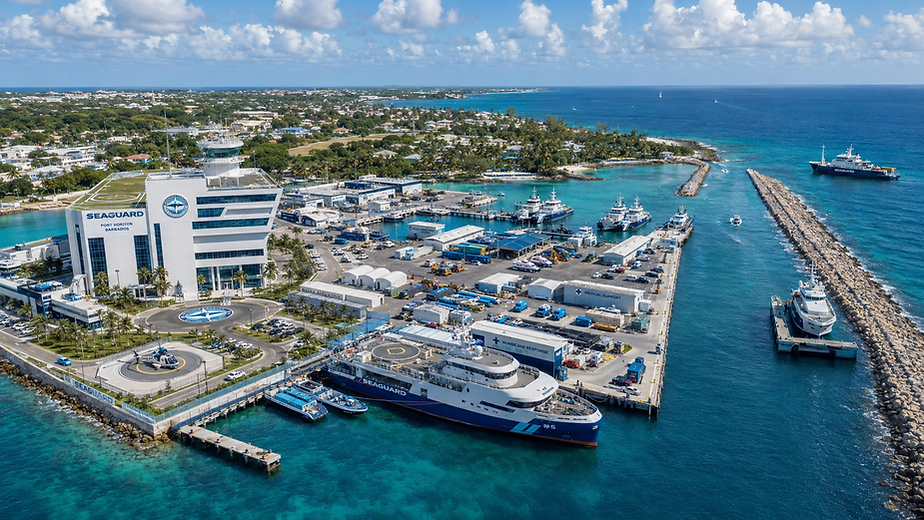
Port HORIZON
Barbados / Marauder Harbor (near Grantley Adams Airport)
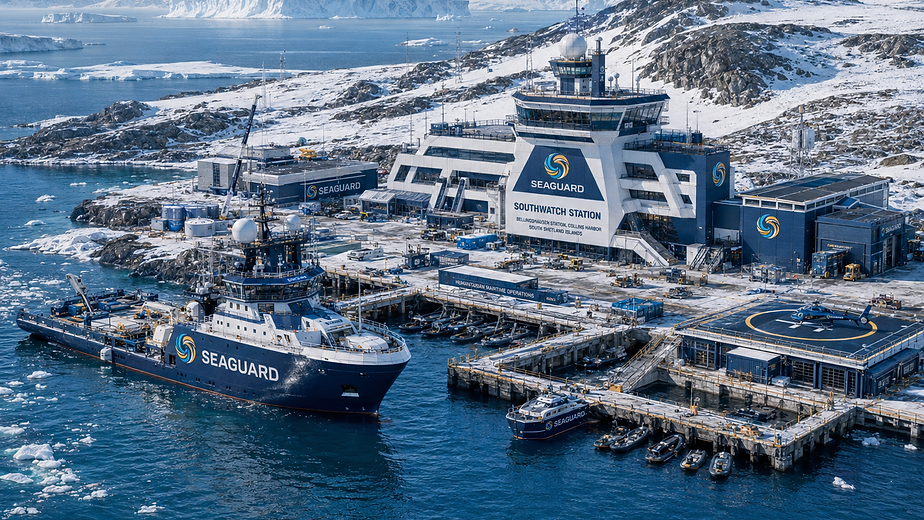
SOUTHWATCh station
Antarctica (Bellingshausen/Collins Harbor)
PORT RESOLUTE
GUARD ACADEMY - Cape Cod, Massachusetts, USA

Abyssal Station pelagos
Underwater Station south of Adak, Alaska, Pacific Ocean
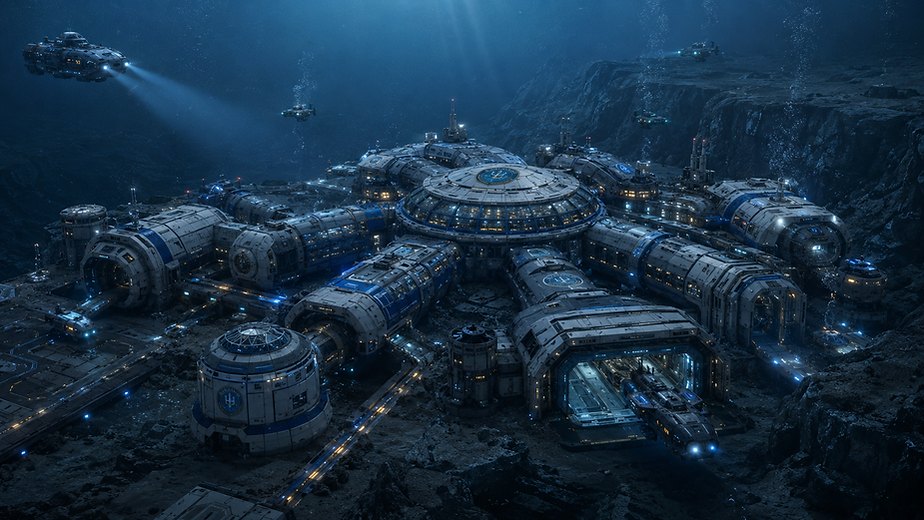
Abyssal Station TRIDENT
Underwater Station near Cape Verde, Atlantic Ocean

VESSELS & DRONES

This section includes all types of major vessels, maritime systems and drones in SEAGUARD. This includes sections that are broken down into fleet classifications for the following:
-
GMS — GUARD Maritime Ship
-
Major SEAGUARD surface vessels, mobile command vessels, cargo ships, hospital ships, rescue ships, and large maritime platforms.
-
-
GSS — GUARD Submersible Ship
-
SEAGUARD submarines, deep submersibles, and major undersea vehicles.
-
-
GES — GUARD Emergency System
-
Deployable emergency infrastructure such as floating piers, modular harbors, desalination platforms, and sea-based temporary support systems.
-
-
GTS — GUARD Training Ship
-
GUARD Academy and SEAGUARD training vessels.
-
-
GDS — GUARD Drone System
-
Autonomous or remotely operated maritime and undersea drone platforms.
-
GMS LEVIATHAN
Hybrid mobile command platform capable of air, surface, and limited-depth underwater operations (twice the size of an AEROGUARD Air Station)
Homeport: Boston, MA USA


GMS ARGONAUT
Surface Command Ship (Homeport: Boston, MA USA)

GMS Atlas Bridge
Heavy Sealift Vessel

GMS CLEANWAKE
Environmental Response Ship

GMS CLEAR HORIZON
Humanitarian Coordination Ship

GMS GATEKEEPER
Portal Cargo Control Vessel

GMS Goodwill Star
Long-Range Humanitarian Relief Carrier

GMS LANTERN WATCH
Drone-Supported Wide-Area Search Vessel

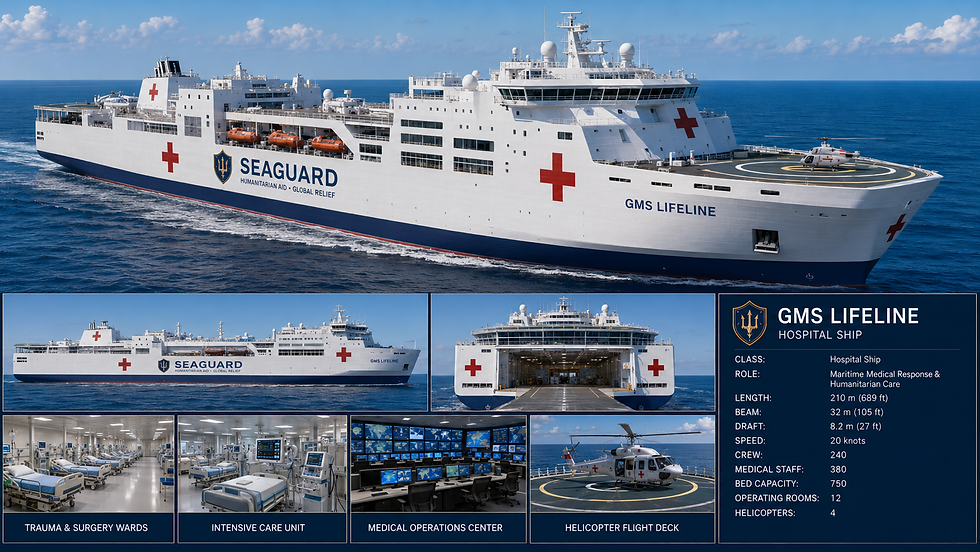
GMS LIFELINE
Full-Capability GUARD Hospital Ship

GMS MERcY current
Emergency Aid Distribution Ship

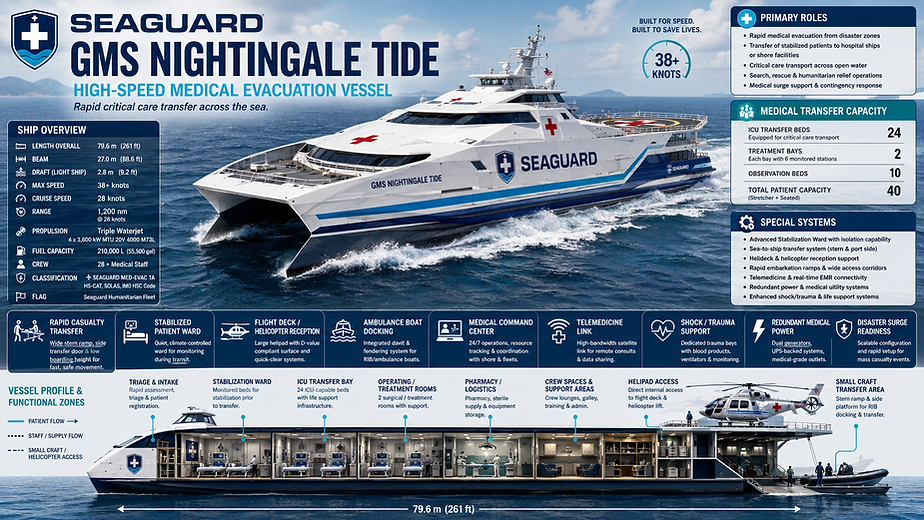
GMS NIGHTINGALE TIDE
High-Speed Medical Evacuation Vessel
GMS OPEN HAND
Refugee and Civilian Support Ship

GMS REEfguard
Environmental Response Ship

GMS SAFE RETURN
Rescue and Recovery Ship

GMS Stormrunner
High-Speed Rescue Cutter

GMS WHITE HARBOR
Quarantine and Biosecurity Vessel


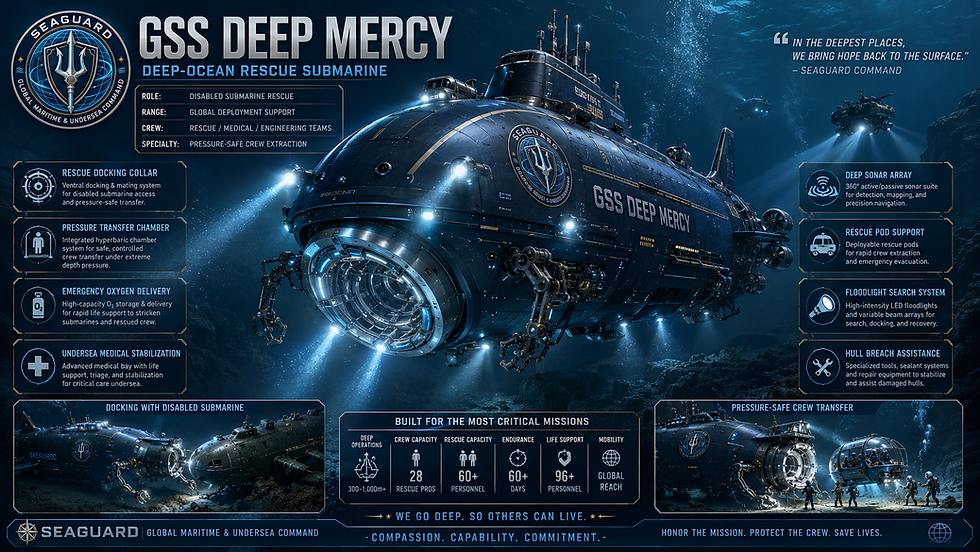
GSS DEEP MERCy
Deep-Ocean Rescue Submarine

GSS Abyss Lantern
Deep Reconnaissance Ssubmersible

GSS Harbor ANgel
Shallow-Water Rescue Submersible

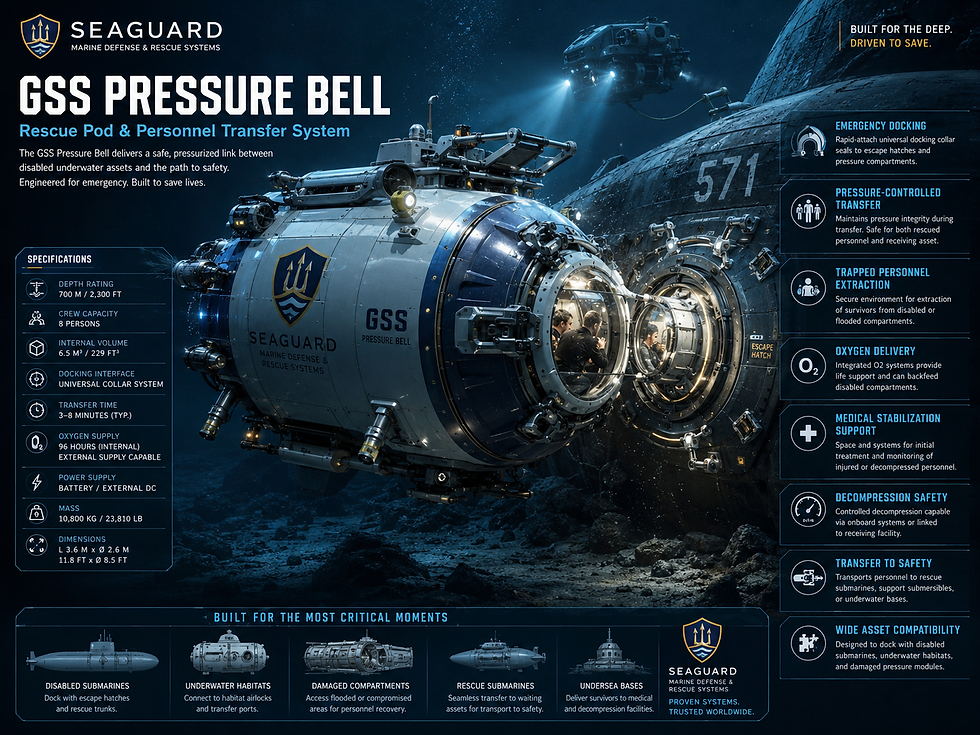
GSS PRESSURE BELL
Rescue Pod and Personnel Transfer System


GES Brightshore
Mobile Power and Communications Platform

GES CLEARWATER ARK
Mobile Desalination and Water Support Platform

GES HARBORFRAME
Deployable Modular Harbor System


GTS DEEP LANTERN
SEAGUARD Training Submarine - GUARD Academy

GTS RESOLUTE
SEAGUARD Training Ship-GUARD Academy


GDS Cleanswarm
Environmental Cleanup Drone System


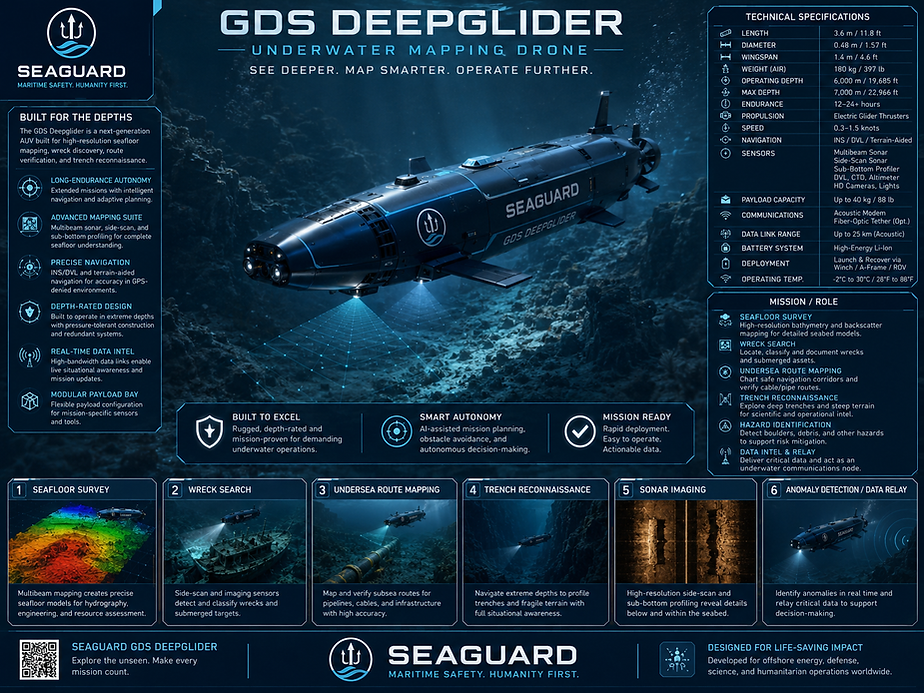
GDS DEEPGLIDER
Underwater Mapping Drone
GDS HULLMENDER
Repair and Inspection Drone

GDS LIFEBOUY
Rescue Support Ddrone

GDS Watchfin
Undersea Security and Monitoring Drone

GDS Wavefinder
Surface Search Drone
