
A Universe of Pure Imagination

TM


Arabian Knight
( 1942-1945 )



Info
REAL NAME:
IDENTITY:
AFFILIATION:
REGISTERED?:
RELATIVE AGE:
MARITAL STATUS:
DIED:
Hassan Yashid
Known
Iraqi/Hero
N/A
mid 20s
Married in 1946
1 January 1980
ALIAS(ES):
TEAM:
FIRST APPEARANCE:
APPEARANCE DATE:
CREATED BY:
CREATION DATE:
Hatar Yashid (father, deceased)
Hamik Yashid (brother, deceased)
Jasar Yashid (brother, deceased)
History
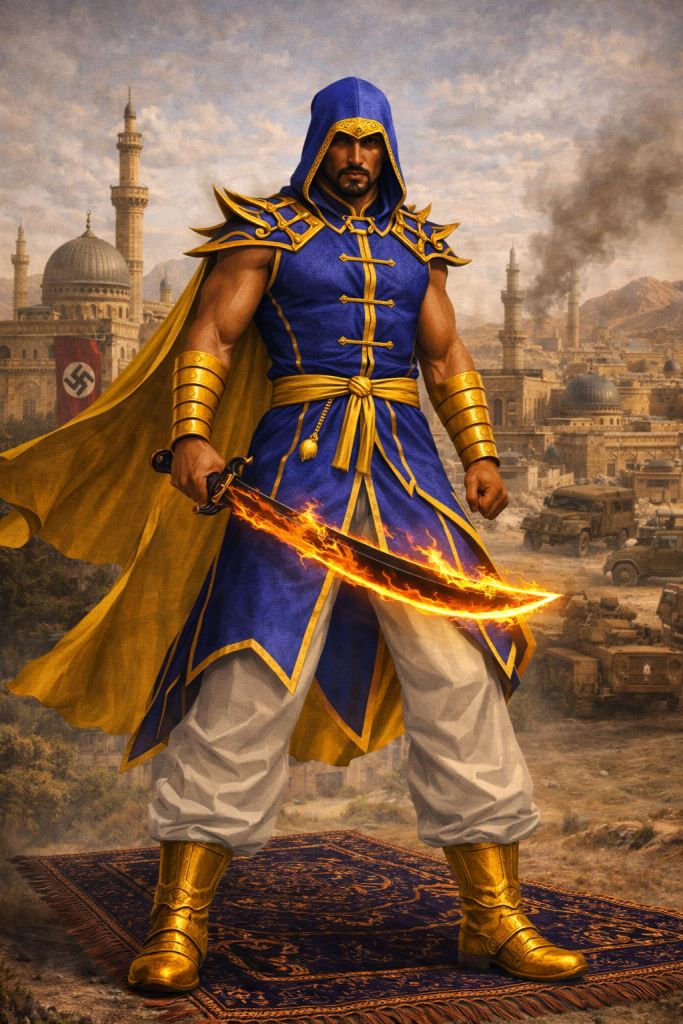
Hassan Yashid was the first Arabian Knight of the modern age and the man who transformed an ancient family legend into a living symbol of wartime heroism. Born into the respected Yashid bloodline of Mesopotamia, Hassan was the youngest surviving son of Hatar Yashid, a benevolent tribal leader known for both wisdom and ferocity in defense of his people. Though raised amid tradition, Hassan dreamed from childhood of adventure, hidden treasures, and the chance to become a warrior worthy of his father’s name. Recognizing both the old world and the changing one, Hatar allowed his son to travel to Europe in his youth, where Hassan learned foreign customs and trained intensely in gymnastics, tumbling, wrestling, and swordsmanship. By his mid-teens, he had developed into an extraordinary athlete and disciplined young fighter, already carrying the poise of someone destined for greatness.
When Hassan returned home, he found his homeland increasingly destabilized by anti-British agitation, tribal unrest, and growing Axis influence filtering into the region through foreign embassies and political intrigue. The Yashids, long respectful of British support and tied to honorable trade relations, became targets in an atmosphere that increasingly treated such loyalties as betrayal. Violence soon escalated.
Raiders armed with Nazi-supplied weapons attacked villages and tribal lands, and in 1940 Hassan suffered the devastating loss of both of his brothers, Hamik Yashid and Jasar Yashid, who were killed while defending women and children from one such assault. Their deaths marked the beginning of Hassan’s transformation from adventurous young nobleman into hardened defender of his people.
The turning point came in 1941 during the Anglo-Iraqi War. On the opening day of the conflict, Hassan’s father was gravely wounded by a Nazi-supplied grenade and could no longer lead his fighters in battle. In that moment, Hatar revealed to Hassan the truth of their bloodline: the Yashids were direct descendants of the original Arabian Knight, and the family’s ancient relics now belonged to Hassan by birthright.
Those relics—the Flying Carpet of Prince Husain, the Bracers of Protection, and the Ebony Scimitar—had been hidden away for generations, reserved for the heir who would need them most. With his father near death and his people facing destruction, Hassan accepted the burden without hesitation. He took up the relics and, for the first time in centuries, the Arabian Knight rose again.
Hassan’s mastery of the Arabian Knight accoutrements came with startling naturalness, as though the role had long been preparing itself within him. Mounted upon the Flying Carpet and armed with the Ebony Scimitar and Bracers, he rallied the Yashid fighters and inspired them with the declaration that the blood of the Arabian Knight still lived among them. Under his leadership, the Yashids fought beside British forces and Allied supporters to help break the Axis-leaning coalition in Iraq. Hassan’s courage, speed, and battlefield skill quickly made him a legend, and by the end of the campaign the name Arabian Knight had spread through both military circles and the press. In a nation struggling to define itself amid war and political upheaval, Hassan became a new and powerful symbol of resistance.
After Iraq, Hassan carried the fight into the broader war. He fought alongside British troops in North Africa, was wounded in action, and later returned to help push Axis forces back across the desert. From there he was quietly brought to London, where he met Captain Invader and the heroes who would become the Allied Fighters. When asked to join them, Hassan accepted readily. For the remainder of World War II, he served with distinction in major theaters of conflict, standing shoulder to shoulder with some of the greatest heroes of the era. He was not the loudest among them, nor the most flamboyant, but he was consistently among the bravest—steadfast, honorable, and willing to face overwhelming danger wherever duty demanded.
In 1945, however, Hassan’s war took a deeply personal turn. As the Allied Fighters prepared for the Battle of Berlin, he received word that his father, Hatar Yashid, had been assassinated by Baron Berlin, leader of the Nazi super-group Axis Force. Though Hassan burned with the desire to finish the war in Europe and strike back at the Axis, he instead chose to return home for his father’s funeral and to protect the remnants of his tribe. It was a decision that defined his character as much as any battlefield victory: Hassan Yashid never placed vengeance above duty to family and people. Even at the height of his heroic renown, he remained first and foremost a son of the Yashid line.
After the war, Hassan was celebrated internationally. He received some of the highest honors the Western world could bestow, including the Congressional Medal of Honor, and was recognized as both a wartime champion and a bridge between worlds. Yet he did not spend the rest of his life chasing glory. In 1946 he married, raised a large family, and focused on rebuilding his lands and restoring dignity, prosperity, and learning to his people. Through the decades that followed, even as the Middle East endured wars, instability, and competing pressures from every direction, Hassan remained devoted to his responsibilities as patriarch, leader, and guardian. He chose not to continue using the magical relics openly. Instead, he sealed them away in a hidden, nearly indestructible vault deep beneath the Yashid estate, leaving behind a message for the future heir who would one day be called to bear the mantle again.
By the time of his death on January 1, 1980, Hassan Yashid had lived a life few men could equal. He had fought in world war, flown beside legends, buried family, rebuilt a people, and preserved an ancient legacy for a future he would never see. At his bedside were generations of descendants, along with an old friend from another age—John Brown, better known to the world as Captain Invader and later Major Invader.
In his final moments, Hassan reflected that the “buried treasure” he had dreamed of seeking in childhood was now before him in the form of his family. With that, the first modern Arabian Knight passed from the world. His name faded from public memory, and the relics vanished into secrecy beneath the estate. But Hassan Yashid’s story was far from over, because the bloodline he preserved would one day bring the Arabian Knight back into the world once more.
Powers
Power Origin: Natural
He had no powers.
Equipment
-
Flying Carpet of Prince Husain
-
Magical Arabian Rug (over 1000 years old) that in completely indestructible (cosmic-level damage to even start damage to it)
-
Operates through a monstrous level mental command of only the blood heir to the title of the Arabian Knight.
-
can also be controlled without mental connection by using body movement/leaning but again, only by the blood heir to the title of the Arabian Knight.
-
-
Can fly up to 100 mph at an unchecked altitude (possible even space!)
-
Can fly without any recharging, rest etc.
-
Cannot be stunned, but can be slammed versus an incredible level attack
-
-
Bracers of Protection
-
When installed on the wrist of a blood heir to the title of the Arabian Knight, provides a remarkable protection field versus all forms of damage except magic; the bracers then provide fantastic protection against any form of magical attack.
-
Can be mentally activated
-
Protection field can come on automatically if the heir is in distress or trouble (psyche check vs. good control by the bracers)
-
Material is indestructible (cosmic level damage to even start damage to it).
-
-
Ebony Scimitar
-
Material is indestructible (cosmic level damage to even start damage to it).
-
Does damage only a level above the heir's strength.
-
Can be held by others, but it will not inflict any damage on anything so long as it is in a non-heir's hand.
-
Can be thrown a maximum of 30 yards from the heir (or a corresponding arc at that range)
-
Non-heirs who throw the scimitar:
-
if heir is within range, it'll adjust its direction to go to the heir's hand instead
-
if heir is not within range, scimitar falls out of the sky/throw within the 20 yard arc, pending the strength/distance the non-heir can throw it (again, it'll just fall on the ground at the 30 yard mark/distance).
-
-
Talents
-
Scimitar Swordsman (Master)
-
Flying Carpet Piloting/Combat (Master)
-
Acrobatics (Professional)
-
Olympics (Professional)
-
Military Tactics (Proficient)
-
Military Vehicles(Proficient)
-
Business (Proficient) (1950->death)
-
Finance (Proficient) (1955->death)
-
Languages:
-
Arabic (Professional)
-
English (Proficient)
-

Arabian Knight II
( 2000 )


Info
REAL NAME:
IDENTITY:
AFFILIATION:
REGISTERED?:
RELATIVE AGE:
MARITAL STATUS:
DIED:
Hamik Yashid
Secret
Iraqi/Hero
N/A
Mid-30s
Married
8 July 2000
ALIAS(ES):
TEAM:
FIRST APPEARANCE:
APPEARANCE DATE:
CREATED BY:
CREATION DATE:
-
Masso Yashid — father, deceased
-
Jasmin Yashid — sister, deceased
-
Shara Yashid — sister
-
Hassan Jasar Yashid — son
-
Terra Yashid — daughter
-
Hassan Yashid — grandfather, deceased
History
Hamik Yashid was the second modern bearer of the Arabian Knight mantle and the man who restored his family’s lost legacy at the very moment the world needed it most. A grandson of the legendary Hassan Yashid, Hamik was born into a bloodline rich in history but increasingly stripped of its former strength by decades of war, dictatorship, and unrest. By the end of the twentieth century, the Yashid family name still carried echoes of greatness, but little remained of the prosperity, stability, and honor that Hassan Yashid had fought to preserve after World War II. Hamik inherited not a kingdom of confidence, but a family in decline, hunted by violence and forced to endure the collapse of nearly everything his grandfather had once rebuilt.
The destruction of the Yashids became deeply personal in 1995, when militants and terrorists attacked the family estate in Iraq. In that assault, Hamik’s father, Masso Yashid, and his sister, Jasmin Yashid, were killed. The estate itself was devastated, and the surviving family was scattered into years of fear, starvation, displacement, and flight. Hamik’s surviving sister, Shara Yashid, vanished during those desperate years after being abducted, leaving the family with yet another grief they could neither resolve nor avenge. Hamik’s wife, his young son Hassan Jasar Yashid, and later his daughter Terra Yashid survived beside him, but survival came at the price of constant movement, hiding, and uncertainty. By the dawn of 2000, Hamik was no prince of a restored house. He was instead the exhausted protector of a broken family carrying the remnants of a shattered bloodline.
On January 1, 2000, Hamik returned with his family to the ruins of the old Yashid estate, hoping against reason that something might still be salvaged from the wreckage of their past. Instead of simple refuge, he found destiny waiting there in the form of Major Invader, the wartime hero once known as Captain Invader and one of the closest comrades of his grandfather. Their meeting began in suspicion and tension, but quickly turned into revelation. Major Invader confessed that years earlier he had promised Hassan Yashid he would always watch over the Yashid family. He had attempted to rescue them in the 1990s, but a helicopter crash and false intelligence led him to believe they had all perished. Consumed by grief and failure, he had returned every New Year’s Day to light a candle in their memory. Hamik, who had every reason to hate him, instead forgave him. It was a moment of profound humanity in the middle of ruin.
That fragile reunion was interrupted by armed raiders, whom Major Invader quickly defeated. Among their belongings was an Iraqi intelligence directive showing that Saddam Hussein’s forces had nearly succeeded in locating and breaching a hidden Yashid vault beneath the estate. Until that moment, Hamik had no idea such a vault even existed. Guided by Major Invader’s scan equipment and their shared urgency, the two men descended below the destroyed property and found a massive underground chamber, where Iraqi engineers had nearly broken through the final barrier. Breaching the vault themselves, Hamik and the Major uncovered the long-lost heart of the Arabian Knight legacy: the Flying Carpet of Prince Husain, the Bracers of Protection, and the Ebony Scimitar, along with hidden wealth and a final message from Hassan Yashid intended for the rightful heir. In one stroke, Hamik rediscovered not only his grandfather’s greatest secret, but the inheritance that had been buried for twenty years waiting for him.
Hamik did not have the luxury of slowly growing into the role his grandfather had once embraced. The world changed almost immediately.
Within days of the Yashids’ escape from Iraq and arrival in the United States, Earth came under attack by the Soltan Star Empire. Boston itself became a war zone, and the Yashids were driven once again into hiding, taking refuge in the abandoned old base of the original Allied Fighters. There, amid wounded heroes, terrified civilians, and the collapse of organized resistance, Hamik made the defining choice of his life. Refusing to let the Arabian Knight legend remain buried any longer, he stepped forward and declared that the Arabian Knight would fight. In doing so, he transformed himself from a displaced survivor into the second modern bearer of the mantle.
Hamik joined Major Invader and a small, desperate band of remaining heroes in reforming the Allied Fighters during the darkest hours of the Soltan invasion. Unlike the carefully forged teams of the past, this group had almost no time to train together and no guarantee of survival. But Hamik understood that the title of Arabian Knight was not meant for comfort or ceremony. It existed for moments exactly like this—when the world was breaking and someone still had to stand. Armed with the ancient relics of his bloodline and driven by the weight of his family’s suffering, Hamik entered battle as a true heir to the Yashid legacy. He fought beside heroes against impossible odds and helped halt total destruction in Boston and New York, proving that even a mantle buried for decades could still blaze brightly when carried by the right man.
Hamik Yashid’s time as Arabian Knight was tragically short, but his courage ensured that it would never be forgotten. During the climactic struggle of the Soltan conflict, he gave his life defusing a Soltan bomb intended to annihilate New York City. In saving millions, Hamik elevated the Arabian Knight legend from historical memory to modern myth. His sacrifice restored honor not only to the Yashid family, but to the very idea that heroism could emerge from exile, ruin, and generational loss. He had begun the year as a hunted refugee returning to the bones of his ancestral home. He died within that same year as one of the great heroes of Earth.
In the aftermath of the Soltan invasion, Hamik Yashid was honored internationally for his sacrifice. At a formal United Nations memorial ceremony, the relics of the Arabian Knight were entrusted to his son, Hassan Jasar Yashid, ensuring that Hamik’s death would not mark the end of the mantle, but the beginning of its next chapter. Songs, ceremonies, and public remembrance elevated him into a symbol of selfless courage, and his widow’s words captured what many around the world felt: that Hamik had been given to the world so that the world might live. Though his time as Arabian Knight lasted only a short span, Hamik Yashid proved himself fully worthy of the name. He did not merely recover a family legacy. He redeemed it, renewed it, and handed it forward in blood and sacrifice.
Powers
Power Origin: Natural
He had no powers.
Equipment
-
Flying Carpet of Prince Husain
-
Magical Arabian Rug (over 1000 years old) that in completely indestructible (cosmic-level damage to even start damage to it)
-
Operates through a monstrous level mental command of only the blood heir to the title of the Arabian Knight.
-
can also be controlled without mental connection by using body movement/leaning but again, only by the blood heir to the title of the Arabian Knight.
-
-
Can fly up to 100 mph at an unchecked altitude (possible even space!)
-
Can fly without any recharging, rest etc.
-
Cannot be stunned, but can be slammed versus an incredible level attack
-
-
Bracers of Protection
-
When installed on the wrist of a blood heir to the title of the Arabian Knight, provides a remarkable protection field versus all forms of damage except magic; the bracers then provide fantastic protection against any form of magical attack.
-
Can be mentally activated
-
Protection field can come on automatically if the heir is in distress or trouble (psyche check vs. good control by the bracers)
-
Material is indestructible (cosmic level damage to even start damage to it).
-
-
Ebony Scimitar
-
Material is indestructible (cosmic level damage to even start damage to it).
-
Does damage only a level above the heir's strength.
-
Can be held by others, but it will not inflict any damage on anything so long as it is in a non-heir's hand.
-
Can be thrown a maximum of 30 yards from the heir (or a corresponding arc at that range)
-
Non-heirs who throw the scimitar:
-
if heir is within range, it'll adjust its direction to go to the heir's hand instead
-
if heir is not within range, scimitar falls out of the sky/throw within the 20 yard arc, pending the strength/distance the non-heir can throw it (again, it'll just fall on the ground at the 30 yard mark/distance).
-
-
Talents
-
Scimitar Swordsman (Proficient)
-
Flying Carpet Piloting/Combat (Proficient)
-
Street Life/Homeless Lifestyle (Professional)
-
Languages:
-
Arabic (Professional)
-
English (Proficient)
-

Arabian Knight III
( Current )


Info
REAL NAME:
IDENTITY:
AFFILIATION:
REGISTERED?:
RELATIVE AGE:
MARITAL STATUS:
Hassan Jasar Yashid
Known
Iraqi/Hero
N/A
Mid-30s
Single
ALIAS(ES):
CURRENT TEAM:
FIRST APPEARANCE:
APPEARANCE DATE:
CREATED BY:
CREATION DATE:
-
Hamik Yashid — father, deceased
-
Sahara Yashid — mother
-
Terra Yashid — sister
-
Shara (Yashid) Al Basir — aunt
-
Achmel Al Basir — uncle
-
Abolo Yashid — brother-in-law
History
Hassan Jasar Yashid is the third modern bearer of the Arabian Knight mantle and the man who carried the Yashid legacy into the fractured modern era. Unlike his great-grandfather, who rose in the crucible of World War II, or his father, who took up the role in the desperate hours of alien invasion, Hassan Jasar was shaped by a childhood of instability, fear, and inherited grief. Born into a family already under pressure from war, dictatorship, militant violence, and the lingering shadow of a hidden legacy, he came of age without security, without peace, and without any certainty that the old stories of the Arabian Knight were more than fading legend. What he did have was the blood of the Yashids—and the burden that came with it.
Early in life, Hassan Jasar and his family were driven from the Yashid Family Estate in Iraq by militants and raiders. In that attack, his grandfather Masso Yashid and his aunt Jasmin Yashid were killed. His father Hamik Yashid, mother Sahara Yashid, and the surviving members of the family were forced into years of hunger, hiding, and desperate flight. During those terrible years, Hassan Jasar’s aunt, Shara Yashid, was abducted and vanished, leaving yet another wound in an already shattered family. For the young Hassan, survival meant constant movement, fear of capture, and the daily reality that the Yashids were being hunted for reasons he did not yet fully understand.
That changed forever on New Year’s Day 2000, when Hassan Jasar returned with his family to the ruins of the Yashid estate. There, in the wreckage of his ancestors’ home, he encountered Major Invader, the aging wartime hero and former comrade of his great-grandfather, Hassan Yashid. What began as confusion and confrontation soon became revelation. Through Major Invader, the family learned of an old promise made to protect the Yashids, of a failed rescue years before, and of the hidden vault buried beneath the estate. Though Hassan Jasar was not the one who opened the chamber, he was there when his father and Major Invader recovered what had been lost for two decades: the Flying Carpet of Prince Husain, the Bracers of Protection, and the Ebony Scimitar—the sacred relics of the Arabian Knight. For the first time, the old family stories became undeniable truth before his eyes.
Only days later, the world fell into catastrophe. The Soltan Star Empire invaded Earth, and Boston became one of the cities thrown into chaos and destruction. Hassan Jasar and his family fled once more, taking shelter in the abandoned base of the original Allied Fighters. There he witnessed both the collapse of civilization and the rebirth of heroism. He saw his father, Hamik Yashid, take up the Arabian Knight mantle and join Major Invader and a desperate band of surviving heroes in the fight against the Soltans. He also saw the terrible cost of that choice. In the final struggle, Hamik gave his life to defuse the Soltan bomb that would have destroyed New York City and killed millions. For Hassan Jasar, the Arabian Knight ceased to be merely a family inheritance at that moment. It became a sacred charge, sealed by his father’s sacrifice.
At the formal international memorial ceremony that followed the Soltan conflict, Hassan Jasar was presented with his father’s Arabian Knight relics. The moment was symbolic, but not ceremonial in any shallow sense. Hassan Jasar understood that the title he had inherited came with centuries of expectation, a history of sacrifice, and enemies both ancient and modern. Rather than rushing blindly into action, he spent years preparing himself. He trained relentlessly in combat disciplines, swordsmanship, wrestling, martial arts, acrobatics, and physical conditioning until he became an elite athlete and warrior in his own right. At the same time, he learned to master the blood-bound relics of his line: the Flying Carpet as an extension of will and motion, the Bracers as both shield and instinctive defense, and the Ebony Scimitar as the blade of a true heir. Hassan Jasar did not rely on the relics to make him great. He worked until he was worthy of them.
As the third Arabian Knight emerged into the modern world, he quickly faced a pressure his forebears had known in different forms: political power wanted to claim him. Representatives from multiple Arab nations expected him to become their national champion, a living emblem to serve state interests and official narratives. Hassan Jasar refused them all. He made it clear that he would not fight for governments, borders, or political convenience. He would fight for the people—for the innocent, the hunted, the abused, and the forgotten. That decision defined him. It also made him dangerous in the eyes of the powerful. A hero who could not be controlled was far more threatening than one who could be praised, decorated, and directed.
Beginning in the early years of his adult hero career, Hassan Jasar used the Arabian Knight mantle to wage a relentless campaign against the violence that had scarred his own life. Flying patrols across the Middle East, he intervened against traffickers, raiders, murderers, abusers, and predatory networks that governments had failed—or refused—to stop. To ordinary people, he became something almost mythic: a warrior on a magic carpet appearing out of the sky to defend the helpless. His growing legend spread through the streets and villages of the region, and with it came real effects. Tribal violence and raider activity declined in areas touched by his influence, and his very existence forced political and criminal powers to react. For many, he became the first true people’s champion the region had seen in generations.
In 2015, Hassan Jasar’s mission turned deeply personal when, while pursuing a human trafficking ring operating through Jordan and Syria, he found his long-lost aunt, Shara Yashid, who had been abducted years earlier during the family’s long years of ruin and displacement. Her rescue was not only an act of family loyalty, but a confrontation with the very kind of cruelty that had haunted the Yashids for decades. Hassan Jasar struck hard against those responsible, freeing other captives and destroying major elements of the criminal enterprise that had profited from such misery. Yet even righteous vengeance has consequences. His actions, while morally justified in his eyes, exposed him to legal, political, and cultural retaliation from men who had power, influence, and an interest in painting him as something other than a hero.
Chief among those enemies was Achmel Al-Yassar, who emerged as Hassan Jasar’s first great personal nemesis. Through wealth, influence, and manipulation of public opinion, Achmel helped turn parts of the Muslim world against the Arabian Knight, recasting him as an outlaw, an expatriate, and a supposed puppet of Western interests rather than a defender of the innocent. The pressure eventually became so great that Hassan Jasar and the surviving Yashid family were forced once again into exile. They returned to Boston, Massachusetts, where Major Invader offered them refuge, support, and protection. It was a bitter irony that the family should once more find safety far from home, but it also placed Hassan Jasar at the center of events far larger than his own regional mission.
For by then, the past itself had returned. Baron Berlin, the Axis Force leader whose actions had once shattered the first Arabian Knight’s family in World War II, had somehow resurfaced in the modern era, once again threatening global catastrophe. Major Invader began assembling a new Allied Fighters team to meet that threat, and Hassan Jasar took his place among them as a member of Omega Squad. In doing so, he completed the third great chapter of the Arabian Knight legacy. He was no longer simply the son of a fallen hero or the descendant of a wartime legend. He had become, in his own right, the modern Arabian Knight: a warrior forged by exile, sacrifice, discipline, and duty, carrying an ancient mantle into the battles of a new century.
What distinguishes Hassan Jasar Yashid from those who came before him is not that he inherited more, but that he inherited more brokenness. He was born into the aftermath of old heroism, forced to rebuild identity from loss, and compelled to define the Arabian Knight not in a world of clear fronts and armies, but in an age of fractured loyalties, political manipulation, trafficking, terrorism, and returning fascist evil. Yet in that complexity, he proved himself worthy of the Yashid line. Like his great-grandfather Hassan, he chose duty over comfort. Like his father Hamik, he stood up when the hour was darkest. And like every true heir before him, he made the Arabian Knight more than a title.
He made it a promise that the innocent would not stand alone.

Powers
Power Origin: Natural
He has no powers.

Equipment
-
Earwig
-
Communications transceiver for Allied Fighters
-
Range of 250 miles
-
-
Armbands
-
Contain technology-based incredibly powerful psychic filters
-
Prevents mental control, confusion, fear from affecting wearer
-
-
Flying Carpet of Prince Husain
-
Magical Arabian Rug (over 1000 years old) that in completely indestructible (cosmic-level damage to even start damage to it)
-
Operates through a monstrous level mental command of only the blood heir to the title of the Arabian Knight.
-
can also be controlled without mental connection by using body movement/leaning but again, only by the blood heir to the title of the Arabian Knight.
-
-
Can fly up to 100 mph at an unchecked altitude (possible even space!)
-
Can fly without any recharging, rest etc.
-
Cannot be stunned, but can be slammed versus an incredible level attack
-
-
Bracers of Protection
-
When installed on the wrist of a blood heir to the title of the Arabian Knight, provides a remarkable protection field versus all forms of damage except magic; the bracers then provide fantastic protection against any form of magical attack.
-
Can be mentally activated
-
Protection field can come on automatically if the heir is in distress or trouble (psyche check vs. good control by the bracers)
-
Material is indestructible (cosmic level damage to even start damage to it).
-
-
Ebony Scimitar
-
Material is indestructible (cosmic level damage to even start damage to it).
-
Does damage only a level above the heir's strength.
-
Can be held by others, but it will not inflict any damage on anything so long as it is in a non-heir's hand.
-
Can be thrown a maximum of 30 yards from the heir (or a corresponding arc at that range)
-
Non-heirs who throw the scimitar:
-
if heir is within range, it'll adjust its direction to go to the heir's hand instead
-
if heir is not within range, scimitar falls out of the sky/throw within the 20 yard arc, pending the strength/distance the non-heir can throw it (again, it'll just fall on the ground at the 30 yard mark/distance).
-
-
Talents
-
Scimitar Swordsman (Master)
-
Flying Carpet Piloting/Combat (Master)
-
Acrobatics (Professional)
-
Business (Proficient)
-
Martial Arts (Proficient)
-
Wrestling (Proficient)
-
Unlimited Fighting (Proficient)
-
Languages:
-
Arabic (Professional)
-
English (Proficient)
-