
A Universe of Pure Imagination

TM


PORTALGUARD



OVERVIEW
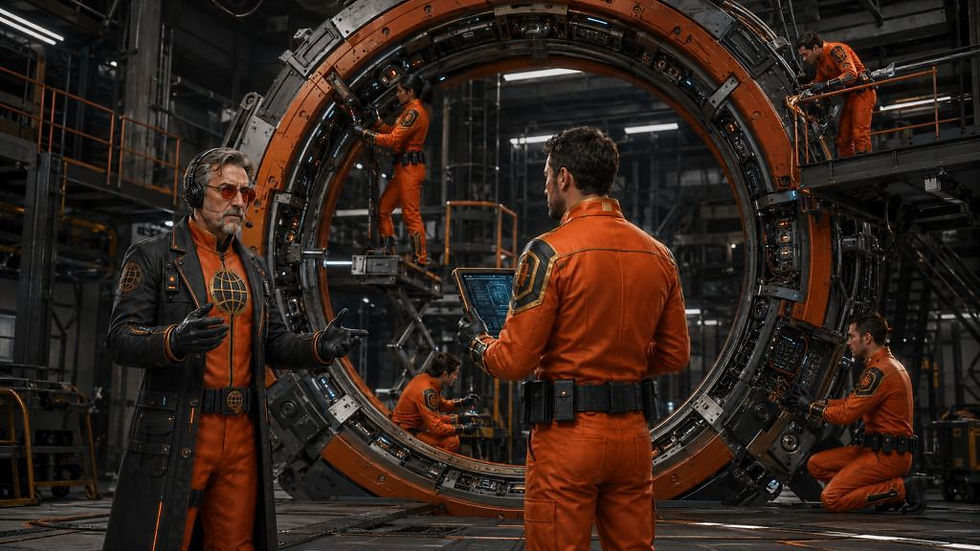
PORTALGUARD is a specialized division of GUARD’s Global Operations Command, operating under Special Threat Command. Built around advanced portal engineering and controlled threshold technology, PORTALGUARD manages secure rapid-transit gateway systems that allow GUARD personnel, emergency teams, medical responders, supplies, and critical resources to move between authorized GUARD facilities around the world.
Unlike conventional transportation, PORTALGUARD’s systems use secured anchor-to-anchor gateway technology. These portals are carefully controlled, monitored, and opened only between approved Earth-based locations. Each transit event is treated as a regulated security crossing, with identity verification, cargo review, medical safeguards, receiving-side confirmation, and emergency shutdown procedures.
PORTALGUARD plays a major role in GUARD’s global crisis-response capability. During disasters, attacks, medical emergencies, or large-scale humanitarian operations, PORTALGUARD can help move specialized personnel and essential supplies quickly to where they are needed most. Its network strengthens GUARD’s ability to respond across national borders, remote locations, and rapidly changing emergencies.
The division is also responsible for portal safety, portal infrastructure security, and threshold-related emergency response. PORTALGUARD personnel include portal engineers, route controllers, security operators, containment specialists, medical screening teams, logistics coordinators, and scientific researchers trained to operate in high-risk gateway environments.
STATISTICS


HISTORY
The Door That Changed GUARD Forever (PORTALGUARD History)
Before PORTALGUARD had a name, before its orange-and-black emblem marked the walls beneath GUARD Headquarters, and before the world knew that GUARD could move personnel across the planet through controlled gateways, there was a scientist in Barcelona who believed distance was only a problem waiting for the right equation.
His name was Doctor Vernon Perse.
Born in Naples, Italy, Vernon Perse was the kind of scientist who never quite accepted the limits other people treated as permanent. To him, space was not empty distance. It was structure. It was alignment. It was a puzzle of forces, coordinates, and hidden relationships. Where others saw miles, oceans, borders, or walls, Perse saw the possibility of a threshold.
Not a transporter. Not a magic trick. Not a fantasy doorway.
A real passage.
A controlled corridor between two points that should never have touched.
For years, Perse chased that idea through quantum engineering, astrophysics, mathematics, and theoretical threshold science. His work attracted interest from universities, governments, private investors, intelligence agencies, and people whose motives were far less honorable. Eventually, that interest brought him to Barcelona, Spain, where he and his team built the first true technology-based portal system.
To Perse, it was the beginning of a new age. If the portal could be configured and aligned correctly, it might connect distant places, perhaps even worlds beyond Earth. It could change emergency response, exploration, logistics, medicine, and human understanding itself.
But the first great doorway did not open into triumph.
It opened into disaster.
During the Barcelona activation, the portal connected to a world inhabited by werewolf-like beings. In that moment, Vernon Perse proved that his science worked. He also learned, with terrible speed, that a portal was not a window. It was not a screen. It was not a harmless experiment safely contained behind glass.
It was a door.
And doors open both ways.
The disaster became catastrophic when Perse’s second-ranking scientist disabled critical safety systems. Whether driven by greed, sabotage, ambition, criminal pressure, or betrayal, that act turned a scientific breakthrough into an uncontrolled breach. The creatures on the far side came through. Technicians died. The facility collapsed into chaos. The promise of portal science became a nightmare of blood, panic, and containment failure.
GUARD responded.
The werewolf incursion was contained. The beings that had crossed through were rounded up and returned. The Barcelona portal was destroyed before it could be exploited again. Only afterward did Perse learn the full depth of the disaster surrounding him: the project’s mysterious financier was connected to a major criminal organization, and the scientist who had disabled the safeguards vanished before justice could reach him.
For Vernon Perse, Barcelona became the wound that never fully closed.
For GUARD, it became a warning.
Portal technology could not be ignored. It was too powerful, too dangerous, and too strategically important to leave buried in the ruins of one failed experiment. It could save lives if controlled. It could also bypass borders, breach secure facilities, unleash hostile organisms, contaminate entire regions, or open the wrong door at the wrong time.
GUARD made a hard decision.
Rather than bury Perse’s work, GUARD brought it under authority.
The agreement that followed became known within the organization as the GUARD Accord. Under that accord, Vernon Perse would continue his research only under GUARD oversight, GUARD security, GUARD law, and Special Threat Command safety doctrine. Perse would provide the science. GUARD would provide the discipline his science had proven it could not survive without.
From that decision, PORTALGUARD was born.
PORTALGUARD was not created to chase every unknown doorway in existence. It was created to make sure humanity survived the ones it opened. Under GUARD’s Global Operations Command and Special Threat Command, Perse and his new teams rebuilt portal science from the ground up. The early obsession with blind exploration gave way to a safer principle: a stable portal required two known, secured, and actively monitored anchors. One on the departure side. One on the receiving side.
No unknown destination.
No unsecured opening.
No single scientist bypassing the rules.
No door opened without someone ready to close it.
That principle changed everything.
The first successful GUARD-controlled Earth-to-Earth portal proved that the technology could be used safely when disciplined by procedure, containment, and command authority. Over time, PORTALGUARD built a secure network of more than three dozen operational portal anchors linking authorized GUARD facilities around the world. These portals gave GUARD a new kind of response capability: emergency teams could move faster, medical personnel could reach crisis zones sooner, critical supplies could cross continents in moments, and command resources could shift where they were needed most.
To the public, PORTALGUARD became one of GUARD’s most advanced emergency-response divisions: a scientific marvel used for rapid movement, humanitarian logistics, and secure facility-to-facility support.
But beneath GUARD Headquarters in Boston, the deeper story continued.
Inside the classified Threshold Operations Complex, PORTALGUARD maintains three experimental portal systems. These are not part of the routine Earth-based network. They are isolated, guarded, and monitored under strict Special Threat Command oversight. They exist because Barcelona proved that unknown doors are possible, and because other incidents proved that those doors are stranger than PORTALGUARD first understood.
One experimental portal opened to what scientists initially believed was a demon dimension. It was later determined, through coordination with MYSTIGUARD, that the portal had actually connected to Satanazes Isle — not a separate hellish realm, but an Earth-bound mystical location misunderstood by instruments that could measure energy but not interpret magical geography. That mistake permanently changed PORTALGUARD’s relationship with MYSTIGUARD. It taught the division that data without context can still lead to the wrong conclusion.
Another experimental portal opened briefly onto a world of red ocean water.
The aperture lasted only a short time, but that was enough. Red water surged through the portal and flooded the bay. Strange alien aquatic organisms crossed with it, carried into GUARD custody by pressure, chaos, and the simple fact that an environment does not need hostile intent to become dangerous. The red-ocean incident reshaped PORTALGUARD facility design, quarantine doctrine, and environmental-breach response forever.
From that day forward, every PORTALGUARD trainee learned the rule:
If the far side has an environment, assume the environment wants to come through.
The third experimental portal has produced brief and unrepeatable windows into unknown places. Some lasted less than a minute. Some left only fragments of imagery, unusual readings, or impossible data patterns. Vernon Perse has spent years trying to recreate those openings. He has failed every time.
That failure is part of what makes PORTALGUARD dangerous, and part of what keeps it honest.
PORTALGUARD can connect GUARD’s world. It can move people, supplies, emergency teams, and critical equipment across Earth through controlled, secured anchors. It can reinforce facilities, evacuate casualties, support humanitarian operations, and give GUARD the speed needed to meet crises that would otherwise outrun response.
But PORTALGUARD cannot yet command the worlds beyond Earth. It has glimpsed them. It has been flooded by one. It has mistaken one for something else. It has lost people to the consequences of opening too much too soon.
That is why PORTALGUARD is built around restraint as much as discovery.
Its personnel are scientists, engineers, security operators, medical screeners, route controllers, containment specialists, and crisis logisticians. They work in bright orange-and-black uniforms under the glow of portal rings and hazard lights, surrounded by machinery that can save lives or create disasters depending on how well the doctrine is followed. They do not treat a portal like a hallway. They treat it like a border crossing, a breach point, and a promise that whatever waits on the other side may be able to come through.
At the center of it all remains Doctor Vernon Perse — Door Man.
Older now, seasoned by failure and responsibility, Perse still carries the wonder that began in Naples and became a breakthrough in Barcelona. He is still brilliant, still distracted, still driven by equations no one else can quite see, and still haunted by the first door he opened. But he is no longer alone with his curiosity. PORTALGUARD surrounds him with doctrine, oversight, safety boards, operators, engineers, and people empowered to tell him no.
That is not an insult to his genius.
It is the reason his genius can still serve the world.
PORTALGUARD’s history is not simply the story of a technology. It is the story of GUARD learning that the future must be secured before it is entered. It is the story of a scientist who opened the wrong door and spent the rest of his life building an organization strong enough to open the right ones.
Every PORTALGUARD portal carries that history.
Every glowing aperture is a reminder of Barcelona.
Every secured anchor is a promise of discipline.
Every emergency deployment is proof that the science can save lives.
Every experimental threshold is a warning that discovery still has teeth.
PORTALGUARD stands where science meets the unknown, where response meets containment, and where every doorway is treated with the respect it deserves.
Because every door has two sides.
ORG CHART

PORTALGUARD Commander

PORTALGUARD Major Branches
1. Command & Administration Branch
Handles division leadership, staffing, clearance, legal compliance, mission approvals, policy, budgeting, and coordination with Global Operations Command and Special Threat Command.
Subsections:
-
Commander’s Office
-
Deputy Commander’s Office
-
Division Administration
-
Legal and Compliance Office
-
Training Records Office
-
Budget and Resource Planning
-
Inter-Division Coordination Desk
-
Incident Review Board
2. Portal Operations Branch
Responsible for daily use of the Earth-to-Earth portal network.
Subsections:
-
Global Portal Operations Center
-
Route Control Office
-
Anchor Scheduling Office
-
Transit Manifest Office
-
Receiving-Side Veto Coordination
-
Emergency Deployment Desk
-
Watch Officer Program
-
Portal Operator Certification Unit
This is the branch that makes the operational network function.
3. Portal Engineering & Maintenance Branch
Responsible for portal hardware, anchor calibration, power systems, gateway frames, aperture stabilization equipment, and maintenance.
Subsections:
-
Anchor Engineering Unit
-
Portal Ring Maintenance Unit
-
Quantum Alignment Lab
-
Aperture Stabilization Team
-
Power Regulation Team
-
Emergency Repair Team
-
Systems Fabrication Shop
-
Field Anchor Installation Team
This branch keeps portals physically functional and safe.
4. Threshold Science & Research Branch
Responsible for portal theory, experimental analysis, threshold resonance studies, destination drift research, and non-Earth event reconstruction.
Subsections:
-
Threshold Resonance Lab
-
Experimental Portal Analysis Unit
-
Destination Drift Research Team
-
Red-Ocean Data Cell
-
Barcelona Reconstruction File
-
Satanazes Misclassification Review Cell
-
Perse Event Archive
-
Non-Earth Signature Study Group
This is Vernon’s natural home, but the branch still operates under safety controls.
5. Containment & Portal Security Branch
Responsible for physical security, portal bay defense, breach containment, hostile crossing response, detainee transfer security, and emergency hard-seal procedures.
Subsections:
-
Portal Security Teams
-
Containment Response Teams
-
Breach Suppression Unit
-
Detainee Transit Security
-
Hard-Seal Door Control Team
-
Kill Station Certification Unit
-
Tactical Gateway Defense Unit
-
Internal Threat Monitoring Cell
This branch handles the reality that a portal can become an attack route.
6. Medical, Quarantine & Exposure Branch
Responsible for medical screening, biological exposure, alien organism handling, pathogen risk, threshold lag monitoring, and quarantine operations.
Subsections:
-
Transit Medical Screening Unit
-
Threshold Quarantine Team
-
Biological Sample Isolation Lab
-
Alien Aquatic Organism Holding Unit
-
Exposure Treatment Team
-
MCARE Liaison Desk
-
Environmental Contamination Team
-
Post-Transit Health Monitoring
This branch grew in importance after the red-ocean incident.
7. Portal Logistics & Emergency Movement Branch
Responsible for moving personnel, cargo, equipment, relief supplies, and critical assets through authorized portal routes.
Subsections:
-
Crisis Logistics Desk
-
Cargo Manifest Office
-
Humanitarian Supply Transit Unit
-
Medical Evacuation Coordination Cell
-
Emergency Pallet Movement Team
-
Equipment Transfer Office
-
Chain-of-Custody Unit
-
Disaster Response Staging Team
This branch is the reason PORTALGUARD is so useful to GUARD’s global response mission.
8. AI, Cybersecurity & Network Integrity Branch
Responsible for portal software, AI safety monitoring, cyber defense, network isolation, route file integrity, and prevention of portal-network compromise.
Subsections:
-
Portal AI Safety Core
-
Network Integrity Team
-
Route File Security Office
-
Cyber Defense Cell
-
Anchor Authentication Unit
-
Network Contamination Response Team
-
Operational/Experimental Separation Office
-
Signal Intrusion Analysis Team
This branch protects the portal network from hacking, spoofing, sabotage, and cascading failure.
9. MYSTIGUARD / Special Threat Liaison Branch
Responsible for coordination with MYSTIGUARD, Special Threat Command, SSIIC, ASTROGUARD, MCARE, XGUARD, and other divisions when a portal event crosses normal boundaries.
Subsections:
-
MYSTIGUARD Liaison Cell
-
Magical Resonance Alert Desk
-
Technomagic Review Unit
-
Artifact Transit Review Office
-
ASTROGUARD Off-World Indicator Desk
-
SSIIC Classified Threat Desk
-
XGUARD Tactical Transit Coordination
-
Legal/Treaty Review Cell
This branch prevents PORTALGUARD from operating in a vacuum.
Standing Review Boards
PORTALGUARD should have several standing boards due to the danger of its work.
Portal Activation Review Board
Reviews high-risk experimental activation requests.
Core members:
-
Vernon Perse
-
Deputy Commander
-
Chief Threshold Safety Officer
-
STC representative
-
Portal Engineering representative
-
Containment/Security representative
-
AI/Cyber representative
-
Medical/Quarantine representative
-
MYSTIGUARD representative when magical resonance is possible
Threshold Incident Review Board
Reviews portal accidents, breaches, malfunctions, and near-misses.
Experimental Ethics & Risk Board
Reviews whether scientific research justifies the operational danger.
Portal Network Security Board
Reviews anchor security, route file integrity, cyber risks, and possible network contamination.
Magical Threshold Coordination Board
Joint PORTALGUARD/MYSTIGUARD board for magical or suspected magical portal events.
Rank/Role Titles
PORTALGUARD has its own role titles within GUARD:
-
Portal Operations Officer
-
Portal Route Controller
-
Anchor Engineer
-
Aperture Stabilization Engineer
-
Threshold Safety Officer
-
Portal Security Officer
-
Containment Response Specialist
-
Transit Manifest Coordinator
-
Receiving-Side Control Officer
-
Portal Bay Chief
-
Threshold Quarantine Specialist
-
Portal Network Integrity Analyst
-
Experimental Portal Scientist
-
Resonance Analyst
-
Gateway Defense Specialist
-
Kill Station Officer
-
Hard-Seal Technician
-
MYSTIGUARD Liaison Officer
-
Portal Incident Commander
OPERATIONS
PORTALGUARD ORIENTATION AND DOCTRINE HANDBOOK
This Handbook is authorized only for:
GUARD Officers, PORTALGUARD personnel and PORTALGUARD-Related Academy Personnel
This document provides an orientation of the basics of PORTALGUARD, Portal operations, policies, doctrine and rules.
Click the PDF Document image to download and open the Handbook.
Mission Description
PORTALGUARD is GUARD’s specialized portal operations and threshold-security division under Global Operations Command’s Special Threat Command. Built around Doctor Vernon Perse’s breakthrough portal research, PORTALGUARD operates a secure Earth-based portal network connecting authorized GUARD facilities around the world. These controlled gateways allow GUARD to move personnel, supplies, emergency teams, and critical resources with unmatched speed during global crises.
Behind that public mission is a far more dangerous responsibility. PORTALGUARD also studies unstable portal phenomena, investigates failed or unauthorized openings, secures experimental portal systems, and responds to threshold breaches involving unknown environments, alien lifeforms, mystical gateways, or hostile incursions. The division’s operating doctrine is shaped by a hard lesson from its earliest disaster: a portal is not simply a doorway. It is a border, a breach point, and a promise that whatever stands on the other side may be able to come through.
PORTALGUARD’s stable technology remains Earth-centric, connecting approved GUARD locations through tightly controlled anchor points. Its experimental systems, housed beneath GUARD Headquarters, have occasionally opened brief windows to stranger places, but those moments remain unstable, classified, and nearly impossible to recreate. For this reason, PORTALGUARD stands at the edge of GUARD’s scientific ambition and operational caution—connecting the world while guarding it from every door it dares to open.
Operating Doctrine
Doctrine 1: The Anchor Principle
A portal is only considered operationally safe when both sides are known, mapped, secured, and actively monitored.
PORTALGUARD uses fixed anchor points, not random openings. An approved portal route is treated like a secured aircraft corridor, border checkpoint, and hazardous materials lane combined.
No anchor, no routine transit.
Doctrine 2: Two-Way Risk
Anything that can go through a portal in one direction can come through from the other.
This doctrine comes directly from Vernon Perse’s Barcelona disaster. A portal is never opened without assuming that something, someone, or some environmental hazard may attempt to cross from the far side.
Every PORTALGUARD portal bay therefore requires:
-
Physical security teams.
-
Emergency blast shutters.
-
Containment doors.
-
Environmental isolation.
-
Remote shutdown capability.
-
Medical and biological screening.
-
Emergency evacuation protocols.
-
Independent power cutoff.
-
AI-assisted anomaly monitoring.
Doctrine 3: Containment Before Curiosity
Scientific discovery never outranks containment.
This is the doctrine that keeps Vernon Perse honest. PORTALGUARD is built around scientific ambition, but its command culture must prevent the Barcelona mistake from repeating.
When a portal behaves unexpectedly, the immediate priorities are:
-
Preserve life.
-
Seal or stabilize the portal.
-
Prevent hostile or hazardous passage.
-
Isolate biological, chemical, magical, psychic, or dimensional contaminants.
-
Record scientific data only within safe limits.
-
Begin investigation after containment is achieved.
Doctrine 4: Every Portal Is a Border Crossing
PORTALGUARD treats portal transit as a controlled crossing point, not casual movement.
All routine portal movement requires:
-
Identity verification.
-
Manifest approval.
-
Route authorization.
-
Security clearance confirmation.
-
Biological and environmental scan.
-
Cargo declaration.
-
Receiving-side confirmation.
-
Chain-of-custody tracking for sensitive materials.
This gives PORTALGUARD a strong procedural feel, similar to a mix of airport operations, nuclear facility access, special operations deployment, customs control, and disaster-response logistics.
Doctrine 5: No Solo Openings
No PORTALGUARD portal may be opened by one person acting alone.
Minimum authorization requires:
-
Portal Operations Officer.
-
Portal Engineering Officer.
-
Security/Containment Officer.
-
AI system verification.
-
Receiving-side confirmation for operational portals.
Experimental portals require higher authorization, including Special Threat Command command approval and, depending on risk level, MYSTIGUARD, ASTROGUARD, MCARE, SSIIC, or GUARD Executive review.
Doctrine 6: Unknown Thresholds Are Treated as Hostile Until Classified
This does not mean PORTALGUARD assumes everything beyond a portal is evil. It means unknown portal events are handled as hazardous until proven otherwise.
Unknown thresholds may involve:
-
Hostile organisms.
-
Environmental pressure changes.
-
Alien atmosphere.
-
Pathogens.
-
Magical energy contamination.
-
Psychic influence.
-
Temporal distortion.
-
Gravitational anomalies.
-
Weaponized portal traps.
-
Artificial intelligence or signal intrusion.
-
Refugees or victims needing rescue.
The initial posture is containment, not aggression.
Doctrine 7: PORTALGUARD Does Not Explore Blind
PORTALGUARD does not send teams casually into unknown portals.
Before any exploratory entry, the division requires:
-
Drone reconnaissance where possible.
-
Environmental sampling.
-
Atmospheric analysis.
-
Structural stability confirmation.
-
Receiving-side imagery or telemetry.
-
Retrieval cable or beacon protocol.
-
Medical quarantine plan.
-
Armed containment backup.
-
Command authorization.
-
Mission abort criteria.
Classification of Portal Operations
Class P-1: Routine Earth Transit
Stable GUARD facility-to-facility portal movement.
Examples:
-
Personnel transfer.
-
Courier movement.
-
Controlled equipment shipment.
-
Scheduled emergency-response staging.
Class P-2: Priority Operational Transit
Urgent but controlled movement during an active crisis.
Examples:
-
Disaster response.
-
Medical evacuation.
-
Rapid deployment team transfer.
-
Crisis command relocation.
Class P-3: Restricted Tactical Transit
Sensitive movement requiring elevated clearance.
Examples:
-
XGUARD movement.
-
High-risk detainee transfer.
-
Artifact transport.
-
Classified equipment relocation.
-
Special Threat Command deployment.
Class P-4: Portal Malfunction or Unscheduled Activation
A portal behaves outside normal parameters.
Examples:
-
Failed lock.
-
Unknown energy reading.
-
Partial opening.
-
Unexpected destination signal.
-
Anchor instability.
Class P-5: Unknown Threshold Event
A portal opens to an unverified location or displays non-Earth, magical, alien, or anomalous markers.
Examples:
-
Red-ocean world event.
-
Unmapped environment.
-
Strange atmospheric reading.
-
Unknown organism incursion.
-
Possible dimensional bleed-through.
Class P-6: Hostile Breach / Dimensional Incursion
A portal event creates immediate threat to life, security, or Earth containment.
Examples:
-
Barcelona werewolf incursion.
-
Hostile entity crossing.
-
Armed force emerging through portal.
-
Pathogen-bearing organism entry.
-
Environmental flood/fire/toxic atmosphere breach.
Class P-7: Strategic Threshold Crisis
A portal event threatens mass casualty, geopolitical stability, planetary security, or reality integrity.
Examples:
-
Portal network hijack.
-
Multi-site unauthorized openings.
-
Large-scale dimensional incursion.
-
Portal weaponization.
-
Cascading anchor failure across GUARD facilities.
Portal Transit Safety Rules
These are standard PORTALGUARD rules:
-
No portal opens without two-side confirmation unless under emergency breach protocol.
-
No unidentified biological matter passes without quarantine.
-
No unknown artifact passes without MYSTIGUARD/Artifact review.
-
No detainee moves through a portal without containment escort.
-
No experimental portal opens without STC authorization.
-
No personnel enter an unknown portal without retrieval protocol.
-
No portal route remains active longer than operationally necessary.
-
No portal can override receiving-side lockdown.
-
No mystical portal is accessed without MYSTIGUARD liaison approval.
-
No scientist, commander, or field officer can bypass safeties alone.
Portal Transit Effects
Normal portal transit is brief and safe, but not always comfortable.
Common effects may include:
-
momentary vertigo
-
ear pressure shift
-
temperature flicker
-
static sensation on skin
-
brief afterimage from aperture light
-
mild nausea in first-time users
-
disorientation if moving heavy equipment
-
temporary equipment interference
PORTALGUARD refers to this informally as threshold lag.
Repeated transit is monitored for fatigue, neural stress, and cumulative exposure. Most personnel can tolerate routine use, but high-frequency portal operators and response teams undergo periodic screening.
UNIFORMS

FACILITIES
POTALGUARD'S PORTALS
PORTALGUARD’s portal systems are built around controlled anchor-to-anchor threshold technology. Unlike teleportation, which would move a person or object from one place to another without an intervening passage, a PORTALGUARD portal creates a temporary corridor between two stabilized points. Because the portal is a real opening, matter, atmosphere, sound, light, and living organisms can potentially pass in both directions while the aperture remains active.
For this reason, every stable PORTALGUARD portal requires two approved anchors: one at the departure site and one at the receiving site. These anchors allow PORTALGUARD to verify location, environmental safety, security status, identity clearance, cargo manifest, and emergency shutdown readiness before the portal opens. The system is powerful, but deliberately limited. PORTALGUARD’s reliable portal network remains Earth-centric, linking authorized GUARD facilities through controlled, secured, and actively monitored gateway stations.
The division’s experimental systems are far less predictable. Located beneath GUARD Headquarters, three classified portal arrays have occasionally opened brief and unstable thresholds to non-Earth locations, including one event that flooded a portal bay with red ocean water and unknown alien aquatic lifeforms. Doctor Vernon Perse has spent years trying to reproduce those contacts, but the science remains incomplete. PORTALGUARD can reliably connect GUARD’s world. It cannot yet command the worlds beyond it.
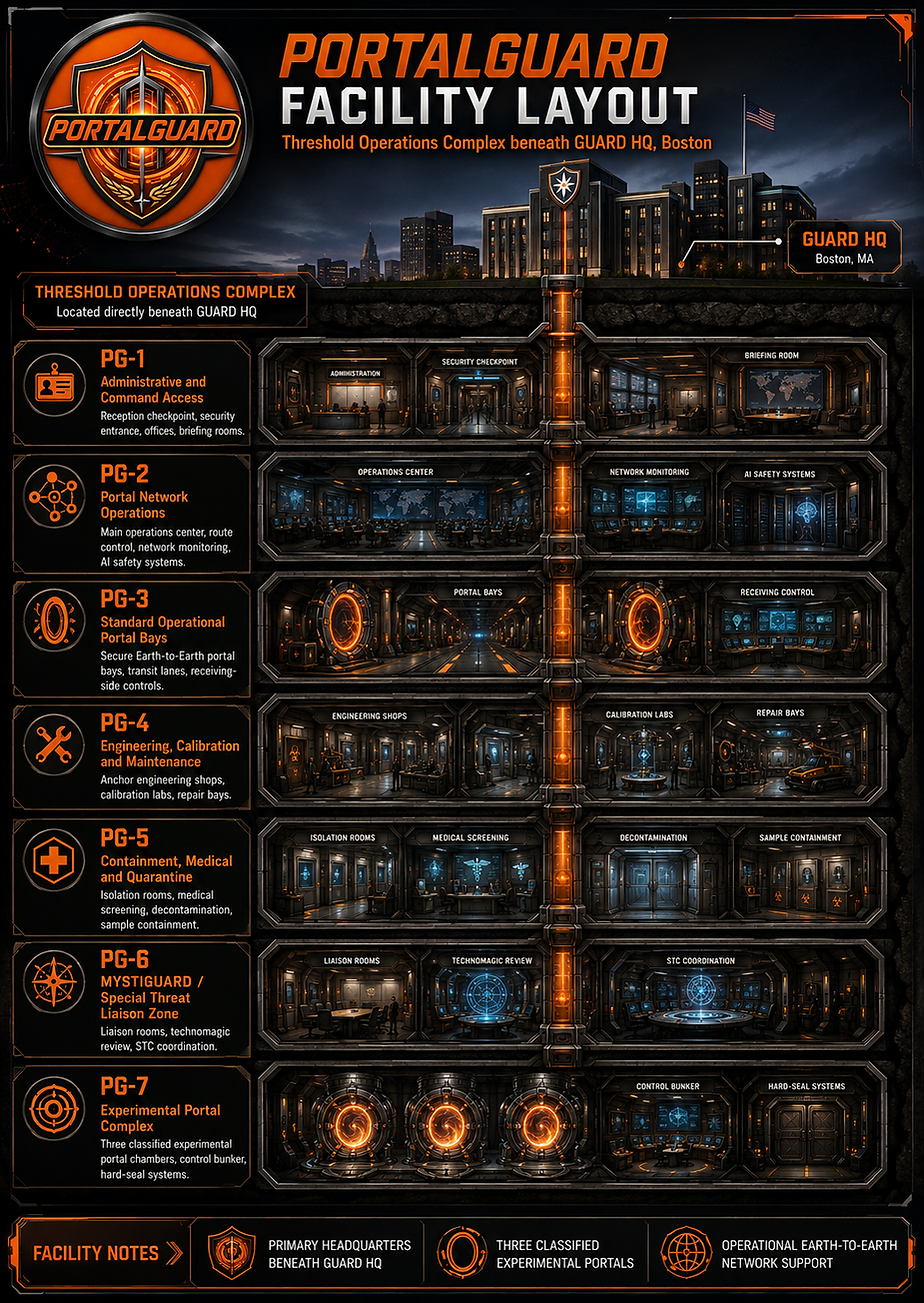
NOTE: The above image is not to scale, or space aligned; this is showing representations of the levels and relative spaces at these levels.
PORTALGUARD LOCATION, BASE & BASE DESIGN
Base Description
PORTALGUARD’s primary command and research facility is housed beneath GUARD Headquarters in Boston, Massachusetts, inside the classified Threshold Operations Complex. From this hardened sub-basement facility, PORTALGUARD monitors GUARD’s Earth-based portal network, certifies portal operators, maintains anchor systems, and controls three classified experimental portal arrays separated from routine operations by strict physical, digital, and procedural safeguards.
The Threshold Operations Complex combines the functions of a command center, research laboratory, emergency operations hub, containment facility, secure border crossing, and high-risk engineering site. Its standard portal bays support controlled Earth-to-Earth transit between authorized GUARD locations, while its deepest experimental levels study rare and unstable threshold events that cannot yet be reliably reproduced.
After the Barcelona werewolf incursion, the Satanazes Isle misclassification, and the red-ocean flooding incident, PORTALGUARD’s facilities were designed around one constant assumption: every portal is a potential breach. For that reason, every PORTALGUARD portal bay includes security checkpoints, hard-seal containment doors, AI monitoring, medical screening, decontamination corridors, manual kill stations, receiving-side veto systems, and emergency lockdown capability.
PORTALGUARD’s architecture reflects the division’s identity: bright science, hard security, disciplined logistics, and the constant awareness that every open door has two sides.
Facility Role
The Threshold Operations Complex serves four major functions.
1. Portal Network Command
This is where PORTALGUARD monitors and regulates GUARD’s Earth-to-Earth portal network. Operators track active routes, anchor readiness, emergency requests, transit manifests, security alerts, and receiving-side approvals across all operational portal sites.
2. Experimental Portal Research
The three classified experimental portals beneath GUARD HQ are housed here. These systems are physically, digitally, and procedurally separated from the operational portal network.
They are used to study unstable non-Earth openings, threshold resonance anomalies, failed destination locks, magical interference, and rare “Perse Events.”
3. Containment and Response
The facility is designed to contain unexpected environmental, biological, hostile, or anomalous breaches. Its architecture assumes that any portal can become a disaster site within seconds.
4. Training and Certification
PORTALGUARD trains portal operators, portal security teams, containment technicians, network logisticians, and emergency response personnel in this facility. Every person authorized to work near active portal systems must complete specialized threshold safety training.
Threshold Operations Complex Layout
Level PG-1: Administrative and Command Access
This upper PORTALGUARD level handles controlled entry into the division’s space.
Key areas include:
-
PORTALGUARD reception checkpoint
-
Biometric security entrance
-
Personnel clearance office
-
Mission briefing rooms
-
Transit authorization office
-
Secure records and route file archive
-
Deputy Commander offices
-
Watch officer station
-
Legal/compliance review office
-
Conference rooms
-
Training classrooms
This level looks professional and institutional, with orange-and-black PORTALGUARD branding, GUARD security seals, clean wall displays, and constant reminders that portal transit is regulated infrastructure.
Level PG-2: Portal Network Operations
This level is the operational heart of the Earth-based portal system.
Key areas include:
-
Main Portal Operations Center
-
Global portal network display wall
-
Route coordination consoles
-
Anchor readiness monitoring
-
AI portal safety interface
-
Emergency response dispatch station
-
Receiving-side veto coordination desk
-
Transit manifest approval room
-
Cargo clearance office
-
Portal security watch floor
-
Communications suite
-
Power and systems monitoring room
This level has the feel of an air traffic control center, emergency operations center, and secure border authority combined.
Operators monitor every active portal, every pending route, every emergency closure, and every abnormal reading. No stable portal opens without the network floor knowing it.
Level PG-3: Standard Portal Bays
This level houses GUARD HQ’s operational Earth-to-Earth portal bays.
These are not the three experimental portals. They are approved anchor bays used for stable GUARD facility-to-facility transit.
Each standard bay includes:
-
Portal ring/frame
-
Departure and receiving lane markings
-
Armored containment doors
-
Security checkpoint
-
Cargo inspection zone
-
Medical screening alcove
-
Decontamination corridor
-
Emergency kill station
-
AI sensor array
-
Pressure and atmosphere controls
-
Overhead hazard lights
-
PORTALGUARD security post
-
Receiving-side communication wall
Standard portal bays are bright, controlled, and highly organized. They are designed for efficiency, but not comfort. Personnel are constantly reminded that the portal is a controlled hazard.
Level PG-4: Engineering, Calibration and Maintenance
This level supports the physical and technical systems that keep the portal network functional.
Key areas include:
-
Portal ring maintenance shops
-
Anchor calibration laboratories
-
Quantum alignment testing rooms
-
Aperture stabilization lab
-
Threshold resonance sensor lab
-
Power regulator maintenance bay
-
Parts fabrication shop
-
Drone probe workshop
-
Containment systems repair bay
-
Emergency generator access
-
AI hardware service room
-
Engineering crew ready room
This level is busy, loud, and technical. Engineers here maintain the difference between a useful doorway and a catastrophic breach.
Level PG-5: Containment, Medical and Quarantine
This level exists because PORTALGUARD learned the hard way that the far side of a portal can enter the near side.
Key areas include:
-
Threshold quarantine suites
-
Medical exposure treatment rooms
-
Isolation chambers
-
Biohazard containment labs
-
Alien aquatic sample tanks
-
Unknown organism holding cells
-
Decontamination showers
-
Chemical and atmospheric analysis lab
-
MCARE support station
-
Autopsy/necropsy room for nonhuman organisms
-
Contaminated cargo lockup
-
Environmental sample vault
-
Emergency triage room
After the red-ocean incident, this level was expanded and hardened. It now includes flood-rated drains, sealed fluid channels, negative-pressure rooms, and independent air/water filtration.
Level PG-6: MYSTIGUARD / Special Threat Liaison Zone
This level handles cross-division coordination.
Key areas include:
-
MYSTIGUARD liaison chamber
-
Arcane resonance analysis room
-
Ward-safe observation area
-
Technomagic review lab
-
STC command suite
-
SSIIC secure briefing room
-
Artifact transit inspection room
-
Legal and treaty review office
-
Magical portal documentation vault
-
Joint incident analysis room
This zone exists because PORTALGUARD technology sometimes intersects with magical geography, hidden Earth-bound portals, ley-line effects, artifacts, and unusual threshold behavior.
The guiding principle is simple:
PORTALGUARD measures and contains.
MYSTIGUARD interprets and wards.
Special Threat Command decides when the risk becomes strategic.
Level PG-7: Experimental Portal Complex
The deepest and most secure section of PORTALGUARD’s Boston facility contains the three classified experimental portals.
This level is separated from the operational portal network by physical walls, isolated power routing, independent servers, manual hard-kill systems, and security protocols that require multiple authorizations.
Key areas include:
-
Experimental Portal Bay One
-
Experimental Portal Bay Two
-
Experimental Portal Bay Three
-
Reinforced portal control bunker
-
Observation gallery with blast-rated glass
-
Flood containment channels
-
Pressure-compensation systems
-
Emergency foam and sealant systems
-
Autonomous drone launch racks
-
Robotic sample retrieval arms
-
Heavy quarantine shutters
-
Independent kill stations
-
STC authorization chamber
-
Vernon Perse’s experimental analysis office
-
Red-ocean incident memorial marker
-
Barcelona safety doctrine wall
The experimental level is not designed for smooth operations. It is designed to survive failure.
The Three Experimental Portals
Experimental Portal One: The Satanazes Misclassification Portal
This portal is associated with the event once misidentified as a “demon dimension.” Later MYSTIGUARD analysis confirmed the connection was actually to Satanazes Isle.
This portal is now used carefully for studying:
-
Magic-physics interference
-
Earth-bound mystical location resonance
-
False dimensional readings
-
Ley-line distortion effects
-
Scientific misclassification of magical geography
It is rarely activated and never without MYSTIGUARD liaison presence.
Experimental Portal Two: The Red-Ocean Event Portal
This portal produced the red-ocean incident, briefly opening onto an alien ocean environment and flooding the bay with red water and unknown aquatic organisms.
It is now surrounded by:
-
Reinforced fluid containment
-
Rapid-drain floor systems
-
Aquatic biological containment tanks
-
Water chemistry sensors
-
Pressure isolation doors
-
Robotic sampling equipment
-
Emergency anti-flood shutters
It is considered one of the most dangerous non-Earth threshold systems in GUARD custody.
Experimental Portal Three: The Unrepeatable Window Portal
This portal has opened briefly to several unknown locations, none of which have been successfully reproduced.
Its data includes:
-
Short-lived environmental signatures
-
Partial visual recordings
-
Unstable destination drift
-
Incomplete resonance maps
-
Unclear spatial or planetary indicators
-
Possible non-Earth terrain contacts
Vernon Perse is especially obsessed with this portal because it may hold the key to controlled non-Earth access.
PORTALGUARD safety doctrine prevents him from chasing that obsession recklessly.
Standard Operational Portal Bay Design
Every operational PORTALGUARD portal bay is built around the assumption that a stable route can become unstable without warning.
A standard bay includes:
-
Portal Ring / Gateway Frame
-
The physical anchor structure that opens and stabilizes the aperture.
-
-
Control Gallery
-
A protected operations area where portal engineers, route controllers, and security officers monitor the opening.
-
-
Transit Lane
-
Marked floor path for personnel, stretchers, cargo pallets, or emergency response teams.
-
-
Security Checkpoint
-
Identity verification, clearance review, weapon control, and transit authorization.
-
-
Cargo Inspection Zone
-
Cargo manifests, hazardous material checks, artifact review, and chain-of-custody processing.
-
-
Medical Screening Point
-
Used for rapid post-transit checks, injury review, exposure scanning, and disorientation assessment.
-
-
Decontamination Corridor
-
Activated if biological, chemical, magical, radiological, alien, or unknown contamination is detected.
-
-
Hard-Seal Doors
-
Heavy armored doors that can isolate the portal bay from the rest of the facility.
-
-
Kill Station
-
A manual emergency shutdown point separated from the main control console.
-
-
Receiving Veto System
-
The receiving-side anchor must confirm readiness and may reject the opening.
-
-
AI Monitoring Node
-
Dedicated system monitoring energy fluctuation, pressure change, unauthorized motion, destination drift, and environmental anomalies.
-
Operational Portal Network
PORTALGUARD maintains over three dozen operational portal anchors across authorized GUARD locations.
These are not public portals. They are secured GUARD infrastructure.
Likely anchor categories include:
-
GUARD HQ
-
GUARD regional commands
-
Global Operations Command facilities
-
Special Threat Command sites
-
selected Air Stations
-
emergency logistics hubs
-
major medical response centers
-
classified shelter facilities
-
secure detainee transfer points
-
disaster response staging locations
-
MYSTIGUARD-approved liaison sites
-
ASTROGUARD ground-support sites
-
SEAGUARD/TERRAGUARD/RESCUEGUARD coordination hubs
Each anchor has local staff, security protocols, emergency closure authority, and receiving-side veto rights.
Base Defense and Emergency Systems
PORTALGUARD facilities require unusually strong safety systems.
Core defensive systems include:
-
Armed PORTALGUARD security teams
-
Containment-trained response squads
-
Automated blast doors
-
Manual hard-kill switches
-
Independent power isolation
-
AI anomaly detection
-
Local lockdown zones
-
Remote shutdown authority
-
Quarantine seals
-
Fire suppression
-
Flood channels
-
Pressure balancing
-
Radiation and atmosphere sensors
-
Magical resonance alarms
-
Cyber intrusion defense
-
Drone reconnaissance systems
-
Biological containment teams
-
Medical exposure response
The goal is not only to stop intruders from entering the portal facility. The goal is to stop anything from leaving the portal facility if an event goes wrong.
Operational Portals
Stable Earth-to-Earth Portals
PORTALGUARD’s reliable operational network consists of Earth-to-Earth portal links between authorized GUARD locations.
These portals can connect:
-
GUARD HQ
-
GUARD regional command facilities
-
Air Stations
-
secured GUARD bases
-
disaster-response staging sites
-
classified emergency shelters
-
Special Threat Command sites
-
MYSTIGUARD or PORTALGUARD-approved liaison facilities
-
medical evacuation hubs
-
logistics hubs
These portals are normally opened for short, mission-specific windows rather than left continuously active.
Typical Operational Uses
PORTALGUARD’s Earth-based network supports:
-
emergency team deployment
-
humanitarian supply movement
-
medical evacuation
-
transfer of specialists
-
rapid command relocation
-
secure equipment movement
-
classified detainee transfer
-
crisis logistics
-
evacuation from compromised facilities
-
rapid reinforcement of GUARD sites under threat
Operational portals are extremely useful, but they are not casual convenience doors. Every activation is tracked, logged, secured, and reviewed.