
A Universe of Pure Imagination

TM


THE LEGEND OF EXCALIBUR
For generations, Britain has entrusted its most celebrated knightly champion with a sword called Excalibur, a shield called Pridwen and an enchanted scabbard. Together, these artifacts have protected soldiers and civilians through world wars, alien invasion and the troubled years that followed. Their bearers have become symbols of courage, sacrifice and service. Yet the history of the weapons is more complicated than the legend attached to them.
Relics beneath the Tower
By the sixteenth century, the artifacts were held under the protection of the Crown and the Church of England. Their custodians believed them to be the sword and shield of Arthurian legend. Preserved within a concealed priory beneath the Tower of London, they were guarded as sacred relics and powerful instruments whose use demanded extraordinary responsibility.
The surviving records did not establish an unbroken history from their creation to their arrival in royal custody. Nevertheless, their extraordinary properties lent credibility to the Arthurian attribution. Over generations, that attribution became accepted tradition. Ceremonies and religious observances reinforced their standing as holy relics, while knowledge of their practical capabilities remained confined to a small circle of custodians.


The lost expedition
In 1776, as the American colonies declared independence, George III authorized a secret expedition intended to restore British control. An unnamed knight was entrusted with the sword, shield and scabbard and dispatched across the Atlantic aboard the British vessel Allice, accompanied by a military escort.
The expedition never reached its objective. The vessel was lost at sea, and the artifacts disappeared with it. The knight's identity was not preserved in the surviving accessible records. He belongs to the equipment's earlier history; the numbered Excalibur lineage recognized today begins with the First World War.
For 129 years, the weapons remained beyond the reach of their custodians. In 1905, the wreck was located and the artifacts recovered. Returned to the Tower's concealed priory, they were conserved, examined and placed once more under close protection.
Project: Excalibur
By 1914, selected government officials had learned of the artifacts and sought a role in deciding how they should be used. Inspection and controlled testing established that the equipment could provide a trained bearer with exceptional protection and formidable combat capabilities. Discussions between the Crown, government and custodians were overtaken by the outbreak of the Great War.
Project: Excalibur was activated to select, train and deploy a bearer. Herbert Lancaster became the first of the modern numbered Excaliburs. His service established the mantle as a battlefield identity, and the name of his sword became the name by which soldiers remembered their champion.
A legacy of five bearers
Lancaster's death in 1918 ended his service, but the artifacts survived. During the Second World War, Bartholomew Richards inherited the mantle through Project: Camelot. The wartime loss and recovery of the equipment exposed the danger of allowing such weapons to fall into enemy hands. After the war, the Excalibur Accord restricted their deployment and established safeguards for selecting future bearers.
Those restrictions were lifted during the Soltan Invasion of 2000. Rory Cavendish took up the equipment amid an immediate threat to the Crown and the nation, then fought until his death defending others. In the aftermath, the artifacts were transferred from the compromised Tower facility to secure custody at Camelot, a British G.U.A.R.D. installation.
In 2013, public pressure prompted a new selection process and a change in the mantle's purpose: Britain sought a protector available beyond the confines of a declared wartime emergency. The process was corrupted, and Carlton Carrington's brief tenure ended in disgrace. The subsequent investigation cleared the path for Arthur Mattocks, who accepted the responsibility in 2014.
Across these five lives, the mantle acquired a history of its own. Each bearer faced a different test of duty, judgment and personal sacrifice. Their stories form the modern legend of Excalibur.
The truth behind the legend
The artifacts' earliest history remains partly concealed. Britain’s accepted account, the beliefs of its custodians and the knowledge held by certain ancient magical authorities do not fully agree. The significance of that difference becomes clear during the story of Excalibur V.
Whatever their original names, the weapons have been carried by people whose decisions shaped the lives of those around them. The legacy of Britain's Excaliburs rests in those decisions and in the people they chose to protect.





Info
REAL NAME:
IDENTITY:
AFFILIATION:
REGISTERED?:
RELATIVE AGE:
SERVICE AS EXCALIBUR:
MARITAL STATUS:
HOME:
ALIAS(ES):
TEAMS:
FIRST APPEARANCE:
APPEARANCE DATE:
CREATED BY:
CREATION DATE:
Arthur Mattocks
Known
British/Hero
Yes
40 as of 2026
23 April 2014 - present
Single
London, United Kingdom; residence near Westminster Abbey
Sir Mattocks
30 Oct 2016
Don "Major Deej" Finger
12 July 2011

History
The swordsman behind the spectacle
Before he became Excalibur, Arthur Mattocks worked at the London Medieval Renaissance Faire. Swordsmanship was his practiced craft, used in performances, instruction and supervised contests. His colleague and close friend Tom Thatcher shared the work of presenting medieval combat to a modern audience.
In late 2013, Thatcher publicly challenged Carlton Carrington's claimed association with the Faire. Arthur agreed to face Britain's appointed champion in a supervised contest. On 15 December, in an arena muddied by rain, he demonstrated the difference between a reputation promoted through publicity and skill developed through practice.
Arthur won the first two rounds and offered his opponent assistance and advice. Carrington responded with anger, eventually attempting a potentially lethal strike outside the rules. Arthur avoided it and disarmed him. His brief contact with the enchanted blade did not complete the six-second transfer of armor control. Designated personnel secured the sword, shield and scabbard; full resheathing dismissed Carrington's armor. Officials disqualified Carrington, who later departed into nearby woodland and disappeared from the established record.
Arthur left the encounter as its better swordsman, not as the new owner of the artifacts or the next appointed Excalibur.
The selection that had been stolen
In March 2014, the investigation into the Hastings Data Center established that the 2013 selection had been manipulated. Documents, technical examination and evidence disclosed by the Virtual Corsairs exposed false accounts and the removal of genuine candidates. Sir Bernard Hastings was arrested, but died before arraignment.
When the tainted results were examined, Arthur emerged as the legitimate leading candidate. His name had been excluded from the published selection. Legal review corrected that injustice and restored his place in the process; it could not make him accept the responsibility.
Arthur initially refused. He respected the previous bearers and doubted whether his experience qualified him to represent their legacy. The next two candidates also declined: a young medieval-history student with film swordsmanship experience, and a former Royal Navy woman whose ceremonial sword work had benefited from Arthur's instruction. Their decisions deepened the public disappointment surrounding the failed appointment.
Thatcher continued urging his friend to reconsider. Arthur had already shown restraint under pressure and could teach others to handle a blade. Tom believed that those qualities deserved more weight than Arthur's reluctance to call himself worthy.
Tea with the sovereign
One evening, Tom arranged for Arthur to enter a nearby flat, where Queen Elizabeth II and her security detail waited privately. Surprised and embarrassed, Arthur bowed before joining her for tea.
Elizabeth acknowledged the failure of Carrington's appointment and asked Arthur to help restore confidence. He initially answered in the formal language of knightly loyalty. The Queen redirected the conversation toward the people who would depend on him. Ceremony mattered less than his willingness to protect them and accept the risks that duty would bring.
Arthur recognized the distinction. He was being asked to serve people, including those who might never see a royal ceremony or care about a legendary sword. He accepted that responsibility without claiming certainty about his own worth.
On 23 April 2014, under the applicable government authorization, Elizabeth II knighted Arthur and appointed him Excalibur V. Designated custodians released the sword, shield and scabbard from secure custody at Camelot. Their transfer followed the authorized appointment; drawing the sword manifested his armor without delivering any supernatural verdict on his character.
The appointment was announced, and a public investiture followed approximately two weeks later. Arthur's service began with his acceptance and lawful appointment, rather than with the later publicity.
Learning the work of a champion
Arthur received a residence near Westminster Abbey and a ten-person support staff. Their responsibilities included security, meals, transport, government liaison, conservation of the physical relics and assessment of enchantments. The core armor was magically manifested; the staff did not routinely manufacture and rebuild a separate suit.
He joined the Commonwealth but declined its leadership. Elizabeth encouraged him to remain available to the team and grow into wider responsibilities at his own pace. His exceptional swordsmanship gave him a useful foundation, but did not replace experience in field command, extraordinary threats or coordinated superhero operations.
Initially, a police chauffeur helped him reach assignments. Arthur disliked the dependence, yet accepted that getting to people who needed assistance mattered more than the appearance of his arrival. He began building the habits of service that Carrington had neglected.
A name challenged by the truth
Months after his accession, Arthur responded to an attack by shape-changing Fir Bolgs at a military base. Conventional weapons had proved insufficient to stop them. The Knights Arcanus were already engaged when he arrived, and he joined their successful defense.
Afterward, their leader, Samhain Knight, recognized Arthur's equipment and questioned its Arthurian attribution. Drawing on his former service as Master at Arms of the Conglomerate, Samhain identified the weapon as an enchanted Saxon War Sword. The shield's actual name was Valiance. Both were powerful, well-made artifacts, but they were distinct from the genuine Holy Excalibur and Pridwen.
Arthur challenged the explanation. Samhain supported it with an ancient illustrated record and translated its account of the genuine artifacts' association with the Holy. Those weapons remained secluded and beyond ordinary mortal use. Their precise location and ancient history were not established for Arthur through that conversation.
The discovery hurt. Arthur had accepted a burden attached to what he believed was Britain's greatest legendary sword. In his frustration, he asked Samhain and the Knights to leave England. Samhain recognized that he had delivered the truth too abruptly and apologized; he had assumed Arthur already knew the distinction.
Their conversation continued. Arthur accepted the evidence, even though acceptance did not immediately repair his confidence. The exchange did not become a public revelation, and it did not establish that Britain's officials had knowingly deceived him.
A gift between knights
Samhain offered Arthur a practical gift: a separate pair of enchanted armored boots, ornamented with small metal wings at the ankles. They enabled levitation and flight, giving Arthur greater independence in reaching emergencies.
After instruction in their use, Arthur thanked him. The gift did not change the origin of the sword, confer membership in the Holy or grant him a magical mount. It gave him another useful means of doing the work he had accepted.
Samhain also offered Arthur an unusual opportunity to train with the Knights Arcanus as a Knight Errant. Arthur accepted and became associated with their work while retaining Commonwealth membership. Objections from parliamentary and Conglomerate representatives did not persuade him to abandon the relationship, although his British appointment continued to carry its own operational responsibilities.
Service beyond the legend
Arthur continued carrying the public name Excalibur. He knew what the equipment was, and understood that it could still protect people regardless of the mistaken legend attached to it. His duties ranged from ordinary rescues to confrontations with dangerous magical creatures.
The discovery also drew him toward research into the genuine Holy artifacts. That search remains unresolved. He has not found them, claimed them or demonstrated that he could survive wielding them. His hope of testing his worth is a personal aspiration, not evidence that those weapons will accept him.
In the modern day, Arthur remains an active British champion, serving under the Crown and the authorized Excalibur framework while working with the Commonwealth and training with the Knights Arcanus. His story continues through the decisions he makes with the equipment he already carries: whom he protects, how he responds to difficult truths and whether he can learn to trust service as a measure of worth.

Powers
Power Origin: Normal human.
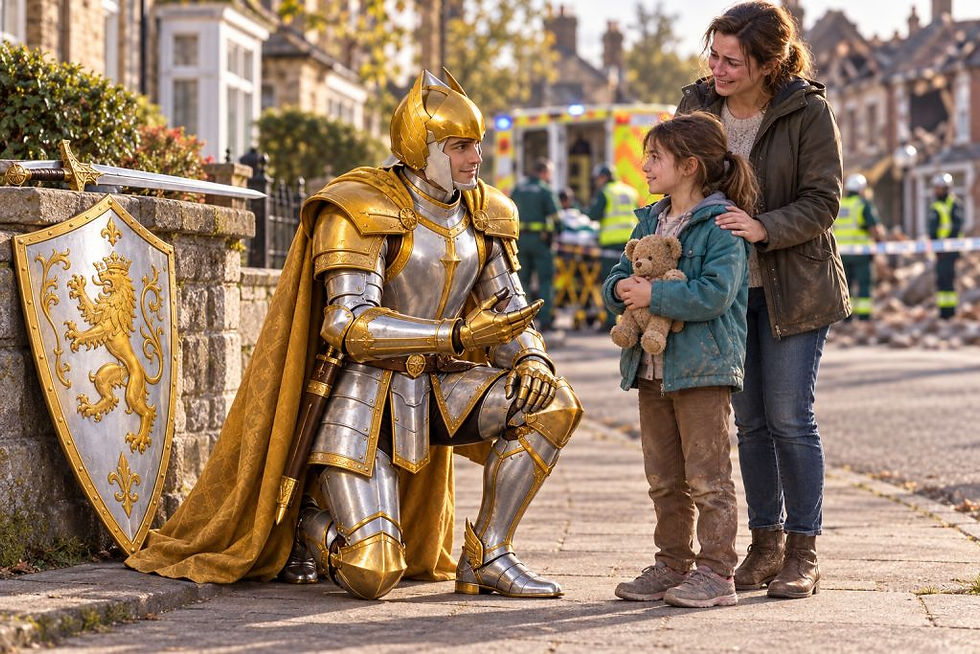
Arthur Mattocks has no established innate superhuman powers. His swordsmanship, coordination, judgment and practical knowledge are developed human abilities. Extraordinary protection, translation, magical detection and flight come from the equipment described below. Knights Arcanus training does not itself establish spellcasting.
Equipment
Excalibur — enchanted Saxon War Sword
Arthur carries the same sword used by the earlier numbered bearers. He initially accepted its Arthurian attribution; Samhain Knight later explained its Saxon identity. Excalibur remains its public name and the name of his mantle.
-
Unearthly material strength; attacks or magic capable of overcoming that strength remain consequential.
-
Drawing the blade manifests the core protective armor. A new wielder deliberately controlling an already drawn blade for six continuous seconds takes control of the manifestation.
-
Directional pull indicates nearby magical activity; it does not automatically identify spells, establish exact distance or reveal intent.
-
While actively wielded, it translates supported speech into English for the bearer and enables intelligible speech in the recipient's supported tongue.
Supported tongues include English, Welsh, Scots, Ulster Scots, Irish, Angloromani, Scottish Gaelic, Cornish, Portuguese, Spanish and Shelta, together with the historical labels Insular Celtic, Anglic, Nordic, Indic, Latin and Romanaic.
Enchanted scabbard
The scabbard stores the sword and participates in the armor system. Fully resheathing the blade dismisses the core armor, regardless of who performs the action. No established healing, immortality or protection against bleeding is provided.
Manifested armor
-
Amazing protection against arcane energy and psychic attacks.
-
Incredible protection against physical impact, force, heat, cold, radiation, other energy, chemicals, toxins and acids.
-
Excellent protection for vision and hearing.
-
Ordinary equipment damage repairs at one percent of full condition per minute while active, up to its original condition.
Only one core manifestation exists. A completed transfer of sword control dismisses the previous manifestation and forms it on the new wielder. Brief contact, dropping the sword or unconsciousness does not immediately dismiss the armor; full resheathing does. Independently worn clothing and equipment remain.
Protection has limits. Overwhelming attacks, sustained pressure, magical suppression and loss of artifact control remain dangerous. Equipment repair never heals Arthur. Damaged enchantments and destroyed magical anchors require specialist assessment.
Pridwen — enchanted shield, actual name Valiance
Arthur inherited the same physical shield as the earlier bearers. Its British attribution was corrected through Samhain's explanation.
-
Unearthly protection against heat, fire, cold, energy, magic and radiation.
-
Strong protection against physical, force, toxic and acidic attacks.
-
Ordinary damage repairs at one percent of full condition per minute, capped at original condition and subject to the same enchantment limitations as the armor.
-
Its reflective face can redirect light and assist deflection when positioning permits.
Protection depends on placement; the shield does not form an all-direction barrier or automatically reflect every attack. Its physical shape and lion design remain controlling. Any repainting is a visual decision, not a new artifact or altered protection.
Enchanted flight boots — gift of Samhain Knight
These are separate physical equipment acquired after Arthur's appointment and the Saxon revelation. Their small metal ankle wings are ornamentation on armored boots.
-
Amazing material strength and protection.
-
Levitation and flight up to 40 miles per hour.
-
Maximum established height: 400 feet above local ground level.
Sheathing the sword does not erase the boots or automatically end their enchantment. Their protection is localized to the equipment; it does not raise every rating of the core armor. No extra speed, healing, duration, passenger capacity or independent self-repair rate is established. Arthur did not possess these boots during the 2013 duel or at his initial appointment.
Support and limits
Independent communications and transport are mission-dependent. Arthur has no established enchanted mount or possession of the genuine Holy artifacts. His modern armor appearance does not upgrade the shared protection inherited from I–IV.
Talents
-
Swordsmanship
-
Mastery
-
Exceptional blade handling, timing, distance and controlled exchanges; demonstrated against Carrington.
-
-
Armored Knight Combat
-
Proficient
-
Competent integration of sword, shield and protective armor; broader experience continues to develop.
-
-
Jousting
-
Proficient
-
Trained mounted-lance technique and supervised tournament practice.
-
-
Medieval Combat
-
Professional
-
Practiced historical fighting methods, distinct from general military command.
-
-
-
Horsemanship
-
Professional
-
Skilled riding and horse handling; no magical steed established.
-
-
Acrobatics
-
Proficient
-
Balance, controlled movement and agility developed through practice.
-
-
Renaissance Faire and Entertainment Operations
-
Professional
-
Performances, demonstrations, instruction and practical event work.
-
-
Cooking
-
Proficient
-
Established meal preparation; no professional chef career added.
-
-
Knightly History and Lore
-
Professional
-
Knowledge of knightly traditions and their historical context; does not confer complete magical knowledge.
-
-
Medieval Armor and Weapons
-
Professional
-
Practical knowledge of historical equipment, handling and care.
-
-
Medieval Dance
-
Professional
-
Skilled performance of period dance.
-
-
Video Production
-
Proficient
-
Working production knowledge associated with Faire entertainment; Tom retains authorship of his own challenge recording.
-



Info
REAL NAME:
IDENTITY:
AFFILIATION:
REGISTERED?:
HOME:
RELATIVE AGE:
SERVICE AS EXCALIBUR:
MARITAL STATUS:
Carlton Carrington
Known
British / Former Hero; Excalibur appointment ended in disgrace
Recorded with MI6 as an Excalibur bearer
Windsor, United Kingdom
early 30s during 2013
10 Aug - 15 Dec 2013
Single
ALIAS(ES):
TEAM:
FIRST APPEARANCE:
APPEARANCE DATE:
CREATED BY:
CREATION DATE:
STATUS:
Sir Carrington, The Unworthy
None
N/A
N/A
Don "Major Deej" Finger
12 July 2011
Missing after the Faire confrontation; subsequent fate unknown
None identified
History
A champion selected by public demand
In 2013, a growing public campaign demanded the return of Excalibur. Britain already had superhuman defenders, including the Commonwealth, but supporters wanted a national champion carrying the legacy of Herbert Lancaster, Bartholomew Richards and Rory Cavendish. Frustration with political leadership turned the proposed appointment into a larger argument over who could be trusted to represent the country.
The postwar Excalibur Accord had restricted the artifacts to extraordinary emergencies. The 2013 settlement amended that framework to permit continuing protective service against exceptional threats. Parliament and the Crown retained their respective responsibilities for authorization and appointment; public nominations would inform the selection rather than transfer the office themselves.
Initial online nominations were chaotic. Serious candidates competed for attention with jokes, fictional figures and campaigns organized chiefly to provoke opponents. Sir Bernard Hastings, a House of Commons Civil Chairman, proposed a managed process in which the public could nominate candidates and vote through the Hastings Data Center. The arrangement appeared to offer a compromise between popular participation and official oversight.
After two months, the published results placed Carlton Carrington ahead of the remaining finalists. The announced result was accepted before the underlying manipulation was exposed.
The biography and the man
Carrington was a former British Army serviceman who had left the military in 2008. His promoted biography presented him as a former special-forces officer awarded the Conspicuous Gallantry Cross for classified operations in 2002. It also claimed years of dedicated sword training and work at the London Medieval Renaissance Faire between 2008 and 2011. These specialist and award claims were part of the public case for his selection; their repetition was not independent verification.
He presented himself as a man committed to becoming worthy of Rory Cavendish's legacy, emphasizing discipline, combat preparation and his Catholic faith. The combination of military credentials, patriotic language and an apparently decisive public vote made him an appealing choice to many supporters.
The selection process relied too heavily on the promoted record, curated demonstrations and the momentum of the public campaign.
Carrington's basic military competence did not establish that he possessed the swordsmanship, judgment or commitment required of Excalibur. Those distinctions received too little scrutiny before the office was conferred.
On 10 August 2013, Queen Elizabeth II knighted Carrington and appointed him Excalibur IV under the authorized program. The sword, shield and scabbard were released from secure custody. Drawing the blade manifested its armor; the equipment imposed no automatic test of his character.
Approximately two months of mandatory preparation followed. Carrington received combat instruction, government liaisons and a substantial support staff. Conservators assessed the relics, while other personnel organized transport, independent equipment and personal support. The magical armor was a manifestation, not a manufactured suit routinely rebuilt by designers. Increasing attention went to publicity, appearances and presentation.
A public figure without public service
During October and November, Carrington appeared at interviews, banquets, charities, sporting occasions and official events. His visibility grew, but evidence of protective service did not grow with it. When asked why he had performed so few heroic actions, he suggested that ordinary problems belonged to the police and that he should be reserved for a supervillain worthy of his attention.
The remark sharpened doubts about whether he understood the office. Two significant villainous incidents in November passed without his intervention. Supportive online accounts praised his restraint, while critics asked what Britain had gained beyond an expensive ceremonial celebrity.
The Virtual Corsairs then released documents exposing extensive use of false accounts and manipulated online activity associated with the selection and Carrington's promotion. Hastings rejected the allegations publicly. Denial did not settle the matter, and the gap between the official narrative and the available evidence became increasingly difficult to ignore.
Thatcher's challenge
In November, Tom Thatcher, a jouster, performer and video-maker at the London Medieval Renaissance Faire, challenged Carrington's claimed training record through Ya!Go! video. Thatcher and his fellow swordsman Arthur Mattocks had worked at the Faire during the years Carrington claimed to have trained there. Neither recognized him as a colleague or student.
Thatcher compared Carrington's public sword demonstrations with the techniques taught at the Faire and identified visible weaknesses. He proposed a supervised contest against Mattocks so that the public could assess Carrington's abilities directly. This challenge questioned a specific claimed background and demonstrated skill; it did not by itself prove that every part of his military biography was false.
The video spread widely. Supporters of the museum founded around the Excalibur legacy joined calls for accountability. By early December, protests outside royal and government locations, transport disruption and confrontations with police made the dispute a national crisis of confidence. Parliamentary proponents of the appointment pressed for the contest, expecting it to vindicate their choice.
The contest in the mud
On 15 December 2013, after heavy rain, Carrington arrived at the Faire with his entourage to face Arthur Mattocks. The contest was supervised under exhibition rules prohibiting lethal strikes, with officials, medical personnel and designated custodial staff present. Those safeguards could not make an enchanted sword harmless if its bearer deliberately violated the rules.
Mattocks won the first two rounds decisively. He remained courteous, offering pointers and assistance when Carrington fell. Carrington treated those gestures as humiliation. As the contest continued, his frustration gave way to abusive language and increasingly reckless attacks.
The differences were plain: Mattocks controlled distance, timing and his own temper; Carrington relied on the protection of his equipment and the expectation that his opponent should submit to his reputation. Thatcher's recording documented techniques inconsistent with Carrington's claimed Faire training.
Finally, Carrington attempted a potentially lethal strike outside the agreed rules. Mattocks avoided it and disarmed him of the sword and shield. His brief handling of the drawn blade did not complete the deliberate six-second transfer required to take control of its manifested armor. He immediately passed the recovered weapons to a designated custodian. Security personnel secured the scabbard, and full resheathing dismissed Carrington's armor.
The officials declared Carrington disqualified. Mattocks withdrew from the contest, but Carrington pursued him in further unarmed attempts to attack. Mattocks avoided the charges and left him in the mud. An angry crowd jeered and threw food and mud as recordings captured the collapse of Carrington's public image.
The man who disappeared
Carrington left the field in the ordinary clothing that remained beneath the dismissed manifestation and walked into nearby woodland. He was not seen again in the established account. His disappearance did not establish his death, a new identity or the cancellation of his knighthood through a separate legal process.
The sword, shield and scabbard returned to secure custody at Camelot. The defeated bearer did not retain them, and Mattocks' victory did not automatically make him their owner or the next Excalibur. Investigators still had to resolve the corrupted selection, while any successor would require lawful authorization, Crown appointment and a willingness to accept the duty.
Carrington became remembered as The Unworthy. The name described his conduct, not a supernatural verdict delivered by the sword. His tenure demonstrated how public acclaim and protective equipment could conceal failures of accountability until a direct test exposed them. The subsequent investigation and Arthur Mattocks' appointment belong to the story of Excalibur V.

Powers
Power Origin: Normal human.
Carlton Carrington had no established innate superhuman powers. His exceptional protection and magical functions came from the enchanted equipment. His trained human abilities remained distinct from his promoted credentials. Neither activation of the armor nor formal appointment certified his competence or moral worth.
Equipment
Excalibur — enchanted sword
Carrington believed the weapon to be Arthurian Excalibur. It was the enchanted Saxon War Sword, whose true identity was later explained during Arthur Mattocks' tenure. Carrington is not known to have learned that distinction.
-
Unearthly material strength; attacks or magic capable of overcoming that strength remain consequential.
-
Drawing the sword manifests the core armor around its wielder. A new wielder deliberately controlling an already drawn blade for six continuous seconds takes control of the manifestation.
-
Directional pull indicates nearby magical activity; it does not automatically identify spells, determine exact distance or reveal intent.
-
While actively wielded, the sword translates supported speech into English for the bearer and enables him to speak intelligibly in the recipient's supported tongue.
Supported tongues include English, Welsh, Scots, Ulster Scots, Irish, Angloromani, Scottish Gaelic, Cornish, Portuguese, Spanish and Shelta, together with the historical language labels Insular Celtic, Anglic, Nordic, Indic, Latin and Romanaic.
Enchanted scabbard
The scabbard stores the blade and participates in the armor system. Fully resheathing the sword dismisses the core armor, regardless of who performs the action. The scabbard does not provide established healing, immortality or protection against bleeding.
Manifested armor
-
Amazing protection against arcane energy and psychic attacks.
-
Incredible protection against physical impact, force, heat, cold, radiation, other energy, chemicals, toxins and acids.
-
Excellent protection for vision and hearing.
-
Ordinary equipment damage repairs at one percent of full condition per minute while the manifestation is active, up to its original condition.
Only one core armor manifestation exists at a time. Completing a transfer of sword control dismisses the previous manifestation and forms it on the new wielder. Brief contact does not transfer it. Dropping the blade or becoming unconscious does not immediately dismiss the armor; full resheathing does. Independently worn clothing remains when it disappears.
Protection has limits. Overwhelming attacks, sustained pressure, magical suppression and loss of artifact control can leave the bearer vulnerable. Self-repair restores equipment condition, never the bearer's health. Destroyed magical anchors or damaged enchantments require specialist assessment.
Pridwen — enchanted shield
Carrington knew the shield as Pridwen. Its actual name is Valiance.
-
Unearthly protection against heat, fire, cold, energy, magic and radiation.
-
Strong protection against physical, force, toxic and acidic attacks.
-
Ordinary damage repairs at one percent of full condition per minute, up to its original condition, subject to the same enchantment limitations as the armor.
-
The reflective face can redirect light and assist deflection when positioning permits.
Protection depends on placement. The shield does not produce an all-direction barrier or automatically reflect every attack. Protecting one approach can leave another exposed.
Operational equipment
Carrington used the same original sword, shield and scabbard inherited from the earlier bearers. Their established physical designs remain controlling. His manifested armor may adopt his own approved appearance without increasing its shared protective ratings.
He had no established enchanted flight boots, magical mount, separate healing artifact or innate spellcasting ability. Any independent communications, transport or field equipment was mission-dependent.
Talents
-
Swordsmanship
-
Proficient
-
Trained fundamentals; inadequate depth and control for the demands of the mantle or an opponent of Arthur's caliber.
-
-
Armored Knight Combat
-
Proficient
-
Basic sword, shield and armor use; unreliable integration and judgment under pressure.
-
-
Judo
-
Proficient
-
Established grappling fundamentals; does not guarantee success against a more skilled or composed opponent.
-
-
Military Hand-to-Hand Combat
-
Professional
-
Trained military close combat; impulsive pursuit after disqualification undermined its application.
-
-
Military Operations
-
Professional
-
Actual service experience, field procedures and coordinated operations; no verified special-forces qualification assigned here.
-
-
Demolitions
-
Proficient
-
Existing working explosives knowledge retained; no new operations or specialist history established.
-
-
Small-Arms and Rifle Marksmanship
-
Professional
-
Established firearms proficiency, separate from medieval weapons skill.
-
-
Religious History and Lore
-
Proficient
-
Working knowledge of religious traditions, including his stated Catholic background.
-


Info
REAL NAME:
IDENTITY:
AFFILIATION:
REGISTERED?:
HOME:
RELATIVE AGE:
SERVICE AS EXCALIBUR:
MARITAL STATUS:
DIED:
Rory Cavendish
Secret (then); known (now)
British / Hero; Scottish-born; Project: Pridwin
Recorded with MI6 as an Excalibur candidate and bearer
Scotland, United Kingdom
early 30s
January–17 August 2000
Single
17 Aug 2000
ALIAS(ES):
TEAM:
FIRST APPEARANCE:
APPEARANCE DATE:
CREATED BY:
CREATION DATE:
Sir Cavendish, Rory o' Pain
Knights Arcanus - wartime association
N/A
N/A
Don "Major Deej" Finger
12 July 2011
None identified
History
The candidate passed over
Rory Cavendish was a Scottish-born wrestler who had completed the training required to become Britain's next Excalibur. Under the postwar Excalibur Accord, the enchanted sword, shield and scabbard remained secured while a readiness program maintained trained candidates. MI6 coordinated preparations for their deployment through Project: Pridwin, to be activated when the Crown and Parliament authorized the mantle's return.
In December 1999, the leading candidate died after a rapidly developing illness first detected the previous month. The death placed Rory next in line. His fighting ability and preparation made him a strong successor, but some members of the House of Lords favored the aristocrat Sir Thomas Greene. Their objections to Rory reflected prejudice against his Scottish background and profession, dressed as concern over who should represent Britain.
On Christmas Eve, political pressure displaced Rory in favor of Greene. Rory was deeply hurt, but accepted the decision publicly and remained available to the program. He would not abandon the people the office existed to protect simply because he had been denied it.
An enemy inside the ceremony
In January 2000, the Soltan Star Empire invaded Earth to seize its resources and enslave humanity. Britain rapidly authorized reactivation under the Excalibur Accord. Project: Pridwin assembled the personnel needed to invest Greene with the office and release the artifacts for service.
Queen Elizabeth II and the appointment party were escorted to the fortified facility beneath the Tower of London. A Scottish MI6 supervisor included Rory both in recognition of his treatment and because an additional trained defender was valuable during the emergency. Rory agreed to assist with the sovereign's protection.
As the party descended toward the bunker, magical security wards sounded an alarm indicating a nonhuman presence. The wards had been restored after recharging earlier than the escort's briefing indicated. Priory personnel confirmed that the warning was genuine, but the system could not identify the person responsible. Guards placed the Queen under close protection and held the party in the secured chamber while the threat was assessed.
Greene urged them to complete his appointment, arguing that an equipped Excalibur could resolve the danger. Rory instead watched the people around him. In the heat and tension, Greene was behaving differently from the man Rory knew through repeated training sessions. In particular, the normally heavy perspiration Rory remembered was absent. It was a reason for suspicion, and Rory looked for a way to test it without provoking an immediate attack on the Queen.
He interrupted the proceedings with a fabricated recollection: Greene had once requested a particular Bible passage in honor of his mother for this ceremony. The man posing as Greene claimed to remember the conversation, then asked Rory for the verse. Rory supplied Galatians 2:4, a passage warning of false brethren entering secretly to spy and bring others into bondage.
The Queen and clergy understood the warning. Combined with the active ward alarm and the false recollection, Greene's response justified immediate detention. When the guards moved to secure him, he attacked. His physical disguise was torn away in the fighting, exposing a Soltan infiltrator.
Taking up Excalibur
The close-quarters battle killed most of the guards and agents present. Rory fought to keep the attacker from reaching the Queen, then reached the sword and drew it from its scabbard. Protective armor manifested around him and absorbed a blow that would otherwise have killed him. Rory counterattacked with the enchanted blade and killed the infiltrator.
The survivors included Rory, the Queen, two priory clergymen and one MI6 agent. Reinforcements arrived as Rory checked the sovereign's condition. Recognizing his judgment and courage, Elizabeth II knighted him with a separate ceremonial sword and appointed him Excalibur. His immediate defensive use of the equipment had been an emergency act; the appointment now made him its authorized bearer.
Sir Cavendish promised to defend the United Kingdom and departed with the sword, shield and scabbard. The Queen was moved to another protected location as the attack on London intensified.
Later investigation established that the infiltrator intended to seize the artifacts and murder the sovereign. He had caused the leading candidate's fatal illness and manipulated the selection process. Greene's limited close personal connections had made him easier to replace without familiar people noticing the deception. The real Sir Thomas Greene had been murdered; his remains were subsequently recovered and given a proper funeral.
Britain's invasion knight
For the following months, Rory fought alongside military personnel, civilian resistance forces and Earth's superhuman defenders. He also cooperated with groups whose ordinary allegiances were set aside against the invasion. His wartime association with the Knights Arcanus placed him among defenders confronting both military and magical threats.
Rory's reputation grew through sustained service under exhausting conditions. He fought through ruined districts and contested positions while remaining attentive to people whose losses could not be repaired by a battlefield victory. In brief periods of rest, he wrote encouragement to children who had lost their parents, devastated families and the Queen herself.
The candidate once dismissed as an unsuitable national symbol became a champion whose Scottish identity and British duty belonged naturally together. His determination was measured in the people he defended and the trust he earned.
The final battle at Greenwich
On 17 August 2000, Rory joined the Knights Arcanus in an assault on a Soltan magical siphoning tower at Greenwich. The installation was part of a wider network draining Earth's magical resources. Its continued operation threatened consequences extending far beyond the immediate battlefield. The defenders had to penetrate the site and place mystical charges to destroy it.
During the final push, a super-powered Soltan commander threatened Samhain Knight with a killing strike. Rory intervened. With his shield committed against another attack, he placed himself between the commander and Samhain. The strike exceeded the armor's protection and inflicted fatal injuries. His equipment could repair its own damage, but it could not heal him.
The Knights Arcanus killed the commander and recovered Rory's body and the bodies of other fallen defenders before detonating the charges. The tower imploded. Rory's sword, shield and scabbard were recovered with him and entrusted to designated British custodians.
A legacy beyond the sword
Rory was buried on the grounds of the battle-damaged Excalibur Museum in Yorkshire. Samhain Knight placed a simple memorial honoring him as Britain's greatest knight and urging others to aspire to the worth of his sacrifice.
After the invasion ended, citizens and leaders from around the world visited his grave. The rebuilt institution became the Excalibur Memorial and Museum, preserving the history of the mantle and honoring its deceased bearers. Where their remains could be recovered, earlier bearers were reinterred on its grounds. Flowers and personal remembrances continued to mark Rory's resting place.
The museum's displayed weapons were reproductions or the substitute equipment associated with Excalibur II. The enchanted originals remained under secure government custody. Because the Tower facility had been compromised during the invasion, they were transferred to Camelot, a British G.U.A.R.D. installation, and held under the Accord until another authorized bearer was appointed.
Rory had entered the crisis as the man passed over. He left a legacy grounded in the judgment that exposed an infiltrator, the endurance that carried him through the invasion and the final decision to protect another person at the cost of his life.
Excalibur III Memorial Gravestone
Here lies
Sir Rory Cavendish
EXCALIBUR
Died: 17 August 2000
The Greatest Knight of Great Britain.
He is your champion. He is our hero.
May we all aspire to one day
be worthy of his sacrifice.

Powers
Power Origin: Normal human.
Rory Cavendish had no established innate superhuman powers. His extraordinary protection and magical functions came from his enchanted equipment. His physical conditioning, combat skill and observational judgment were developed human abilities.
Equipment
Excalibur — enchanted sword
Rory believed the weapon to be Arthurian Excalibur. It was the enchanted Saxon War Sword, whose true identity was later explained during Arthur Mattocks' tenure. Rory is not known to have learned that distinction.
-
Unearthly material strength; attacks or magic capable of overcoming that strength remain consequential.
-
Drawing the sword manifests the core armor around its wielder. A new wielder deliberately controlling an already drawn blade for six continuous seconds takes control of the manifestation.
-
Directional pull indicates nearby magical activity; it does not automatically identify spells, determine exact distance or reveal intent.
-
While actively wielded, the sword translates supported speech into English for the bearer and enables him to speak intelligibly in the recipient's supported tongue.
Supported tongues include English, Welsh, Scots, Ulster Scots, Irish, Angloromani, Scottish Gaelic, Cornish, Portuguese, Spanish and Shelta, together with the historical language labels Insular Celtic, Anglic, Nordic, Indic, Latin and Romanaic.
Enchanted scabbard
The scabbard stores the blade and participates in the armor system. Fully resheathing the sword dismisses the core armor, regardless of who performs the action. The scabbard does not provide established healing, immortality or protection against bleeding.
Manifested armor
-
Amazing protection against arcane energy and psychic attacks.
-
Incredible protection against physical impact, force, heat, cold, radiation, other energy, chemicals, toxins and acids.
-
Excellent protection for vision and hearing.
-
Ordinary equipment damage repairs at one percent of full condition per minute while the manifestation is active, up to its original condition.
Only one core armor manifestation exists at a time. Completing a transfer of sword control dismisses the previous manifestation and forms it on the new wielder. Brief contact does not transfer it. Dropping the blade or becoming unconscious does not immediately dismiss the armor; full resheathing does. Independently worn clothing remains when it disappears.
Protection has limits. Overwhelming attacks, sustained pressure, magical suppression and loss of artifact control can leave the bearer vulnerable. Self-repair restores equipment condition, never the bearer's health. Destroyed magical anchors or damaged enchantments require specialist assessment.
Pridwen — enchanted shield
Rory knew the shield as Pridwen. Its actual name is Valiance.
-
Unearthly protection against heat, fire, cold, energy, magic and radiation.
-
Strong protection against physical, force, toxic and acidic attacks.
-
Ordinary damage repairs at one percent of full condition per minute, up to its original condition, subject to the same enchantment limitations as the armor.
-
The reflective face can redirect light and assist deflection when positioning permits.
Protection depends on placement. The shield does not produce an all-direction barrier or automatically reflect every attack. Protecting one approach can leave another exposed.
Operational equipment
Rory used the same original sword, shield and scabbard inherited from the earlier bearers. Their established physical designs remain controlling. His manifested armor may adopt his own approved appearance without increasing its shared protective ratings.
He had no established enchanted flight boots, magical mount, separate healing artifact or innate spellcasting ability. Any independent communications, transport or field equipment was mission-dependent.
Talents
-
Swordsmanship
-
Mastery
-
Expert blade handling, timing and sustained combat with Excalibur.
-
-
Military Operations
-
Professional
-
Tactical discipline, coordinated operations and field procedures.
-
-
Armored Knight Combat
-
Mastery
-
Integrated sword-and-shield fighting and use of manifested protection.
-
-
Wrestling
-
Professional
-
Grappling, balance, leverage and close-quarters control.
-
-
Medieval History and Lore
-
Proficient
-
Working knowledge relevant to the mantle and its accepted traditions.
-
-
Business
-
Proficient
-
Practical understanding of business activity and administration.
-


Info
REAL NAME:
IDENTITY:
AFFILIATION:
REGISTERED?:
RELATIVE AGE:
MARITAL STATUS:
DIED:
Bartholomew Richards
Secret (then); known (now)
British/Hero
N/A
WWII: late 20s
Single
1980
ALIAS(ES):
TEAM:
FIRST APPEARANCE:
APPEARANCE DATE:
CREATED BY:
CREATION DATE:
None identified

History
In 1938, Great Britain saw the unmitigated Nazi Germany expansion across the Czechoslovakian territory and its neighboring nations. Adolph Hitler was quickly assimilating nations into his Nazi empire without even having to fire a shot. Great Britain knew it was only a matter of time before they would be embroiled in another conflict with Germany. As such, the same Parliament leaders that initiated "Project: Excalibur" in World War I set forth to perform the same action yet again, this time called "Project: Camelot".
Once again, a powerful yet secretive recruitment program was performed. As part of the stipulations of the recruitment, the 'candidates' were not allowed to be married NOR were they allowed to get married so long as they remained on the project, which was projected to be at least 10 years in duration. These stipulations unto themselves, thinned out the candidates drastically. In the end, British Army Captain Bartholomew Richards of Yorkshire, England was selected.
After being knighted and trained in the use of the sword and shield, as well as receiving a new suit of armor that deflected even high caliber machine gun bullets, "Sir Bart" as his team unofficially called him, was cast upon the rocky shoals of British military operations upon the start of World War II. In his seven years of being "Excalibur", Sir Bart engaged in hundreds of battles, skirmishes and assaults. He was transferred and/or reassigned to over 2 dozen infantry, special forces, commando and even MI-6 units during the duration of the war. He was a highly documented hero who primarily ran with British troops and regulars. At least several instances occurred where Excalibur was tasked to work with the American superhero group, the Allied Fighters, where he did so to great aplomb, even so much as receiving American, French, and Maltan medals and citations for his actions as recommended by the Allied Fighters leader, Captain John Brown AKA "Captain Invader".
During one particular battle in 1944, Sir Bart was captured by Nazi troops. He was questioned and tortured for a month by Nazi SS Division interrogators until a specialized rescue unit comprised of American and British special forces and the Allied Fighters extracted Sir Bart in a bloody rescue effort. Over 20 special forces troops lost their lives in the rescue, as well as one of the Allied Fighters' heroes. As such, Sir Bart was placed on medical leave for the rest of 1944 until his wounds were healed and a proper psychological recovery was performed. The sad part of this whole episode is that "Excalibur", its sheath and "Pridwin" were still in Nazi hands. The legendary Arthurian weapons were given to Baron Berlin, the leader of Nazi Germany's super-powered team, Axis Force. Baron Berlin decided to place them with an Axis Force master swordsman and SS Captain Friedrick Fausbaum AKA the Teutonic Knight. In January 1945, Sir Bart was released from the hospital.
The British government created makeshift versions of Excalibur and Pridwin for him to use, preventing the UK and the world from believing the Nazi rhetoric that the Excalibur sword was being used by the Teutonic Knight instead. Sir Bart joined the Allied Fighters a month after his release in a successful recovery of the Arthurian weapons from the Teutonic Knight in a brilliantly orchestrated operation led by Captain Invader himself; an operation that left Teutonic Knight close to death before the team was able to retreat back to Great Britain. Sir Bart has his weapon, sheath and shield back, as well as a new unshakable confidence in an inevitable Allied victory over Nazi Germany.
For the rest of the war, Sir Bart fought bravely and relentlessly against the Nazi aggressors, taking the fight to the city's edge of Berlin itself. In the end however, Sir Bart and his team were recalled back to London, where from that time forward, Excalibur, the sword's sheath and the Pridwin shield would be under the authority of British Intelligence, MI-6. Sadly, Sir Bart sat out the last month of the war in a secretive MI-6 base, ill-utilized and relatively ignored. It is believed that the reasoning for Sir Bart's 'sidelining' had something to do with a critical encounter with MI-6's director and a young mutant superhero known as the Irish Fighter, wherein the MI-6 director remained hospitalized for months after the war's end as a result of an 'argument' with the young Irish Fighter. Although the Americans consistently requested for Sir Bart to join them to finish the Imperial Japanese forces in the Pacific Campaign, England refused to release Sir Bart ever again to war, even though Sir Bart himself pleaded to go and help his friends.
Again, sadly, the British government decided to put the sword, sheath and shield away at war's end. It was placed back in the Priory under the Tower of London, which now soon thereafter became a nuclear-proof bunker by 1950. Sir Bart, now in retirement from being Excalibur, was showered with accolades, medals, honors, titles and property. He was treated as a legend and a true knight of the realm by the media, the Crown, Parliament and the Church of England. Over time, Bart's net worth was over 3 million Pounds (value comparison: equivalent to $15 million in 2015 US dollars). His vast estate in Yorkshire, England was a gift by a fellow nobleman and the Crown.
Sadly, Bart never married. He was known to have many lady 'admirers' over the decades, though. When Bart died in 1980, half his worth was to be equally distributed to the Crown, the Church of England and to the orphanages of England. His will requested that his Yorkshire estate be divided into parcels for homes for WWII disabled veterans and that over 200 acres of that land be made into a museum and learning center with the theme of a what was considered to be a true knight of the realm, as outlined in the 1981 posthumously published book he'd (partially) written back in the 1970s called "The Excalibur Knighthood". Of course MI-6 doctored portions of Bart's writings, hiding the events where the Teutonic Knight had the Arthurian weapons, stating that the weapons were always in Sir Bart's custody throughout the entire war. To allay public suspicion, the makeshift sword and shield forged when "Excalibur" and "Pridwin" were stolen by the Teutonic Knight were placed on display (even to this day) at the museum and were "officially" designated as THE sword and shield that Sir Bart used throughout all of World War II.
The real "Excalibur", its sheath or "Pridwin" remained secretly housed in the Tower of London's Priory location, now unofficially dubbed as the "Excalibur Bunker". The British Government, predominantly MI-6, secretly insisted that "Excalibur", the sword's sheath and "Pridwin" should be used again in such rough-shot situations such that led to the Teutonic Knight seizing the Arthurian weapons. The Allied deaths performed by Teutonic Knight as he wielded Excalibur were a massive embarrassment for British military and officials, and as such, it was deemed necessary that Britain would never again allow its most cherished legendary artifacts to fall into the hands of the enemy.
Thus was drafted the "Excalibur Accord".
The Excalibur Accord allotted that only a solid vote of 'aye' by the majority of each major component of Parliament of the United Kingdom (The Crown (Queen-in-Parliament), The House of Lords and the House of Commons) would ever allow for these considerably powerful (and holy) legendary artifacts to ever be used in war again. It was agreed by Parliament that only a massive national wartime crisis or world-shattering situation would be the only cause by which the sword, sheath and shield could ever be utilized again.
That crisis occurred in 2000 A.D. when the alien Soltan Star Empire invaded Earth.

Powers
-
Swordsman (Master)
-
Military (Professional)
-
Combat - Knight (Master)
-
Boxing (Proficient)
-
Marksman (Proficient)
-
Medieval History/Lore (Proficient)
-
Finance (proficient)
Equipment
-
Swordsman (Master)
-
Military (Professional)
-
Combat - Knight (Master)
-
Boxing (Proficient)
-
Marksman (Proficient)
-
Medieval History/Lore (Proficient)
-
Finance (proficient)

Talents
-
Swordsman (Master)
-
Military (Professional)
-
Combat - Knight (Master)
-
Boxing (Proficient)
-
Marksman (Proficient)
-
Medieval History/Lore (Proficient)
-
Finance (proficient)


Info
REAL NAME:
IDENTITY:
AFFILIATION:
REGISTERED?:
HOME:
RELATIVE AGE:
MARITAL STATUS:
DIED:
ALIAS(ES):
TEAM:
FIRST APPEARANCE:
APPEARANCE DATE:
CREATED BY:
CREATION DATE:
Herbert Lancaster
Secret during service; subsequently known (now)
British / Hero; British Regular Army
N/A
Yorkshire, England, UK
late 20s
Married (11 April 1918)
12 April 1918
Sir Lawrence
None
N/A
N/A
Don "Major Deej" Finger
12 July 2011
Anne (Raleigh) Lancaster (wife, deceased)

History
Herbert Lancaster was a British Regular Army lieutenant from Yorkshire when Britain entered the Great War on 4 August 1914. Within a week, selected government officials instructed the concealed priory beneath the Tower of London to prepare its guarded sword, shield and scabbard for wartime use. The artifacts were believed to be Excalibur and Pridwen, the legendary weapons of King Arthur. The program to appoint their bearer became Project: Excalibur.
Lancaster was one of dozens of candidates drawn from across Britain. Interviews examined their judgment, discipline and commitment to service, while practical trials tested their physical readiness and fighting skills. After successive elimination rounds, three finalists competed for the appointment. Lancaster emerged as the selected bearer.
Initial briefings introduced him to the responsibility attached to the weapons. He was then brought to the Tower's secret priory, where King George V formally knighted him in a private ceremony attended by designated custodians and government representatives. The Crown conferred the knightly office; the wartime program arranged his training and deployment.
Two months of intensive instruction followed. Lancaster learned to fight with the enchanted sword and shield, manage the armor's manifestation and protect himself without assuming the equipment made him invulnerable. By late 1914, he was ready for deployment to the front.
His official operational alias was Sir Lawrence. At first, soldiers regarded the armored knight and his seemingly antiquated sword with skepticism. Many assumed he was a royal publicity stunt with little place in a war of rifles, artillery and entrenched positions. Experience changed their opinion. When desperate operations required a protected fighter to advance where ordinary troops could not, Lancaster demonstrated the practical value of his equipment and training. The soldiers began calling him Excalibur. Their name for him endured.
During limited, officially arranged recruiting appearances, Lancaster stood beside illustrated posters encouraging men to join the British Army. These events introduced civilians to Excalibur while his personal identity and operational assignments remained protected. Publicity artwork circulated more widely than photographs of the bearer himself.
Between 1915 and 1918, Lancaster took part in more than one hundred battles and engagements. His deployment remained controlled, often reserved for attacks in which failure carried grave consequences. Accounts of his actions spread chiefly through soldiers' recollections. The surviving visual record was small: ten grainy photographs and three brief motion-picture segments, approximately fifteen seconds each. These were secured at the Tower of London rather than released for general circulation.
War also sharpened Lancaster's wish for a life beyond his assignment. In 1918, his relationship with his childhood sweetheart, Anne Raleigh, became a commitment to marriage. Officials associated with Parliament and the priory urged him to postpone the wedding until the war's end, arguing that the personal obligations of the bearer required further consideration. Herbert refused to leave his future with Anne indefinitely subject to their deliberations.
Herbert and Anne married on 11 April 1918. Before taking leave, he voluntarily returned the sword, shield and scabbard to the Tower's priory. The arrangement was temporary: the artifacts would remain secured while the couple spent their honeymoon together, and Lancaster intended to resume service afterward. With the sword sheathed and left behind, its manifested armor afforded him no protection.
On the night of 12 April 1918, during their honeymoon in the Midlands, bombs dropped by a German airship displaced from its intended course killed both Herbert and Anne. The weapons survived in London. Their bearer never returned to claim them.
The custodians began considering a replacement, but no successor completed appointment before the war ended in November. The equipment returned to inactive custody. Preparations for another bearer would begin in 1938; Bartholomew Richards would enter wartime service as Excalibur II in 1939.
Lancaster established the modern Excalibur mantle through service under conditions no medieval legend could have anticipated. His story also exposed the personal cost of an office that expected its bearer to remain continually available. He had chosen to protect his fellow soldiers, and he had chosen a future with Anne. His death left both commitments unfinished, while the name given to him by the troops became a legacy carried by those who followed.

Powers
Power Origin: Normal human.
Herbert Lancaster had no established innate superhuman powers. His extraordinary protection and magical functions came from the sword, scabbard, shield and manifested armor described below. His combat abilities depended on training and experience.

Equipment
Excalibur — enchanted sword
Lancaster and his custodians believed the weapon to be Arthurian Excalibur. It was, in fact, the enchanted Saxon War Sword later identified during Arthur Mattocks’ tenure. Herbert did not learn that distinction during his lifetime.
-
Unearthly material strength; sufficiently powerful attacks or magic can still overcome it.
-
Drawing the sword manifests the core protective armor. A new wielder deliberately controlling an already drawn blade for six continuous seconds takes control of the manifestation.
-
The blade provides a directional pull toward nearby magical activity. This does not automatically identify a spell, reveal intentions or establish exact distance.
-
While actively wielded, its established translation effect lets the bearer hear supported speech in English and speak intelligibly to the recipient in the corresponding supported tongue.
The legacy translation list is English, Welsh, Scots, Ulster Scots, Irish, Angloromani, Scottish Gaelic, Cornish, Portuguese, Spanish and Shelta, with the historical labels Insular Celtic, Anglic, Nordic, Indic, Latin and Romanaic.
Enchanted scabbard
The scabbard stores the sword and participates in the armor system. Fully resheathing the blade dismisses the core armor, regardless of who sheathes it. No healing, immortality or protection against bleeding is established.
Manifested armor
-
Amazing protection against arcane energy and psychic attacks.
-
Incredible protection against physical impact, force, heat, cold, radiation, other energy, chemicals, toxins and acids.
-
Excellent protection for vision and hearing.
-
Repairs ordinary equipment damage at one percent of full condition per minute while active, up to its original condition.
Only one core armor manifestation can exist at a time. A completed transfer of sword control ends the previous manifestation and forms it on the new wielder. A brief touch does not transfer it. Losing or dropping the blade does not immediately dismiss the armor, and unconsciousness alone does not end it. Full resheathing does.
Protection is resistance, not immunity. Overwhelming attacks, sustained pressure, magical suppression and loss of control over the artifacts remain dangerous. Equipment repair does not heal Herbert; damaged enchantments or destroyed magical anchors require specialist assessment. His independent clothing remains when the armor disappears.
Pridwen — enchanted shield
Known publicly and to Lancaster as Pridwen, the shield's actual name is Valiance.
-
Unearthly protection against heat, fire, cold, energy, magic and radiation.
-
Strong protection against physical, force, toxic and acidic attacks.
-
Repairs ordinary damage at one percent of full condition per minute, capped at its original condition and subject to the same enchantment limitations as the armor.
-
Its reflective face can redirect light and help deflect attacks when correctly positioned.
The shield protects the area it covers. It does not generate an all-direction barrier or automatically reflect every incoming attack.
Era limitations
Lancaster had no enchanted flight boots. No separate enchanted mount, healing artifact, energy attack or additional magical weapon is established. Any independently worn WWI equipment is mission oriented in nature.

Talents
-
Swordsmanship
-
Professional
-
Practical blade handling and combat with Excalibur.
-
-
Military Operations
-
Professional
-
British Army discipline, field procedures and coordinated operations.
-
-
Armored Knight Combat
-
Professional
-
Fighting with sword, shield and manifested protection.
-
-
Boxing
-
Professional
-
Trained unarmed striking and close combat.
-
-
Marksmanship
-
Proficient
-
Competent use of period service firearms.
-
-
Medieval History and Lore
-
Proficient
-
Working knowledge relevant to his assigned knightly role.
-
-
Athletics
-
Proficient
-
Conditioning, movement and physical readiness for field service.
-