
A Universe of Pure Imagination

TM


INFO
NUMBER OF JOKERS:
CLASSIFICATION:
IDENTITIES:
AFFILIATION:
REGISTERED?:
RELATIVE AGE:
MARITAL STATUS:
Over 100 per region
Masked criminal mercenary corps; regional covert-action and terror-enforcement units
Secret
Regional/Villain
No
19-35
Single (Required)
ALIAS(ES):
CURRENT TEAM:
FIRST APPEARANCE:
APPEARANCE DATE:
CREATED BY:
CREATION DATE:
Joker Crews; Wild Cards; Laughing Men; Bruno’s Masks
NA
NA
Don "Major Deej" Finger
7 Feb 2020
CHARACTER AND GROUP SUMMARY
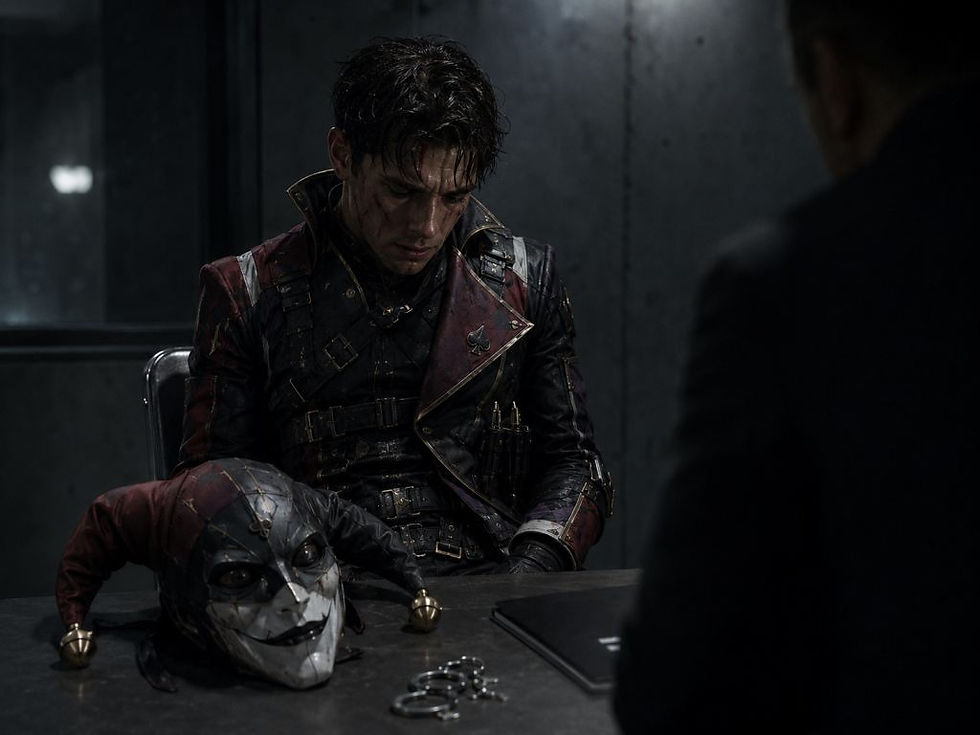
The Wild Jokers are the Blackjacks’ masked theater of violence. They are not a random gang of lunatics, but a compartmentalized mercenary corps trained to make organized crime look like madness. Their costumes, voices, movements, and apparent instability are all tools designed to terrify witnesses, confuse investigators, conceal identities, and distance the Blackjacks from their actions.
Each Joker is a trained criminal performer with a practical field specialty. One may be a sniper, another a burglar, another an acrobat, another an explosives technician. Their shared training allows them to operate in small cells, combine into larger packs, and adapt quickly to unusual assignments. Their unpredictability is partly genuine, but most of it is rehearsed.
The Wild Jokers are feared because they do not behave like ordinary enforcers. They may turn a collection into a staged game, a robbery into a performance, or an assassination into a spectacle recorded for later intimidation. The madness disguises planning. The humor disguises cruelty. The mask allows the person beneath it to pretend the crime belonged to someone else.
Within the Blackjacks, Wild Jokers occupy the lowest recognizable field tier but remain one of the organization’s most useful assets. They perform the jobs that must be visible enough to frighten people, yet disconnected enough to protect Bruno. They are disposable, deniable, and dangerous—and every one of them knows that if they betray the Blackjacks, King of Spades may be sent to collect the mask.

HISTORY
The Need for Disposable Violence
As Blackjack Bruno’s gambling empire expanded, so did the number of problems that could not be solved through ordinary collection work or conventional casino security. Street gangs were unreliable, professional assassins were expensive, and uniformed security personnel were too closely tied to the properties they were meant to protect. Bruno needed operatives who could be sent into hostile territory, terrify a target, damage a rival, recover an asset, and disappear without leaving a clear path back to the Blackjacks.
His first answer was a small masked enforcement unit assembled from violent debt collectors, former casino-security personnel, thieves, stunt performers, and criminal entertainers. Their costumes were deliberately excessive, their behavior theatrical, and their statements wildly inconsistent whenever one of them was captured. They laughed at the wrong moments, argued with people who were not there, changed accents in the middle of a sentence, and claimed afterward that they had been drugged, possessed, hypnotized, or controlled by someone else.
The confusion worked better than Bruno expected.
Witnesses remembered the masks and the laughter, but not the escape vehicle. Investigators focused on the bizarre behavior and missed the disciplined timing behind it. Early reports described the attackers as cultists, terrorists, mentally unstable criminals, performance artists, or victims of metahuman coercion. By the time law-enforcement agencies began to recognize a common pattern, Bruno had already expanded the concept into several regions.
The Wild Jokers had arrived.
The First Wild Deck
The earliest Wild Jokers were not trained simply to commit crimes. They were trained to make organized crime appear irrational.
A robbery might begin with one Joker singing while another announced the rules of an imaginary game show. During an abduction, a crew might stage an argument about which victim was “real,” forcing witnesses to focus on the performance instead of the vehicle waiting outside. Some left misleading symbols behind. Others recorded false confessions, delivered threats in nursery-rhyme form, or claimed to be speaking for invisible masters.
The spectacle was not random. It was camouflage.
Underneath every laugh, countdown, and dramatic gesture was a working plan. The crews followed escape routes, target priorities, communication signals, evidence-control procedures, and strict deadlines. The insanity was rehearsed until it could be maintained during gunfire, injury, pursuit, and interrogation.
Bruno realized that the apparent madness gave the Blackjacks several advantages at once. It frightened targets, confused witnesses, concealed identities, disrupted police profiling, and made captured operatives easier to portray as unwilling participants. The stories told after an arrest were intentionally contradictory. One Joker might claim possession while another blamed experimental drugs and a third insisted that the costume itself had controlled them.
The goal was not always acquittal. Sometimes delay was enough.
A delayed prosecution gave Blackjacks lawyers time to intervene. It gave corrupt officials time to misplace evidence, witnesses time to change their statements, and regional operatives time to arrange a transfer, escape, or identity replacement. Even when the story was not believed, it forced investigators to spend time disproving it.
That time belonged to Bruno.
Actors Playing Monsters
The Wild Jokers became feared because they looked uncontrolled while operating with discipline.
They might scream, dance, joke, or speak to an imaginary audience, but the performance never replaced the mission. A crew could appear to be descending into chaos while quietly moving a target toward a preselected exit. A Joker might deliver a rambling threat that concealed a command signal to the rest of the cell. A sudden argument could cover the placement of explosives. A burst of laughter might mark the moment a getaway vehicle had arrived.
Different crews developed different styles. Some operated in complete silence, using exaggerated pantomime to unsettle everyone around them. Others adopted the language of game-show hosts, false prophets, courtroom judges, or children reciting rhymes. A few imitated horror films or turned each operation into a mock card game in which the victims were assigned roles they did not understand.
The performance was considered successful when the witnesses remembered the spectacle more clearly than the crime.
That distinction became the heart of Wild Joker doctrine. Their greatest weapon was not insanity, but misdirection. They taught everyone watching to focus on the wrong thing.
The Blackjacks’ Dirty Hands
The Wild Jokers soon became responsible for the work Bruno did not want associated with his casinos, his senior lieutenants, or his more disciplined enforcement divisions. They sabotaged rival gambling houses, kidnapped debtors, intimidated witnesses, recovered stolen money, destroyed evidence, planted false leads, burned facilities, attacked criminal competitors, and carried out public acts of violence designed to spread fear far beyond the immediate target.
Their brutality was often disproportionate because the story of an operation mattered almost as much as the result. A debtor who quietly disappeared frightened one family. A debtor dragged from a private club by masked lunatics while cameras recorded every second frightened an entire district.
Bruno understood the value of reputation. He wanted people to hear that the Wild Jokers had been sent. He wanted the masks to become a warning before the first weapon was drawn. Fear reduced resistance, and reduced resistance made later collections easier.
Even so, the Blackjacks did not reward pointless destruction. A Joker who killed someone valuable, destroyed recoverable property, attracted unnecessary heroic attention, or violated a protected status could be disciplined severely. Bruno had no moral objection to cruelty, but he did object to waste.
Useful terror was an investment.
Uncontrolled slaughter was bad business.
Rivals Within the House
The creation of Jack of Clubs’ disciplined enforcement structure produced immediate tension.
Jack’s Clubs Division viewed the Wild Jokers as wasteful, theatrical, difficult to control, and too fond of collateral damage. Jack believed that violence should complete a transaction, not become a performance for its own sake. His personnel preferred clear warnings, controlled force, and recoverable assets.
The Wild Jokers saw the Clubs Division as rigid, humorless, and self-important. They mocked Jack’s rules and treated his collectors as men who had mistaken predictability for professionalism.
Bruno encouraged the rivalry as long as it remained useful. Jack’s people were sent when payment, security, recovery, or control mattered most. The Wild Jokers were sent when confusion, humiliation, deniability, and fear were more valuable than restraint.
Both groups served the same empire.
They simply represented different faces of it.
The Decks Spread
As the Blackjacks moved into new regions, the Wild Joker system expanded with them. Training became more standardized, but local crews adapted to the environments in which they operated.
European Decks became known for infiltration, safecracking, surveillance, and access to historic or heavily protected sites. North American crews developed a reputation for firearms, vehicle pursuits, casino raids, explosives, and public spectacle. South American cells became skilled in smuggling, kidnapping, river movement, rural operations, and improvised devices. Asian Decks excelled at dense urban movement, technical intrusion, electronics, surveillance, and precision theft. African and Middle Eastern crews adapted to desert routes, remote facilities, convoy attacks, weapons trafficking, and difficult extractions.
These differences were tendencies rather than fixed rules. Bruno frequently reassigned operatives between regions to break recognizable patterns and prevent investigators from developing reliable profiles. A crew trained in one environment might suddenly appear thousands of miles away using unfamiliar equipment and a completely different performance style.
No two Decks were meant to look identical.
That inconsistency was part of the design.
Smile for the Camera
Recording became central to Wild Joker operations.
Cameras built into masks, hidden microphones, portable recorders, and remote devices captured target reactions, property access, security weaknesses, confessions, combat performance, and proof that assignments had been completed. Some footage was used to train new recruits. Some was edited into threats and sent to future targets. Some was cut into misleading propaganda intended to confuse investigators or damage a rival’s reputation.
Much of it was retained by Bruno.
Every Wild Joker understood that the Blackjacks might possess a complete record of their crimes, failures, private remarks, and moments of disobedience. The same footage that proved mission success could later become evidence against the operative who created it.
The cameras did not merely document the performance.
They enforced loyalty.
Capture, Rescue, and Abandonment
One of the most carefully maintained myths among new recruits was that Blackjack Bruno always protected his people.
The truth was less comforting.
Bruno rescued valuable operatives. A veteran with rare technical skills might receive legal intervention, bribed testimony, altered records, a prison transfer, or an engineered escape. A Face Joker with sensitive information might disappear from custody before formal charges were filed. A highly useful specialist could be given a new identity and reassigned to another region.
Less valuable Jokers were not always so fortunate.
A failed recruit with limited knowledge might be abandoned. An operative who had violated orders could be left in prison as an example. Someone whose rescue would expose too much of the organization might be discredited, silenced, or permanently removed from consideration.
High-ranking Jokers understood this calculation.
New recruits usually believed the legend until it was too late.
The People Beneath the Masks
Not every Wild Joker joined for the same reason.
Some were career mercenaries attracted by money and protection. Others were thieves, thrill seekers, sadists, addicts, fugitives, or debtors attempting to work off obligations. A few were coerced into service. Some believed the Blackjacks would erase their records or protect them from rivals. Others simply wanted permission to become the worst version of themselves behind a mask.
This made the organization dangerous in ways Bruno did not always control.
The official doctrine taught that the madness was an act, but prolonged exposure to violence, anonymity, reward, and theatrical cruelty changed some recruits. The costume made it easier to separate the crime from the person committing it. The mask allowed an operative to tell themselves that the Joker had done it, not the man or woman underneath.
For some, that emotional distance remained useful.
For others, it became permanent.
The Wild Jokers Today
The Wild Jokers now serve as the Blackjacks’ most visible and least identifiable field force. They operate alone, in pairs, in disciplined cells, or in full assault packs. They may pose as performers, embed themselves in legitimate security teams, imitate rival gangs, or appear in regionally modified costumes designed to confuse anyone attempting to connect one operation to another.
No two crews perform in exactly the same way, but the pattern beneath the chaos remains consistent. The masks conceal identity. The theater controls attention. The training keeps the mission on course. The Blackjacks remain safely behind the spectacle.
To the public, the Wild Jokers are unpredictable monsters.
To the Blackjacks, they are tools.
They are not insane.
They are actors playing monsters.
The danger is that some of them eventually forget they are acting.
ORGANIZATION
MEMBERSHIP AND RECRUITMENT
Wild Jokers are recruited from individuals who possess useful criminal, combat, technical, or performance-related skills but lack the discipline, loyalty, or status required for senior Blackjacks membership.
Common recruitment sources include:
-
Street gangs
-
Private-security washouts
-
Former military personnel
-
Criminal acrobats
-
Thieves
-
Smugglers
-
Stunt performers
-
Explosives specialists
-
Hackers
-
Fire-setters
-
Failed entertainers
-
Disgraced law-enforcement personnel
-
Professional criminals seeking protection
-
Violent offenders willing to accept Blackjacks control
Candidates are screened for:
-
Physical fitness
-
Ability to follow operational orders
-
Tolerance for violence
-
Improvisation
-
Performance under pressure
-
Criminal usefulness
-
Willingness to conceal identity
-
Lack of strong independent loyalties
-
Ability to maintain the “insanity” performance
The Blackjacks prefer unmarried recruits because spouses and dependents create leverage, divided loyalties, and investigative exposure.
Being single is officially required, although some recruits conceal relationships or children.
Discovery of an unauthorized family connection may result in:
-
Dismissal
-
Threats
-
Forced relocation
-
Blackmail
-
Permanent reassignment
-
Elimination
REGIONAL STRUCTURE
Wild Jokers do not operate as one enormous uncontrolled mob.
Each major Blackjacks region maintains multiple crews.
Joker Cell
A standard Wild Joker cell contains four to eight operatives.
Each cell is formed around complementary skills such as:
-
Entry
-
Combat
-
Surveillance
-
Explosives
-
Extraction
-
Technical support
-
Distraction
-
Escape
Joker Pack
Two to four cells may combine into a Joker Pack for larger operations.
A pack generally contains 12–24 members.
Regional Deck
All Wild Joker assets assigned to a particular region collectively form a Regional Deck.
A Regional Deck may include:
-
100–200 active field operatives
-
Safehouse staff
-
Armorers
-
Drivers
-
Surveillance technicians
-
Medical personnel
-
Recruiters
-
Costume specialists
-
Document forgers
Face Joker
Each cell is led by a Face Joker.
The Face Joker is not necessarily the strongest member. The role goes to the operative most capable of maintaining mission control while performing the group’s false insanity.
High Joker
A Regional Deck is commanded by a High Joker, usually a veteran operative whose identity is known only to Bruno and select senior Blackjacks.
High Jokers coordinate missions, discipline, recruitment, and losses.
Some High Jokers never appear in costume and may pose as:
-
Casino security directors
-
Entertainment managers
-
Private contractors
-
Lawyers
-
Local crime bosses
-
Transportation executives
STANDARD PHYSICAL CAPABILITIES
A typical trained Wild Joker possesses approximately:
-
Good Fighting
-
Good Agility
-
Good Strength
-
Good Endurance
-
Typical Reason
-
Typical Intuition
-
Typical Psyche
Individual specialists may vary by one rank in relevant areas.
They are athletic, dangerous humans—not superhumans.
LIMITATIONS AND WEAKNESSES
Human Vulnerability
Wild Jokers are physically human and can be injured or killed normally.
Uneven Quality
Not all regional crews receive equal training.
Some are highly effective.
Others are little more than costumed thugs.
Performance Dependency
Their reputation depends on maintaining the act.
If opponents recognize the behavior as rehearsed, much of the psychological advantage disappears.
Compartmentalization
Most Jokers know only:
-
Their cell
-
Immediate commander
-
Limited safehouses
-
Current mission
-
Regional payment system
This protects the Blackjacks but limits flexibility when command is disrupted.
Disposable Status
Despite recruitment promises, many Wild Jokers are expendable.
Bruno rescues useful operatives, not everyone.
Internal Rivalry
Cells compete for:
-
Pay
-
Reputation
-
Better equipment
-
High-profile assignments
-
Promotion
-
Bruno’s attention
This can encourage recklessness.
Mask Dependency
Loss of a mask can expose:
-
Identity
-
Voice
-
Mission footage
-
Regional patterns
-
Technical data
Operatives are trained to recover or destroy damaged masks.
No Shared Moral Code
The group contains mercenaries, sadists, opportunists, and coerced recruits.
This makes loyalty unpredictable.
Heroic Countermeasures
Disciplined heroes who ignore the theatrics and focus on:
-
Communication
-
Exits
-
Fire lanes
-
Civilian protection
-
Mask disruption
-
Team isolation
Can sharply reduce Wild Joker effectiveness.
EQUIPMENT
Wild Joker Costume
The costume is designed to appear extravagant, disturbing, or absurd while remaining practical.
Common elements include:
-
Reinforced bodysuit
-
Layered fabric
-
Flexible body armor
-
Hidden pockets
-
Harness points
-
Mask
-
Gloves
-
Boots
-
Regional decorative elements
-
False seams
-
Concealed holsters
Protection
-
Poor physical protection
-
Poor energy protection
-
Poor toxin protection
-
Typical radiation protection
Specialized mission suits may provide greater protection.
Costume Variation
There is no single uniform.
Each Joker customizes their costume within Blackjacks guidelines.
Common visual elements include:
-
Black
-
Red
-
White
-
Gold
-
Purple
-
Card-suit symbols
-
Stripes
-
Diamonds
-
Bells
-
Tails
-
Asymmetry
-
Painted smiles
-
Oversized collars
-
Layered masks
The costume must conceal:
-
Face
-
Hairline
-
Identifying marks
-
Voice
-
Body profile where practical
WILD JOKER MASK
The mask is the group’s most important shared equipment.
Protection and Functions
-
Excellent flash protection
-
Polarized glare reduction
-
Night vision
-
Basic low-light enhancement
-
Voice distortion
-
Encrypted communications
-
Video recording
-
Audio recording
-
Mission timer
-
Directional prompts
-
Team-location display
Advanced versions may include:
-
Thermal imaging
-
Facial recognition
-
Chemical filters
-
Remote data transfer
-
Target identification
-
Live Blackjacks command feed
Identity Protection
Masks are coded to individual wearers.
If removed without authorization, internal memory may erase or corrupt mission data.
Some masks contain tracking or incapacitation systems to prevent defection.
STANDARD WEAPONS
Wild Jokers choose weapons according to mission and skill.
Knives
Standard Quantity: Up to 10
Material Strength: Amazing
Damage: Good Edged
Used for:
-
Melee combat
-
Throwing
-
Cutting restraints
-
Sabotage
-
Intimidation
-
Emergency climbing
9mm Handguns
Damage: Typical Shooting
Capacity: 8 rounds
Burst Capability: Two short bursts
Most Jokers carry four spare magazines.
Specialists may carry different firearms.
Smoke Grenade
Intensity: Excellent visibility reduction
Duration: Approximately 30 seconds
Area: One standard area
Smoke may include:
-
Conventional concealment
-
Irritant compounds
-
Colored smoke
-
Thermal masking
-
Odor markers
Fighting Staff
Material Strength: Amazing
Damage: Good or Excellent Blunt depending on wielder
Used by acrobats, crowd-control specialists, and less-lethal teams.
Climbing and Rappelling Gear
Available as needed.
May include:
-
Grappling launchers
-
Magnetic anchors
-
Climbing claws
-
Compact rope systems
-
Glass cutters
-
Line ascenders
-
Building-access tools
SPECIALIST EQUIPMENT
Depending on role, a Wild Joker may carry:
-
Explosives
-
Breaching charges
-
Electronic lockpicks
-
Compact drones
-
Traps
-
Wire
-
Restraints
-
Stun weapons
-
Fire accelerants
-
Cameras
-
Audio bugs
-
Disguises
-
Forged credentials
-
Signal jammers
-
Medical injectors
-
Evidence-destruction kits
-
Tracking devices
-
Vehicle-control tools
No operative carries every item.
Loadouts are mission-specific.
TALENTS
Shared Core Training
-
All qualified Wild Jokers possess:
-
Criminal Operations — Proficient
-
Gun Handling — Proficient
-
Knife Fighting — Proficient
-
Breaking and Entering — Proficient
-
Arson — Proficient
-
Stealth — Proficient
-
Acrobatics — Proficient
-
Parkour — Proficient
-
Escape and Evasion — Proficient
-
Intimidation — Proficient
-
Disguise — Proficient
-
Acting — Professional
-
Deception — Professional
-
Masked Performance — Professional
-
Team Tactics — Proficient
-
Surveillance — Proficient
-
Evidence Destruction — Proficient
Skill Specialization
-
Each Joker possesses two to four additional specialties.
-
No ordinary Wild Joker exceeds Professional rank without promotion or exceptional status.
-
Possible specialties include:
-
Explosives
-
Marksmanship
-
Safecracking
-
Hacking
-
Vehicle Operation
-
Demolitions
-
Trap Design
-
Firearms Maintenance
-
Drone Operation
-
Paramedical Aid
-
Lockpicking
-
Interrogation
-
Smuggling
-
Forgery
-
Electronics
-
Tracking
-
Sniping
-
Martial Arts
-
Heavy Weapons
-
Theft
-
Pickpocketing
-
Audio-Visual Editing
-
Social Engineering
-
Crowd Manipulation
-
Escape Driving
-
Maritime Operations
-
Wilderness Survival
-
Languages
-
PERFORMANCE TRAINING
The “madness act” is a formal skill.
Wild Jokers learn how to:
-
Maintain character under stress
-
Use laughter without losing breath control
-
Conceal tactical signals within speech
-
Fake emotional breakdowns
-
Create contradictory witness accounts
-
Distort posture and movement
-
Suppress natural voice patterns
-
Perform while injured
-
Use cameras theatrically
-
Shift between chaos and discipline instantly
A trained observer may detect the performance with a successful Intuition or Psychology-based FEAT.