
A Universe of Pure Imagination

TM


Description
The Army of Garlawa is a Lithuanian extremist paramilitary force loyal to the self-styled Count of Garlawa. Publicly, the organization presents itself as a patriotic resistance movement dedicated to ending corruption, foreign dependency, political weakness, and the public reliance on “false heroes” such as Captain Lithuania.
In truth, the Army of Garlawa is a disciplined militant network designed to destabilize Lithuania from within. It combines political propaganda, targeted violence, tactical raids, sabotage, social media manipulation, and symbolic public demonstrations to make the Count appear not as a terrorist leader, but as a necessary alternative to the existing government.
The organization numbers approximately 300 active personnel, supported by sympathizers, smugglers, financiers, propagandists, and hidden technical cells.
HISTORY
The Army of Garlawa first appeared publicly in 2018, during a period of national strain in Lithuania following decades of Soviet occupation, the Soltan Star Empire invasion of Earth in 2000, and later attacks connected to ex-Soviet terrorist networks such as the Red Guard/Soviet Guard.
The group’s earliest operations were street-level but coordinated: attacks on police stations, political offices, government vehicles, and civilian businesses connected to political opponents. The Army quickly shifted from crude violence to theatrical violence. Each attack was designed to send a message, produce propaganda footage, or bait Lithuanian authorities into public missteps.
Their most infamous early operation involved a coordinated attack on a Vilnius police station. When Captain Lithuania intervened, the Count remotely disabled his armor, allowing Army of Garlawa fighters to nearly kill him before Lithuanian Special Forces arrived. This event became foundational to the group’s myth: proof, according to the Count’s propaganda, that even Lithuania’s greatest hero was vulnerable.
Later, when Captain Lithuania and Allied Fighters contacts helped dismantle several Garlawa cells, the Count arranged a civilian-poisoning trap that made the hero appear responsible for innocent deaths. Although the truth was later disputed, the damage to public trust was significant. The Army of Garlawa gained new recruits from the politically disaffected, ex-communist factions, neo-socialist radicals, unemployed veterans, criminal technicians, and citizens drawn to the Count’s false promise of restored national strength.
Today, the Army of Garlawa operates as a hybrid force: part insurgency, part private army, part cult of political personality.
ORGANIZATIONAL STRUCTURE
The Army of Garlawa is small compared to a true military force, but unusually disciplined for a paramilitary organization.
Command Structure
Supreme Commander:
-
Count of Garlawa
Senior Field Command:
-
4 Army of Garlawa Captains
Operational Command:
-
Lieutenants, cell leaders, technical officers, propaganda coordinators
Combat Force:
-
Approximately 300 troopers divided into cells, squads, security details, mobile strike teams, and urban disruption units
Estimated Force Layout
-
4 Captains
-
12–20 Lieutenants
-
40–60 squad leaders / senior troopers
-
220–250 regular troopers
-
Additional sympathizers, informants, logistics personnel, cyber-supporters, and off-book contractors
The Army is built to survive decapitation. If one cell is destroyed, the others continue operating. Captains know enough to lead major operations, but very few members know the Count’s full strategy.
BASES AND SAFEHOUSES
The Army of Garlawa does not operate from one permanent military base. Its infrastructure is layered and concealed.
Primary Command Site: Underground Castle War Room
The Count maintains a well-kept underground command chamber, possibly beneath an old estate, castle ruin, or historic property tied to sympathetic financiers. This site blends old stone architecture with modern electronics, secure communications, tactical displays, power systems, and encrypted map networks.
Features likely include:
-
Marble tactical planning table with electronic map system
-
Secure communications suite
-
Short-range drone control station
-
Armory vaults
-
Medical recovery room
-
Data archive and propaganda editing station
-
Emergency tunnel access
-
Garlawa banners and ceremonial command symbols
This location is as much theater as command center. It reinforces the Count’s image as a noble ruler operating from a hidden seat of power.
Secondary Sites
The Army also uses:
-
Abandoned Soviet-era bunkers
-
Rural farm compounds
-
Industrial warehouses
-
Safe apartments in Vilnius and Kaunas
-
Underground parking structures
-
Hidden server rooms
-
Mobile command vans
-
Temporary training camps in forested or rural terrain
Their bases are usually compartmentalized. Troopers may know only one depot, one safehouse, and one rally point.
VEHICLES
The Army of Garlawa uses practical, modern vehicles rather than large armored columns. Their vehicles are usually civilian or commercial platforms modified for tactical use.
Common Vehicles
-
Dark utility vans with hidden armor panels
-
Off-road SUVs
-
Modified pickup trucks
-
Motorcycles for couriers and scouts
-
Box trucks for weapons movement
-
Civilian sedans used for surveillance
-
Mobile communications vans
-
Small drones and quadcopters
Specialty Vehicles
-
Command Van: Equipped with encrypted radios, drone feeds, and tactical map systems
-
Riot Suppression Truck: Modified with reinforced grill, smoke launchers, and crowd-control gear
-
Armored Extraction SUV: Used to move Captains or key personnel under threat
-
Signal Masking Vehicle: Carries jammers, spoofers, and electronic interference systems
The Army avoids obvious heavy armor unless staging propaganda or a major assault.
UNIQUE WEAPONS AND TECHNOLOGY
The Army of Garlawa does not possess technology equal to the Count’s armor, but select units use advanced support gear derived from his systems.
Signature Technologies
Garlawa Tactical Network
-
-
Encrypted short-range communication system linking captains, lieutenants, drone operators, and command cells.
-
-
Armor Disruption Modules
-
Rare devices inspired by the Count’s anti-armor shutdown capabilities. These are weaker than the Count’s own system and usually require proximity, line of sight, or preloaded technical data.
-
-
Herald Drones
-
Small quadcopters used for surveillance, propaganda recording, target tracking, and crowd monitoring. Some carry flash charges, smoke markers, or signal repeaters.
-
-
Ward-Pattern Armor Plates
-
Ceremonial-looking armor inserts marked with energy-conductive patterns. These offer limited protection and reinforce the Count’s tech-or-magic mystique.
-
-
Signal Scramblers
-
Portable jamming units used to disrupt police radios, drones, cameras, and hero communications.
-
-
Propaganda Capture Kits
-
Helmet cameras, drone cameras, body cameras, and rapid-upload devices used to edit and broadcast attacks within minutes.
DOCTRINE
The Army of Garlawa operates under five principles:
-
Control the image before the battlefield.
-
Force heroes into no-win scenarios.
-
Strike symbols, not just targets.
-
Withdraw before full military response arrives.
-
Turn every loss into recruitment material.
They are not built to conquer Lithuania through open war. They are built to make the public question whether the existing state can protect itself.

PERSONNEL
CAPTAIN
The Army of Garlawa Captains are the Count’s senior field commanders. There are only four, and each is expected to command major operations, control multiple cells, and represent the Count’s authority in the field.
Captains wear ornate red, green, and gold command armor inspired by the Count’s own regal style, though less elaborate than his personal suit. Their armor blends old-world Lithuanian noble imagery with modern tactical command systems. They appear more like militant knight-commanders than ordinary officers.
Captains are not merely soldiers. They are political enforcers, battlefield commanders, public symbols, and loyalty judges. A Captain may lead a raid one night, coordinate propaganda the next morning, and conduct internal discipline by sunset.
Typical Captain Profile
-
Senior militant commander
-
Highly loyal to the Count
-
Politically indoctrinated
-
Comfortable speaking to recruits and civilians
-
Trained in tactics, command, propaganda, and urban warfare
-
Often given ceremonial visibility during rallies or staged public actions
-
May command 50–90 personnel depending on the operation
-

LIEUTENANT
Army of Garlawa Lieutenants are the operational backbone of the organization. They are less ceremonial than Captains but far more capable than ordinary troopers. They lead squads, manage safehouses, oversee weapons caches, command strike teams, and act as the link between the Captains and the rank-and-file troops.
Lieutenants usually wear lighter versions of the Captain’s uniform: tactical armor with more visible field utility, muted green/tan camouflage, red and gold officer accents, and a distinctive Garlawa badge. Some wear partial capes, officer scarves, or reinforced shoulder guards to show rank.
They are practical, disciplined, and dangerous. Many are former soldiers, police officers, intelligence assets, smugglers, or politically radicalized professionals.
Typical Lieutenant Profile
-
Squad or cell commander
-
Manages 8–20 personnel
-
Handles mission planning at the tactical level
-
Controls weapons distribution and communications discipline
-
Often supervises propaganda recording and retreat timing
-
May specialize in drones, demolitions, intelligence, or electronic disruption
TROOPERS
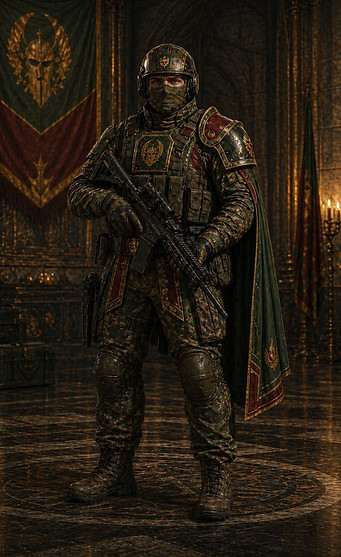
Army of Garlawa Troopers are the primary combat personnel of the organization. They are modern paramilitary fighters equipped with tactical camouflage, rifles, body armor, communications gear, and faction insignia. Their uniforms are intentionally designed to look professional and visually appealing, creating a “cool elite army” image that supports recruitment.
Troopers are not all equal. Some are hardened veterans. Others are radicalized youths, ex-criminals, failed soldiers, unemployed security contractors, or politically angry recruits seeking status and belonging.
They are trained to operate in small cells, avoid prolonged engagements, capture propaganda footage, and withdraw before superior government forces arrive.
Typical Trooper Profile
-
Rank-and-file combatant
-
Modern tactical appearance
-
Usually masked or helmeted
-
Works in squads and cells
-
Trained in raids, intimidation, crowd control, and urban movement
-
Often motivated by grievance, ideology, status, or loyalty to the Count’s image

EQUIPMENT
CAPTAIN
Armor and Uniform
-
Ceremonial tactical command armor in red, green, and gold
-
Reinforced chest cuirass with Garlawa emblem
-
Armored pauldrons and forearm guards
-
Ballistic underlayer
-
Helmet with full face protection
-
Integrated HUD and encrypted comms
-
Tactical cape or officer cloak
-
Rank-coded gold trim and command insignia
-
Ceremonial belt with encrypted command access token
Weapons
-
Customized assault rifle or compact carbine
-
Heavy pistol
-
Shock baton or ceremonial officer blade
-
Smart grenades or smoke charges
-
Optional wrist-mounted stun or signal device
-
Limited access to armor-disruption modules
Technology
-
Encrypted command radio
-
Tactical tablet or wrist command interface
-
Drone feed uplink
-
Biometric access token
-
Signal jammer access
-
Body camera with propaganda upload lock
-
Emergency extraction beacon
Protective Gear
-
Ballistic protection against small arms
-
Limited energy-dispersal plating
-
Smoke and gas filtration
-
Flash protection
-
Basic radiation and chemical sensors
-
Emergency medical injector kit
LIEUTENANT
Armor and Uniform
-
Reinforced tactical uniform in green/tan/dark green camouflage
-
Medium body armor with Garlawa crest patch
-
Officer shoulder plate or rank tab
-
Combat helmet with comms headset
-
Face covering or half-mask
-
Red/yellow/green faction accents
-
Tactical gloves, boots, knee pads, web gear
-
Optional short cloak, scarf, or officer tabard
Weapons
-
Modern assault rifle or carbine
-
Sidearm
-
Combat knife
-
Smoke grenades
-
Flashbangs
-
Breaching charges or cutting tools if mission-specific
-
Optional compact drone controller
Technology
-
Encrypted squad radio
-
Helmet camera
-
Tactical map receiver
-
Short-range signal scanner
-
Remote detonator access when authorized
-
Portable jammer or camera scrambler for specialist lieutenants
Protective Gear
-
Ballistic vest
-
Eye and ear protection
-
Gas mask or respirator attachment
-
First aid kit
-
Identification scrambler patch or transponder blocker
TROOPERS
Uniform and Armor
-
Lithuanian-inspired green/tan/dark green camouflage
-
Tactical helmet
-
Face mask or balaclava
-
Plate carrier or armored vest
-
Garlawa chest or shoulder patch
-
Small red-yellow-green faction accents
-
Tactical gloves
-
Knee and elbow pads
-
Combat boots
-
Utility belt and pouches
-
Optional short green cloak, scarf, or shoulder cloth for ceremonial units
Weapons
-
Standard assault rifle or carbine
-
Sidearm for selected personnel
-
Combat knife
-
Smoke grenade
-
Flashbang or distraction device
-
Zip ties/restraint cuffs
-
Baton or compact breaching tool
Technology
-
Encrypted short-range radio
-
Helmet or chest camera
-
GPS receiver
-
Basic tactical phone
-
Small drone access for designated troopers
-
Portable camera jammer for specialist teams
Field Gear
-
Ammunition magazines
-
Medical pouch
-
Water pack
-
Flashlight
-
Multitool
-
Spare batteries
-
Mask filters
-
Propaganda recording device or upload relay for selected units
TALENTS
CAPTAINS
-
Leadership — Professional
-
Military Tactics — Professional
-
Urban Warfare — Professional
-
Strategic Planning — Proficient
-
Political Indoctrination — Professional
-
Propaganda Use — Professional
-
Public Speaking — Proficient
-
Intimidation — Proficient
-
Firearms — Proficient
-
Hand-to-Hand Combat — Proficient
-
Security Operations — Proficient
-
Counter-Hero Tactics — Proficient
-
Communications Security — Proficient
-
Lithuanian History and Symbolism — Proficient
CAPTAIN COMMANDER'S TALENTS (Above plus following):
-
Operations and Assault Planning
-
Intelligence and Internal Security
-
Propaganda and Recruitment
-
Logistics and Weapons Procurement
LIEUTENANTS
Core Talents
-
Small Unit Tactics — Proficient
-
Firearms — Proficient
-
Urban Movement — Proficient
-
Squad Leadership — Proficient
-
Security Procedures — Proficient
-
Ambush Tactics — Proficient
-
Surveillance — Proficient
-
Communications — Proficient
-
Drone Operation — Basic to Proficient
-
Demolitions — Basic to Proficient
-
Crowd Control — Basic to Proficient
-
Propaganda Capture — Proficient
-
Escape and Evasion — Basic to Proficient
-
Lithuanian Politics — Basic to Proficient
Common Lieutenant Specialties
-
Drone Control
-
Safehouse Management
-
Weapons Distribution
-
Technical Sabotage
-
Police Radio Interference
-
Recruitment Cell Management
-
Counter-Surveillance
TROOPERS
Core Talents
-
Firearms — Basic to Proficient
-
Paramilitary Tactics — Basic
-
Urban Movement — Basic
-
Formation Discipline — Basic
-
Crowd Intimidation — Basic
-
Riot Tactics — Basic
-
Security Patrol — Basic
-
Basic First Aid — Basic
-
Radio Discipline — Basic
-
Propaganda Awareness — Basic
-
Escape and Evasion — Basic
-
Physical Conditioning — Basic to Proficient
Advanced Trooper Talents
Veteran or specialist troopers may also have:
-
Sniping — Proficient
-
Drone Operation — Proficient
-
Demolitions — Proficient
-
Breaching — Proficient
-
Hacking Support — Basic to Proficient
-
Vehicle Operations — Proficient
-
Heavy Weapons — Proficient
-
Interrogation Support — Basic