
A Universe of Pure Imagination

TM


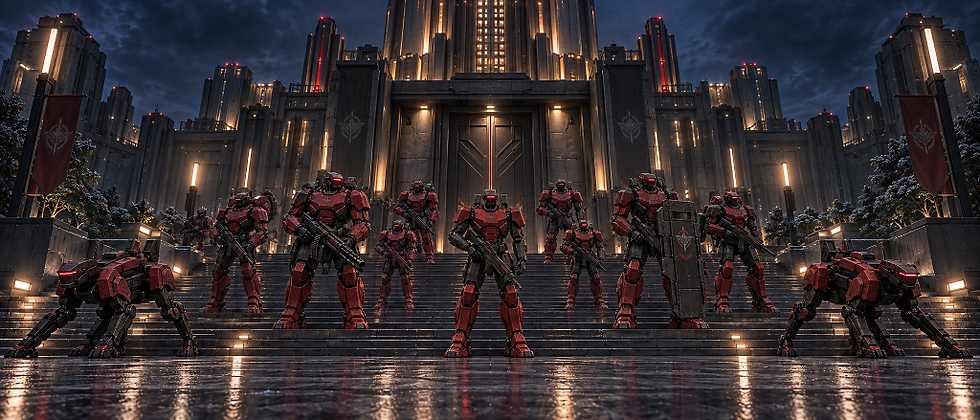



UCE REDCOATS

Mk VII Robotic Combat Systems
Tireless. Networked. Specialized. Built to continue when communications fail, environments collapse, and conventional forces cannot.
The Redcoats are the United Canadian Empire’s primary robotic combat force: non-sentient tactical machines engineered for sustained military operations, security, hazardous environments, forced entry, heavy combat, and pursuit.
The current Mk VII generation represents the most advanced Redcoat architecture fielded to date, comprising six purpose-built variants operating within a single standardized combat ecosystem.
18,000 active Mk VII Redcoats. Six specialized variants. One Imperial system.

THE REDCOAT PROGRAM


From Experimental War Machine to Imperial Combat Standard
The Redcoat program began with a simple requirement: create a battlefield machine that could go where soldiers could not, remain operational longer than soldiers could, and continue executing its mission when communications, command infrastructure, or battlefield conditions began to collapse.
The result was never intended to be an artificial person.
Redcoats do not possess consciousness, emotion, ambition, self-awareness, or independent political judgment. They are highly advanced tactical processing machines built to interpret orders, assess changing conditions, coordinate with friendly forces, select authorized courses of action, and continue operating within defined mission parameters.
That distinction became one of the program’s most important design principles.
The United Canadian Empire did not want thinking mechanical citizens.
It wanted reliable military systems.
The First Generation
The Mk I Redcoat entered operational service during the formative years of the UCE military and became publicly associated with the Empire during the 2008 Siege of Wolfe Island — Operation IRON LANTERN.
Compared with later generations, the Mk I was crude.
Its armor was heavier and less efficiently distributed. Its sensors were comparatively limited. Its weapon interfaces were less integrated. Its communications architecture was more conventional, and its mechanical systems required greater maintenance support.
But the Mk I proved something far more important than technical elegance:
the concept worked.
During the defense of Wolfe Island, Mk I Redcoats demonstrated the value of robotic troops capable of holding defensive positions under sustained attack, operating in severe conditions, supporting Imperial personnel, and continuing combat operations without exhaustion, panic, hesitation, or loss of discipline.
The Redcoat ceased to be an experiment.
It became doctrine.
Continuous Evolution
Every succeeding generation incorporated lessons learned from the battlefield.
The Redcoat program evolved through increasingly capable Marks as processors improved, armor became lighter and stronger, power systems became more efficient, sensors became more sophisticated, and communications architecture became progressively more resilient.
-
Mk II improved mobility and tactical processing.
-
Mk III introduced stronger networked warfare capabilities.
-
Mk IV expanded modular specialization.
-
Mk V hardened the platform against electronic and cyber disruption.
-
Mk VI advanced distributed tactical processing and autonomous mission continuity.
The result of that progression is the current Mk VII architecture.
Rather than treating every Redcoat as the same machine carrying different equipment, Mk VII represents a standardized family of specialized combat systems designed around common hardware, software, communications, power, logistics, and command architecture.
The six current variants are therefore different machines performing different roles while remaining parts of the same operational system.
A Deliberately Disposable Generation
The UCE does not permit obsolete Redcoat generations to linger indefinitely in service.
When a new Mark enters full production, active Redcoat units are expected to be upgraded, rebuilt, or replaced within approximately one year.
Units that cannot meet the new standard are withdrawn and destroyed.
This policy serves several purposes.
It prevents obsolete hardware from becoming a security vulnerability. It simplifies maintenance and ammunition logistics. It ensures compatible communications and command protocols across the active fleet. It also prevents older machines from remaining in circulation long enough to be captured, reverse-engineered, or repurposed outside Imperial control.
To the UCE, a Redcoat is not an individual.
It is state equipment.
A machine that no longer meets the current Imperial standard has no reason to remain in existence.
Not AI Soldiers — Tactical Machines
Despite their sophistication, Mk VII Redcoats remain fundamentally different from self-aware artificial intelligence.
Their tactical systems can identify threats, compare options, navigate terrain, coordinate formations, interpret battlefield changes, and select authorized responses at machine speed.
They can also operate independently when communications are lost.
But autonomy is not consciousness.
A Redcoat does not wonder why it was given an order.
It does not resent command.
It does not fear destruction.
It does not seek promotion.
It does not possess loyalty in the emotional sense.
Its “loyalty” is architectural.
Every decision remains bounded by command authority, mission parameters, identification protocols, rules of engagement, target classification, and embedded security restrictions.
This makes Redcoats frightening for a very different reason than rogue artificial intelligence.
They do not need hatred.
They do not need courage.
They do not need belief.
They simply continue.
The Mk VII Standard
Today, approximately 18,000 Mk VII Redcoats form one of the most recognizable components of the United Canadian Empire’s military and security apparatus.
From the standard VII-A Line unit to the quadrupedal VII-F Hunter, each machine is engineered for a specific operational role while sharing common communications, command, power, sensor, navigation, and authentication architecture.
Their greatest advantage is therefore not any single weapon or armor system.
It is continuity.
A Redcoat formation can lose long-range communications and continue through local machine networking.
It can lose local networking and continue through close-range encrypted communication.
It can lose radio communications entirely and continue coordinating through machine-speed visual signaling.
And if every external connection disappears, each Redcoat retains sufficient onboard processing to continue its assigned mission independently.
The result is exactly what the Redcoat program was designed to produce:
a military force that becomes harder to coordinate against precisely when conventional forces expect it to become easier.
MARK EVOLUTION TIMELINE

From Mk I to Mk VII
The Redcoat program has never been static.
Each generation was developed to address weaknesses identified in the previous Mark while preserving the qualities that made the system valuable in the first place: endurance, obedience, battlefield continuity, and compatibility with Imperial doctrine.
The progression from Mk I to Mk VII represents nearly two decades of continuous refinement.
Mk I — 2008
First Operational Combat Generation
The Mk I established the Redcoat as a viable military platform.
Heavy, mechanically conservative, and comparatively simple by later standards, it proved during Operation IRON LANTERN that robotic combat systems could hold ground, absorb punishment, and continue functioning in conditions that would exhaust or overwhelm conventional personnel.
Its limitations were equally clear: weight, maintenance burden, modest sensor integration, limited communications resilience, and relatively primitive tactical processing.
Even so, Mk I became the foundation for everything that followed.
Mk II — 2010
Mobility and Tactical Processing
Mk II focused primarily on correcting the Mk I’s greatest battlefield liabilities.
Actuator efficiency improved. Weight distribution became better balanced. Processing hardware became faster. Movement became more fluid, and tactical response time improved substantially.
The Redcoat became less like a moving armored emplacement and more like a true robotic infantry platform.
Mk III — 2012
Networked Warfare
Mk III represented the first major leap toward coordinated machine combat.
Redcoats could exchange targeting data, battlefield observations, route information, threat classifications, and command updates more effectively across formations.
This dramatically increased group effectiveness.
It also exposed a critical weakness:
a highly networked force could become vulnerable if the network itself was disrupted.
That lesson would shape every later generation.
Mk IV — 2015
Modular Specialization
Mk IV moved the Redcoat program away from the idea of a single universal combat chassis.
Different mission requirements increasingly demanded different armor profiles, tools, weapons, sensor packages, and power characteristics.
The first mature specialization doctrine emerged during this period.
Instead of forcing one machine to perform every mission adequately, the program began designing machines to perform selected missions exceptionally well.
Mk V — 2018
Electronic and Cyber Hardening
By Mk V, Imperial engineers increasingly assumed that enemy forces would attempt to jam, spoof, corrupt, isolate, or compromise Redcoat communications.
Electronic warfare resistance therefore became a primary design requirement rather than an additional defensive feature.
Encryption hardened.
Network authentication became more aggressive.
Processing and mission data became increasingly segmented.
Captured systems became less useful.
Redcoat formations also became more capable of continuing their missions when portions of their communications architecture were unavailable.
Mk VI — 2021
Distributed Tactical Intelligence
Mk VI represented the bridge between network-dependent robotics and the resilient architecture now associated with Mk VII.
Greater tactical processing was distributed directly into individual machines.
Redcoats became less dependent on centralized command nodes for immediate battlefield decision-making.
Formation-level coordination remained valuable, but loss of the wider network no longer implied loss of tactical effectiveness.
The basic principle was becoming clear:
The network should make a Redcoat formation better—not make it possible.
Mk VII — 2024
Resilient Autonomous Combat Architecture
Mk VII is the culmination of every major lesson learned since the first generation.
It is not simply a faster or more heavily armored Redcoat.
It is a complete standardized combat ecosystem built around redundancy, specialization, secure command authority, modular logistics, and graceful degradation.
The current Mk VII family consists of six principal variants:
-
VII-A Line
-
VII-B Heavy
-
VII-C Breacher
-
VII-D Sentinel
-
VII-E Hazard
-
VII-F Hunter
Each performs a different mission.
All operate within the same broader system.
That is what makes Mk VII different from every Redcoat generation before it.
Mk VII UNIVERSAL ARCHITECTURE
One Combat Ecosystem. Six Specialized Machines.
The six Mk VII variants differ significantly in size, armor, mobility, weapons, and mission profile.
What makes them a single family is what exists beneath those differences.
Every Mk VII Redcoat is built around a common operational architecture that governs command authority, communications, tactical processing, navigation, sensors, authentication, power management, equipment integration, mission continuity, and destruction safeguards.
The result is a force that can specialize without fragmenting.
Tactical Machine Intelligence — TMI-7
At the center of every Mk VII is the Tactical Machine Intelligence 7 architecture — TMI-7.
TMI-7 does not create consciousness.
It creates battlefield competence.
The system allows a Redcoat to:
-
interpret mission orders,
-
identify threats,
-
classify targets,
-
compare tactical options,
-
navigate changing terrain,
-
coordinate with friendly units,
-
manage weapons and equipment,
-
assess damage,
-
respond to unexpected conditions,
-
and continue operating when external direction becomes unavailable.
The important distinction is that TMI-7 operates within constraints.
It does not decide what the Empire should want.
It determines how best to perform what the Empire has already ordered.
Command Core Architecture — CCA-7
The CCA-7 Command Core Architecture governs hierarchy, authority, mission assignment, and command relationships across Redcoat formations.
Each machine carries an embedded authority level within the B00–B50 architecture.
Higher-authority units can assume leadership of lower-level Redcoats and compatible Cybersentinels when required, however, command status is intentionally not visually obvious.
There is no distinctive “officer helmet,” gold armor, or prominent rank marking that would allow enemy forces to identify machine leadership at a glance. The hierarchy exists inside the system, not on the outside.
Imperial Tactical Authentication Protocol — ITAP
The Imperial Tactical Authentication Protocol controls access to advanced Redcoat systems, weapons, data, and command functions.
ITAP verifies:
-
machine identity,
-
mission authorization,
-
command authority,
-
equipment compatibility,
-
weapon permissions,
-
and target-engagement privileges.
Captured Imperial equipment may remain mechanically functional, but without valid authentication many advanced capabilities are lost.
This makes battlefield capture less useful and reduces the likelihood that Imperial weapons or support systems can simply be turned against their original operators.
RRCS-7 — Redcoat Resilient Communications Suite
One of the most important Mk VII developments is the RRCS-7 Redcoat Resilient Communications Suite.
Its design is based on a simple assumption:
communications will eventually be attacked.
Instead of relying on one network, Mk VII Redcoats move through progressively more localized forms of communication as conditions deteriorate.
Tier I — Imperial Tactical Network
Under normal conditions, Redcoats communicate through encrypted, frequency-agile RF and microwave systems.
Organic range is typically approximately 5–10 miles, depending on terrain, interference, relay support, and environmental conditions.
This network supports high-speed exchange of:
-
target information,
-
tactical maps,
-
unit status,
-
mission updates,
-
sensor data,
-
navigation information,
-
and command instructions.
Tier II — CTPL / “Cell Whisper”
If long-range communications are jammed or compromised, nearby Redcoats can form a highly localized Close Tactical Pulse Link, commonly referred to as Cell Whisper.
Effective range is only approximately 6–10 feet. That limitation is deliberate.
The extremely short range allows a small group of Redcoats operating physically near one another to continue exchanging encrypted tactical information even when the broader electromagnetic environment is heavily contested. A squad can therefore become its own isolated machine cell.
Tier III — MVTL
If radio-frequency communication becomes completely unusable, Redcoats can fall back to Machine Visual Tactical Language — MVTL.
MVTL uses extremely rapid:
-
hand movements,
-
head orientation,
-
optical flashes,
-
limb positions,
-
body geometry,
-
and other machine-readable visual signals.
To a human observer, these movements may appear almost instantaneous or meaningless. To another Redcoat, they can contain complex tactical information.
Machine-speed signaling allows units to exchange instructions far faster than conventional human hand signals.
This creates an uncomfortable battlefield reality for opponents who believe they have successfully “silenced” the Redcoat network. The machines may simply continue coordinating visually.
Tier IV — Autonomous Mission Continuity
If every communications method fails, the Redcoat continues.
Each unit retains:
-
mission objectives,
-
rules of engagement,
-
target priorities,
-
friendly-force identification,
-
navigation data,
-
contingency instructions,
-
and local tactical processing.
The machine does not need continuous communication to remain operational.
This final layer is what turns communications disruption from a potential defeat mechanism into merely another degraded operating condition.
IRSA-7 — Integrated Redcoat Sensor Array
The IRSA-7 Integrated Redcoat Sensor Array provides a common sensor architecture across the Mk VII family.
Exact sensor emphasis varies by variant, but the shared system may include:
-
visible-spectrum imaging,
-
infrared detection,
-
thermal imaging,
-
low-light capability,
-
rangefinding,
-
motion tracking,
-
battlefield mapping,
-
target identification,
-
and environmental monitoring.
Specialized variants expand on this foundation.
The VII-D Sentinel emphasizes surveillance and persistent observation.
The VII-E Hazard expands environmental sensing.
The VII-F Hunter emphasizes pursuit and target persistence.
But all begin with the same underlying architecture.
ABNS-7 — Autonomous Battlefield Navigation Suite
The ABNS-7 Autonomous Battlefield Navigation Suite allows Redcoats to continue moving even when satellite positioning, external maps, or network support become unavailable.
The system combines:
-
inertial navigation,
-
terrain comparison,
-
visual mapping,
-
stored geographic data,
-
obstacle analysis,
-
local route generation,
-
and continuous positional correction.
A Redcoat therefore does not simply stop because GPS disappears. Navigation degrades. It does not vanish.
HDPM-7 Power Architecture
The Mk VII family uses a standardized HDPM-7 high-density power architecture with mission-specific variants.
These include:
-
HDPM-7 — standard
-
HDPM-7H — Heavy
-
HDPM-7C — Breacher
-
HDPM-7D — Sentinel
-
HDPM-7E — Hazard
-
HDPM-7F — Hunter
This approach allows each variant to receive the power characteristics appropriate to its mission while preserving common engineering and maintenance principles across the fleet.
IRWI-7 — Imperial Robotic Weapon Interface
Humanoid Mk VII variants use the IRWI-7 Imperial Robotic Weapon Interface.
IRWI-7 integrates:
-
weapon authentication,
-
targeting data,
-
ammunition status,
-
diagnostic information,
-
firing authorization,
-
maintenance state,
-
and machine-specific handling parameters.
This allows Redcoat weapons to function as extensions of the machine rather than merely firearms being physically held by a robot.
The VII-F Hunter uses a different purpose-built equipment architecture because of its quadrupedal chassis.
Cryptographic Death Protocol
Every Mk VII includes a Cryptographic Death Protocol.
If a machine is destroyed, captured, compromised, or reaches defined security thresholds, sensitive data can be rendered unusable.
The system is designed to protect:
-
communications keys,
-
mission records,
-
tactical software,
-
authentication credentials,
-
command architecture,
-
and classified Imperial systems data.
The goal is straightforward: an enemy may recover the hardware; it should not recover the Empire inside it.
Segmented Mission Memory
Mk VII Redcoats do not store all operational data as one continuously accessible block.
Mission information, command credentials, tactical data, and sensitive system functions are compartmentalized.
This limits the damage caused by:
-
cyber intrusion,
-
corruption,
-
captured hardware,
-
malicious code,
-
or partial systems compromise.
-
A successful attack against one segment does not automatically expose the entire machine.
Graceful Degradation
Perhaps the defining characteristic of Mk VII architecture is graceful degradation.
A Redcoat is not designed around the assumption that every system will remain functional.
It is designed around the assumption that systems will fail.
A damaged Redcoat may lose:
-
communications,
-
sensors,
-
navigation support,
-
external weapons,
-
mobility,
-
power capacity,
-
or portions of its processing architecture.
Instead of transitioning immediately from “fully functional” to “disabled,” the machine progressively reduces capability while preserving mission-critical functions for as long as possible.
This philosophy applies across the entire Mk VII family. The machine does not need to remain perfect; it only needs to remain useful.
Field Compatibility and Logistics
Standardization extends beyond software.
Compatible Mk VII systems can exchange selected:
-
weapons,
-
ammunition,
-
tools,
-
power accessories,
-
sensor packages,
-
and repair components
when physical architecture permits.
This significantly reduces the logistical burden created by maintaining six specialized variants.
A damaged unit may also surrender usable equipment to another machine if mission priorities require it.
Redcoats are not sentimental about their hardware - they use what remains.
The Mk VII Principle
Taken individually, none of these systems explains why Mk VII Redcoats are so difficult to neutralize. Their strength comes from layering them together.
Secure command.
Redundant communications.
Independent navigation.
Local tactical processing.
Authenticated weapons.
Segmented memory.
Graceful degradation.
Standardized logistics.
Specialized chassis.
The result is not an invulnerable machine.
It is something more practical:
a machine designed so that there is rarely only one thing an enemy can break to make it stop functioning.
That is the core philosophy of Mk VII.
And it is the reason the current Redcoat family represents the most mature robotic combat system the United Canadian Empire has ever fielded.
MK VII FORCE COMPOSITION

18,000 Machines. Six Specialized Roles.
The Mk VII generation is not organized as a single uniform robotic army.
It is a deliberately balanced force composed of six specialized Redcoat variants, each optimized for a defined operational role while retaining compatibility with the wider Mk VII architecture.
The current active inventory is approximately 18,000 Mk VII Redcoats.
Variant | Primary Role | Active Inventory |
|---|---|---|
Mk VII-A Line | General-purpose robotic infantry | 10,800 |
Mk VII-B Heavy | Heavy weapons / assault support | 2,160 |
Mk VII-C Breacher | Forced entry / close assault | 1,800 |
Mk VII-D Sentinel | Security / strategic-site defense | 1,440 |
Mk VII-E Hazard | Hazardous-environment combat / rescue | 900 |
Mk VII-F Hunter | Pursuit / tracking / anti-metahuman support | 900 |
TOTAL | 18,000 |
The force is intentionally weighted toward the VII-A Line Redcoat, which forms the general-purpose backbone of Imperial robotic combat operations. The remaining variants provide capability where a standard Line unit would be less efficient, less survivable, or insufficiently specialized.
The operational identity of the family can be summarized simply:
-
VII-A fights.
-
VII-B overwhelms.
-
VII-C enters.
-
VII-D watches and holds.
-
VII-E survives where others cannot.
-
VII-F finds what tries to escape.
Together, they form a combat ecosystem rather than six unrelated robot types.
A Line formation may be reinforced by a Heavy.
A Breacher may create access for Line units.
Sentinels may secure a site while Hunters patrol its approaches.
Hazard units may enter contaminated ground before human forces are permitted to follow.
The strength of Mk VII therefore lies not only in specialization, but in the ability of the variants to operate together under common command, communications, authentication, and logistics standards.
MK VII-A LINE REDCOAT

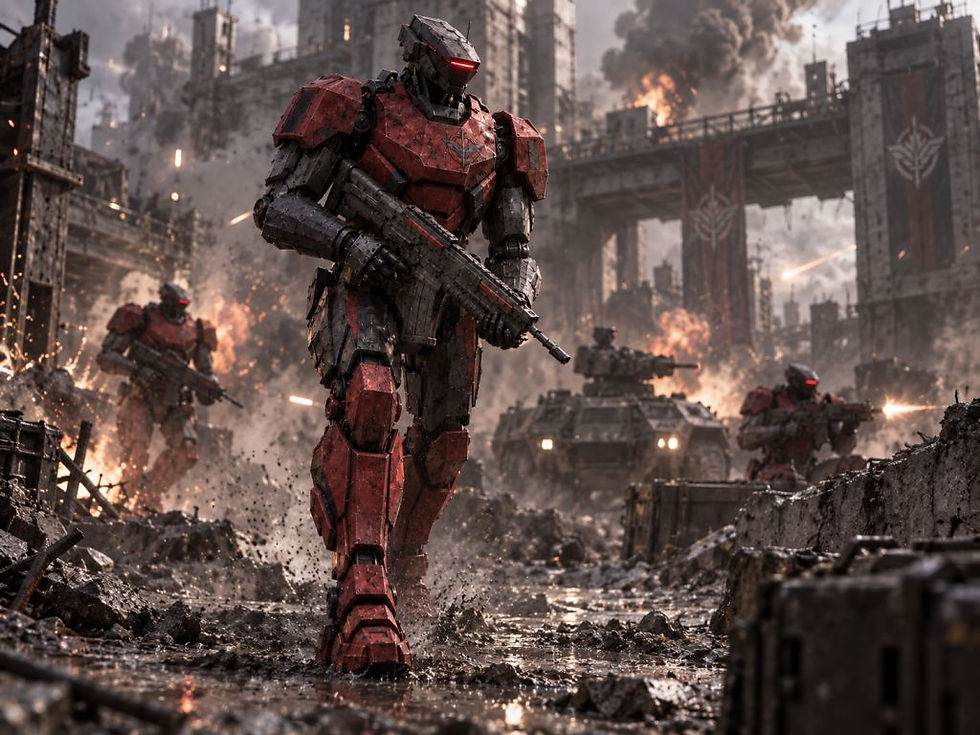


General-Purpose Robotic Infantry
The Mk VII-A Line Redcoat is the standard combat platform of the modern Redcoat force.
It is the machine most commonly encountered in frontline operations, patrols, occupation duties, defensive deployments, facility seizures, convoy security, and general military support.
More than any other variant, the VII-A defines what most people mean when they refer simply to a Redcoat.
Mission
The VII-A is designed to perform the widest possible range of ordinary military tasks without requiring extensive mission-specific modification.
Typical assignments include:
-
frontline combat,
-
patrol and security,
-
urban operations,
-
defensive positions,
-
convoy escort,
-
battlefield reinforcement,
-
perimeter control,
-
facility seizure,
-
and sustained occupation/security duties.
It is deliberately balanced.
The VII-A is not the strongest Redcoat.
It is not the most heavily armored.
It is not the fastest.
It is the most broadly useful.
That is why it forms approximately 60% of the active Mk VII fleet.
Physical Profile
The VII-A stands approximately 6 ft 8 in / 2.03 m tall.
Its base machine weight is approximately 690 lb / 313 kg, increasing to roughly 760–800 lb under normal combat load.
The chassis retains a humanoid form because much of the infrastructure it must operate within was designed for humans:
-
doors,
-
corridors,
-
stairways,
-
vehicles,
-
ships,
-
industrial facilities,
-
and military structures.
Its proportions remain clearly mechanical.
Broad shoulders, reinforced thighs, stable feet, articulated hands, and a compact wedge-shaped sensor head make the machine recognizable as equipment rather than armor worn by a person.
Mobility
The VII-A is capable of sustained tactical movement at approximately 12–15 mph, with a maximum sprint speed of roughly 25 mph.
It can negotiate:
-
stairs,
-
rubble,
-
snow,
-
mud,
-
shallow water,
-
industrial terrain,
-
low obstacles,
-
and damaged structures.
It can crouch, kneel, crawl, recover from falls, and maintain stable firing positions under conditions that would rapidly exhaust a human soldier.
The machine does not move like a superhero.
It moves like an extremely powerful industrial mechanism designed for war.
Strength
A standard VII-A can perform an approximately 2,250 lb controlled lift under ideal conditions.
Short-duration pushing, dragging, and leverage can exceed that value.
In practical terms, this allows a Line Redcoat to:
-
move heavy debris,
-
force doors,
-
reposition barriers,
-
carry wounded personnel,
-
manipulate vehicle components,
-
and physically overpower ordinary humans with ease.
Its strength is substantial without intruding into the VII-B Heavy’s specialized role.
Armor
The VII-A uses Medium-Heavy Robotic Infantry Armor.
Protection is designed to resist:
-
ordinary handgun fire
-
many rifle threats
-
fragmentation
-
blast debris
-
fire
-
limited heavier impacts
Repeated armor-piercing fire, anti-materiel weapons, explosives, dedicated anti-armor systems, and powerful metahuman attacks remain serious threats.
The platform is difficult to stop. It is not invulnerable.
Sensors
The Line Redcoat carries the standard IRSA-7 Integrated Redcoat Sensor Array with combat-oriented processing.
Capabilities include:
-
visible-spectrum imaging,
-
low-light imaging,
-
thermal detection,
-
directional acoustic sensing,
-
rangefinding,
-
motion analysis,
-
environmental monitoring,
-
electromagnetic awareness,
-
and friend-or-foe verification.
Distributed secondary optics reduce dependence on the primary head array.
Destroying the visible sensor band does not automatically blind the machine.
Weapons
The standard VII-A combat load is built around the:
AR-27 Imperial Automatic Rifle
The AR-27 is a Redcoat-optimized service rifle designed around machine strength, recoil control, integrated targeting, and the IRWI-7 Imperial Robotic Weapon Interface.
The weapon is larger and heavier than a conventional human infantry rifle and can take full advantage of:
-
machine stabilization,
-
predictive targeting,
-
recoil compensation,
-
rangefinding,
-
and TMI-7 fire-control processing.
A CP-12 Compact Pistol may be carried as a secondary weapon where mission requirements justify it.
Mission-specific equipment may also include:
-
utility launchers,
-
anti-armor systems,
-
less-lethal equipment,
-
additional sensors,
-
extra ammunition,
-
and specialized security gear.
The VII-A does not carry every possible weapon at once.
Its loadout is mission-driven.
Close Combat
At close range, the VII-A relies on efficiency rather than theatrical combat technique.
Its doctrine emphasizes:
-
seize,
-
restrain,
-
disarm,
-
strike,
-
throw,
-
pin,
-
disable.
Mechanical strength, reaction time, balance, and precision make even an unarmed Line Redcoat extremely dangerous.
Squad Organization
A typical Redcoat Tactical Squad consists of approximately eight machines.
A common arrangement includes:
-
six or seven VII-A Line Redcoats,
-
plus one specialist or command-capable unit.
These squads can divide into two four-machine tactical cells.
That organization directly supports the RRCS-7 communications architecture.
If wider communications collapse, each cell can continue operating independently through Cell Whisper, MVTL, and local TMI-7 processing.
Command Authority
Most VII-A units operate within the lower B-series authority ranges.
Selected Line Redcoats may carry higher authority, including B40–B50 command capability.
That authority is not visually obvious.
A battlefield observer cannot reliably determine machine leadership by armor, markings, or position alone.
Destroying the Redcoat that appears to be leading does not necessarily remove the actual command node.
Integration with Imperial Forces
The VII-A is designed to operate:
-
independently,
-
in Redcoat formations,
-
alongside Imperial soldiers,
-
with vehicles,
-
under Enforcer direction,
-
and in mixed robotic formations.
It is not a separate robot army.
It is an integrated part of the Imperial Armed Forces.
That distinction is central to Redcoat doctrine.
Human personnel provide strategic judgment, political authority, occupation functions, and command.
Redcoats provide persistence, firepower, precision, and survivability.
Public and Military Perception
Inside the UCE, the VII-A can be presented as a machine that reduces the need to expose Imperial citizens to unnecessary battlefield risk.
Outside the Empire, the same machine is often perceived differently.
A Line Redcoat does not tire.
It does not become frightened.
It does not lose morale.
It does not surrender because the situation has become psychologically unbearable.
It continues until its mission changes, its systems fail, or it is destroyed.
That is why the VII-A has become one of the most recognizable symbols of Imperial military power.
MK VII-B HEAVY REDCOAT


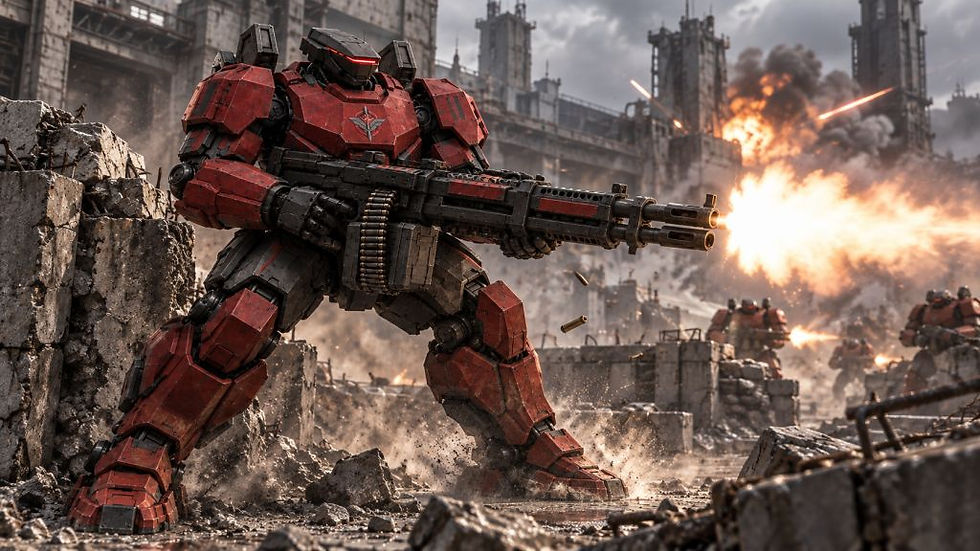

Heavy Weapons / Assault Support
The Mk VII-B Heavy Redcoat is the UCE’s principal heavy robotic infantry support platform.
Where the VII-A provides broad battlefield versatility, the VII-B exists to bring greater armor, greater physical strength, and substantially heavier firepower into the same tactical space.
It is not a tank.
It is not a Cybersentinel.
It remains an infantry-scale machine capable of moving through buildings, riding military transports, accompanying Redcoat formations, and operating directly alongside Imperial troops.
Its purpose is to make a Redcoat formation much harder to stop.
Mission
The VII-B is optimized for:
-
heavy weapons support,
-
anti-vehicle operations,
-
hardened-position reduction,
-
assault support,
-
strongpoint defense,
-
convoy defense,
-
suppression,
-
anti-materiel operations,
-
equipment transport,
-
and reinforcement of Line or Breacher units.
A Heavy may be deployed independently in limited circumstances, but its greatest value comes from operating as the force multiplier inside a larger Redcoat formation.
One VII-B can significantly change the type of threat an otherwise ordinary Line squad can engage.
Physical Profile
The VII-B stands approximately 7 ft 4 in / 2.24 m tall.
Its base weight is approximately 1,250 lb / 567 kg, increasing to roughly 1,400–1,600 lb under full combat load.
The chassis is visibly broader and heavier than the VII-A.
Its design includes:
-
expanded shoulder structure,
-
thicker torso protection,
-
larger forearms,
-
reinforced hips and thighs,
-
wider feet,
-
increased cooling capacity,
-
and enlarged power architecture.
Its head remains part of the common Mk VII design family, but is more deeply recessed into surrounding armor to improve protection.
The result is immediately recognizable:
a Redcoat built around mass, protection, and firepower.
Mobility
Despite its weight, the VII-B remains surprisingly mobile. Typical sustained tactical movement is approximately 8–10 mph, with a maximum sprint speed of roughly 18 mph.
The machine can negotiate:
-
rubble,
-
snow,
-
mud,
-
industrial terrain,
-
stairs where structural loading permits,
-
defensive positions,
-
and damaged urban environments.
It accelerates and turns more deliberately than the VII-A.
That is a consequence of mass, not weakness.
Strength
The VII-B is capable of approximately a 5,000 lb controlled lift under ideal conditions.
Its short-duration pushing and leverage capacity can exceed that significantly.
This allows a Heavy to:
-
move wrecked vehicles,
-
shift major structural debris,
-
reposition barriers,
-
carry oversized battlefield equipment,
-
physically dominate smaller Redcoat models,
-
and force its way through obstacles that would stop ordinary infantry.
The VII-B therefore functions partly as a mobile industrial machine operating inside a combat role.
Armor
The Heavy uses Heavy Robotic Combat Armor.
Protection is substantially greater than that of the VII-A, particularly across:
-
torso,
-
shoulders,
-
thighs,
-
forearms,
-
power systems,
-
processor compartments,
-
and primary sensor regions.
Armor distribution favors the forward arc. The machine is designed to advance toward the threat and absorb punishment while doing so. That does not make it invulnerable. Dedicated anti-materiel weapons, anti-armor systems, heavy explosives, vehicle weapons, and powerful metahuman attacks remain serious threats. Flanking also matters.
The VII-B is strongest where it expects the enemy to be.
Power and Cooling
The Heavy uses the HDPM-7H dual-module configuration.
The dual-module system supports:
-
stronger actuators,
-
heavy weapons,
-
enhanced cooling,
-
greater electrical redundancy,
-
and reduced dependence on a single power source.
Typical endurance is approximately:
-
60 hours mixed duty
-
14–18 hours high-intensity combat
Heavy operation produces substantial heat.
The VII-B therefore uses enhanced cooling architecture, including reinforced internal loops, thermal buffers, and armored external heat-management structures.
Under extreme output, the chassis may visibly vent heat.
Primary Weapon — HC-40 Heavy Support Cannon
The standard VII-B weapon is the:
HC-40 Heavy Support Cannon
The HC-40 is designed for:
-
suppression,
-
anti-materiel fire,
-
light vehicle defeat,
-
fortified positions,
-
structural penetration,
-
and sustained heavy combat.
Its size and recoil make it impractical for ordinary human infantry.
The VII-B’s weight, actuators, and stabilization systems allow it to control the weapon effectively.
The system can use:
-
active recoil compensation,
-
gyroscopic stabilization,
-
stance adjustment,
-
and mechanical bracing.
When firing at maximum output, a Heavy may visibly widen its stance or brace into the ground.
Heavy Mission Packages
The VII-B can exchange its standard support weapon for specialized systems.
Approved heavy mission packages include:
-
HC-40S Suppression Package
-
HAW-7 Anti-Armor Package
-
HSW-9 Siege Package
-
HAD-4 Air-Defense Package
These are mission configurations.
They are not separate Redcoat variants.
The same Heavy chassis can therefore support very different battlefield tasks without fragmenting the fleet into additional sub-models.
Secondary Weapon
The VII-B may carry a secondary carbine or compact automatic weapon for threats that do not justify use of the heavy system.
This prevents unnecessary expenditure of heavy ammunition and gives the machine greater flexibility at close range.
Close Combat
At close range, the VII-B is extremely dangerous.
Its doctrine relies on:
-
mass,
-
strength,
-
mechanical precision,
-
and direct force.
It can:
-
break doors,
-
overturn barricades,
-
move light vehicles under favorable conditions,
-
throw smaller machines,
-
restrain enhanced humans,
-
and use its own armored body as mobile cover.
The Heavy does not need elaborate hand-to-hand technique.
Its physical advantages are already overwhelming.
Deployment
The VII-B is commonly:
-
embedded within Line formations,
-
assigned to assault teams,
-
deployed at defensive strongpoints,
-
paired with Breachers,
-
or grouped into Heavy Support Sections.
A typical Heavy Support Section may include:
-
two VII-B Heavy Redcoats,
-
supported by two VII-A Line or specialist units.
In larger operations, one or two Heavies per eight-machine Redcoat squad may be assigned when mission demands justify it.
Command Authority
The VII-B uses the same B-series authority architecture as every other Mk VII.
Most Heavy units operate within lower or intermediate authority bands.
Selected machines may hold significantly greater authority.
Size does not equal rank.
A VII-B may be physically dominant while remaining subordinate to a smaller VII-A carrying higher machine-command authority.
Logistics
The Heavy imposes a greater logistical burden than the VII-A.
It requires:
-
more power,
-
more ammunition,
-
heavier maintenance equipment,
-
stronger transport systems,
-
and greater support capacity.
That is one reason the UCE does not simply replace its Line force with Heavy Redcoats.
The Heavy is powerful because it is specialized.
Battlefield Identity
The simplest way to understand the VII-B is this:
The VII-A is the robotic infantryman. The VII-B is the robotic weapons team.
Its appearance on the battlefield signals that the UCE expects resistance substantial enough to require more than ordinary Redcoat firepower.
MK VII-C BREACHER REDCOAT


Forced Entry / Close Assault
The Mk VII-C Breacher Redcoat is the UCE’s dedicated forced-entry and close-assault platform.
Where the Heavy brings more firepower, the Breacher brings access.
Its mission is to overcome the barriers that separate an assault force from its objective:
-
doors,
-
bulkheads,
-
barricades,
-
fortified entries,
-
bunkers,
-
interior strongpoints,
-
tunnels,
-
and ship compartments.
The VII-C is engineered around one simple operational reality: a defended doorway is often one of the most dangerous places on the battlefield.
The Breacher is designed to survive it.
Mission
The VII-C specializes in:
-
fortified entry,
-
close-quarters assault,
-
bunker penetration,
-
urban assault,
-
ship boarding,
-
tunnel fighting,
-
barricade removal,
-
blast-door defeat,
-
hostage-site entry support,
-
and hostile-structure clearance.
Its purpose is not merely to open a barrier.
Its purpose is to create access and then establish control of the space immediately beyond it.
Physical Profile
The VII-C stands approximately 6 ft 10 in / 2.08 m tall.
Its base weight is approximately 890 lb / 404 kg, increasing to roughly 980–1,100 lb under combat load.
The chassis is denser and more compact than the VII-B.
Its visual emphasis is concentrated forward:
-
thicker chest protection,
-
reinforced shoulders,
-
massive forearms,
-
protected hands,
-
reinforced knees and shins,
-
strong hips,
-
and a heavily protected sensor head.
The machine looks less broad than the Heavy and more compressed around the forward assault arc.
It is built to drive into resistance rather than merely withstand it.
Mobility
The Breacher is slower than the Line Redcoat, but faster than the Heavy.
Typical sustained tactical movement is approximately 10–12 mph, with a maximum sprint speed of roughly 21 mph.
The more important characteristics are:
-
rapid short-distance acceleration,
-
stable movement in confined spaces,
-
strong low-speed pushing force,
-
stair performance,
-
rubble negotiation,
-
crouched movement,
-
and rapid recovery after impact.
The VII-C is designed to fight inside structures.
Strength
The VII-C can perform approximately a 3,500 lb controlled lift under ideal conditions.
Its defining strength feature, however, is not the basic lift figure.
It is the:
High-Torque Assault Mode
High-Torque Assault Mode temporarily redirects available power toward major limb actuators.
This increases performance for tasks such as:
-
forcing doors,
-
bending barriers,
-
moving debris,
-
driving breaching tools,
-
holding damaged structures,
-
and physically opening obstructed access points.
The tradeoff is increased:
-
power consumption,
-
thermal load,
-
and mechanical stress.
The Breacher can do more for a short period precisely because it is not intended to do so continuously.
Armor
The VII-C uses Reinforced Assault Armor.
Its protection is particularly concentrated on:
-
head,
-
forward sensor systems,
-
shoulders,
-
chest,
-
forearms,
-
hands,
-
thighs,
-
and knees.
The Breacher is expected to move through an opening where hostile forces may already be aiming.
Its armor reflects that assumption.
Side and rear protection remain substantial, but the machine is intentionally optimized for forward assault.
Reinforced Hands and Forearms
The VII-C’s forearms and hands are among its most important physical systems.
They are built to:
-
withstand repeated impact,
-
grip damaged structures,
-
manipulate heavy tools,
-
resist crush damage,
-
and continue functioning after repeated forced-entry operations.
The forearm structure also supports the MBTS Modular Breach Tool System.
MBTS — Modular Breach Tool System
The MBTS allows the VII-C to configure itself for different entry problems.
Approved tool modules include:
-
hydraulic spreader,
-
powered ram,
-
cutting tool,
-
rotary-impact breach head,
-
thermal cutting unit.
The machine selects equipment according to the mission.
It does not require an entirely different chassis every time the obstacle changes.
Explosive Breaching
The VII-C can support approved explosive entry operations.
It may:
-
place authorized charges,
-
calculate likely blast direction,
-
identify suitable placement,
-
coordinate timing,
-
and shield follow-on forces.
It does not independently invent or improvise explosive devices.
The use of breaching explosives remains governed by mission authority and rules of engagement.
IAS-7 Imperial Assault Shield
The Breacher may carry the:
IAS-7 Imperial Assault Shield
The shield is specifically designed for a machine capable of carrying more armor than a human operator could practically manage.
It can be used during:
-
doorway entry,
-
corridor advance,
-
riot/security operations,
-
hostage rescue,
-
and close-quarters assault.
The shield does not make the Breacher invulnerable.
It increases survivability during exactly the few seconds when survival matters most.
Primary Weapon — CAR-18
The standard VII-C weapon is the:
CAR-18 Compact Assault Rifle
The CAR-18 is shorter and more maneuverable than the AR-27.
It is optimized for:
-
rooms,
-
corridors,
-
tunnels,
-
ships,
-
stairways,
-
and other confined environments.
Its compact design allows the Breacher to fight effectively while carrying tools or the IAS-7 shield.
Specialized Ammunition
Mission packages may include:
-
barrier-defeat ammunition,
-
reduced-penetration ammunition,
-
frangible ammunition,
-
non-lethal options,
-
and specialist close-defense loads.
This allows the VII-C to operate in very different environments without requiring a completely different weapon system.
Structural Analysis
The Breacher carries enhanced Tactical Structural Analysis capability.
It can evaluate:
-
wall composition,
-
door construction,
-
reinforcement,
-
weak points,
-
load-bearing structures,
-
hidden spaces,
-
likely failure points,
-
and safe breach locations.
It can also fuse sensor data with available blueprints and local mapping.
This does not give the machine magical X-ray vision.
It gives it extremely sophisticated engineering judgment at machine speed.
Sensor Protection
Breaching environments are hostile to sensors.
-
Flash
-
Smoke
-
Dust
-
Debris
-
Fire
-
Fragments
The VII-C therefore uses:
-
recessed primary optics,
-
blast-resistant shutters,
-
sacrificial sensor protection,
-
secondary torso optics,
-
and automatic sensor switchover.
The machine is designed to continue moving even after its first sensor layer is damaged.
Power and Endurance
The VII-C uses the:
HDPM-7C Assault Module
This system is optimized for short bursts of high actuator output.
Typical endurance is approximately:
-
64 hours mixed duty
-
16–20 hours high-intensity assault
Frequent use of High-Torque Assault Mode reduces endurance and increases thermal burden.
Typical Breach Formation
A standard Redcoat Breach Element typically consists of four machines:
-
one VII-C Breacher,
-
two VII-A Line Redcoats,
-
one additional specialist or command-capable unit.
For more heavily defended targets, a larger assault element may include:
-
two VII-C Breachers,
-
one VII-B Heavy,
-
five VII-A Line Redcoats.
The logic is straightforward: the Breacher creates access; the Line units exploit it; the Heavy ensures the opposition cannot easily close it again.
Shipboard and Underground Operations
The VII-C is particularly well suited to:
-
ships,
-
bunkers,
-
tunnels,
-
hardened facilities,
-
utility corridors,
-
mines,
-
underground installations,
-
and industrial complexes.
Its scale and chassis allow it to operate in spaces where the larger VII-B becomes less practical.
That makes the Breacher especially valuable to Imperial Maritime Service and hardened-site assault units.
Domestic and Rescue Use
The same systems that allow the VII-C to defeat military barriers also have legitimate emergency applications.
It can support:
-
vehicle extrication,
-
disaster access,
-
collapsed-building entry,
-
debris removal,
-
industrial rescue,
-
emergency structural support.
The UCE can therefore present the machine as both an assault platform and a life-saving heavy rescue system.
Both descriptions are accurate.
Battlefield Identity
The VII-C can be summarized in one line: VII-A fights through the opening, VII-B brings the firepower, VII-C creates and owns the opening.
When a Breacher arrives outside a hardened position, the most important question is usually no longer whether the barrier will hold...it's how long it will take the machine to remove it.
MK VII-D SENTINEL REDCOAT

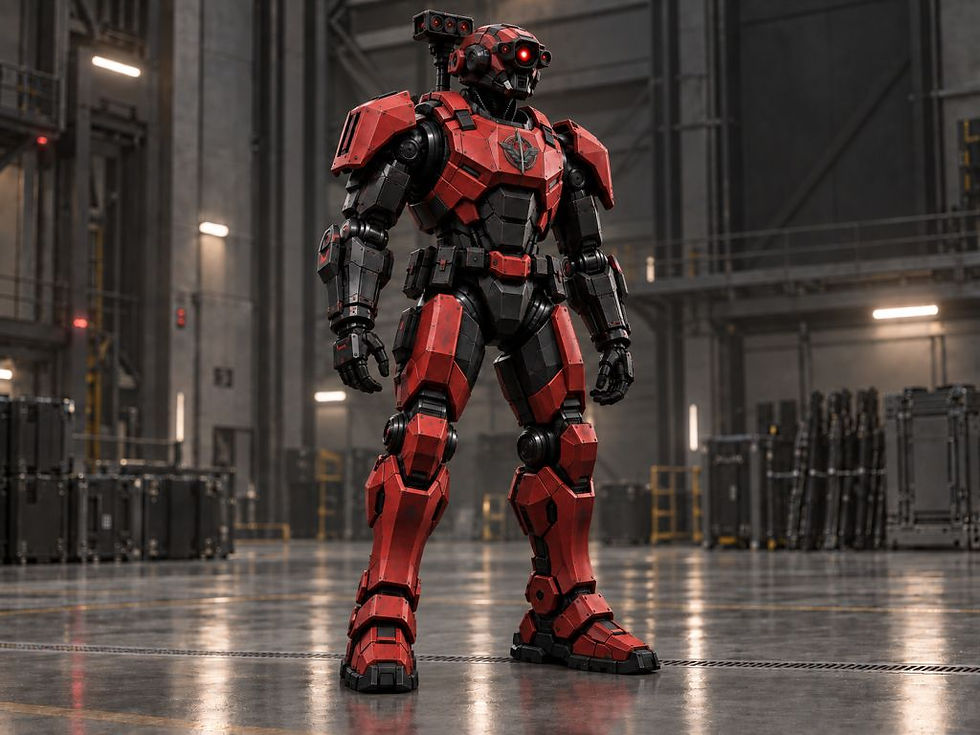
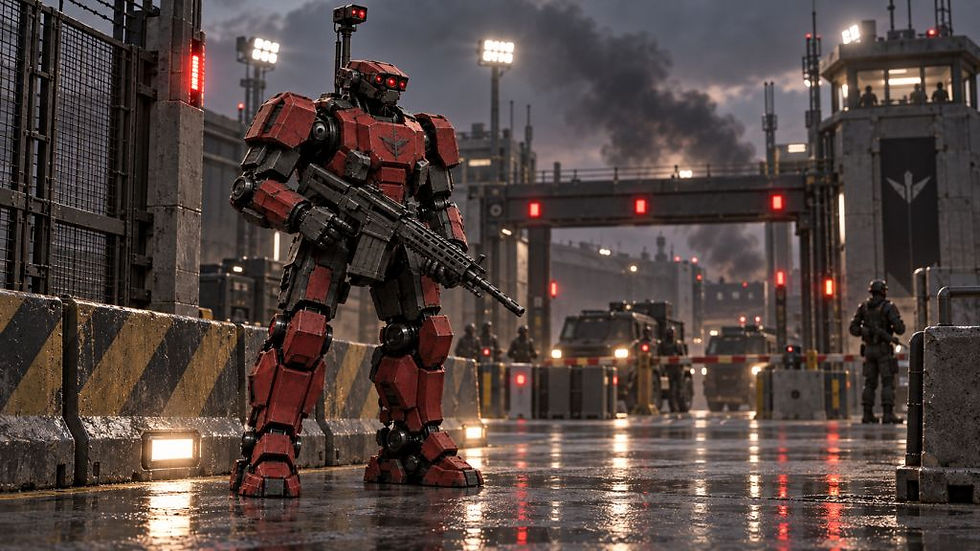

Security / Strategic-Site Defense
The Mk VII-D Sentinel Redcoat is the UCE’s dedicated security, surveillance, checkpoint, prison, and strategic-site defense platform.
Where the VII-A is built to maneuver with frontline forces, the VII-D is built to remain.
Its purpose is persistence.
A Sentinel may spend hours, days, or even longer assigned to the same facility, access point, perimeter, detention complex, weapons site, or critical infrastructure node while continuously monitoring the environment around it.
It is not simply a guard robot. It is a machine designed to make surprise difficult.
Mission
The VII-D is optimized for:
-
strategic-site defense,
-
persistent surveillance,
-
prison and detention security,
-
checkpoint operations,
-
perimeter control,
-
restricted-access enforcement,
-
rapid internal response,
-
infrastructure protection,
-
government-facility security,
-
and long-duration observation.
Typical assignments may include:
-
military installations,
-
command centers,
-
research facilities,
-
weapons depots,
-
power infrastructure,
-
communications hubs,
-
ports,
-
detention sites,
-
government compounds,
-
and Crown-security locations.
Physical Profile
The VII-D stands approximately 6 ft 9 in / 2.06 m tall.
Its base weight is approximately 760 lb / 345 kg, increasing to roughly 830–900 lb under normal operational load.
Its body remains recognizably part of the Mk VII humanoid family, but the Sentinel emphasizes:
-
sensor coverage,
-
stability,
-
endurance,
-
protected electronics,
-
observation equipment,
-
and defensive positioning.
The most visually distinctive feature on some configurations is the Extended Observation Sensor Mast.
This sensor system increases the machine’s ability to observe:
-
over vehicles,
-
across crowds,
-
beyond barriers,
-
around fixed defensive positions,
-
and across restricted compounds.
The mast is optional equipment, not a separate Sentinel model.
Mobility
The Sentinel is fully mobile and capable of deploying with ordinary Redcoat formations when required. Typical sustained tactical movement is approximately 10–12 mph, with a maximum sprint speed of roughly 22 mph. It is not optimized for prolonged pursuit.
Its mobility exists primarily to:
-
reposition within defended areas,
-
respond to alarms,
-
reinforce access points,
-
intercept intruders,
-
and move between security sectors.
Strength
The VII-D can perform approximately a 2,500 lb controlled lift under ideal conditions.
This allows it to:
-
move security barriers,
-
reposition heavy equipment,
-
remove debris,
-
restrain intruders,
-
force damaged doors,
-
and physically reinforce access-control points.
Its strength is more than sufficient for its security role without unnecessarily increasing chassis mass.
Armor
The VII-D uses Defensive Security Armor.
Armor distribution prioritizes:
-
torso,
-
head and sensor systems,
-
shoulders,
-
forearms,
-
power systems,
-
and lower-leg stability.
Unlike the Breacher or Heavy, the Sentinel is not designed primarily around aggressive forward assault.
Its armor is intended to keep it operational during:
-
attacks on checkpoints,
-
riots,
-
sabotage,
-
facility breaches,
-
small-arms engagements,
-
and defensive firefights.
Power — HDPM-7D Endurance Module
The VII-D uses the HDPM-7D Endurance Module.
The system is optimized for long periods of low-to-moderate activity punctuated by short periods of high-intensity response.
Typical endurance is approximately:
-
96 hours mixed duty
-
up to approximately 7 days in low-activity guard conditions
-
20–24 hours high-intensity combat
This makes the Sentinel one of the longest-duration humanoid Mk VII variants.
Watch State
The VII-D possesses a specialized low-consumption operating mode known as:
Watch State
During Watch State, the machine reduces unnecessary actuator and processing activity while maintaining:
-
core sensors,
-
threat monitoring,
-
communications,
-
access-control functions,
-
environmental awareness,
-
and rapid-response readiness.
The Sentinel does not “sleep.” It becomes quieter and more efficient. If a threat threshold is crossed, it can return to full operational status almost immediately.
Sentinel Brace Mode
The VII-D also possesses:
Sentinel Brace Mode
When defending a fixed position, the machine can shift into a mechanically reinforced posture.
This improves:
-
weapon stability,
-
resistance to physical displacement,
-
crowd-control effectiveness,
-
and survivability behind defensive cover.
Sentinel Brace Mode is especially useful at:
-
gates,
-
checkpoints,
-
corridors,
-
vehicle barriers,
-
prison access points,
-
and fortified entrances.
The machine becomes harder to move precisely when its mission requires it to remain in place.
Sensors
The Sentinel carries an expanded version of the IRSA-7 Integrated Redcoat Sensor Array optimized for persistent observation.
Capabilities may include:
-
visible-spectrum imaging,
-
thermal imaging,
-
low-light surveillance,
-
motion tracking,
-
directional acoustic detection,
-
range finding,
-
environmental monitoring,
-
identity verification,
-
pattern recognition,
-
and long-duration activity comparison.
The VII-D is particularly effective at noticing change. A vehicle parked where none was expected. A door opened outside its schedule. A person moving against established traffic flow. An object left behind. Repeated observation allows the system to compare current activity against known or expected conditions.
Extended Observation Sensor Mast
The optional sensor mast expands observation range and line-of-sight coverage.
It may include:
-
elevated optical systems,
-
long-range thermal imaging,
-
enhanced rangefinding,
-
panoramic scanning,
-
and improved perimeter observation.
Because the mast is exposed, it is designed to retract, fold, or remain absent entirely when the tactical situation makes it vulnerable. A Sentinel does not require the mast to function. It is an enhancement.
Weapons
The standard VII-D weapon is typically the:
SC-22 Security Carbine
The SC-22 is optimized for:
-
checkpoint defense,
-
facility protection,
-
controlled-range engagements,
-
and security operations.
Some assignments may instead use the AR-27 Imperial Automatic Rifle.
Weapon selection depends on whether the Sentinel’s assignment is primarily:
-
security,
-
military defense,
-
prison control,
-
or high-threat strategic protection.
ICP-7 Imperial Compliance Package
The VII-D may carry the:
ICP-7 Imperial Compliance Package
The ICP-7 provides equipment suited to situations in which lethal force is not the first or preferred response.
Depending on mission authorization, it may include:
-
restraint systems,
-
less-lethal launchers,
-
acoustic warning systems,
-
high-intensity illumination,
-
crowd-control tools,
-
electronic access-control interfaces,
-
and compliance-enforcement equipment.
The presence of the package does not make the Sentinel harmless.
It gives the machine more options before escalation to lethal force.
Checkpoint Operations
The VII-D is particularly effective at checkpoints because it can continuously combine:
-
identity verification,
-
vehicle observation,
-
behavioral analysis,
-
communications checks,
-
weapons detection,
-
access authorization,
-
and physical enforcement.
It does not become distracted. It does not become bored. It does not waive procedure because a shift is ending. That makes it useful to Imperial security planners and deeply unpopular with anyone attempting to bypass Imperial control.
Prison and Detention Use
Sentinels are frequently suited to detention environments because of their ability to maintain continuous control without fatigue.
They may be assigned to:
-
cell-block access,
-
secure corridors,
-
perimeter zones,
-
transport bays,
-
high-risk detainee areas,
-
and emergency-response stations.
Their machine strength allows them to physically restrain ordinary detainees without requiring the same number of human officers. Against metahuman or enhanced detainees, Sentinel units normally operate as part of a broader layered security system rather than as the sole containment mechanism.
Rapid Response
Although optimized for static security, VII-D units can immediately transition into mobile response.
A Sentinel detecting a breach can:
-
alert nearby units,
-
seal access points,
-
track intruders,
-
coordinate with other Sentinels,
-
direct Line Redcoats,
-
and pursue threats within the defended complex.
This makes the Sentinel both an observer and an active part of the site's defensive network.
Command Authority
Selected VII-D units may carry elevated B-series authority.
A high-authority Sentinel can coordinate:
-
lower Redcoats,
-
security cells,
-
checkpoint teams,
-
and compatible Cybersentinels.
As with the rest of the Mk VII family, this status is deliberately concealed from external observation.
The machine with the largest sensor mast is not necessarily the one in command.
Battlefield Identity
The VII-D can be summarized simply: the Line Redcoat takes ground.
The Sentinel makes sure the Empire keeps it. Its value is not spectacular movement or overwhelming firepower. It is presence.
Hours later, it is still watching. Days later, it may still be standing in exactly the same place. And if something changes, it notices.
MK VII-E HAZARD REDCOAT


Hazardous-Environment Combat / Rescue / Recovery
The Mk VII-E Hazard Redcoat is the UCE’s dedicated machine for environments considered too contaminated, unstable, toxic, radioactive, flooded, burning, or biologically dangerous for ordinary personnel.
The VII-E exists because not every battlefield is survivable and not every military crisis looks like a battlefield. Some environments kill before an enemy ever needs to fire a weapon. The Hazard Redcoat is designed to go anyway.
Mission
The VII-E specializes in:
-
chemical contamination,
-
biological hazards,
-
radiological environments,
-
nuclear incident response,
-
industrial disasters,
-
toxic atmospheres,
-
severe fire conditions,
-
flood operations,
-
contaminated battlefield recovery,
-
WMD aftermath,
-
hazardous rescue,
-
and recovery of sensitive equipment or materials.
Its mission can be military, emergency, scientific, or security related.
The defining requirement is always the same: the environment itself is dangerous enough to become part of the mission.
Physical Profile
The VII-E stands approximately 6 ft 11 in / 2.11 m tall.
Its base weight is approximately 940 lb / 426 kg, increasing to roughly 1,020–1,140 lb under full operational load.
The chassis is heavily sealed and visually denser than the Line or Sentinel models.
Its design includes:
-
reinforced environmental joints,
-
sealed sensor housings,
-
protected actuator interfaces,
-
contamination-resistant exterior surfaces,
-
reinforced lower legs,
-
protected torso systems,
-
and dedicated environmental monitoring hardware.
Its bulk comes less from raw combat armor than from isolation and survival systems.
Mobility
Typical sustained tactical movement is approximately 9–11 mph, with a maximum sprint speed of roughly 20 mph.
The VII-E is designed to operate through:
-
deep mud,
-
contaminated water,
-
smoke,
-
industrial debris,
-
flood zones,
-
chemically active terrain,
-
damaged facilities,
-
and fire-compromised structures.
Its movement is deliberate. Maintaining seal integrity and environmental protection often matters more than maximum speed.
Strength
The VII-E can perform approximately a 3,000 lb controlled lift under ideal conditions.
This allows the machine to:
-
move wreckage,
-
extract casualties,
-
manipulate industrial equipment,
-
lift damaged barriers,
-
recover hazardous containers,
-
and carry heavy rescue tools.
Its strength supports both combat and emergency-response functions.
Armor
The VII-E uses Environmental Reinforced Armor. This armor system is designed not only to stop physical threats but also to protect sensitive internal systems from hostile environments.
Protection includes resistance to:
-
chemical exposure,
-
biological contamination,
-
high particulate loads,
-
thermal extremes,
-
corrosive environments,
-
radiation exposure,
-
and contaminated liquids.
Conventional ballistic protection remains substantial, but environmental survival is the defining requirement.
FEIS — Full-Spectrum Environmental Isolation
At the heart of the VII-E is:
FEIS — Full-Spectrum Environmental Isolation
FEIS isolates critical machine systems from the surrounding environment.
The architecture includes:
-
sealed actuator interfaces,
-
protected electronics,
-
environmental barriers,
-
internal pressure management,
-
contamination-resistant seals,
-
protected sensor channels,
-
and controlled internal thermal management.
The purpose is simple: external contamination should remain external.
Power — HDPM-7E Environmental Module
The VII-E uses the:
HDPM-7E Environmental Module
The system is optimized for the additional energy demands created by:
-
environmental sealing,
-
sensor operation,
-
thermal management,
-
pumps,
-
filtration support,
-
and specialized mission equipment.
Typical endurance is approximately:
-
70 hours mixed duty
-
16–18 hours high-intensity hazard operations
-
4–5 days low-mobility environmental monitoring
Environmental Sensors
The VII-E uses an expanded hazard-detection suite built around IRSA-7.
It can monitor for:
-
toxic industrial chemicals,
-
radiation,
-
airborne particulates,
-
temperature extremes,
-
atmospheric oxygen levels,
-
biological indicators,
-
explosive gases,
-
contamination gradients,
-
and environmental changes.
Sensor packages can be tailored to mission type.
A radiological response unit and a biological containment unit may therefore carry different external modules while remaining the same VII-E chassis.
Hazard Sampling Module
The VII-E may carry a dedicated Hazard Sampling Module.
This allows it to collect:
-
air samples,
-
liquid samples,
-
soil,
-
residue,
-
particulate matter,
-
biological material,
-
and contaminated debris.
Samples can be isolated within sealed containers for later analysis. This lets the machine act not only as a responder, but as a mobile collection platform.
HOTP-7 — Hazard Operations Tool Package
The standard specialized equipment suite is the:
HOTP-7 Hazard Operations Tool Package
Mission-configured tools may include:
-
remote manipulators,
-
cutting equipment,
-
industrial clamps,
-
sampling systems,
-
decontamination sprayers,
-
sealing compounds,
-
thermal tools,
-
extraction gear,
-
heavy rescue equipment,
-
and hazardous-material containment systems.
The package changes according to mission requirements.
Primary Weapon — AR-27E Environmental Rifle
The VII-E uses the:
AR-27E Environmental Rifle
The AR-27E is based on the standard AR-27 architecture but modified for contaminated and extreme environments.
Enhancements may include:
-
protected action components,
-
sealed electronic interfaces,
-
corrosion-resistant materials,
-
contamination-tolerant controls,
-
and simplified external surfaces.
The weapon is intended to remain functional where ordinary systems may quickly degrade.
Fire Operations
The VII-E can operate in severe heat and fire environments beyond normal Redcoat tolerance.
It may:
-
enter burning structures,
-
cross active fire zones,
-
recover personnel,
-
isolate hazardous materials,
-
open blocked access,
-
and suppress limited localized fires using mission equipment.
It is not a fireproof machine. Extreme temperatures can still damage it. The difference is that its failure threshold is much higher.
Radiological and Nuclear Environments
The VII-E is capable of operating in radiological environments that would rapidly endanger human personnel. Shielding, hardened electronics, and radiation-aware mission planning reduce vulnerability.
The machine can support:
-
reactor incidents,
-
fallout zones,
-
contaminated facilities,
-
damaged weapons sites,
-
and post-detonation recovery.
Long-term radiation accumulation still matters. A Hazard Redcoat may survive a mission while still requiring decontamination, component replacement, or retirement afterward.
Chemical and Biological Environments
Because it does not breathe and does not possess organic tissue, the VII-E has obvious advantages in chemical and biological incidents.
However, contamination can still threaten:
-
seals,
-
joints,
-
sensors,
-
equipment,
-
external surfaces,
-
and anything the machine carries back with it.
This is why containment and decontamination procedures remain essential. A machine immune to infection can still become a carrier.
Flood and Submersion Operations
The VII-E can operate in flooded environments and may tolerate limited submersion to approximately 100 ft / 30 m.
This capability supports:
-
flooded facilities,
-
ship damage,
-
submerged infrastructure,
-
river or harbor incidents,
-
and disaster recovery.
It is not a dedicated underwater combat vehicle. Depth and time remain limited by pressure, sealing, navigation, and communications constraints.
Rescue Operations
The Hazard is one of the Redcoat variants most easily presented to the public as a life-saving system. It can enter environments before firefighters, medics, engineers, or hazardous-material teams are cleared to enter.
It can:
-
locate survivors,
-
lift debris,
-
transport casualties,
-
carry emergency supplies,
-
identify contamination,
-
establish safe routes,
-
and recover trapped personnel.
This humanitarian function is real. So is the machine's ability to perform the same tasks during warfare.
WMD Aftermath
The VII-E is particularly valuable after weapons-of-mass-destruction incidents.
Its roles may include:
-
contamination mapping,
-
survivor search,
-
infrastructure inspection,
-
evidence collection,
-
hazardous-material recovery,
-
secure-site entry,
-
and support to decontamination teams.
Human personnel can remain outside the most dangerous zone while the Redcoat establishes what conditions actually exist inside it.
Operational Pairing
VII-E units frequently work with:
-
VII-A Line Redcoats for security,
-
VII-D Sentinels for perimeter control,
-
VII-C Breachers for hazardous entry,
-
Imperial engineers,
-
medical teams,
-
scientific personnel,
-
and emergency-response units.
Hazard missions often require expertise from multiple disciplines.
The VII-E provides the physical platform capable of entering first.
Battlefield Identity
The VII-E fills a role no other Redcoat completely replaces.
A Line unit may be stronger than a human.
A Heavy may carry more firepower.
A Breacher may force entry.
A Sentinel may remain on station longer.
But when the air is poisonous, the ground is contaminated, the structure is burning, or the site remains radioactive, those advantages may no longer be enough.
That is where the Hazard begins. VII-E survives where others cannot.
Mk VII-F Hunter Redcoat


Pursuit / Tracking / Anti-Metahuman Support
The Mk VII-F Hunter Redcoat is the most physically unconventional member of the Mk VII family.
Unlike the humanoid A-through-E variants, the VII-F is built around a low quadrupedal chassis optimized for speed, pursuit, tracking, terrain stability, and target persistence.
It is not a robotic dog. It is a purpose-built Imperial pursuit machine. Its role begins where ordinary containment starts to fail:
when the target runs.
Mission
The VII-F specializes in:
-
pursuit,
-
tracking,
-
perimeter interception,
-
fugitive recovery,
-
anti-metahuman support,
-
wilderness operations,
-
urban chase,
-
route denial,
-
escaped-detainee response,
-
and target persistence.
Its primary function is not conventional frontline infantry combat. The Hunter exists to locate, pressure, follow, contain, and help capture targets that are difficult to keep fixed in one place.
This includes:
-
fleeing combatants,
-
infiltrators,
-
enhanced individuals,
-
hostile scouts,
-
escaped prisoners,
-
sabotage teams,
-
and other mobile threats.
The VII-F is particularly valuable when the target’s best defense is speed, distance, terrain, or concealment.
Physical Profile
The Hunter measures approximately 6 ft 10 in / 2.08 m in overall length and approximately 4 ft 2 in / 1.27 m at the shoulder.
Its base weight is approximately 610 lb / 277 kg, increasing to roughly 660–740 lb under full mission load.
The chassis is deliberately low.
Its design emphasizes:
-
four-point stability,
-
rapid acceleration,
-
high-speed turning,
-
obstacle negotiation,
-
low center of gravity,
-
terrain grip,
-
and resistance to being knocked off balance.
The front assembly carries the familiar Mk VII design language through a compact wedge-shaped sensor head and narrow red optical band. Its body, however, is entirely specialized for quadrupedal movement.
Visual Identity
The VII-F retains the common UCE Redcoat visual language while adapting it to a pursuit platform.
Its standard appearance includes:
-
predominantly black mechanical legs,
-
restrained Imperial red armor,
-
red forward shoulder guards,
-
red chest/front chassis armor,
-
black mechanical joints and structural components,
-
narrow red optics,
-
and the Imperial Redcoat chest insignia.
The front leg articulation is intentionally animal-like in function without making the machine literally canine. The Hunter should look engineered for movement. Not domesticated. Not friendly. Not organic.
Mobility
Mobility is the Hunter’s defining characteristic.
Typical performance includes:
-
30–35 mph sustained pursuit
-
approximately 48 mph maximum sprint
-
approximately 6 ft vertical jump
-
approximately 18–22 ft running jump
These figures allow the VII-F to operate across:
-
roads,
-
alleys,
-
industrial yards,
-
forest terrain,
-
snow,
-
rubble,
-
rail corridors,
-
damaged urban environments,
-
and uneven ground.
Its four-legged configuration provides exceptional stability during rapid directional changes. The Hunter can brake, turn, accelerate, and reposition more aggressively than humanoid Redcoats.
Strength
The VII-F possesses approximately 1,800 lb equivalent controlled strength. Its strength is distributed differently from humanoid models.
Rather than being optimized for lifting large objects upright, the Hunter excels at:
-
pulling,
-
dragging,
-
pinning,
-
bracing,
-
restraining,
-
climbing over obstacles,
-
and maintaining traction during pursuit.
Its low body and four-point stance also allow it to resist physical displacement surprisingly well.
Armor
The Hunter uses Mobile Pursuit Armor.
Protection is concentrated around:
-
forward torso,
-
shoulders,
-
sensor systems,
-
power architecture,
-
upper limb structures,
-
and critical internal components.
The legs receive lighter protection than the torso in order to preserve mobility and speed. That creates an intentional tradeoff.
The VII-F is harder to hit effectively when moving, but less suited than a Heavy or Sentinel to standing in place and absorbing sustained fire.
Its defense is partly armor. Its defense is also movement.
Power — HDPM-7F High-Output Pursuit Module
The Hunter uses the:
HDPM-7F High-Output Pursuit Module
This power system is optimized for rapid acceleration, high-speed movement, actuator responsiveness, and sustained tracking.
Typical endurance is approximately:
-
60 hours mixed duty
-
36 hours active tracking
-
8–12 hours high-speed pursuit
Extended maximum-speed operation significantly reduces endurance.
The Hunter is therefore designed to alternate between:
-
search,
-
track,
-
pressure,
-
burst pursuit,
-
and interception.
It does not sprint continuously unless mission circumstances demand it.
ATAS — Atmospheric Trace Analysis
One of the VII-F’s most important specialized systems is:
ATAS — Atmospheric Trace Analysis
ATAS assists the Hunter in detecting and comparing environmental traces associated with a target.
Depending on conditions, this may include:
-
disturbed particulates,
-
chemical residue,
-
thermal traces,
-
material transfer,
-
exhaust,
-
blood,
-
smoke,
-
environmental disruption,
-
and other machine-detectable evidence.
ATAS is not supernatural tracking. It is high-speed sensor analysis.
The system becomes less effective as:
-
time passes,
-
environmental contamination increases,
-
weather changes,
-
crowds overlap the area,
-
or deliberate countermeasures are used.
But under favorable conditions, it can make disappearing from a Hunter extremely difficult.
Sensor Architecture
The VII-F uses an IRSA-7 derivative optimized for pursuit.
Its capabilities may include:
-
wide-angle visual tracking,
-
low-light imaging,
-
thermal detection,
-
motion prediction,
-
terrain scanning,
-
path analysis,
-
acoustic localization,
-
target recognition,
-
and route forecasting.
The Hunter does not merely observe where a target is. It continuously estimates where the target is likely to go next.
That predictive element is especially important during high-speed pursuit.
Pack Tactics
Hunters are frequently deployed in groups. The standard configuration is a six-unit Hunter Pack. Smaller operations may use a three-unit Hunter Cell. Major pursuit operations may deploy 12–18 Hunters.
This allows the machines to perform coordinated actions such as:
-
flanking,
-
leapfrogging,
-
route blocking,
-
area compression,
-
cross-tracking,
-
and multi-directional interception.
One Hunter may maintain pressure while others move ahead. Another may remain behind to preserve the trail. Others may spread outward to close likely escape routes. The target is therefore not simply being chased by several machines. It is being tactically surrounded over time.
RRCS-7 in Hunter Operations
The Hunter makes especially effective use of RRCS-7.
At range, pack members exchange:
-
tracking data,
-
route predictions,
-
target position,
-
sensor contact,
-
and interception instructions.
At close range, Cell Whisper allows nearby Hunters to coordinate without depending on broader communications.
MVTL can also be used.
Because the VII-F is quadrupedal, its visual tactical language emphasizes:
-
head orientation,
-
body angle,
-
leg positioning,
-
optical signaling,
-
and posture shifts.
To an observer, these movements may appear instinctive. They are not. They are encoded machine communication.
ICD-6 — Hunter Close Defense
The VII-F uses:
ICD-6 Hunter Close Defense
ICD-6 provides the Hunter with integrated defensive capability for close-range engagements.
The system is intended for:
-
self-defense,
-
target suppression,
-
disengagement,
-
and support during containment.
-
The Hunter is not intended to function as a walking heavy-weapons platform. Its weapons exist to support pursuit. Not replace it.
HTRL-7 — Hunter Tactical Restraint Launcher
One of the Hunter’s primary capture-oriented systems is the:
HTRL-7 Tactical Restraint Launcher
The HTRL-7 allows a VII-F to deploy specialized restraint systems against fleeing or mobile targets.
Depending on mission authorization, this may include:
-
tethering systems,
-
entanglement devices,
-
weighted restraints,
-
or other immobilization tools.
Its purpose is to reduce the need for lethal force when capture remains practical. Against sufficiently strong metahumans, restraint may only delay the target. Delay can still be enough.
ITD-7 — Imperial Target Designator
The:
ITD-7 Imperial Target Designator
allows the Hunter to mark and track high-priority targets for other Imperial assets.
This may support:
-
Redcoat formations,
-
Cybersentinels,
-
aircraft,
-
vehicles,
-
Enforcers,
-
and security forces.
Once a Hunter obtains persistent identification, the rest of the Imperial force can be directed toward the same target.
IPT-7 — Imperial Pursuit Tag
The:
IPT-7 Imperial Pursuit Tag
is designed to maintain target continuity after initial contact.
Where mission conditions permit, a Hunter may deploy a tracking tag onto:
-
clothing,
-
equipment,
-
vehicles,
-
or other suitable surfaces.
This allows continued pursuit even if direct visual contact is temporarily lost. The target may escape the Hunter’s line of sight.
That does not necessarily mean the pursuit has ended.
Anti-Metahuman Support
The VII-F is especially valuable against metahumans whose abilities make ordinary containment difficult. It is not designed to defeat every enhanced individual by itself.
Instead, it supports capture by:
-
maintaining contact,
-
forcing movement,
-
narrowing escape routes,
-
designating targets,
-
delaying flight,
-
and guiding heavier Imperial assets into position.
Against a target stronger than the Hunter, the correct response is not necessarily direct confrontation.
The correct response may be to keep the target from disappearing until something stronger arrives.
Urban Pursuit
In urban environments, the Hunter can use:
-
alleys,
-
service roads,
-
parking structures,
-
rail corridors,
-
industrial lots,
-
pedestrian spaces,
-
and damaged infrastructure
that may restrict larger military vehicles.
Its low profile and acceleration make it especially effective in dense areas. However, crowd density can reduce its ability to operate at maximum speed. Imperial doctrine therefore emphasizes prediction and containment rather than reckless high-speed movement through civilians.
Wilderness Pursuit
The VII-F is equally effective outside cities.
Its four-legged architecture gives it advantages in:
-
forest,
-
snow,
-
rough ground,
-
steep embankments,
-
trails,
-
and broken terrain.
Where wheeled vehicles may become constrained by terrain, the Hunter can continue. This makes it particularly useful in remote regions and border zones.
Capture and Restraint
The Hunter’s capture doctrine emphasizes:
-
isolate,
-
pressure,
-
intercept,
-
restrain,
-
hold.
If a target is brought to the ground, the VII-F can use its mass and four-point stance to maintain physical pressure until additional forces arrive. Against ordinary humans, this can be overwhelming. Against metahumans, it may be temporary. The machine understands the difference through threat classification.
Limitations
The Hunter’s specialization creates clear weaknesses.
It is less suited to:
-
prolonged static defense,
-
heavy suppression,
-
fortified assault,
-
narrow vertical interior spaces,
-
ladders,
-
confined stairways,
-
and environments requiring extensive manual manipulation.
Its lighter leg armor also makes mobility damage especially serious.
A Hunter with major leg damage may remain dangerous, but its primary advantage can disappear rapidly.
Its tracking capability can also be degraded by:
-
environmental contamination,
-
deliberate masking,
-
weather,
-
decoys,
-
electronic interference,
-
and targets capable of unusual movement or teleportation.
The Hunter is persistent. It is not infallible.
Command and Pack Authority
Hunter Packs use the same B-series authority architecture as the rest of Mk VII. Selected units may possess higher command authority. That command status is not externally obvious. A pack does not require a physically different “alpha” machine. The commanding Hunter may look identical to the others. Authority exists in architecture, not ornament.
Operational Identity
The VII-F represents the final specialized edge of the Mk VII family.
It does not hold the line like the VII-A.
It does not overwhelm positions like the VII-B.
It does not force entry like the VII-C.
It does not maintain strategic sites like the VII-D.
It does not survive contamination like the VII-E.
It does something none of them perform as efficiently:
it refuses to let the target simply leave.
The Hunter closes distance. It follows. It predicts. It coordinates. It persists.
And when the target believes distance has created safety, the machine is often still coming.
VII-F finds what tries to escape.