
A Universe of Pure Imagination

TM


IMPERIAL ARMED FORCES OF THE UNITED CANADIAN EMPIRE (UCE) OVERVIEW

IMPERIAL ARMED FORCES OF THE UNITED CANADIAN EMPIRE (UCE)
The Imperial Armed Forces of the United Canadian Empire are the conventional military forces responsible for the defense of UCE territory, strategic infrastructure, airspace, waterways, military installations, and national interests.
Built around a compact but highly prepared force structure, the Imperial Armed Forces emphasize rapid mobilization, territorial defense, advanced technology, hardened infrastructure, integrated surveillance, and joint-service operations. Rather than competing through sheer manpower, the UCE military is designed to make Imperial territory extremely difficult to penetrate, occupy, or disable.
The armed forces operate under the authority of the Emperor of the United Canadian Empire, who serves as Commander-in-Chief. Day-to-day professional military leadership is exercised through the Chief of Imperial Defense.
Force Strength
Active Personnel: Approximately 5,000
Imperial Reserve: Approximately 3,000
Total Mobilizable Conventional Force: Approximately 8,000
NOTE: These numbers do not include the UCE Enforcers, Redcoats, Cybersentinels, Crown Security personnel, or other extraordinary strategic assets.
Primary Services
The Imperial Armed Forces are composed of three principal military branches:
-
Imperial Army — ground combat, territorial defense, mechanized operations, engineering, reconnaissance, and infrastructure security
-
Imperial Air Service — air defense, tactical aviation, rotary-wing operations, reconnaissance, transport, drones, and airspace control
-
Imperial Maritime Service — territorial-water defense, harbor security, interdiction, maritime patrol, amphibious support, and search and rescue
The military is further supported by Imperial Special Operations Command (ISOC), a joint command drawing selected personnel from all three services for high-risk and sensitive military operations.
Command Authority
The Imperial Armed Forces operate through an integrated command structure designed to coordinate ground, air, maritime, intelligence, and special-operations capabilities during both routine readiness and national emergencies.

Commander-in-Chief:
Emperor of the United Canadian Empire
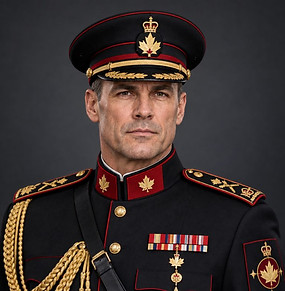
Senior Professional Military Officer:
Chief of Imperial Defense (General)
Mission
The primary mission of the Imperial Armed Forces is to:
-
defend UCE territory against military attack
-
protect critical national infrastructure
-
secure UCE airspace and surrounding waterways
-
maintain rapid-response military capability
-
support national emergency operations
-
preserve military readiness and territorial control
-
deter hostile intervention through preparedness and technological superiority
Force Character
The Imperial Armed Forces are best defined as: Professional. Disciplined. Defensive. Highly Prepared.
The UCE military is not structured to dominate a continent through numbers. It is structured to ensure that any attempt to attack or occupy the United Canadian Empire would face a highly coordinated, technologically supported, and deeply prepared defense.


Military Doctrine
The Imperial Armed Forces are built around one central principle: make the United Canadian Empire extremely difficult to penetrate, disable, or occupy.
Rather than relying on overwhelming manpower, the UCE emphasizes rapid mobilization, hardened infrastructure, advanced surveillance, integrated communications, and tightly coordinated ground, air, maritime, and special-operations forces.
UCE doctrine favors controlling the battlespace, identifying threats early, moving forces quickly, and using technology to multiply the effectiveness of a relatively compact military.
The result is a defensive strategy based on preparedness, mobility, information superiority, and deterrence—ensuring that any attack on the Empire comes at a very high cost.
BRANCHES OF SERVICE
The Imperial Armed Forces are organized into three primary military branches, supported by a joint special-operations command. Each branch maintains a distinct mission while operating as part of an integrated national defense structure. Together, these forces provide the UCE with a compact but highly coordinated military capable of responding rapidly across ground, air, and maritime domains.


STANDARD IMPERIAL TROOPER


Imperial Army

ISOC Specialist

Maritime Service

Air Service

Officer (Female)

Officer (Male)
The Standard Imperial Trooper represents the baseline combat personnel of the Imperial Armed Forces. While uniforms and equipment vary by branch and assignment, all Imperial troops share a common emphasis on protection, communications, mobility, and cold-weather readiness. The result is a professional, well-equipped soldier capable of operating effectively across the UCE’s ground, airfield, maritime, and joint-service environments.
Standard Equipment
Typical field equipment includes:
-
dark charcoal / black combat uniform
-
modular ballistic body armor
-
combat helmet with integrated communications
-
eye and hearing protection
-
encrypted personal radio
-
individual medical kit
-
utility and ammunition pouches
-
navigation equipment
-
hydration and survival gear
-
cold-weather equipment as required
Standard Training
All Imperial military personnel receive training in:
-
weapons proficiency
-
small-unit tactics
-
communications
-
navigation
-
first aid
-
defensive operations
-
urban operations
-
physical conditioning
-
cold-weather field operations
Standard Weapons
Imperial troops typically carry:
-
service rifle or carbine
-
service pistol where assigned
-
squad automatic or support weapons as required
-
specialized equipment based on mission and branch

IMPERIAL ARMY


The Imperial Army is the largest branch of the Imperial Armed Forces and serves as the UCE’s primary ground-combat and territorial-defense force.
Approximately 3,000 active personnel provide infantry, mechanized, engineering, reconnaissance, communications, logistics, medical, and heavy-weapons capabilities throughout UCE territory. For larger operations, units may be combined into mission-specific Imperial Battle Groups.
Primary Roles
-
territorial defense
-
ground combat
-
rapid-response operations
-
infrastructure protection
-
mechanized support
-
combat engineering
-
reconnaissance
-
emergency military support
Organization
The Army is built around flexible formations rather than large permanent divisions. Its principal components include:
-
Infantry Forces
-
Mechanized Forces
-
Combat Engineers
-
Fires / Heavy Weapons
-
Signals & Electronic Support
-
Logistics & Transport
-
Army Medical Service
-
Army Reconnaissance
Imperial Army Seal

Equipment & Mobility
Imperial Army troops use modern modular body armor, encrypted communications, standardized service weapons, reconnaissance drones, armored personnel carriers, tactical vehicles, engineering vehicles, and mobile command systems.
The Army favors mobility, prepared defenses, and rapid reinforcement over large traditional armored formations.
Branch Character
The Imperial Army is designed to move quickly, hold critical ground, protect strategic sites, and provide the conventional military backbone of UCE territorial defense.
UCE M-50 "Razorback" Tank


IMPERIAL AIR SERVICE


The Imperial Air Service provides the UCE with air defense, tactical aviation, reconnaissance, transport, rotary-wing support, drone operations, and continuous airspace monitoring.
Approximately 650 active personnel operate and support a compact but technologically advanced aviation force designed for rapid response rather than large-scale strategic air warfare.
Primary Roles
-
airspace defense
-
tactical aviation
-
rotary-wing operations
-
aerial reconnaissance
-
transport and mobility
-
drone operations
-
maritime support
-
search and rescue
Organization
The Air Service is built around several specialized components:
-
Air Defense Command
-
Tactical Aviation Group
-
Rotary-Wing Group
-
Air Mobility Group
-
Uncrewed Systems Group
-
Air Technical & Support Command
Imperial Air Service Seal

Aircraft & Systems
The Air Service uses a small number of versatile aircraft supported by extensive sensors, drones, and ground-based air-defense systems.
Key UCE aircraft include:
-
F-50 Guardian — indigenous UCE multirole fighter / interceptor
-
AH-50 Enforcer — armed rotary-wing assault and deployment platform
Ground-based radar, passive sensors, anti-drone systems, and layered air-defense networks are considered just as important as combat aircraft.
Branch Character
The Imperial Air Service is compact, technically sophisticated, and highly integrated with Army, Maritime, and Special Operations forces.
Its mission is simple: detect threats early, respond quickly, and deny hostile aircraft easy access to UCE airspace.
UCE F-50 "GUARDIAN" FIGHTER JET


UCE AH-50 "ENFORCER" ATTACK/SUPPORT HELICOPTER


IMPERIAL MARITIME SERVICE


The Imperial Maritime Service protects UCE-controlled waterways, harbors, shoreline approaches, and maritime infrastructure.
Approximately 850 active personnel operate patrol craft, interceptor boats, landing craft, surveillance systems, and maritime-security units designed for rapid response and control of the UCE’s surrounding waters.
Primary Roles
-
territorial-water defense
-
harbor and port security
-
patrol and interdiction
-
maritime transport
-
amphibious support
-
vessel boarding operations
-
reconnaissance
-
search and rescue
Organization
The Maritime Service includes:
-
Patrol Command
-
Harbor Defense Command
-
Amphibious Operations Group
-
Maritime Security Group
-
Maritime Surveillance & Systems Group
-
Maritime Logistics & Engineering Command
Vessels & Systems
Rather than maintaining a traditional blue-water navy, the Maritime Service relies on fast, versatile craft optimized for local waters and shoreline defense.
Key vessels include:
-
IMS-1 Interceptor Class Swift/Attack Boat — high-speed armed interceptor with a crew of 8–10
-
IMS-L-1 Crab Class Landing Craft — UCE-designed amphibious transport and shoreline deployment craft
The branch also uses coastal sensors, maritime drones, uncrewed surface systems, and limited underwater systems to maintain continuous awareness of nearby waterways.
Branch Character
The Imperial Maritime Service is fast, patrol-heavy, and locally dominant.
Its purpose is not distant naval power projection, but to ensure hostile vessels cannot approach, enter, or operate freely within UCE-controlled waters.
IMS-1 "Interceptor" Swift Boats


IMS-L-1 "Crab" Class
Landing Craft


IMPERIAL SPECIAL OPERATIONS COMMAND


Imperial Special Operations Command (ISOC) is the joint special-operations component of the Imperial Armed Forces.
Approximately 300 personnel support high-risk missions requiring capabilities beyond normal branch operations while remaining within conventional military command.
Primary Roles
-
special reconnaissance
-
direct action
-
counterterrorism
-
hostage recovery
-
sensitive-site operations
-
strategic-facility recovery
-
counter-WMD support
-
high-risk maritime interdiction
-
personnel recovery
Organization
ISOC draws experienced personnel from the Imperial Army, Air Service, and Maritime Service.
Its principal elements include:
-
Special Operations Group — Ground
-
Special Maritime Operations Group
-
Special Aviation Detachment
-
Special Intelligence & Reconnaissance Group
-
Special Operations Support Group
Operational Structure
ISOC typically deploys in small, mission-specific formations:
-
Special Operations Teams: 6–8 operators
-
Special Operations Detachments: 12–24 personnel
-
Task Forces: assembled as needed from ground, maritime, aviation, intelligence, medical, and communications specialists
Branch Character
ISOC is highly selective, discreet, and mission-focused.
Its personnel are elite conventional military operators—more specialized than standard troops, but distinct from the UCE Enforcers, Redcoats, Cybersentinels, and other extraordinary strategic assets.

ORGANIZATION & RANKS
The Imperial Armed Forces use a centralized command structure with branch-specific leadership beneath the Chief of Imperial Defense.
While the Army and Air Service use a standardized rank system, the Maritime Service retains a distinct nautical hierarchy. ISOC personnel keep the ranks of their parent branch.
Imperial Maritime Service Ranks
Enlisted
-
Recruit
-
Sailor
-
Sailor First Class
-
Leading Sailor
-
Naval Technician
-
Master Technician
-
Department Director
-
Command Director
-
Fleet Marshal
Officers
-
Ensign
-
Lieutenant Junior Grade
-
Lieutenant
-
Lieutenant Commander
-
Commander
-
Captain
-
Commodore
-
Admiral
Imperial Army / Air Service Ranks
Enlisted
-
Trooper
-
Senior Trooper
-
Corporal
-
Sergeant
-
Staff Sergeant
-
Sergeant Major
-
Command Sergeant Major
Officers
-
Lieutenant
-
Captain
-
Major
-
Colonel
-
Brigadier
-
General
Senior Branch Commands
-
Imperial Army: Commanding General, Imperial Army
-
Imperial Air Service: Commanding General, Imperial Air Service
-
Imperial Maritime Service: Chief of Maritime Operations — Commanding Admiral
-
ISOC: Commander, Imperial Special Operations Command
This structure keeps overall military authority centralized while allowing each service to preserve the traditions and terminology suited to its role.
STANDARD / COMMON TALENTS
All personnel of the Imperial Armed Forces receive a common foundation of military training, with additional specialization based on branch, assignment, and role. Together, these skills allow Imperial personnel to operate effectively across ground, air, maritime, and joint-service environments.
Standard / Common Talents
-
weapons proficiency
-
small-unit tactics
-
military communications
-
navigation and fieldcraft
-
physical conditioning
-
combat first aid
-
defensive operations
-
urban operations
-
cold-weather operations
-
emergency response
Common Specialized Skills
Depending on assignment, personnel may also be trained in:
-
reconnaissance
-
combat medicine
-
heavy weapons
-
engineering and demolitions
-
drone operations
-
electronic warfare
-
vehicle or vessel operation
-
aviation support
-
intelligence
-
logistics and maintenance
-
maritime operations
-
advanced communications