A Universe of Pure Imagination

TM


OVERVIEW

Cybersentinels are the United Canadian Empire’s most advanced family of large-scale robotic weapons platforms, designed to perform missions beyond the practical limits of conventional troops, vehicles, Redcoats, or individual UCE Enforcers.
Developed from technologies first explored during the Empire’s post-2008 military expansion, modern Cybersentinels combine advanced tactical artificial intelligence, heavy armor, specialized weapons and defensive systems, sophisticated sensors, and highly adaptable mission architecture.
Unlike Redcoats, which are designed to function as robotic soldiers, Cybersentinels serve as specialized strategic platforms. Each production class is built around a distinct battlefield purpose—from surveillance and electronic warfare to heavy combat, mobile shield defense, and metahuman containment.
The modern Cybersentinel force is centered on four primary production classes:
Sentry — surveillance, electronic warfare, strategic-site defense, and local air defense.
Legion — heavy combat, armored engagement, breakthrough operations, and hardened-target destruction.
Bulwark — mobile kinetic-shield generation, strategic defense, and critical-site protection.
Warden — specialized anti-metahuman interdiction, suppression, restraint, and containment.
A fifth classification, Prototype, is reserved for experimental Cybersentinel systems undergoing advanced testing or performing highly specialized missions.
Program Scale
As of 2026, the United Canadian Empire maintains an authorized Cybersentinel force of 96 operational systems across the five classes.
The program remains deliberately limited in size. Cybersentinels are expensive, technically demanding strategic assets intended to provide disproportionate capability without requiring proportional increases in manpower.
________________________________________________________________
Redcoats fight as soldiers. Cybersentinels fight as weapons platforms.
________________________________________________________________


HISTORY & DEVELOPMENT
The Cybersentinel Program traces its origins to the United Canadian Empire’s military expansion following Operation IRON LANTERN in 2008. Early Imperial defense planners were already exploring advanced robotics, automated targeting, heavy armor, battlefield networking, kinetic-defense systems, and anti-metahuman countermeasures. IRON LANTERN accelerated those efforts and gave the program a clear purpose: create mobile strategic weapons platforms capable of delivering the kind of battlefield power normally associated with fortified positions.
Doctor Phlebotinum became central to the program’s early development, combining heavy robotics, experimental power systems, automated combat logic, advanced defensive technologies, and highly specialized countermeasure research.
Generation I — 2008–2012
The first true Cybersentinel test platforms appeared during this period. These machines were powerful but comparatively crude: heavily armored, mechanically complex, maintenance-intensive, and dependent on centralized support.
Early designs also experimented with several different mission concepts, including heavy battlefield combat, mobile defense, and dedicated anti-metahuman systems.
By the time of Operation: Gambit in February 2012, fewer than twenty Generation I Cybersentinels were believed to be deployable.
Their performance was formidable—but costly.
Approximately two-thirds of the operational machines committed during Gambit were destroyed or rendered combat ineffective.
Their losses exposed major weaknesses in early command networking, recovery, cooling, survivability, electronic warfare protection, and technology-denial systems.
One exceptionally resilient Generation I platform survived prolonged combat after losing network contact. Its ability to continue functioning independently became an important engineering reference for the next generation.
Generation II — 2012–2018
The lessons of Gambit fundamentally reshaped the program.
Generation II emphasized:
-
greater tactical autonomy;
-
hardened communications;
-
compartmentalized systems;
-
improved redundancy;
-
better recovery and self-righting capability;
-
modular repair architecture;
-
reduced dependence on centralized control.
During this era, the modern Cybersentinel class structure began to emerge.
The Sentry, Legion, Bulwark, Warden, and Prototype classifications were gradually formalized around distinct strategic missions rather than body shape or weapon size.
Generation III — 2018–2024
Generation III introduced more sophisticated tactical artificial intelligence and significantly improved battlefield adaptability.
Cybersentinels became better able to:
-
analyze multiple threats;
-
predict movement;
-
adapt routes and weapon use;
-
operate under degraded communications;
-
coordinate through secure tactical networks;
-
continue fighting after partial damage.
This period also saw major improvements in armor, electronic warfare resistance, sensor fusion, limited underwater operations, tactical hover capability, and the standardized use of Phleboto-bot repair systems.
Generation IV — 2024–Present
The current Generation IV fleet represents the most mature expression of the Cybersentinel concept.
Rather than radically changing the program, Generation IV integrates decades of lessons into a more reliable and standardized architecture.
Modern systems feature:
-
advanced tactical AI;
-
decentralized battlefield coordination;
-
hardened electronic security;
-
improved survivability;
-
standardized internal architecture;
-
refined repair systems;
-
mission-specific class specialization.
The result is a family of machines that can operate independently when necessary while remaining firmly subordinate to human strategic authority.
____________________________________________________________
Operation: Gambit nearly broke the first generation of Cybersentinels.
The lessons learned from those losses created the modern program.___________________________________________________________
CYBERSENTINEL CLASSES


Five Mission Families. One Strategic Weapons Program.
Cybersentinels are classified by primary strategic mission, not by size, shape, or weapon count.
Each class is built around a different operational problem, allowing the United Canadian Empire to deploy specialized machines instead of forcing one design to perform every battlefield role.
Modern production systems fall into four principal classes—Sentry, Legion, Bulwark, and Warden—with a fifth Prototype classification reserved for experimental platforms.
Sentry
Strategic Surveillance & Defense
Sentries are the most numerous Cybersentinel class and form the program’s surveillance backbone.
Their missions include:
-
persistent observation;
-
electronic warfare;
-
perimeter defense;
-
counter-drone operations;
-
local air defense;
-
target detection and tracking.
Their low quadrupedal design allows them to establish stable observation positions while maintaining enough mobility to relocate as battlefield conditions change.
Signature Capability: Watch Configuration
Legion
Heavy Combat & Breakthrough
Legions are the primary heavy-combat platforms of the Cybersentinel force.
They are designed to engage:
-
armored vehicles;
-
hardened defenses;
-
heavy robotic systems;
-
fortified positions;
-
concentrated battlefield resistance.
Their broad armored frame, integrated Heavy Kinetic Cannon, and powerful stabilization systems allow them to deliver significant battlefield firepower without replacing conventional armored formations.
Signature Capability: Braced Fire Posture
Bulwark
Mobile Shield Defense
Bulwarks are the heaviest standard production Cybersentinels and serve as mobile strategic-defense platforms.
Their primary function is the projection of powerful kinetic defensive fields capable of protecting:
-
strategic facilities;
-
military concentrations;
-
critical infrastructure;
-
temporary defensive positions.
When anchored, a Bulwark raises its armored shield-emitter tower and can temporarily reinforce or replace damaged fixed shield systems.
Signature Capability: Anchored Shield Deployment
Warden
Metahuman Interdiction & Containment
Wardens are rare, highly specialized Cybersentinels designed to counter powered individuals whose abilities may overwhelm conventional military responses.
Their systems emphasize:
-
advanced threat assessment;
-
specialized containment;
-
mobility denial;
-
restraint;
-
precision suppression.
Unlike Legions, Wardens are not designed around maximum conventional firepower. Their strength lies in identifying how a dangerous target operates and applying the correct response.
Signature Capability: Containment Stance
Prototype
Experimental Systems
Prototype Cybersentinels are not a single standardized machine.
The classification is reserved for experimental platforms used to test technologies that may eventually influence future production systems.
Prototype projects may explore:
-
new mobility systems;
-
experimental defensive technology;
-
advanced cognition;
-
extreme-environment operation;
-
specialized weapons or sensors.
Most Prototype systems never enter full production.
For security reasons, individual Prototype configurations are not publicly documented.
Class Philosophy
The Cybersentinel Program follows a simple design principle:
No single class is expected to perform every battlefield function.
Instead, classes are combined when missions require multiple capabilities.
A Sentry may detect the threat.
A Legion may destroy the obstacle.
A Bulwark may protect the objective.
A Warden may contain the extraordinary.
That specialization is one of the defining strengths of the modern Cybersentinel force.
CS-S4-01 SENTRY

Strategic Surveillance & Defense Platform
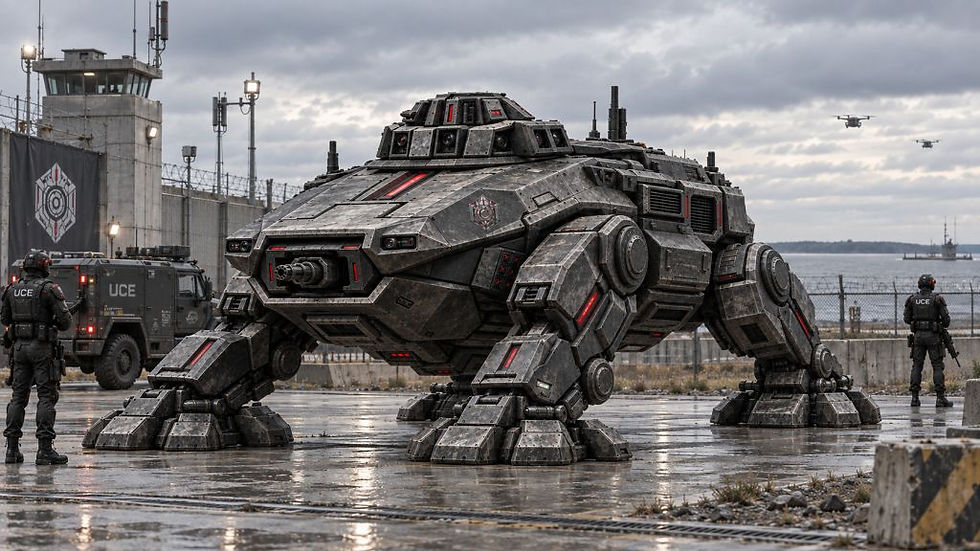
The Sentry is the most numerous production Cybersentinel and serves as the program’s primary surveillance, electronic-warfare, and strategic-site defense platform.
Built around a low, heavily armored quadrupedal chassis, the Sentry is designed to observe, classify, track, and share battlefield information while remaining capable of defending itself and nearby forces. Its value comes less from raw firepower than from its ability to help the wider Imperial force understand the battlespace before the enemy does.
Primary Roles
Sentries are commonly used for:
-
persistent surveillance;
-
perimeter and strategic-site defense;
-
electronic warfare;
-
counter-drone operations;
-
local air defense;
-
target detection and tracking;
-
tactical data relay and coordination.
Their sensor-heavy design makes them particularly effective around military bases, shield sectors, ports, airfields, critical infrastructure, and likely avenues of approach.
Watch Configuration
The Sentry’s signature operating posture is Watch Configuration.
When monitoring an area for an extended period, the machine lowers its hull, widens its stance, and stabilizes itself against the terrain. This reduced profile improves observation, firing stability, and defensive control while lowering unnecessary power consumption.
A Sentry in Watch Configuration can function almost like a mobile surveillance bunker—remaining alert while presenting a smaller and more stable target.
Battlefield Role
Sentries are often the first Cybersentinels to identify an approaching threat.
They can detect suspicious movement, aircraft, drones, armored vehicles, unusual electronic activity, or possible metahuman signatures and relay that information to the appropriate Imperial response force.
When heavier opposition appears, the Sentry normally tracks, disrupts, and hands the target off rather than attempting to defeat everything itself.
This makes the class a natural partner for Legions, Air Service units, Redcoats, and other defensive forces.
Defensive Capability
Although surveillance is its primary mission, the Sentry is not lightly armed.
Its integrated defensive systems provide protection against:
-
drones;
-
light vehicles;
-
local aerial threats;
-
hostile personnel;
-
incoming guided weapons.
Its weapons remain deliberately secondary to its sensor and information-warfare role.
Mobility
The Sentry’s quadrupedal configuration provides strong stability across rough terrain and allows it to reposition between observation points without requiring dedicated transport for every short movement.
Its low profile and broad stance also make it comparatively difficult to overturn.
Modern Sentries possess limited underwater and short-duration tactical-hover capability, allowing them to cross obstacles or reposition in terrain that might stop conventional ground vehicles.
Strengths
-
Exceptional battlefield awareness
-
Advanced surveillance and sensor fusion
-
Strong electronic-warfare capability
-
Effective counter-drone and local air-defense support
-
Excellent stability
-
Useful as a tactical coordination platform
Limitations
The Sentry is not designed to function as a heavy assault machine.
It is less effective against heavily armored formations, major fortifications, or prolonged direct combat where Legion-class firepower is more appropriate.
Its battlefield value is highest when it can remain mobile, maintain sensor coverage, and support other Imperial forces.
_______________________________________________________________
A successful Sentry mission may end without the machine firing a single shot.
If it detects the threat early enough to change the battle, it has already done its job.
_______________________________________________________________
CS-L4-01 LEGION


Heavy Combat & Breakthrough Platform
The Legion is the principal heavy-combat Cybersentinel of the United Canadian Empire.
Built around a broad, heavily armored bipedal chassis, the Legion is designed to defeat armored vehicles, fortified positions, heavy robotic systems, and other battlefield threats that exceed the practical limits of conventional infantry or lighter robotic forces.
Where the Sentry observes and coordinates, the Legion delivers concentrated combat power.
Primary Roles
Legions are commonly assigned to:
-
heavy battlefield combat;
-
armored engagement;
-
breakthrough operations;
-
counterattack missions;
-
hardened-target destruction;
-
reinforcement of heavily contested positions.
They are most effective when used as part of a wider combined-arms force rather than as independent occupation units.
Heavy Kinetic Cannon
The Legion’s defining weapon is its integrated Heavy Kinetic Cannon.
Built directly into the machine’s primary weapon-arm assembly, the cannon is optimized for:
-
armored targets;
-
fortifications;
-
heavy robots;
-
hardened battlefield positions.
Secondary weapons and defensive systems allow the Legion to engage lighter threats, drones, and local aerial targets without wasting its primary weapon on every contact.
Braced Fire Posture
The Legion’s signature combat stance is Braced Fire Posture.
When maximum firing stability is required, the machine widens its stance, lowers its center of gravity, locks its lower-body stabilization systems, and directs its armor toward the primary threat.
This posture allows the Legion to deliver powerful repeated fire while controlling recoil and maintaining accuracy.
It is especially useful against:
-
fortified positions;
-
heavy armor;
-
large robotic opponents;
-
defensive strongpoints.
Battlefield Role
Legions are designed to break resistance, not hold every inch of ground afterward.
A typical heavy-combat operation may see:
-
a Sentry identify and track the strongest enemy position;
-
Legions engage and break the heavy resistance;
-
Redcoats and Imperial troops move through the resulting opening to clear, secure, and occupy the area.
This division of labor keeps the Legion focused on the missions for which it was designed.
Mobility
Despite its mass, the Legion remains a mobile battlefield platform.
Its heavily reinforced legs and broad stabilizing feet allow it to cross rough terrain, absorb recoil, and maintain balance under significant combat stress.
Modern Legions also possess limited underwater movement and short-duration tactical-hover capability for obstacle crossing, emergency repositioning, or rapid changes in firing position.
Hover capability is not intended for sustained flight.
Defensive Systems
The Legion combines heavy armor with active defensive systems capable of responding to:
-
missiles;
-
drones;
-
guided weapons;
-
close aerial threats.
It can contribute to local air defense, but that remains a supporting role. Dedicated aerial defense and air superiority remain the responsibility of the Imperial Air Service and Sentry-supported defensive networks.
Close-Range Capability
At close range, the Legion uses reinforced industrial manipulators and its own mass to:
-
grapple;
-
push;
-
pin;
-
breach;
-
clear obstacles.
It is not designed around swords, oversized melee weapons, or theatrical hand-to-hand combat.
Its close-range capability is practical, mechanical, and mission-driven.
Strengths
-
Heavy anti-armor and anti-fortification firepower
-
Strong battlefield durability
-
High stability under recoil
-
Effective against heavy robotic systems
-
Powerful breakthrough and counterattack capability
-
Strong integration with Sentry targeting and conventional forces
Limitations
The Legion is not designed for:
-
routine patrol duty;
-
close interior security;
-
fine urban search operations;
-
persistent surveillance.
Dense urban terrain, confined spaces, and poorly surveyed infrastructure can restrict its mobility and increase its vulnerability.
Legions perform best when supported by reconnaissance, infantry, Redcoats, and other specialized Imperial assets.
___________________________________________________
The Legion is not sent to occupy the battlefield.
It is sent to break the part of the battlefield that refuses to move.
___________________________________________________
CS-B4-01 BULWARK


Mobile Shield-Defense Platform
The Bulwark is the heaviest standard production Cybersentinel and serves as the United Canadian Empire’s mobile strategic shield platform.
Unlike the Legion, which is built to break heavy resistance, the Bulwark is designed to protect what cannot be allowed to fall.
Its broad fortress-like chassis carries a powerful kinetic shield system capable of reinforcing critical defensive sectors, protecting troop concentrations, and temporarily replacing damaged fixed shield infrastructure.
Primary Roles
Bulwarks are commonly assigned to:
-
strategic-site defense;
-
mobile shield reinforcement;
-
protection of critical infrastructure;
-
defense of troop concentrations;
-
emergency replacement of damaged shield nodes;
-
protected transit and withdrawal operations.
Their value comes from creating survivable space for other Imperial forces to operate.
Mobile Field
While moving, the Bulwark can maintain a reduced-output defensive field around itself and nearby forces.
This Mobile Field is useful during:
-
convoy movement;
-
approach to a deployment site;
-
protected repositioning;
-
tactical withdrawal.
Because movement, shielding, and cooling all compete for power, the Mobile Field is intentionally less powerful than the Bulwark’s fully deployed configuration.
Anchored Shield Deployment
The Bulwark’s signature capability is Anchored Shield Deployment.
Once positioned, the machine:
-
levels and stabilizes its chassis;
-
deploys heavy ground anchors;
-
locks itself into position;
-
raises its armored shield-emitter tower;
-
synchronizes the field;
-
transitions to full defensive output.
In this configuration, the Bulwark functions as a temporary mobile shield station.
Strategic Shield Role
A deployed Bulwark can reinforce:
-
military installations;
-
command centers;
-
damaged shield sectors;
-
critical infrastructure;
-
temporary defensive positions.
Its field can be adjusted depending on mission requirements.
A broader field can protect a larger area, while a tighter field can concentrate greater defensive strength around a smaller priority zone.
Shield Continuity
One of the Bulwark’s most important roles is fixed-shield substitution.
If part of the Empire’s permanent shield network is damaged or destroyed, a Bulwark can move to a prepared hardpoint and temporarily restore defensive coverage while permanent repairs are made.
This makes the class one of the most strategically valuable defensive assets in the Cybersentinel fleet.
Battlefield Integration
Bulwarks are rarely intended to operate alone.
They commonly work alongside:
-
Sentries for surveillance and early warning;
-
Legions for heavy counterattack;
-
Redcoats and Imperial troops for close security;
-
engineers and technical personnel during infrastructure repair.
A Bulwark can protect the battlefield, but other forces are expected to prevent hostile troops from reaching the machine itself.
Defensive Systems
Although heavily armored, the Bulwark is not an assault platform.
Its integrated weapons emphasize:
-
point defense;
-
missile interception;
-
drone defense;
-
local anti-air protection;
-
close-range self-defense.
Its shield system remains its primary weapon and strategic purpose.
Strengths
-
Powerful mobile shield generation
-
Exceptional battlefield stability
-
Strategic infrastructure protection
-
Fixed-shield replacement capability
-
Strong survivability
-
Effective support for large Imperial formations
Limitations
Bulwarks are:
-
extremely heavy;
-
comparatively slow;
-
dependent on good positioning;
-
most effective when deliberately deployed.
Once fully anchored, mobility is greatly reduced. Poor positioning can allow an attacker to bypass the protected area or force the machine to undergo a vulnerable relocation cycle.
Sustained heavy attack can also produce Shield Burn, forcing field reduction, cooling, rotation, or withdrawal.
__________________________________________________________________________
A Bulwark does not take ground. It makes ground worth holding.
__________________________________________________________________________

CS-W4-01 WARDEN

Metahuman Interdiction & Containment Platform
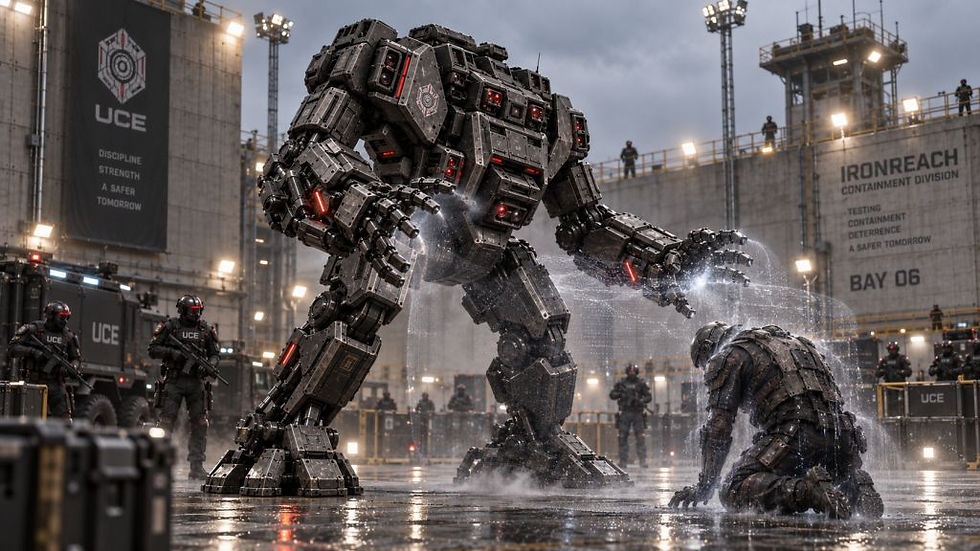
The Warden is the United Canadian Empire’s dedicated anti-metahuman Cybersentinel.
Unlike the Legion, which relies on overwhelming conventional firepower, the Warden is designed to identify, disrupt, contain, and neutralize powered individuals whose abilities may exceed the capabilities of conventional military forces.
Its strength comes from specialized sensors, adaptive threat assessment, restraint systems, and mission-specific countermeasure technology.
Primary Roles
Wardens are commonly assigned to:
-
anti-metahuman response;
-
high-risk containment operations;
-
strategic crisis interdiction;
-
protection of critical objectives from powered threats;
-
support of Enforcers and other Imperial response forces.
Wardens are rare and are not used for routine patrol duties.
Threat Assessment
Before a planned deployment, a Warden receives intelligence about the likely target and operational environment.
This preparation allows the machine to evaluate:
-
known abilities;
-
movement patterns;
-
likely escape methods;
-
associated responders;
-
containment requirements.
Once contact occurs, the Warden continuously reassesses the target and adapts its response.
Containment Stance
The Warden’s signature operational posture is Containment Stance.
In this configuration, the machine positions itself for:
-
rapid restraint;
-
movement denial;
-
precise countermeasure deployment;
-
controlled interception.
Its goal is not to simply overpower the target physically.
Instead, the Warden attempts to reduce the target’s available options until containment, withdrawal, or mission failure becomes unavoidable.
Specialized Countermeasures
Warden systems are designed to address a wide range of extraordinary threats, including:
-
enhanced strength and durability;
-
flight or extreme mobility;
-
energy-based abilities;
-
environmental powers;
-
technological augmentation;
-
unusual or unknown metahuman effects.
The exact configuration of these systems is restricted.
Publicly available information confirms only that Wardens can be prepared differently depending on the expected threat.
Adaptive Response
Not every metahuman encounter can be predicted.
When facing an unfamiliar powered individual, the Warden relies on its integrated sensor network and adaptive tactical systems to observe the target, test defensive responses, and refine its approach.
This makes the machine more dangerous the longer an engagement continues.
However, unexpected abilities, multiple powered opponents, or inaccurate intelligence can still create major tactical challenges.
Battlefield Integration
Wardens frequently operate with supporting assets.
A typical response may include:
-
a Sentry monitoring the wider battlespace;
-
a Legion providing heavy support;
-
Redcoats securing the containment perimeter;
-
an Enforcer addressing threats that require greater flexibility or judgment.
Wardens are not intended to defeat every metahuman threat alone.
Their role is to create the conditions in which the wider Imperial force can regain control of the situation.
Strengths
-
Purpose-built anti-metahuman architecture
-
Advanced target assessment
-
Specialized restraint and containment systems
-
Strong battlefield mobility
-
Highly adaptable response capability
-
Effective integration with other Imperial assets
Limitations
Wardens are most effective when accurate intelligence is available before deployment.
Their effectiveness may be reduced by:
-
unexpected powers;
-
multiple diverse metahuman opponents;
-
rapidly changing abilities;
-
damaged sensors or countermeasure systems;
-
incorrect mission preparation.
Because only a small number exist, every Warden deployment represents a significant strategic commitment.
_________________________________________________________________
A Warden does not patrol. A Warden is released.
_________________________________________________________________
PROTOTYPE CYBERSENTINELS

Experimental Systems Beyond Standard Production Doctrine
Prototype Cybersentinels are not a single model or standardized class.
The Prototype designation is reserved for experimental systems used to test technologies, mission concepts, or environmental capabilities that fall outside the established Sentry, Legion, Bulwark, and Warden production architectures.
Only a very small number are maintained at any given time, and individual Prototype designs are typically restricted from public disclosure.
Purpose
Prototype projects may be created to investigate:
-
experimental weapons or defensive systems
-
advanced mobility concepts
-
extreme-environment operation
-
next-generation artificial intelligence
-
new sensor or power technologies
-
specialized mission requirements that no production class can perform efficiently
A Prototype exists to answer a specific engineering question.
If the technology proves useful, parts of the design may eventually be incorporated into later production systems.
Experimental by Definition
Prototype does not mean “more powerful.”
Some experimental systems may outperform production Cybersentinels in one narrow area while being less reliable, more difficult to maintain, or significantly less practical in normal operations.
Many Prototype projects are ultimately:
-
archived;
-
dismantled;
-
partially adopted;
-
destroyed during testing;
-
retained under restricted storage.
Only successful technologies move toward wider Imperial use.
Extreme-Environment Projects
Some Prototype systems are developed specifically for environments beyond the limits of standard Cybersentinels.
Potential mission areas include:
-
extreme underwater depths;
-
severe thermal environments;
-
hazardous industrial zones;
-
near-space or orbital operations;
-
other specialized recovery or exploration missions.
These machines may sacrifice conventional combat performance in exchange for survivability in conditions no production Cybersentinel was designed to endure.
Restricted Development
Prototype projects are primarily associated with secure Ironreach research and testing facilities.
Because many systems incorporate highly experimental or strategically sensitive technologies, detailed specifications, quantities, and individual project identities are rarely released publicly.
___________________________________________________________________
A Prototype is not built because the Empire needs another Cybersentinel.
It is built because the existing Cybersentinels cannot solve the problem.
___________________________________________________________________
COMMAND, CONTROL & TACTICAL AI
Advanced Battlefield Autonomy Under Human Strategic Authority
Cybersentinels are highly autonomous tactical systems, but they are not independent national decision-makers.
Every production Cybersentinel operates within a defined command structure, mission authority, and rules of engagement established by authorized human commanders.
Their artificial intelligence is designed to help them survive, adapt, coordinate, and complete assigned missions without requiring continuous manual control.
Human Command Authority
Strategic authority remains human at all times.
Cybersentinels may independently decide how best to:
-
move through terrain;
-
select firing positions;
-
avoid hazards;
-
prioritize immediate threats;
-
coordinate with nearby friendly units;
-
preserve mission capability after damage.
They do not independently create national objectives, declare new missions, or override lawful Imperial command authority.
Mission Envelope
Each deployment begins with a defined Mission Envelope.
This establishes the machine’s operating boundaries, including:
-
mission objective;
-
authorized operating area;
-
protected assets;
-
prohibited targets;
-
permitted weapons;
-
rules of engagement;
-
escalation limits;
-
withdrawal or recovery conditions.
Within that framework, the Cybersentinel can make rapid tactical decisions without waiting for every individual action to be approved.
Tactical Artificial Intelligence
Modern Cybersentinel AI is optimized for battlefield decision-making rather than personality or human imitation.
Production systems do not possess humanlike identities, emotions, or unrestricted self-directed cognition.
Their intelligence is focused on:
-
threat recognition;
-
route selection;
-
sensor fusion;
-
weapons employment;
-
damage management;
-
tactical coordination;
-
mission preservation.
Independent Operation
Cybersentinels are designed to continue functioning even when communications are degraded or temporarily lost.
If disconnected from higher command, a machine can continue operating under its last valid mission instructions rather than immediately shutting down.
This capability was heavily influenced by lessons learned during Operation: Gambit, when early systems proved too dependent on centralized communications.
Tactical Networking
Cybersentinels can securely exchange battlefield information with other authorized Imperial systems.
This allows multiple machines to:
-
share sensor contacts;
-
coordinate defensive coverage;
-
avoid unnecessary duplication;
-
hand targets between specialized classes;
-
support combined-arms operations.
They do not operate as a single hive mind. Each Cybersentinel remains an independent platform capable of continuing its mission if the wider network is disrupted.
Electronic Security
Modern Cybersentinels use hardened communications, layered authentication, and compartmentalized control systems.
There is no single universal control signal capable of shutting down or commanding the entire force.
This design reduces the risk that one compromised network, command node, or communications failure could disable the program as a whole.
__________________________________________________________
Cybersentinels are autonomous enough to survive the battlefield—but never autonomous enough to choose the war.
__________________________________________________________
DEPLOYMENT & COMBAT DOCTRINE
Specialized Machines. Combined-Arms Employment. Mission-Driven Force.
Cybersentinels are not deployed as a separate army.
They are used as specialized force multipliers within larger Imperial operations, supporting troops, Redcoats, armored units, aircraft, maritime forces, and Enforcers according to the mission.
Their effectiveness comes from combining different classes rather than relying on a single machine to perform every task.
Typical Deployment Scale
Cybersentinels may deploy individually or in coordinated groups depending on the threat.
Common groupings include:
-
Singleton — 1 machine
-
Element — 2–3 machines
-
Detachment — 4–6 machines
-
Heavy Detachment — 7–12 machines
-
Sentinel Group — 13 or more machines
Larger concentrations are reserved for major crises, campaigns, or threats to the Empire itself.
Combined-Class Operations
Each class fills a different role within the force.
A typical operation may involve:
-
a Sentry detecting and tracking the threat;
-
a Legion engaging the heaviest opposition;
-
a Bulwark protecting the objective or troop concentration;
-
a Warden responding to metahuman threats.
This specialization allows each machine to perform the mission it was designed for.
Tactical Concentration
Imperial doctrine favors distributing Cybersentinels strategically while concentrating them only where decisive capability is required.
This prevents the fleet from becoming vulnerable to a single catastrophic strike and allows multiple regions or installations to remain protected at the same time.
The guiding principle is:
Disperse strategically. Concentrate tactically.
Combined-Arms Integration
Cybersentinels are most effective when operating with conventional Imperial forces.
The Imperial Army provides maneuver, terrain control, logistics, and occupation capability.
Redcoats provide close security, building access, interior operations, and persistent robotic manpower.
The Imperial Air Service and Maritime Service provide wider air, transport, and naval support.
Cybersentinels add capabilities that those forces cannot always provide efficiently on their own.
Strategic Defense of Wolfe Island
Within the United Canadian Empire, Cybersentinels form part of a layered defensive system.
Their roles may include:
-
Detection — Sentry surveillance and early warning
-
Interception — Air Service, Army, and Legion response
-
Shield Defense — Bulwark reinforcement
-
Metahuman Response — Warden deployment
-
Inner Security — Redcoats, Crown Security, and Enforcers
No single layer is expected to stop every threat by itself.
Off-Island Deployment
Cybersentinel deployment beyond Wolfe Island is more restrictive.
These machines are valuable strategic assets, and losing one outside Imperial territory creates both military and technological risks.
Off-island deployment therefore requires a mission whose value justifies the exposure.
Maritime transport is generally preferred for moving the heaviest Cybersentinels beyond the island.
Withdrawal and Preservation
Cybersentinels are not expected to fight until destruction if the mission no longer requires it.
They may withdraw, reposition, or request recovery when preservation of the machine does not compromise the assigned objective.
Imperial doctrine treats Cybersentinels as recoverable strategic assets rather than disposable weapons.
_____________________________________________________________
No Cybersentinel is irreplaceable.
No Cybersentinel is expendable without purpose.
_____________________________________________________________
ORGANIZATION & FLEET STRENGTH
A Small Strategic Force Built Around Specialization, Readiness, and Control
The Cybersentinel Program is deliberately limited in size.
Rather than fielding hundreds of machines as conventional battlefield units, the United Canadian Empire maintains a smaller force of highly specialized strategic platforms that can be concentrated where their capabilities matter most.
As of 2026, the authorized operational fleet consists of 96 Cybersentinels.
2026 Authorized Fleet
-
48 Sentry
-
24 Legion
-
12 Bulwark
-
8 Warden
-
4 Prototype
Total: 96 operational systems
This structure reflects the relative frequency and strategic importance of each class.
Sentries form the largest portion of the fleet because surveillance, perimeter defense, and battlefield awareness are required across many installations and regions.
Legions provide the heavy combat core.
Bulwarks remain fewer because their missions are more specialized and infrastructure-focused.
Wardens are rarer still, reflecting their highly specialized anti-metahuman role.
Prototype systems are maintained only in very small numbers.
Imperial Cybersentinel Command
Operational control is coordinated through Imperial Cybersentinel Command, or ICCOM.
ICCOM manages:
-
force readiness;
-
deployment coordination;
-
strategic allocation;
-
training;
-
mission preparation;
-
fleet recovery and reassignment.
Technical authority remains closely tied to Ironreach, where major maintenance, rebuilds, system certification, and advanced testing are performed.
Readiness Levels
Not every Cybersentinel is expected to be immediately deployable at every moment.
The fleet is managed through several readiness categories:
Immediate Ready — available for rapid deployment.
Mission Ready — operational and available once mission preparation is complete.
Maintenance Ready — temporarily unavailable while undergoing routine servicing, repair, or inspection.
Deep Service — undergoing major overhaul, rebuild, or long-duration technical work.
This allows the Empire to maintain a sustainable force rather than exhausting machines through constant maximum readiness.
Deployment Concentration
Cybersentinels are normally dispersed among strategic locations rather than concentrated in one permanent formation.
Typical deployment levels may include:
-
1 machine for routine strategic coverage;
-
2–3 machines for significant threats;
-
4–6 machines for major combat operations;
-
7–12 machines during national-level crises.
Larger concentrations are possible, but increasingly exceptional.
Strategic Reserve
A portion of the fleet is normally kept available as a strategic reserve.
This prevents every machine from being committed simultaneously and allows the Empire to respond to unexpected threats, replace damaged units, reinforce weakened sectors, or react to a second crisis occurring elsewhere.
______________________________________________
Ninety-six machines.
Five classes.
Each built for a mission conventional forces cannot always perform alone.
______________________________________________
MANUFACTURING & SUSTAINMENT
Built Slowly. Maintained Relentlessly. Recovered Whenever Possible.
Cybersentinels are among the most complex military systems produced by the United Canadian Empire.
They are not mass-produced like conventional vehicles or Redcoats. Each machine requires extensive fabrication, integration, testing, software certification, weapons calibration, and final acceptance before entering operational service.
The heart of this effort is Ironreach, where the Empire’s principal Cybersentinel manufacturing, overhaul, and advanced-testing facilities are located.
Production Philosophy
Cybersentinel production follows a deliberate principle:
Replace before expanding.
New construction normally focuses first on replacing machines that have been destroyed, permanently retired, or judged uneconomical to rebuild.
Expansion beyond the authorized fleet requires additional approval and long-term increases in manufacturing, maintenance, and technical capacity.
Construction Time
Cybersentinels require months of work to complete.
Typical production time varies by class:
-
Sentry: approximately 6–8 months
-
Legion: approximately 9–12 months
-
Bulwark: approximately 12–16 months
-
Warden: approximately 14–18 months
-
Prototype: potentially 18 months to several years
Different components are built in parallel before final integration, allowing multiple machines to move through production at the same time.
Common Architecture
Although each class has a different mission and exterior design, many internal systems share a common engineering foundation.
Standardized components help simplify:
-
diagnostics;
-
training;
-
spare-parts management;
-
software maintenance;
-
field repair;
-
long-term fleet support.
Class-specific systems are added only where required by the mission.
Maintenance Levels
Cybersentinel sustainment is divided into several levels.
Field Maintenance handles routine servicing, minor damage, and component replacement close to the operating area.
Depot Maintenance addresses heavier repair, structural work, subsystem replacement, and more extensive diagnostics.
Ironreach Overhaul is reserved for major reconstruction, deep modernization, lifecycle extension, and full system recertification.
A heavily damaged Cybersentinel may return to service after an extensive rebuild rather than being permanently replaced.
Phleboto-Bot Support
All production Cybersentinels carry Phleboto-bots—small automated repair machines designed to perform emergency maintenance and localized battlefield repair.
These systems can:
-
seal damaged lines;
-
reconnect wiring;
-
patch mechanical assemblies;
-
stabilize damaged components;
-
perform temporary repairs until full maintenance is available.
They do not replace trained technicians.
Their purpose is to keep a damaged machine functional long enough to survive, withdraw, or complete a mission.
Long Service Life
Cybersentinels are built around long-term rebuildability.
A single chassis may remain in service for decades through repeated:
-
armor replacement;
-
electronics upgrades;
-
sensor modernization;
-
power-system refurbishment;
-
structural repair;
-
software updates.
As a result, the age of the original chassis does not necessarily reflect the technological age of the machine currently operating.
Recovery Doctrine
Whenever practical, damaged Cybersentinels are recovered rather than abandoned.
Their systems are too valuable, too complex, and too strategically sensitive to leave behind unnecessarily.
This principle has become deeply embedded in the program:
Recover it. Repair it. Rebuild it. Replace it only when necessary.
PHLEBOTO-BOTS
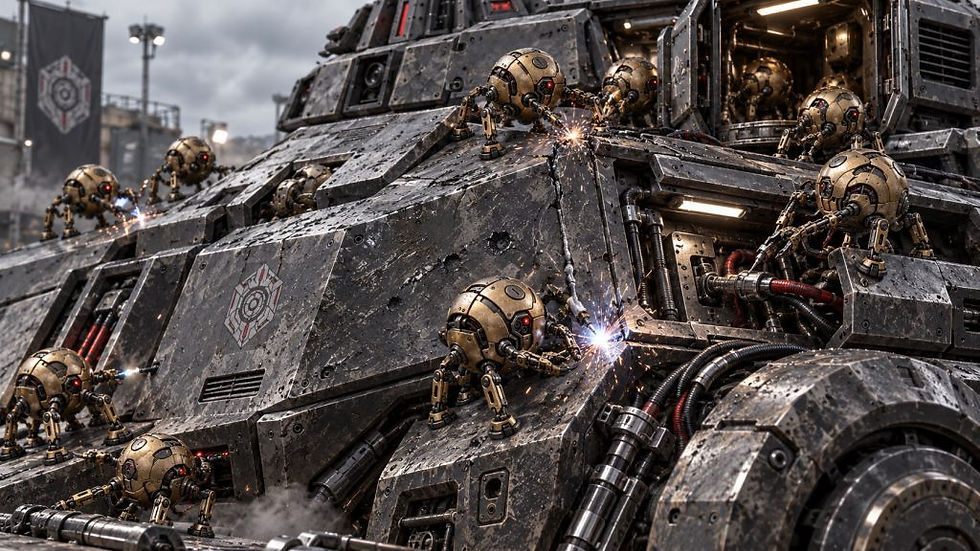
Micro-Repair Systems for Battlefield Survival
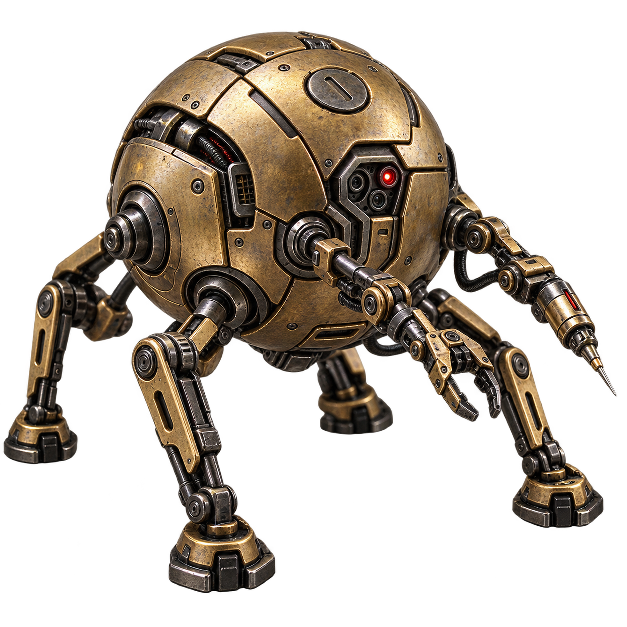
Phleboto-bots are compact automated repair machines carried aboard every production Cybersentinel.
Developed by Doctor Phlebotinum as part of the program’s push toward greater battlefield survivability, these miniature systems are designed to perform rapid emergency repairs when a Cybersentinel is damaged far from conventional maintenance support.
They are not independent combat drones. Their purpose is simple: keep the machine functioning long enough to survive, withdraw, or finish the mission.
Design
A standard Phleboto-bot is a small brass-colored mechanical sphere roughly 1–2 inches in diameter.
When deployed, it unfolds a set of miniature articulated limbs equipped with interchangeable repair tools.
Typical functions include:
-
reconnecting damaged wiring;
-
sealing ruptured lines;
-
stabilizing mechanical joints;
-
patching damaged housings;
-
restoring limited electrical continuity;
-
performing temporary structural repair.
-
Their spherical form allows them to move through confined internal spaces that human technicians cannot easily reach during combat.
Battlefield Use
When a Cybersentinel suffers damage, onboard systems can release Phleboto-bots automatically or direct them toward specific repair priorities.
Depending on the severity of the damage, they may perform:
-
Local Repair — minor damage and isolated faults;
-
Priority Repair — critical system stabilization;
-
Emergency Flood — large-scale release of repair bots when machine survival is at immediate risk.
These repairs are temporary by design.
A Cybersentinel that survives because of Phleboto-bot intervention still requires proper maintenance afterward.
Distributed Repair
Each Cybersentinel carries hundreds—or in larger classes, more than a thousand—Phleboto-bots.
This allows several damaged areas to be addressed at once.
Bots can crawl across internal structures, armor cavities, conduits, joints, and other accessible systems while the Cybersentinel continues operating.
Their effectiveness depends on the type and extent of damage. They cannot replace destroyed armor sections, rebuild major weapons, or restore systems that have been completely lost.
Limited Independence
Phleboto-bots are intentionally simple.
They carry only enough local control to perform assigned repair tasks and can operate independently for approximately ten minutes before requiring recharge or recovery.
They do not possess combat AI, long-range autonomy, or independent mission authority.
This keeps them useful without turning them into a separate robotic system.
Standardized Across the Fleet
The same basic Phleboto-bot architecture is used across Sentry, Legion, Bulwark, and Warden Cybersentinels.
This common design simplifies:
-
manufacturing;
-
replacement;
-
maintenance;
-
technician training;
-
field resupply.
Different Cybersentinel classes simply carry different quantities depending on size, complexity, and expected damage load.
_______________________________________________________
Phleboto-bots do not rebuild a Cybersentinel on the battlefield. They buy it time.
_______________________________________________________
DAMAGE, RECOVERY & TECHNOLOGY DENIAL
Survive the Hit. Preserve the Mission. Deny the Technology.
Cybersentinels are engineered around the assumption that damage will happen.
Their internal architecture is designed so that a single failed component, severed connection, damaged weapon, or compromised subsystem does not automatically destroy the entire machine.
This principle reflects one of the most important lessons learned from early-generation Cybersentinels:
Damage should propagate poorly.
Damage States
Modern Cybersentinels use a simplified operational damage-status system.
GREEN — mission capable with no significant impairment.
AMBER — damaged, but capable of continuing the mission with reduced performance.
RED — severely damaged; mission capability may be limited and recovery becomes a priority.
A separate BLACK security condition may be declared when there is concern about command integrity, hostile interference, or system compromise.
Fighting Through Damage
Cybersentinels are designed to isolate damaged systems wherever possible.
A machine may continue operating after losing:
-
sensors;
-
armor sections;
-
secondary weapons;
-
mobility components;
-
communications;
-
noncritical support systems.
Power can be redirected toward the systems most necessary for mission survival.
The objective is not to make the machine indestructible.
It is to prevent one failure from unnecessarily becoming ten.
Recovery Priority
A damaged Cybersentinel is treated as a strategic asset.
Commanders may choose to:
-
recover it immediately;
-
stabilize it in place;
-
protect it until recovery becomes possible;
-
remove sensitive components;
-
deny remaining technology if recovery is impossible.
Recovery vehicles, engineering teams, Redcoats, and other Cybersentinels may all be used to secure and retrieve a disabled machine.
Technology Denial
Cybersentinels contain advanced Imperial military technology that cannot be casually abandoned.
If a machine is at serious risk of enemy capture, authorized denial procedures may be used to prevent sensitive systems from being exploited.
These measures can progressively protect:
-
mission data;
-
security credentials;
-
control systems;
-
sensitive components;
-
the remaining chassis.
The exact procedures are restricted.
Importantly, modern Cybersentinels do not rely on a single catastrophic self-destruct system.
Earlier experience demonstrated that destroying a machine without regard for nearby Imperial personnel, infrastructure, or civilians could create more damage than the enemy itself.
Lost or Missing Systems
If a Cybersentinel cannot be accounted for, its credentials may be revoked and the machine classified as Missing / Unverified until recovered and authenticated.
This prevents a recovered or compromised machine from simply reconnecting to Imperial networks without verification.
Repair Before Replacement
Many machines that appear catastrophically damaged can still be rebuilt.
If the hardened core, major structural sections, or recoverable systems remain intact, Ironreach engineers may reconstruct the platform and return it to service.
This philosophy is one reason the Cybersentinel fleet can remain operational despite the extraordinary cost and complexity of each machine.
__________________________________________________________________________
A damaged Cybersentinel is a recovery mission before it becomes a replacement order.
______________________________________________________________
THE FIVE GAMBIT LESSONS
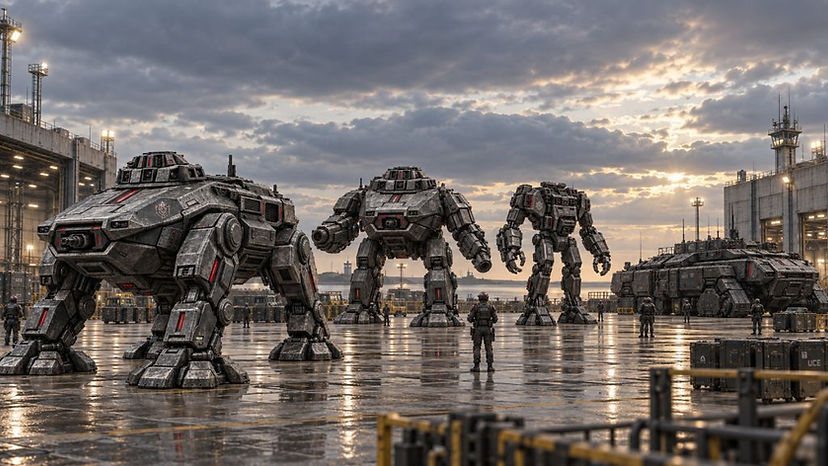
The Failures That Shaped the Modern Cybersentinel Program
Operation: Gambit was the defining test of the first generation of Cybersentinels.
The surviving machines proved that the concept could work. The losses proved how much still had to change.
From that experience, the Empire formalized five enduring lessons that continue to influence Cybersentinel engineering and doctrine.
1. Do Not Centralize Tactical Survival Around One Network
Early systems depended too heavily on centralized communications and coordination.
Modern Cybersentinels are therefore designed to continue operating when network access is degraded, jammed, or temporarily lost.
A machine must be able to survive the battlefield even when the network does not.
2. Do Not Let One Damaged Subsystem Destroy the Whole Machine
Damage during Gambit revealed how quickly one failed component could affect unrelated systems.
Modern designs emphasize compartmentalization, redundancy, distributed power, and independent subsystem control.
A damaged weapon should not disable mobility.
A damaged sensor should not shut down the machine.
A single failure must remain a single failure whenever possible.
3. Anti-Capture Measures Must Not Harm Imperial Forces More Than the Enemy
Early denial concepts placed too much emphasis on destroying the machine at any cost.
Modern doctrine is more controlled.
Technology denial remains essential, but it is now designed around staged isolation, data protection, component denial, and selective destruction rather than indiscriminate catastrophic self-destruction.
4. The Enemy Will Not Always Attack the Strongest Armor First
Opponents learned quickly that defeating a Cybersentinel did not always require penetrating its heaviest protection.
Sensors, joints, cooling systems, communications, mobility components, and exposed support architecture can all become targets.
Modern machines therefore rely on layered protection rather than armor thickness alone.
5. Recover Knowledge From Every Loss
Every damaged or destroyed Cybersentinel is treated as an engineering lesson.
Combat data, failure patterns, recovered components, maintenance history, and battlefield performance are all studied after major incidents.
This continuous feedback process has shaped every generation since Gambit.
Program Legacy
The modern Cybersentinel fleet exists because Generation I failed in ways that could be studied, understood, and corrected.
That history remains part of the program’s identity.
The goal was never to create machines that could not fail.
The goal became to create machines that could fail intelligently, survive damage, and teach the next generation how to survive better.
___________________________________________________________
Gambit did not end the Cybersentinel Program. It taught the program how to survive.
___________________________________________________________
CYBERSENTINEL PROGRAM — 2026 STATUS

A Mature Strategic Weapons Program Entering Its Fourth Generation
By 2026, the Cybersentinel Program has evolved from an experimental post-IRON LANTERN defense initiative into one of the United Canadian Empire’s most technically advanced military capabilities.
The current force is centered on Generation IV systems, standardized around five mission classifications and supported by a mature command, maintenance, recovery, and production structure.
Current Fleet
The authorized 2026 inventory consists of:
-
48 Sentry
-
24 Legion
-
12 Bulwark
-
8 Warden
-
4 Prototype
Total: 96 operational Cybersentinels
These numbers reflect deliberate specialization rather than mass production.
The Empire continues to prioritize readiness, survivability, and supportability over rapid numerical expansion.
Generation IV
Modern Generation IV Cybersentinels incorporate the lessons of nearly two decades of development.
Key improvements include:
-
hardened tactical networking;
-
advanced battlefield AI;
-
decentralized mission execution;
-
standardized internal architecture;
-
improved armor and survivability;
-
integrated Phleboto-bot repair support;
-
refined mobility systems;
-
class-specific mission specialization.
Generation IV does not represent a complete break from earlier designs.
Instead, it is the culmination of lessons learned through every generation before it.
Strategic Role
Cybersentinels now occupy a clearly defined place within Imperial defense doctrine.
They are not replacements for the Imperial Army, Air Service, Maritime Service, Redcoats, or Enforcers.
They exist to provide capabilities that would otherwise require disproportionate manpower, infrastructure, or risk.
Their strategic value comes from being deployed selectively and where their specialized capabilities can have the greatest effect.
Future Development
The program continues to evolve.
Future development is expected to focus on:
-
improved survivability;
-
more efficient power systems;
-
better tactical coordination;
-
enhanced sensor architecture;
-
advanced environmental operation;
-
refined countermeasure technology;
-
continued Prototype experimentation.
Any major fleet expansion will remain secondary to replacement, modernization, and sustainable maintenance of the existing force.
Program Identity
The modern Cybersentinel Program is defined less by raw machine count than by engineering discipline.
Its core principles remain:
-
specialize by mission;
-
maintain human strategic authority;
-
survive network failure;
-
isolate damage;
-
recover whenever possible;
-
rebuild before replacing;
-
learn from every loss.
___________________________________________________________________
The Cybersentinel Program is no longer experimental. It is established, mature, and built to endure.
___________________________________________________________________
UCE CYBERSENTINEL OPERATIONS & DOCTRINE HANDBOOK
2026 Definitive Edition — Restricted Technical & Operational Reference
This public Cybersentinels webpage provides an overview of the program, its principal classes, history, fleet structure, and operational purpose. The UCE Cybersentinel Operations & Doctrine Handbook — 2026 Definitive Edition contains the deeper technical and doctrinal material used to define the program in full.
Definitive Program Reference
The 2026 Handbook serves as the controlling reference for the current Cybersentinel Program.
Where simplified public descriptions differ from detailed technical material, the Handbook provides the authoritative operational context.
Certain portions may be presented as restricted, classified, or Crown Security-controlled material to reflect their in-universe sensitivity.
The handbook expands on subjects that are intentionally simplified or omitted from the public webpage, including:
-
detailed class architecture;
-
engineering systems;
-
weapons and defensive technologies;
-
command hierarchy and tactical AI;
-
Cybersentinel mission-envelope doctrine;
-
Imperial Sentinel Tactical Mesh operations;
-
Warden countermeasure architecture;
-
manufacturing and sustainment;
-
readiness classifications;
-
combined-arms doctrine;
-
mass mobilization;
-
electronic warfare and degraded operations;
-
battlefield damage management;
-
recovery and technology-denial procedures;
-
Phleboto-bot deployment doctrine;
-
Prototype development policy;
-
historical lessons from Operation: Gambit;
-
technical reference material and visual annexes.