
A Universe of Pure Imagination

TM


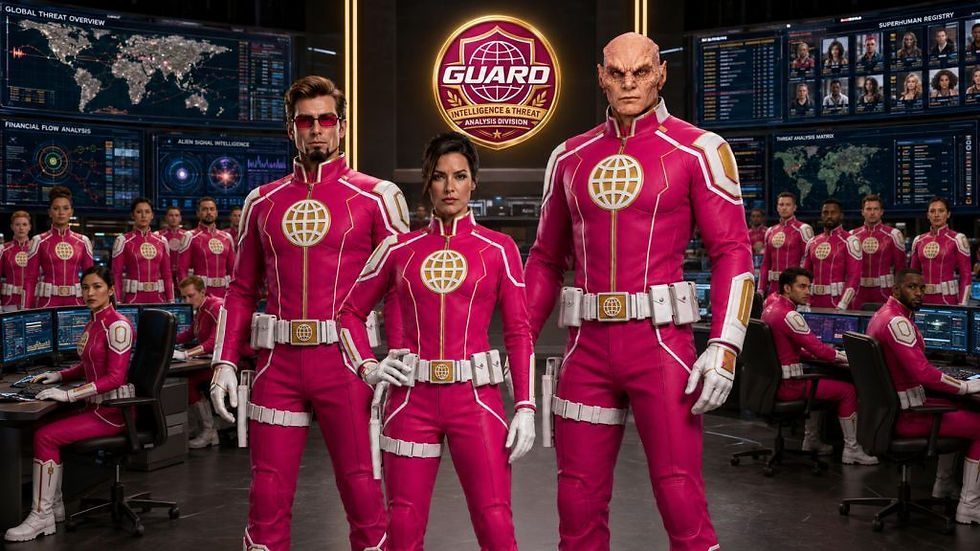
GUARD INTELLIGENCE & THREAT ANALYSIS DIVISION



Mission Statement
The GUARD Intelligence & Threat Analysis Division collects, analyzes, verifies, and distributes intelligence needed to protect Earth,
GUARD personnel, allied governments, civilian populations, and recognized off-world interests from hostile organizations, criminal networks, superhuman threats, extraterrestrial activity, dimensional incursions, emerging technologies, and large-scale strategic dangers.
Its purpose is not political control, public surveillance, or manipulation. Its purpose is warning, verification, analysis, and responsible operational support.
The division exists so GUARD does not act blindly.
Where Global Operations Command responds to crises, the Intelligence & Threat Analysis Division works to understand the crisis before, during, and after it occurs. It identifies patterns, validates information, tracks hostile actors, studies threat behavior, and provides GUARD leadership with the clearest possible picture before decisions are made.

STATISTICS

HISTORY
The Need for Intelligence
GUARD was built to respond to danger, but its earliest leaders quickly learned that response alone was not enough.
A crisis could be stopped in the field, but the next crisis might already be forming somewhere else. A villain could be defeated, but the organization funding that villain might remain untouched. A superhuman attack could be contained, but the false information that caused it might continue spreading. A battlefield could be won, but the pattern behind the war could still be missed.
GUARD needed more than courage, weapons, aircraft, rescue teams, and command centers.
It needed warning.
It needed verification.
It needed people trained to ask what others missed: Who benefits? Who planted the evidence? What pattern connects these events? What is being hidden? What is being made too easy to believe?
The original GUARD Intelligence Division began as a small internal support function. Its early personnel collected reports, studied hostile organizations, tracked criminal activity, reviewed field intelligence, and supported GUARD commanders before and during operations.
That mission grew as the world grew more complicated.
Superhuman activity expanded. Alien contact became harder to deny. Criminal organizations adopted corporate fronts. Shadow networks moved through politics, finance, media, technology, and intelligence gaps. Villains became harder to identify because many stopped acting like villains in public.
The Intelligence Division evolved because GUARD’s enemies evolved first.
The WIA Era
Before GUARD’s modern intelligence structure took shape, one of the world’s most ambitious intelligence efforts was the World Intelligence Agency, or WIA. The WIA was designed as an inter-agency organization bringing together intelligence cooperation from several national and international services.
Its mission was to identify threats that crossed borders faster than traditional agencies could respond.
One of the WIA’s most effective officers was Camile Jansen.
Jansen was a former United States Air Force officer who became one of the most successful intelligence agents of her generation. During her intelligence career, she helped stop terrorist bombings, federal crimes, criminal conspiracies, and dangerous hidden networks. She also uncovered classified information on numerous superhuman identities, villain bases, and criminal organizations.
Then Jansen discovered something larger than anything she had investigated before.
She found evidence of a hidden shadow organization working quietly toward global control through influence, false evidence, economic manipulation, intelligence compromise, and institutional pressure. It was not trying to conquer the world through armies or open war. It was attempting to own the systems that shaped the world’s decisions.
When Jansen revealed what she had found, the shadow organization moved against her.
Within hours, fabricated evidence appeared. False recordings, staged scandals, planted financial records, and manipulated media reports turned Jansen from respected intelligence officer into one of the most wanted people on Earth. She was accused of crimes she had not committed and atrocities she had not planned.
The world believed the lie.
Jansen went on the run.
The Lexington Disaster
Camile Jansen believed GUARD might be the only organization capable of hearing the truth before condemning her. She made her way toward GUARD’s original headquarters in Lexington, Massachusetts, hoping to reach Director Hart, codenamed “Big DoG.”
The shadow organization anticipated her move.
False reports claimed Jansen intended to bomb GUARD headquarters. Police, military forces, emergency crews, and media attention surrounded the area. GUARD personnel were ordered to remain inside for their own safety. In reality, they were being trapped.
Jansen managed to contact Director Hart through the sewer system beneath the headquarters. Hart believed her. He ordered a silent evacuation and assigned Neal Norton to help protect and extract her.
Before the evacuation could succeed, Death Legion entered the sewer lines.
The battle that followed became one of the darkest events in GUARD history. Director Hart was killed. Neal Norton was badly wounded. Jansen lost an arm. Death Legion blocked escape routes beneath the facility, preventing many GUARD personnel from escaping.
Then the Lexington headquarters exploded.
Nearly 400 GUARD personnel, firefighters, police, and emergency workers died. Only about 200 survived.
The public story blamed Camile Jansen.
The truth remained buried.
Jansen’s severed arm was found in the wreckage, allowing the world to believe she had died in the explosion. Neal Norton, Rupert Reinhold, Dr. Elaine Trask, and a very small group of trusted individuals ensured otherwise. Jansen survived, received emergency medical care, gained a prosthetic arm, underwent reconstructive surgery, and was given a new identity.
Camile Jansen disappeared.
Janis Jones was created.
The Janis Jones Era
Janis Jones was publicly introduced as a politically appointed Intelligence Division Director assigned to GUARD through international pressure. Many GUARD personnel disliked and distrusted her. She was viewed as cold, ambitious, arrogant, and more interested in political survival than operational loyalty.
That reputation served a purpose.
The fewer people who liked Janis Jones, the fewer people tried to get close to her. The fewer people who trusted her, the less likely they were to discover who she had once been.
Under Jones, the Intelligence Division changed significantly. It became more disciplined, more suspicious of convenient evidence, and more focused on deception detection. The division began treating misinformation, planted records, false-flag operations, media manipulation, and identity compromise as strategic threats rather than secondary concerns.
The Lexington Disaster shaped the division’s culture permanently.
GUARD had learned that an enemy did not always need to defeat GUARD directly. Sometimes it only needed to make GUARD, the authorities, and the public believe the wrong story quickly enough.
From that point forward, the Intelligence Division adopted a harder rule:
Never let urgency replace verification.
The Scorpio Solutions Incident
The next major turning point came through Albert Conrad.
Conrad was a London-born British genius with three doctorates by age 23 and a reputation as one of the most brilliant analytical minds in the world. He joined Scorpio Solutions, a private think tank that claimed to use elite minds and advanced computer modeling to solve global problems.
While working there, Conrad helped develop an economic model that could stabilize much of the world’s economy if applied responsibly. The model had enormous potential.
Then Conrad discovered where Scorpio Solutions’ data was coming from.
The organization’s powerful Scorpio X computer had been illegally siphoning financial, military, corporate, manufacturing, and governmental information from around the world for years. Scorpio Solutions was not merely a think tank. It was a front for a hidden organization gathering strategic data on a global scale.
When Conrad questioned what he had found, Death Legion moved to silence him.
GUARD’s Terraguardians rescued Conrad before he could be executed. GUARD and Conrad soon determined that Scorpio Solutions was connected to the same kind of hidden network that had destroyed Camile Jansen’s life and devastated GUARD at Lexington.
Before Scorpio Solutions could be fully investigated, the facility exploded. More than 150 of the world’s greatest minds were killed. Scorpio X was destroyed. The evidence was erased.
Conrad later joined GUARD Intelligence, not Resources or Research, because he wanted to expose the people behind Scorpio Solutions. He eventually became GUARD’s World Intelligence Commander, codenamed “World.”
His arrival changed the division’s analytical reach. Conrad brought advanced economic modeling, predictive analysis, large-scale pattern recognition, and financial threat mapping into GUARD’s intelligence work. Through him, GUARD began treating money, data, and institutional behavior as battlefields.
That shift proved vital.
The shadow organization was not only hiding in violence. It was hiding in systems.
Extraterrestrial Intelligence and Rak’A Tos
While Earth-based threats became more complex, GUARD also had to face a larger truth: Earth was not alone.
Rak’A Tos was born an Orionan and raised on Earth under the human name Ryan Toss. His family had fled conflict on their homeworld and settled secretly on Earth in the 1930s. The Tos family lived quietly for decades, building a life among humans while hiding their true origin.
That life changed after the Vietnam War. Several Tos children served in the conflict. Three did not return. Rak’A came home believing more deeply than ever that knowledge and understanding could prevent war. His brother Nam’O reached the opposite conclusion. Consumed by grief and anger, Nam’O used alien weapons in a violent rampage in Washington, D.C., and was killed.
Federal authorities discovered Nam’O was not human.
The Tos family was arrested and taken to Roswell Air Force Base, where they were interrogated, abused, and studied. Their survival came through an unlikely rescuer: the CIA operative known as Major Invader.
Major Invader determined that the Tos family was not an invasion threat. He freed them, helped them escape, and gave them new identities. Rak’A still wanted to work with humans one day. Major Invader promised that when the time was right, he would help make that possible.
That opportunity came through GUARD.
Rak’A joined GUARD as an extraordinary information processor, alien-culture interpreter, and extraterrestrial intelligence specialist. His Orionan mind allowed him to handle information at a scale far beyond human capability. He became one of GUARD’s most important bridges between Earth and the wider realities of alien civilizations, off-world threats, hidden extraterrestrial activity, and interstellar conflict.
During the Soltan Invasion of 2000, Rak’A and members of the Tos family helped GUARD process massive amounts of alien communications, battlefield reports, intercepted signals, tactical data, and cultural information. Their work gave GUARD a critical advantage during one of Earth’s most dangerous wars.
After the Soltan War, Rak’A remained with GUARD and eventually became Commander of Galactic and Extraterrestrial Intelligence, codenamed “Galaxy.”
His role gave GUARD something it had never fully possessed before: a permanent intelligence capability focused beyond Earth.
Rak’A also helped shape one of GUARD’s most important ethical lessons.
Not every hidden alien is an enemy.
Not every unknown species is an invasion force.
Intelligence must identify danger without turning fear into policy.
The Soltan War and the Rise of Threat Analysis
The Soltan Invasion changed GUARD intelligence permanently.
For nine months, Earth faced a war that crossed every boundary GUARD understood. The conflict involved alien armies, orbital activity, battlefield strategy, civilian displacement, superhuman combat, national militaries, criminal exploitation, captured technology, and global psychological trauma.
The Intelligence Division had to process more information than ever before while GUARD and Earth’s defenders fought for survival.
The war revealed that intelligence collection alone was not enough.
GUARD needed deeper threat analysis.
It needed analysts who could understand enemy behavior, escalation patterns, deception, logistics, technology transfer, cultural motives, and long-term consequences. It needed people who could explain not only what was happening, but what was likely to happen next.
After the Soltan War, the threat environment became even more dangerous. Soltan remnants, alien collaborators, black-market technology, orbital debris, stolen weapons, frightened governments, and opportunistic criminal groups all created new intelligence problems.
GUARD’s old intelligence model could not carry the full burden anymore.
The division had to become something larger.
Becoming the GUARD Intelligence & Threat Analysis Division
The formal evolution into the GUARD Intelligence & Threat Analysis Division marked a major change in GUARD doctrine.
The new name recognized that gathering information and analyzing threat behavior were inseparable. A report was not useful simply because it existed. A signal was not important simply because it was intercepted. A rumor was not harmless simply because it sounded unlikely.
Information had to be tested, connected, challenged, and understood.
The modern division reorganized around specialized commands and analysis branches, including World Intelligence Command, Galactic / Extraterrestrial Intelligence Command, Strategic Threat Analysis, the Superhuman Threat Registry, the Intelligence Fusion Center, Dimensional Threat Analysis, Cyber / Signals Intelligence, and Field Investigations.
Each branch exists because GUARD learned a specific lesson.
World Intelligence Command exists because human systems can be infiltrated and weaponized.
Galactic / Extraterrestrial Intelligence Command exists because Earth is part of a larger and more dangerous universe.
Strategic Threat Analysis exists because the first signs of disaster often appear long before the disaster itself.
The Superhuman Threat Registry exists because power, identity, behavior, and risk must be understood responsibly.
The Intelligence Fusion Center exists because single-source intelligence can be wrong, planted, incomplete, or deliberately misleading.
Dimensional Threat Analysis exists because not every impossible event has a conventional explanation.
Cyber / Signals Intelligence exists because modern enemies can attack through data, networks, encryption, artificial intelligence, and electronic deception.
Field Investigations exists because some truths still have to be found in person, at the scene, and under pressure.
The modern division was built from the failures GUARD survived.
Lexington taught GUARD to distrust easy narratives.
Scorpio Solutions taught GUARD to follow money, data, and hidden systems.
Rak’A Tos and the Soltan War taught GUARD to think beyond Earth.
Modern superhuman conflicts taught GUARD to separate threat from prejudice.
Dimensional and portal events taught GUARD to prepare for the impossible.
Cyber warfare taught GUARD that an enemy does not need to enter a room to attack it.
The Division Today
Today, the GUARD Intelligence & Threat Analysis Division serves as GUARD’s central intelligence, warning, registry, and threat-analysis organization.
It does not replace field commanders. It does not replace national law enforcement. It does not act as a political intelligence service. Its role is to help GUARD understand threats before action is taken, while action is underway, and after the crisis has ended.
When a hostile organization hides behind legitimate business interests, the division looks for the structure beneath the paperwork.
When a superhuman threat disappears, the division asks whether the disappearance is retreat, recruitment, deception, or preparation.
When an alien signal repeats, the division asks who sent it, who received it, and who is pretending not to know.
When a portal event is misreported as a natural disaster, the division asks what crossed the threshold before the story changed.
When public evidence appears too perfect, the division asks who needed the world to believe it.
The division’s work is difficult because the modern threat environment is difficult. Enemies hide in systems. Facts are manipulated. Technology outruns policy. Alien threats do not always look alien. Human threats do not always look human.
The GUARD Intelligence & Threat Analysis Division exists to find what is hidden, test what is claimed, challenge what is assumed, and warn GUARD before the next disaster begins.
Its history is marked by sacrifice, suspicion, buried truth, and hard-earned vigilance.
Its purpose remains simple:
Find the truth before the enemy turns the lie into history.
DIVISION ORG CHART

ITAD Commander

World Intelligence Command
Galactic / Extraterrestrial Intelligence Command


Division Overview
The GUARD Intelligence & Threat Analysis Division is GUARD’s primary intelligence, analysis, forecasting, threat registry, and strategic warning organization. It supports every major GUARD command by turning scattered information into usable operational understanding.
The division operates across Earth-based, extraterrestrial, superhuman, technological, dimensional, magical, and criminal threat environments. Its analysts, investigators, registry officers, linguists, cryptologists, alien-culture specialists, behavioral profilers, cyber-intelligence teams, field collectors, and fusion-cell commanders work together to determine what is real, what is false, what is misunderstood, and what may become dangerous if ignored.
The division is structured around several major intelligence functions:
-
World Intelligence Command
-
Galactic / Extraterrestrial Intelligence Command
-
Strategic Threat Analysis
-
Superhuman Threat Registry
-
Intelligence Fusion Center
-
Dimensional Threat Analysis
-
Cyber / Signals Intelligence
-
Field Investigations
These commands and branches allow GUARD to monitor a wide field of threat categories without allowing any single specialty to dominate the intelligence picture. A criminal cartel using stolen alien technology, a magical cult laundering money through a legal corporation, a dimensional breach disguised as a terrorist attack, or a political crisis being manipulated by a hidden organization may all require different experts working from the same intelligence framework.
The division works closely with Global Operations Command, Special Security & Internal Integrity Command, PSIGUARD, ASTROGUARD, MOONGUARD, PORTALGUARD, MYSTIGUARD, TERRAGUARD, SEAGUARD, AEROGUARD, RESCUEGUARD, MEDICALGUARD, and other GUARD components as needed.
Because of its sensitive role, the Intelligence & Threat Analysis Division is one of the most scrutinized divisions inside GUARD. It is powerful, necessary, controversial, and carefully monitored. Its success often prevents wars, exposes conspiracies, stops superhuman attacks, identifies alien movements, and warns GUARD before a crisis becomes a catastrophe. Its failures can cost lives on a global scale.
For this reason, the division is built around a strict operating principle:
Intelligence must inform action, not control it.
OPERATIONS
Operational Role
The GUARD Intelligence & Threat Analysis Division operates as GUARD’s primary intelligence coordination, threat analysis, strategic warning, and information verification body. Its work supports GUARD decision-making before, during, and after operations.
The division does not exist to command every mission, override field leaders, or replace specialized GUARD divisions. Its role is to help GUARD understand what it is facing.
When a crisis begins, GUARD needs more than speed. It needs context. It needs to know who is involved, what patterns match the event, what previous incidents may be connected, what information is reliable, what may be false, and what hidden risks could emerge if action is taken too quickly.
The Intelligence & Threat Analysis Division provides that context.
Its personnel collect, verify, compare, analyze, and distribute intelligence to GUARD leaders, field commanders, specialized divisions, and approved partner organizations. The division’s daily work ranges from routine threat monitoring to full crisis intelligence support during global emergencies.
At its best, the division prevents GUARD from being surprised.
At its most important, it prevents GUARD from being manipulated.
Daily Operating Cycle
The division operates on a continuous intelligence cycle built around collection, verification, analysis, warning, support, and review.
1. Collection
Information is gathered from approved sources, including GUARD field reports, open-source reporting, allied government briefings, cyber and signals monitoring, criminal investigations, superhuman registry updates, extraterrestrial observation, dimensional event reports, portal-adjacent incidents, financial intelligence, and direct field investigation.
Collection is not random. It is guided by mission need, legal authority, ethical review, and approved threat priorities.
The division is not permitted to collect information simply because it is interesting, politically convenient, or personally useful to someone in power.
2. Verification
Raw information is treated as unproven until checked. Reports are compared against prior incidents, source history, technical evidence, field observations, and competing explanations.
The division places special emphasis on identifying planted evidence, fabricated recordings, altered records, false identities, staged attacks, forged documents, manipulated media, and misdirection campaigns.
GUARD history has shown that false information can be as dangerous as any weapon.
3. Analysis
Analysts turn verified information into usable intelligence. They identify patterns, assess hostile intent, study likely next steps, compare threat behavior, model escalation risks, and determine whether an incident is isolated or part of something larger.
This is where the division’s threat-analysis mission becomes essential. A report may explain what happened. Analysis explains why it matters.
4. Warning
When analysts identify a credible threat, the division issues warnings through appropriate GUARD channels. These may include daily intelligence briefs, emergency bulletins, classified threat notices, strategic assessments, field alerts, or direct commander briefings.
A warning does not automatically authorize action. It informs leadership so decisions can be made with better understanding.
5. Operational Support
During active missions, the division provides real-time intelligence support. This may include background profiles, location analysis, communications review, historical incident comparison, threat behavior updates, evacuation intelligence, superhuman capability summaries, alien-language interpretation, cyber intrusion tracking, or deception alerts.
The division supports the mission commander but does not normally replace the mission commander.
6. Post-Incident Review
After an incident, the division conducts intelligence review. Analysts examine what was known, what was missed, what was misunderstood, what was deliberately hidden, and what patterns may continue after the immediate crisis ends.
Post-incident review helps GUARD improve future response and prevents hostile actors from using the same tactic repeatedly.
Intelligence Fusion
One of the division’s most important functions is intelligence fusion.
Modern threats rarely fit into one clean category. A criminal cartel may use alien technology. A superhuman villain may operate through legitimate businesses. A cyberattack may conceal a dimensional experiment. A political crisis may be shaped by a hidden financial network. A magical event may be misreported as terrorism. A portal incident may appear first as an environmental disaster.
The Intelligence & Threat Analysis Division brings different streams of information together so GUARD can see the full picture.
Fusion work may involve:
-
Field investigation reports
-
Cyber and signals intelligence
-
Superhuman registry data
-
Criminal network mapping
-
Extraterrestrial threat monitoring
-
Dimensional event review
-
Portal incident data
-
Financial intelligence
-
Open-source reporting
-
Medical and forensic findings
-
Psychological and behavioral threat analysis
-
Partner agency reports
-
GUARD command updates
The goal is not to collect more information for its own sake.
The goal is to understand what the information means together.
Command Support
The division supports every major GUARD command and specialized division as needed.
Global Operations Command
The division provides operational intelligence, threat forecasts, hostile organization profiles, area assessments, mission background, and real-time updates for active GUARD operations.
Special Threat Command
For unusual, high-risk, or cross-domain threats, the division provides strategic analysis, historical pattern review, anomaly comparison, and classified threat context.
Special Security & Internal Integrity Command
The division may provide intelligence support for internal threat reviews, compromised information channels, infiltration concerns, hostile influence operations, and suspected manipulation of GUARD systems. However, internal integrity investigations remain under the appropriate command authority, not the Intelligence & Threat Analysis Division alone.
ASTROGUARD and MOONGUARD
The division supports orbital, lunar, Soltan-related, extraterrestrial, and space-adjacent intelligence cases. It tracks off-world activity, alien signals, hostile technology transfers, lunar threat indicators, and intelligence connected to Earth’s expanded space presence.
PORTALGUARD
The division supports portal-related intelligence by reviewing destination data, hostile use patterns, unauthorized threshold activity, portal-adjacent incidents, and intelligence links between portal events and criminal, alien, dimensional, or magical actors.
MYSTIGUARD
The division coordinates with MYSTIGUARD when magical activity overlaps with criminal networks, international threats, hostile cults, artifact trafficking, dimensional instability, or unexplained events that may be misclassified by conventional agencies.
PSIGUARD
The division coordinates with PSIGUARD on cognitive threats, coercive influence, psychic manipulation, identity compromise, hostile memory alteration, and ethically approved psionic threat review. Intelligence requests involving minds, memories, emotions, or consent require strict oversight.
TERRAGUARD, SEAGUARD, AEROGUARD, RESCUEGUARD, and MEDICALGUARD
The division provides mission intelligence, environmental threat context, criminal pattern analysis, hostile actor profiles, disaster-related intelligence, evacuation risk assessments, and post-incident review support.
Field Investigations
Although much of the division’s work is analytical, field investigation remains essential.
Some truths cannot be found in a database.
Field Investigations personnel operate when information must be gathered directly from scenes, witnesses, recovered technology, damaged facilities, abandoned bases, crime locations, hostile safehouses, disaster zones, battlefield remnants, alien wreckage, or classified incident sites.
Field investigators may work alone, in small teams, or alongside other GUARD divisions. They are trained to preserve evidence, assess threat conditions, identify deception, interview witnesses, secure intelligence material, and determine whether an incident connects to a larger pattern.
Field Investigations does not exist to replace law enforcement or military investigators. Its purpose is to support GUARD’s threat understanding in cases where ordinary investigative boundaries are not enough.
Threat Registry Operations
The Superhuman Threat Registry and related threat files are among the division’s most sensitive responsibilities.
Registry work includes tracking known hostile superhumans, dangerous organizations, alien actors, dimensional entities, recurring threat technologies, criminal fronts, and high-risk individuals or groups whose activities may affect GUARD operations.
The registry is not designed to punish people for having abilities, unusual origins, alien ancestry, magical connections, or classified histories.
Registry work is based on behavior, capability, risk, intent, and verified incident history.
The division recognizes that poor registry discipline can create fear, prejudice, political abuse, and operational mistakes. For that reason, registry files require review, classification standards, correction procedures, and access controls.
A person is not a threat because they are powerful.
A person becomes a threat through action, intent, behavior, or credible risk.
Strategic Threat Analysis
Strategic Threat Analysis focuses on long-range danger.
Its analysts study trends that may not yet qualify as active crises but could become major threats if ignored. These may include criminal alliances, financial manipulation, alien movement, superhuman recruitment patterns, weapons trafficking, cyber intrusion campaigns, hostile ideology growth, unusual technology transfers, dimensional instability, or coordinated misinformation.
Strategic Threat Analysis asks difficult questions:
-
What are hostile actors preparing for?
-
What systems are being tested?
-
What incidents appear unrelated but may share a hidden source?
-
What threat is becoming normalized before anyone names it?
-
What would GUARD miss if it only watched the obvious danger?
This branch often produces warnings that are unpopular because they are early. Its success is measured by disasters that never happen.
Cyber and Signals Intelligence
Modern threats move through data as often as they move through streets, skies, oceans, or space.
The Cyber / Signals Intelligence branch monitors hostile communications, cyber intrusions, encrypted networks, electronic deception, signal anomalies, artificial intelligence misuse, criminal data exchanges, and technology-enabled threat activity.
Its work supports field missions, protects GUARD systems, tracks hostile organizations, and identifies digital patterns that may reveal larger operations.
Cyber / Signals Intelligence does not operate as an uncontrolled surveillance apparatus. Its work is limited by authority, mission relevance, oversight, and access control. The branch is expected to identify threats, not collect private information without cause.
Dimensional Threat Analysis
Dimensional Threat Analysis reviews incidents involving possible alternate realities, dimensional breaches, unstable portals, impossible physics, cross-threshold contamination, unknown entities, and events that do not fit ordinary scientific or tactical explanations.
This branch often works with PORTALGUARD, MYSTIGUARD, ASTROGUARD, Special Threat Command, and scientific teams when an incident may involve nonstandard reality conditions.
Its mission is to help GUARD distinguish between a hoax, a technological event, a magical event, a portal event, an alien event, and a true dimensional threat.
That distinction matters.
Responding to the wrong kind of threat with the wrong doctrine can turn a contained incident into a disaster.
Extraterrestrial Intelligence
Galactic / Extraterrestrial Intelligence Command monitors alien activity, Soltan-related threats, off-world signals, hidden extraterrestrial influence, alien technology transfers, unidentified species activity, and non-human political or military movements affecting Earth.
This mission is not built on fear of aliens.
It is built on the recognition that Earth is part of a larger environment and that not every non-human presence has the same intent.
Some alien actors are hostile. Some are refugees. Some are observers. Some are criminals. Some are diplomats. Some are lost. Some are hiding from something worse.
The division’s job is to determine the difference.
Preventing Surveillance Abuse
The Intelligence & Threat Analysis Division is powerful, which means it must be limited.
GUARD’s intelligence work is governed by strict rules intended to prevent the division from becoming a surveillance state, political enforcement tool, or private weapon for leadership.
The division’s safeguards include:
-
Mission-based collection requirements
-
Source verification standards
-
Access controls for sensitive files
-
Legal and ethical review
-
Audit trails for classified intelligence access
-
Restrictions on political targeting
-
Limits on civilian data collection
-
Cross-command oversight for high-risk intelligence actions
-
Special review for psionic, medical, genetic, alien, magical, or identity-sensitive information
-
Separation between intelligence analysis and final operational authorization
The division may warn, assess, brief, and recommend.
It does not independently decide who GUARD attacks, arrests, detains, exposes, or punishes.
That separation is essential.
Intelligence informs action. It does not become action by itself.
Political Neutrality
The division is required to remain politically neutral.
Its responsibility is to assess threats, not to protect political reputations, support favored governments, damage rivals, or shape public opinion for institutional convenience.
This neutrality is not always easy. GUARD operates in an international environment where governments, corporations, media groups, criminal organizations, and hidden actors may all attempt to influence intelligence interpretation.
The division is expected to resist that pressure.
A threat assessment must not change because a government dislikes it.
A warning must not be softened because it creates embarrassment.
A file must not be buried because the subject has powerful friends.
A false accusation must not be accepted because the public already believes it.
GUARD’s history has shown the cost of political and informational manipulation. The division exists, in part, to make sure that cost is not paid twice.
Ethical Boundaries
The division works with dangerous information. Some files contain secret identities, alien origins, classified technologies, criminal networks, family vulnerabilities, medical data, psychic risk factors, or evidence that could destabilize public trust if mishandled.
Because of this, the division follows strict ethical boundaries.
Information must be collected for a legitimate purpose. Sensitive data must be protected. Civilian privacy must be respected. Superhuman identity information must not be exposed casually. Alien heritage must not be treated as guilt. Magical association must not be treated as criminal behavior. Mental or psychic vulnerability must not be exploited.
The division is expected to be skeptical without becoming paranoid.
It is expected to be vigilant without becoming oppressive.
It is expected to protect the world without deciding it owns the world.
Operational Products
The division produces several major types of intelligence products for GUARD use:
-
Daily Intelligence Briefs
-
Emergency Threat Bulletins
-
Strategic Threat Assessments
-
Field Intelligence Summaries
-
Superhuman Threat Registry Updates
-
Alien and Extraterrestrial Activity Reviews
-
Dimensional Incident Reports
-
Cyber and Signals Intelligence Alerts
-
Hostile Organization Profiles
-
Criminal Network Maps
-
Deception and False-Flag Assessments
-
Commander’s Intelligence Packets
-
Post-Incident Intelligence Reviews
-
Long-Range Threat Forecasts
Each product is designed for a different operational need. Some are used by senior leadership. Some are used by field commanders. Some are used by specialized divisions. Some are preserved for long-term pattern analysis.
The purpose is always the same:
Give GUARD the clearest possible understanding before decisions are made.
Crisis Operations
During major emergencies, the Intelligence & Threat Analysis Division may activate crisis intelligence cells.
These temporary cells bring together analysts, registry officers, cyber specialists, field investigators, extraterrestrial experts, dimensional analysts, liaison officers, and command representatives to support a specific crisis.
A crisis cell may track a hostile invasion, coordinate intelligence during a superhuman attack, analyze a dimensional breach, support a global disaster response, identify a criminal command structure, or determine whether multiple events are part of a larger campaign.
Crisis cells are designed for speed, but they still operate under verification standards.
The division’s job in a crisis is not to create noise.
Its job is to reduce confusion.
Post-Crisis Accountability
After major incidents, the division conducts review and accountability analysis.
These reviews examine:
-
What was known before the incident
-
What warnings were missed
-
What information was false
-
What information was delayed
-
Which assumptions were wrong
-
Whether hostile deception succeeded
-
Whether registry data was accurate
-
Whether inter-division coordination worked
-
What future indicators should be watched
Post-crisis reviews can be uncomfortable. They may reveal mistakes, missed signals, poor assumptions, or institutional bias.
That discomfort is necessary.
GUARD cannot improve if it only studies its victories.
Operating Philosophy
The division’s operating philosophy is built around one central belief:
Truth is a defensive system.
Every verified fact strengthens GUARD’s ability to protect life. Every exposed lie denies the enemy room to maneuver. Every accurate warning gives commanders time. Every corrected assumption prevents avoidable loss.
The GUARD Intelligence & Threat Analysis Division does not exist to frighten the public, control information, or decide the future from behind closed doors.
It exists to see clearly when others are being misled.
It exists to warn when silence would be easier.
It exists to protect GUARD from acting blindly.
And when the next crisis begins, its responsibility is simple:
Find the pattern. Test the evidence. Warn the command. Guard the truth.
UNIFORMS
