
A Universe of Pure Imagination

TM





EVENT INFORMATION
Event:
New Canada Incident
UCE Operation:
Operation: Gambit
Date:
February 2012
Primary Region:
All six New England states
Duration:
Approximately 30-hour decisive WMD crisis
approximately three additional days of liberation and cleanup
Primary Belligerents:
United Canadian Empire vs. United States / Yankee Minutemen / regional allies
UCE Objective:
Coerce the United States into surrendering New England as New Canada
Outcome:
Complete failure of Operation: Gambit
New England remains under United States control
Major Legacy:
Reorganization of the Green Mountain Boys into the Green Mountaineers
Major doctrinal changes within the Yankee Minutemen
Creation of Rower’s Rule
THE NEW CANADA INCIDENT
- THE STORY -
Operation: Gambit
February 2012
The New Canada Incident, known within the United Canadian Empire as Operation: Gambit, was the largest coordinated attack ever launched against New England and one of the defining crises in Yankee Minutemen history.
Emperor North did not attempt to conquer New England through conventional occupation alone. Instead, the United Canadian Empire used nuclear and radiological extortion, communications warfare, military raids, targeted superhero countermeasures, propaganda, mass detention, and coordinated attacks by UCE troops, Redcoats, and the superpowered UCE Enforcers.
North’s demand was simple:
The United States would surrender Connecticut, Rhode Island, Massachusetts, Vermont, New Hampshire, and Maine to the United Canadian Empire, where the six states would be reorganized as New Canada.
If the United States refused, concealed nuclear and radiological weapons positioned throughout the region would be activated. The decisive phase of the crisis lasted approximately thirty hours. The liberation of remaining UCE-held territory took several more days.
EMPEROR NORTH’S ULTIMATUM
Operation: Gambit began with a coordinated regional broadcast from Emperor North.
He announced that New England would be transferred to United Canadian Empire authority and attempted to present the change as both inevitable and beneficial.
UCE broadcasts described North as a stabilizing ruler who would protect New England from economic instability, political dysfunction, crime, and federal neglect. Residents were told to remain inside their homes and allow the “transition” to proceed peacefully.
At the same time, North warned that resistance would bring catastrophic consequences. Multiple nuclear and radiological devices had already been positioned throughout the region.
The threat included a mixture of:
-
nuclear weapons;
-
radiological dispersal devices;
-
weaponized radioactive material;
-
compromised military or reactor-related systems;
-
other high-consequence hazardous devices.
North retained the ability to activate the network remotely. The threat was rapidly confirmed as credible. Then the rest of Gambit began.
OPERATION: ISOLATION
Within hours of the proclamation, UCE forces launched simultaneous attacks throughout New England.
The objective was not simply destruction.
It was isolation.
UCE troops, Redcoat robotic units, sabotage teams, and Enforcers struck:
-
military communications systems;
-
National Guard infrastructure;
-
emergency-management networks;
-
transportation corridors;
-
secure weapons facilities;
-
broadcast systems;
-
regional communications hubs.
Some military installations were directly attacked. Others were damaged enough to disrupt their response capability. The UCE intended to prevent New England from functioning as a connected region.
Every state was supposed to believe it was fighting alone.
Every military commander was supposed to receive incomplete information.
Every hero was supposed to respond to a different emergency.
Every local authority was supposed to question whether the orders they were receiving were legitimate.
For several hours, the strategy worked.
THE FALSE EMERGENCY
Once legitimate command-and-control began failing, UCE forces began distributing fraudulent emergency instructions.
Police departments, National Guard elements, military support personnel, emergency managers, local officials, communications specialists, and other personnel considered dangerous to UCE control were ordered to report to designated “secure coordination” or “evacuation” sites.
Many of those locations were traps.
UCE troops waited for arriving personnel.
Weapons were confiscated.
Vehicles were seized.
Communications equipment was taken.
Critical personnel were detained.
In several areas, UCE commanders threatened nearby civilians if police or military personnel resisted.
The objective was clear:
Neutralize the people most capable of organizing resistance without having to fight every local department or military formation individually.
At the same time, UCE propaganda urged ordinary residents to remain home.
Broadcasts insisted:
-
the situation was under control;
-
American military forces were provoking unnecessary violence;
-
superheroes were endangering civilians;
-
Emperor North wanted a peaceful transition;
-
resistance would only make conditions worse.
The messaging was designed to keep civilians passive while the UCE dismantled the region’s ability to respond.
UNION BLUE SEES THE OCCUPATION
Union Blue — Sarah Westwood understood the pattern.
As a teenager, Sarah had survived the Soltan occupation of Connecticut.
She recognized:
-
false checkpoints;
-
manipulated evacuation routes;
-
controlled civilian movement;
-
staged security corridors;
-
intimidation-based disarmament;
-
occupation propaganda.
To Sarah, Gambit did not look unfamiliar. It looked organized. She began ignoring compromised orders and contacting people she trusted directly.
Police officers.
National Guard personnel.
Local officials.
Emergency responders.
Civilians.
Small resistance cells began forming.
They preserved:
-
weapons;
-
vehicles;
-
radios;
-
medical supplies;
-
local maps;
-
independent movement.
They opened secondary roads.
They redirected personnel away from UCE traps.
They hid individuals the UCE was trying to capture.
They moved civilians through neighborhoods and industrial routes the UCE had not yet secured.
Union Blue’s resistance cells became one of the earliest organized counters to the occupation phase of Gambit.
DOCTOR PHLEBOTINUM’S COUNTERMEASURES
The UCE had also prepared specifically for superheroes.
Doctor Phlebotinum had developed specialized devices intended to exploit the known weaknesses of regional heroes. These systems were collectively referred to as phlebotinum. They were often strange-looking, over-engineered, and highly specific. They also worked.
Countermeasures included:
-
energy-frequency disruption;
-
anti-magic confinement;
-
thermal inversion;
-
armor-sensor spoofing;
-
kinetic resonance;
-
specialized restraint systems;
-
environmental suppression technology.
The devices were not necessarily designed to defeat superheroes permanently. They only had to work long enough for an ambush, capture, or military objective to succeed. Several heroes responding independently to UCE attacks were injured, trapped, or captured during Gambit’s opening hours.
That created another dangerous realization:
The UCE had not simply prepared for New England.
It had studied its defenders.
THE YANKEE MINUTEMEN SCATTER
The Yankee Minutemen initially responded to the crisis as they had to many previous regional threats.
Heroes went where they were most urgently needed.
Military facilities called for help.
Cities reported attacks.
Emergency services requested assistance.
Supervillains appeared at different locations.
WMD warnings competed with reports of active UCE assaults.
The team began dividing.
That was exactly what Emperor North wanted.
Minuteman — Hunter Hollister eventually recognized the pattern.
The Yankees were being manipulated into reacting to individual crises rather than solving the operation behind them.
He stopped looking at the battles.
He started looking at the system.
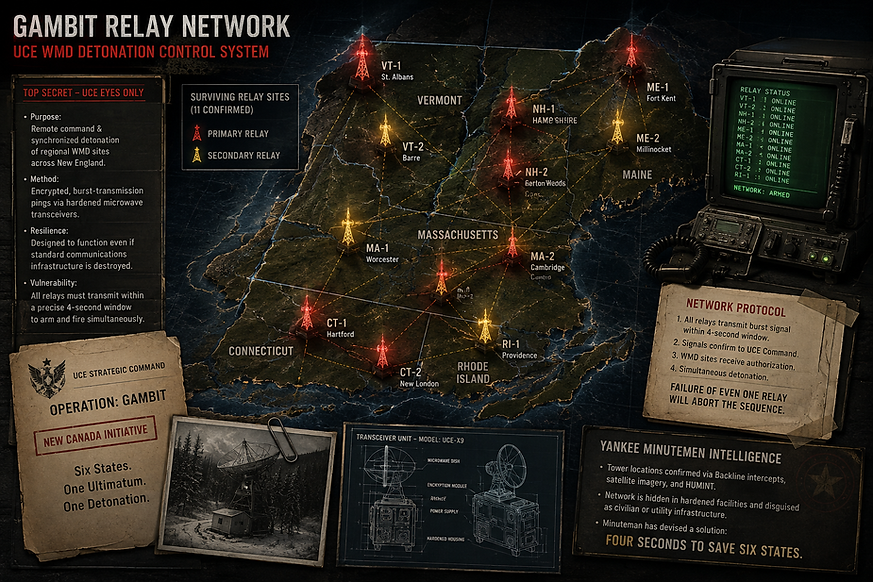
THE NETWORK THE UCE DID NOT DESTROY
Most regional communications were unreliable or compromised. But several high-powered transceiver sites remained operational. At first, military planners assumed the UCE had simply missed them. Hunter Hollister did not believe that.
The surviving transmitters were:
-
strategically positioned;
-
unusually well protected;
-
still transmitting encrypted bursts;
-
geographically aligned with known or suspected WMD locations.
Most importantly, the UCE showed almost no interest in destroying them. Minuteman reached the conclusion that changed the entire crisis. The UCE had not failed to destroy those sites. It had deliberately preserved them. The transmitters formed a dedicated command system used to maintain remote control of the Gambit WMD network.
The system became known as the:
GAMBIT RELAY NETWORK
THE FOUR-SECOND PROBLEM
The Gambit Relay Network was redundant. Destroying one relay would not be enough. If one critical node failed, surviving stations could compensate. Minuteman determined that once the first major relay went offline, the system would begin switching into emergency transmission mode.
That gave the Yankee Minutemen only seconds.
Approximately:
FOUR SECONDS
Every major relay had to be disabled nearly simultaneously. If they failed, Emperor North might still retain enough communications authority to transmit the detonation command. The problem was obvious. New England’s communications systems were already shattered. How do you coordinate multiple attacks across six states when normal communications no longer work?
Vermont provided the answer.
THE BACKLINE
The old Green Mountain Boys had maintained abandoned copper telephone infrastructure throughout remote Vermont properties, workshops, farms, shelters, logging roads, and family holdings.
The system included:
-
analog field phones;
-
old telephone switching equipment;
-
fax machines;
-
low-speed modem connections;
-
physical copper lines;
-
local relay points.
The technology was obsolete.
That was precisely why the UCE had largely ignored it.
The Green Mountain Boys called the system:
THE BACKLINE
Minuteman and Union Blue began using it as an emergency regional command network.
Target coordinates were relayed.
Military contacts were passed.
Hero locations were confirmed.
Timing instructions moved through old copper lines.
Where the Backline could not reach directly, surviving radios, satellite equipment, couriers, and emergency systems bridged the gaps. The Backline ceased being only a Vermont communications network. For several critical hours, it became one of the systems helping coordinate New England itself.
PREPARING THE STRIKE
Minuteman began organizing teams against each Gambit Relay transceiver. Not every strike team consisted of Yankee Minutemen. There were not enough of them.
The operation included:
-
Yankee Minutemen;
-
National Guard personnel;
-
military units;
-
GUARD;
-
police tactical teams;
-
local heroes;
-
Green Mountain Boys;
-
regional responders.
Each group received a single objective. Disable its assigned relay. Do it on the same countdown.
Union Blue coordinated field contingencies.
The Backline carried the timing.
The entire operation depended on everyone moving together.
FOUR SECONDS
Across New England, the strike teams moved.
Some infiltrated relay sites.
Some attacked through UCE defenses.
Some cut power.
Some used explosives.
Some destroyed antennas.
Others physically destroyed control hardware. Minuteman gave the countdown.
Four.
Teams committed.
Three.
UCE defenders realized multiple sites were under attack.
Two.
Transmitters began disappearing from the network.
One.
The final strike teams hit.
Zero.
The Gambit Relay Network went silent.
For the first time since Emperor North’s proclamation, the UCE no longer possessed regional remote-detonation control over the WMD network.
The war changed in four seconds.

ENFORCER ALPHA’S PLAN B
Enforcer Alpha I understood what had happened almost immediately. Remote control was gone. The WMDs could no longer be used as distant bargaining chips. That left one option: physical control.
Alpha issued Plan B.
Every available:
-
UCE Enforcer;
-
Redcoat unit;
-
UCE troop formation
was ordered to:
SECURE THE WEAPON SITES
This explained an important part of Gambit’s structure. The UCE had deliberately kept most of its forces away from the WMD locations during the remote-deterrence phase. No commander wanted to place large numbers of UCE troops next to a weapon Emperor North might intentionally detonate. Once the remote trigger network failed, that calculation changed. The WMD sites became conventional military objectives. And Enforcer Alpha threw everything he had at them.
THE YANKEES MOVE FIRST
Minuteman had anticipated Plan B. The moment the relay network went down, Yankee Minutemen teams moved toward the WMD sites.
Their first job was not complete disarmament. It was to destroy or disconnect the weapons’ local remote-control receivers. Once those components were removed, neither Emperor North nor Enforcer Alpha could simply restore remote control through another transmitter.
Only then did qualified specialists begin the slow process of making the weapons safe.
The heroes were not there to pretend they were nuclear technicians.
They were there to keep the real technicians alive.
THE WMD SIEGES
Within minutes, the UCE attacked. Some WMD sites were assaulted less than half an hour after the relay network collapsed. UCE troops arrived in waves.
Redcoats breached defensive positions.
Enforcers were redirected to whichever sites Alpha considered most vulnerable.
Doctor Phlebotinum’s countermeasures returned to the battlefield.
The Yankee Minutemen found themselves defending small pieces of ground around devices capable of destroying entire communities.
This became the most intense period of Operation: Gambit.
CONNECTICUT
Captain Connecticut I, Minuteman, and Union Blue remained central to the southern New England front. Captain Connecticut I — Nathan Chatham repeatedly placed civilian safety above pursuit of Enforcer Alpha. His armor took severe damage throughout the fighting. When Alpha forced him to choose between continuing the fight and protecting civilians caught in an evacuation crisis, Nathan abandoned the pursuit.
Alpha escaped.
The civilians did not die.
That became one of the defining choices of Nathan Chatham’s late career.
Minuteman coordinated the wider campaign while repeatedly moving between tactical command and direct combat. Union Blue’s resistance cells reopened routes, bypassed UCE checkpoints, guided reinforcements, and preserved local command structures the UCE believed it had already neutralized.

RHODE ISLAND — THE FOUR HOURS
Providence — Sharon Stamos faced the worst sustained medical crisis of her career.
The combination of UCE attacks, radiological danger, civilian panic, and fighting around the local weapon site overwhelmed emergency services. Sharon began using her Arcane Reserve at full strength. At first, she tried to heal everyone.
She could not.
As her reserve fell, she was forced to triage not only patients, but her own power.
Eventually, she faced a brutal choice.
One catastrophically injured person could be saved, but doing so would consume enough power that several others might die.
Providence chose the many.
She continued working.
The incident became known among local responders as:
THE FOUR HOURS
It became one of the experiences that defined her mature understanding of Mercy.

MASTER WARWICK — THE DOOR THAT WOULDN’T STAY CLOSED
While Providence treated casualties, Master Warwick — William Warwick confronted Netherbride.
Her supernatural mobility allowed her to bypass conventional perimeter defenses and threaten evacuation and medical sites directly.
Warwick eventually stopped trying to defend every possible target.
He studied her movement pattern.
He predicted where she would strike next.
Then he prepared the battlefield.
When Netherbride arrived, William used layered temporal and occult defenses to interfere with her ability to escape.The battle became one of containment rather than destruction. He did not need to defeat her permanently. He needed to keep her away from civilians.
When Netherbride challenged the value of protecting people who would eventually die anyway, Warwick answered:
“Because eventually is not today.”

MASSACHUSETTS — THE CAMBRIDGE BLACKOUT
The Cambridge EMP operation became one of Gambit’s major communications-warfare components.
Sister Salem — Cassandra Keating was still extremely young.
Her foresight came in fragments:
-
darkened streets;
-
airport failures;
-
dead electronics;
-
emergency rooms losing systems;
-
Canadian clues;
-
seemingly meaningless locations.
The visions did not give her the answer. They gave her pieces. Cassandra followed them.
She eventually uncovered the larger UCE EMP operation and helped identify dangers conventional intelligence had missed. At the same time, Lexington — Lawrence Xavier became the physical shield around the technical response. Neo Felquiste and UCE troops breached the facility where specialists were working to contain the crisis.
The technicians needed seven minutes.
Lexington held the corridor for eight.
The EMP threat was contained before it became permanently catastrophic.

PORTSMOUTH NAVAL SHIPYARD
The Portsmouth Naval Shipyard became one of Operation: Gambit’s most dangerous military fronts.
The UCE objective involved both WMD coercion and a raid against sensitive military technology.
Maine Man — Judd Ford and Iron Works became central to the defense. Maine Man’s Mystic Sight revealed that the threat had been complicated by a concealed supernatural element tied to the Archduke of Ontario.
The Archduke attempted to draw Judd away from the site.
Judd refused.
He chose the technicians and civilians over personal revenge.
Iron Works kept damaged machinery, access routes, and critical systems operational while UCE forces attacked. Maine Man detected what others could not. Iron Works kept everything else functioning.
Together, they kept the technical team alive long enough to secure the threat.

NEW HAMPSHIRE — THE CORRIDOR
UCE forces attempted to sever mountain transportation and communications routes linking northern New England. Snowfury — Sierra Snowden spent much of the crisis in motion.
She performed:
-
reconnaissance;
-
evacuation;
-
supply movement;
-
route clearing;
-
rescue.
Rocketstro repeatedly tried to force her into a prolonged aerial battle. Sierra refused. She used weather, terrain, and distance to pull him away from an evacuation convoy. By the time he realized what she had done, the convoy was already through. Nearby, Granite Guy — Guy Adams faced a different crisis.
UCE explosives had compromised a major transportation and support structure. Part of the facility began collapsing while civilians and responders remained inside.
Guy got underneath it.
Rescuers told him they needed three minutes.
They needed six.
He held it.
The incident became known simply as:
SIX MINUTES

VERMONT — THE DEVICE
Vermont suffered the most brutal sustained ground fighting of the crisis. The Green Mountain Boys had already taken serious losses before Plan B began. Now they were responsible for defending the Vermont WMD site.
Jason Wentworth led the technical effort against the device.
His Army EOD and industrial explosives background made him the appropriate specialist. Nor’easter — Jack Rower provided cryokinetic environmental control and defensive support.
The Green Mountain Boys provided:
-
perimeter security;
-
communications;
-
logistics;
-
terrain control.
The Backline remained active even as the fighting intensified.

THE YUKON TREE
Yukon became the principal superhuman threat against the Vermont defenders. Conventional attacks repeatedly failed. The Green Mountain Boys responded with the skills they actually possessed.
Logging.
Heavy equipment.
Blasting.
Terrain.
They brought an enormous tree down on the approximately twelve-foot crystalline Enforcer.
Yukon was pinned.
For about a minute.
It was enough.
The story became part of Vermont legend almost immediately.

JUSTICE, NOT REVENGE
Nor’easter eventually gained an opportunity to kill Yukon. Jack wanted revenge. Yukon was tied directly to the grief that had consumed him since Maren Calder’s death.
Josiah Wentworth stopped him.
Killing Yukon would not bring Maren back.
Justice was not vengeance.
Jack stood down.
Soon afterward, UCE indirect fire struck the Green Mountain Boys’ position.
Josiah was mortally wounded.
The lesson immediately became harder.
Jack now had another death he could blame on the UCE.
What mattered was what he chose next.

THE YANKEES BEGIN TO BREAK
The WMD sieges pushed the Yankee Minutemen close to failure. They had already been fighting for more than a day.
Armor was damaged.
Ammunition was running low.
Providence was nearing Arcane Reserve depletion.
Granite Guy was physically battered.
Snowfury had been operating almost continuously.
Captain Connecticut’s systems were degraded.
The Green Mountain Boys were suffering catastrophic casualties.
Doctor Phlebotinum’s countermeasures continued to cause problems.
For several moments, Enforcer Alpha’s Plan B still appeared capable of succeeding.
The Yankee Minutemen needed help.

THE CALL
Minuteman and Union Blue finally received the reports they had been waiting for.
The Gambit Relay Network was dead.
The local remote-control systems at the WMD sites were being neutralized.
The devices were slipping permanently out of UCE control.
That meant military and emergency forces previously held back by the threat of immediate detonation could finally move.
Using the Backline, surviving military frequencies, emergency communications, GUARD channels, and superhero networks, Minuteman sent the message.
The meaning was simple:
THE BOMBS ARE CONTAINED. WE NEED EVERYBODY. NOW.

NEW ENGLAND ARRIVES
The response changed the war.
Air National Guard aircraft moved.
National Guard units mobilized.
Police departments reopened routes.
Military forces converged on UCE positions.
GUARD entered the fight.
The Challengers and other hero groups responded.
Union Blue’s resistance cells guided incoming reinforcements through areas still under UCE control.
Fire departments and EMS crews moved toward casualty zones.
Local civilians came too.
Emperor North had tried to isolate New England.
Instead, the region began moving toward the same fight.

THE GREEN MOUNTAIN RALLY
In Vermont, that mobilization became known as the Green Mountain Rally.
Residents arrived in:
-
pickup trucks;
-
snowmobiles;
-
work vehicles;
-
farm equipment.
Some carried hunting weapons.
Others carried:
-
food;
-
fuel;
-
blankets;
-
medical supplies;
-
tools;
-
chainsaws.
The Rally helped break UCE control around the Vermont front.
Then something more important happened.
As UCE troops began surrendering, the same civilians who had arrived prepared to fight began treating wounded enemies.
Barns became treatment areas.
Volunteer firehouses became clinics.
Workshops became emergency shelters.
Green Mountain Boys were treated.
Civilians were treated.
UCE troops were treated.
First they came armed. Then they came with bandages.

ENFORCER ALPHA’S END
By then, Plan B had failed.
The weapon sites were being secured. Regional reinforcements were arriving. UCE units were losing ground. Enforcer Alpha withdrew to the remaining Gambit command position.
The Yankee Minutemen pursued.
By the time the final defenses were breached, Alpha was badly wounded. The Yankees prepared to take him alive. Alpha understood what capture meant.
Operation: Gambit had failed.
The relay network was destroyed.
The WMD sites were lost.
New England remained American.
His Emperor would know.
Alpha had built his entire identity around service to Emperor North.
Failure left him with nothing he believed worth returning to.
Before the Yankee Minutemen could stop him, Enforcer Alpha I used one of his own weapons to take his own life.
The moment was not celebrated.
It was remembered as evidence of how completely Emperor North had shaped Alpha’s identity.
No Yankee Minuteman was responsible for his death.

NOR’EASTER’S FINAL CHOICE
Even as Gambit collapsed across the rest of the region, Vermont remained dangerous. Clyde Wentworth was badly wounded. Nor’easter used his powers to send him toward safety on an improvised ice rescue sled.
Jack Rower still had a chance to leave.
Then Yukon returned.
There were wounded people behind him.
Jack stayed.
He was mortally wounded during the final confrontation.
Using the last of his cryokinetic strength, Nor’easter contained Yukon.
He did not execute him.
Josiah’s lesson survived.
Jack Rower died at the age of twenty-two.
His final actions became the foundation of:
ROWER’S RULE:
PEOPLE FIRST.

THIRTY HOURS
Approximately thirty hours after Emperor North’s proclamation, the decisive phase of Operation: Gambit was over.
The Gambit Relay Network had been destroyed.
The WMD sites were no longer under effective UCE remote control.
Technical teams were rendering the remaining devices safe.
The UCE had lost its ability to force New England’s surrender through nuclear or radiological extortion.
The crisis was not over.
But the threat that had created New Canada was.
Operation: Gambit ends in failure for the United Canadian Empire, but its effects and aftermath would resonate for many years to come.

THE NEW CANADA INCIDENT
- THE AFTERMATH -
THE THREE-DAY LIBERATION
The next several days belonged increasingly to conventional forces.
The Yankee Minutemen were exhausted.
Many were wounded.
Some remained necessary for Enforcer cleanup.
But the UCE was no longer fighting an isolated region.
It was facing:
-
law enforcement;
-
National Guard;
-
Air National Guard;
-
military forces;
-
GUARD;
-
superhero teams;
-
resistance cells;
-
local responders.
Operations focused on:
-
retaking UCE-held facilities;
-
liberating detention sites;
-
dismantling roadblocks;
-
arresting UCE troops;
-
recovering stolen military materiel;
-
destroying remaining Redcoats;
-
restoring communications;
-
locating sabotage devices;
-
reopening transportation corridors;
-
tracking surviving Enforcers.
The liberation demonstrated an important truth.
New England’s institutions had not vanished.
They had been disrupted.
Once communications returned, they worked.
THE FAILURE OF NEW CANADA
Emperor North had designed Gambit around a single assumption:
If New England could be isolated, it would fracture.
He was wrong.
When modern communications failed, old systems returned.
When official routes became traps, locals found other roads.
When heroes were countered, military personnel and technicians continued working.
When official command collapsed, resistance cells formed.
When the Yankee Minutemen began to fail, the rest of New England arrived.
No single hero defeated Operation: Gambit.
No single organization defeated it.
New England survived because thousands of people continued doing their jobs while the larger system around them was failing.
That became the defining lesson of the incident.
THE COST
Victory came at enormous cost.
All six New England states suffered:
-
casualties;
-
infrastructure damage;
-
disrupted services;
-
displacement;
-
military losses;
-
psychological trauma.
The Green Mountain Boys suffered catastrophic casualties.
Before New Canada:
124 members
During the crisis:
122 deployed
Killed:
88
Deployment survivors:
34
Nondeployed survivors:
2
Immediate surviving organization:
36
The old Green Mountain Boys never truly recovered.
Nor’easter was dead.
Enforcer Alpha I was dead.
Communities across New England began rebuilding.
THE GREEN MOUNTAINEERS
The survivors of the Green Mountain Boys eventually decided not to recreate the organization that had entered New Canada.
They reorganized as the:
GREEN MOUNTAINEERS
Their mission changed.
The modern organization emphasized:
-
wilderness rescue;
-
disaster response;
-
emergency communications;
-
technical operations;
-
logistics;
-
regional preparedness.
The Backline remained active.
Jack Rower’s sacrifice became part of their doctrine.
PEOPLE FIRST.
THE YANKEE MINUTEMEN AFTER GAMBIT
Operation: Gambit changed the Yankee Minutemen as well.
The team became more:
-
decentralized;
-
rescue-oriented;
-
communications-redundant;
-
regionally integrated;
-
conscious of civilian and institutional partnerships.
New Canada proved that direct combat was only one part of superhero response.
Providence’s triage mattered.
Lexington’s hallway mattered.
Granite Guy’s six minutes mattered.
Union Blue’s resistance cells mattered.
Jason Wentworth’s EOD expertise mattered.
The Backline mattered.
The people who came when the heroes were almost beaten mattered.
Gambit changed what the Yankee Minutemen considered victory.
LEGACY OF THE NEW CANADA INCIDENT
The New Canada Incident became one of the defining events of modern New England history. Emperor North failed to create New Canada. But Operation: Gambit exposed how vulnerable an interconnected region could become when communications, infrastructure, trust, and authority were attacked at the same time. The lesson was not that New England had been invulnerable.
It was that resilience could be built from people refusing to stop functioning.
Some fought.
Some healed.
Some carried messages.
Some disarmed weapons.
Some held buildings up.
Some redirected traffic.
Some treated enemies.
Some simply answered when someone called for help.
The UCE tried to make six states stand alone.
Instead, it taught them what happened when they did not.

THE NEW CANADA INCIDENT
- PARTICIPANTS -

-
Captain Connecticut I
-
Minuteman
-
Union Blue
-
Providence
-
Master Warwick
-
Sister Salem
-
Lexington
-
Maine Man
-
Iron Works
-
Snowfury
-
Granite Guy
-
Nor’easter

-
Emperor North
-
Enforcer Alpha I
-
Yukon
-
Netherbride
-
Rocketstro
-
Neo Felquiste
-
Canadian Crab
-
Canadian Shield
-
Archduke of Ontario
-
Doctor Phlebotinum
-
Bonne Fyre
-
Emme Pyre
-
Redcoats
-
UCE conventional troops
UNITED CANADIAN EMPIRE (UCE)

ALLIED ORGANIZATIONS
-
Green Mountain Boys
-
National Guard
-
Air National Guard
-
United States military forces
-
state and local law enforcement
-
emergency responders
-
civilian resistance cells