
A Universe of Pure Imagination

TM


Info
# OF MEMBERS:
IDENTITY:
AFFILIATION:
REGISTERED?:
~40 (once at 124)
Key members are known; in Vermont, they know who's who
American/Hero
Yes
ALIAS(ES):
CURRENT TEAM:
FIRST APPEARANCE:
APPEARANCE DATE:
CREATED BY:
CREATION DATE:
Green Mountain Boys
Yankee Minutemen
N/A
N/A
Don "Major Deej" Finger
15 March 2012
Vernon (Vern) Wentworth (Leader)
Clyde Wentworth
Jason Wentworth
Daryl Wentworth
Sharon Wentworth
Josiah Wentworth (deceased)
ORGANIZATION SUMMARY
The Green Mountaineers are a Vermont-based civilian mountain-response and extraordinary-threat support organization affiliated with the Yankee Minutemen. Descended from the old Green Mountain Boys, the modern organization was born from the catastrophic losses of the UCE New Canada occupation, when local residents, tradespeople, rescuers, technical specialists, veterans, and outdoors professionals fought to keep Vermont functioning after conventional communications and infrastructure collapsed.
Of 124 prewar members, 122 deployed during New Canada and 88 were killed. The surviving thirty-six members refused to simply rebuild the militia that had gone into the fight. Instead, they created something broader, more professional, and more useful to the communities they had nearly died defending.
Today, the Green Mountaineers specialize in wilderness rescue, severe-weather response, emergency communications, logistics, technical operations, remote medical support, and extraordinary-threat assistance. Their doctrine is simple: service first, combat second. Firearms and protective equipment are used when necessary, but the Green Mountaineers exist primarily to find people, move them to safety, restore communications, keep infrastructure working, and remain operational when ordinary systems fail.
Their organizational theme is RESILIENCE, and their most important operational principle is equally simple:
Rower’s Rule: People first.

History
The Green Mountaineers trace their modern origin to the old Green Mountain Boys, a loosely organized Vermont community-defense and emergency network whose roots combined state pride, local self-reliance, outdoors culture, former military experience, and the practical skills of ordinary residents.
The organization was never composed entirely of trained gunfighters. Its membership included mechanics, hunters, climbers, medical personnel, communications specialists, engineers, tradespeople, and other residents whose knowledge became invaluable when normal systems failed.
That structure was tested during the United Canadian Empire's (UCE's) New Canada Incident in 2012.
UCE forces disrupted cellular networks, satellite communications, electrical infrastructure, transportation routes, and conventional government response systems across large portions of Vermont. The Green Mountain Boys mobilized alongside the Yankee Minutemen and local resistance, using terrain knowledge, old infrastructure, civilian equipment, and improvised tactics to remain operational.
One of their most important innovations became known as the Backline. When modern communications were compromised, GMB technicians repurposed abandoned copper telephone lines, analog field phones, fax machines, legacy switching equipment, and low-speed modem connections to move information outside UCE-controlled networks. What looked obsolete became one of Vermont’s most reliable communication systems during the crisis.
The Green Mountain Boys also became known for highly improvised defensive tactics. Snowplows, skidders, tractors, snowmobiles, logging equipment, cables, explosives, and felled timber were adapted to slow or disrupt UCE forces. Their most famous example came when conventional attacks failed against the crystalline villain Yukon. Green Mountain Boys used logging and blasting expertise to bring an enormous tree down directly onto the twelve-foot superhuman, successfully pinning and stunning him.
The cost of the campaign was devastating.
Before New Canada, the Green Mountain Boys numbered 124 members. Of those, 122 deployed. Eighty-eight were killed, leaving only thirty-four deployment survivors and two members who had not deployed. The immediate postwar organization therefore consisted of only thirty-six people.
Among the dead was Josiah Wentworth, one of the organization’s principal moral and field leaders. Josiah had played a critical role in preventing the young mutant hero Nor’easter, Jack Rower, from executing Yukon out of revenge. Josiah’s lesson about the difference between justice and vengeance remained with Jack after Josiah was killed by UCE indirect fire.
As the battle deteriorated, ordinary Vermonters began arriving independently in pickups, farm vehicles, snowmobiles, and work trucks. Some carried hunting weapons. Others carried food, fuel, blankets, tools, chainsaws, and medical supplies. This spontaneous response became known as the Green Mountain Rally.
Once the immediate fighting began to subside, those same civilians turned rapidly toward humanitarian work. Barns, volunteer firehouses, workshops, and private homes became improvised treatment centers. Wounded Green Mountain Boys, civilians, and UCE troops were treated side by side.
Jack Rower witnessed that change.
When Clyde Wentworth was badly wounded, Jack used his powers to send him toward safety on an improvised ice rescue sled. Yukon returned shortly afterward. Jack still had an opportunity to escape, but he turned back toward the threat because wounded people remained behind him.
Mortally wounded in the final confrontation, Nor’easter used his remaining strength to contain Yukon rather than execute him. Jack died protecting the people behind him.
The surviving Green Mountain Boys carried that choice into the postwar reorganization.
They decided not to recreate the old militia.
The Green Mountaineers were born instead.
OPERATIONS, MEMORIAL & ROWER'S RULE

MISSION & OPERATIONS
The modern Green Mountaineers operate primarily as a regional emergency-response and mountain-rescue organization.
Their routine missions include:
-
wilderness search and rescue;
-
missing-person operations;
-
avalanche response;
-
severe-weather emergencies;
-
remote casualty evacuation;
-
mountain medical support;
-
communications restoration;
-
disaster logistics;
-
infrastructure support;
-
winter transportation;
-
emergency shelter and supply coordination.
They also maintain the ability to support the Yankee Minutemen during extraordinary-threat events, including UCE-type incidents, superhuman attacks, regional security emergencies, or other situations in which conventional public-safety agencies require specialized assistance.
Combat capability remains secondary to rescue.
Rower's Rule
The most important informal Green Mountaineer doctrine:
Rower’s Rule: People first
The rule comes from Jack Rower’s (aka Nor'easter's) final actions during the New Canada Incident.
When forced to choose between pursuing Yukon and caring for wounded defenders, Jack remained with the wounded. When Clyde Wentworth needed evacuation, Jack saved him first. When Yukon returned and Jack still had a route to safety, he turned back because vulnerable people remained behind him.
Rower’s Rule is invoked whenever tactical priorities become complicated by human consequences.
It means:
-
rescue before revenge;
-
protection before pursuit;
-
casualty care before personal anger;
-
people before pride.
Among Green Mountaineers, simply saying “Rower’s Rule” is enough.


Green Mountain Boys Monument & New Canada Memorial
-
Green Mountain Boys Monument — located on Green Mountaineer property, but in its own distinct location. This is the full historical honor wall, containing the names of Green Mountain Boys from the organization’s earliest Revolutionary War-era lineage through every subsequent generation and conflict, all the way to New Canada. Its emphasis is history, continuity, lineage, and service across generations.
-
New Canada Memorial — also on the Green Mountaineer property, but at a separate location. This is dedicated specifically to the 88 Green Mountain Boys killed during the New Canada Incident, with room for any additional formally recognized New Canada dead if future canon warrants it. This site should feel more intimate and grief-centered, with flowers, wreaths, candles, photographs, challenge coins, patches, flags, and personal keepsakes left by family, friends, fellow Mountaineers, and visitors.
JACK ROWER/NOR'EASTER - GREEN MOUNTAINEER BY DEED
(Not shown)
-
Nor’easter Memorial — Top Notch Ski Resort — this should remain Jack’s most personal memorial site, tied directly to the place that became his home and to the people who knew him there.
-
Nor’easter Statue — Vermont State House grounds — this remains the public/state-level recognition of his sacrifice and legacy.

Clyde Wentworth

Field Operations Lead
Clyde oversees much of the organization’s active field response.
His specialties include:
-
operational planning;
-
terrain analysis;
-
engineering;
-
drone / UAS support;
-
field coordination;
-
rescue logistics.
Clyde survived New Canada only because Nor’easter Jack Rower chose to save him during the final battle.
That experience strongly influences Clyde’s commitment to Rower’s Rule.

Daryl Wentworth
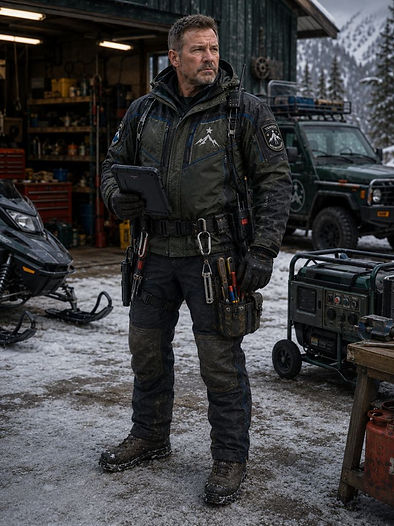
Logistics, Equipment & Fabrication Specialist
Daryl keeps the organization physically operational.
He oversees:
-
vehicle maintenance;
-
generators;
-
mechanical systems;
-
fabrication;
-
equipment repair;
-
workshop operations;
-
field logistics.
When the Green Mountaineers need something repaired, adapted, reinforced, or kept running under terrible conditions, Daryl is usually involved.

Jason Wentworth

Technical Operations & Ordnance Lead
Jason is the Green Mountaineers’ principal hazardous-device and technical specialist.
A former Army EOD technician who later worked in Vermont mining and quarry operations, Jason brings expertise in:
-
explosives safety;
-
industrial systems;
-
hazardous-device assessment;
-
mine safety;
-
technical diagnostics;
-
field engineering.
During New Canada, Jason led the effort to disable the hidden UCE nuclear device.

Sarah Wentworth

Rescue, Reconnaissance & Community Operations Lead
Sharon directs much of the organization’s wilderness rescue and community-response work.
Her specialties include:
-
mountain rescue;
-
climbing;
-
rappelling;
-
reconnaissance;
-
casualty evacuation;
-
community coordination.
Her field identity is deliberately more rescue-oriented than combat-oriented.

Vernon Wentworth

Senior Director / Organizational Leadership
Vern serves as one of the principal modern leaders of the Green Mountaineers. At fifty-four, he represents continuity between the old organization and the rebuilt one.
Calm, experienced, and deeply practical, Vern provides strategic direction without trying to turn the Green Mountaineers into a conventional military force.
His leadership philosophy emphasizes preparedness, competence, regional responsibility, and maintaining the trust of the communities the organization serves.

Standard Field Ops Green Mountaineer
Core Equipment
-
structured forest-green field coat;
-
charcoal reinforced panels;
-
angled or asymmetrical chest construction;
-
integrated low-profile protective layer;
-
Vermont-blue accent piping;
-
silver/off-white insignia;
-
reinforced forearms and knees;
-
compact modular belt;
-
specialized harness attachment points;
-
rugged technical boots.
-
The system can be layered for seasonal conditions and adapted by specialty.
Communications Equipment
The organization uses:
-
encrypted radios;
-
rugged tablets;
-
portable repeaters;
-
satellite equipment when available;
-
field phones;
-
analog Backline equipment;
-
fax and low-speed data systems.
Protective Equipment
Extraordinary-threat operations may add:
-
low-profile ballistic protection;
-
helmets;
-
eye protection;
-
tactical communications;
-
mission-selected firearms.
Heavy armor is avoided unless absolutely necessary.
Rescue Equipment
Common equipment includes:
-
rescue ropes;
-
climbing harnesses;
-
carabiners;
-
medical kits;
-
rescue sleds;
-
snowshoes;
-
avalanche equipment;
-
headlamps;
-
thermal blankets;
-
navigation tools.

Standard Medical Green Mountaineer
Core Equipment
-
structured forest-green field coat;
-
charcoal reinforced panels;
-
angled or asymmetrical chest construction;
-
integrated low-profile protective layer;
-
Vermont-blue accent piping;
-
silver/off-white insignia;
-
reinforced forearms and knees;
-
compact modular belt;
-
specialized harness attachment points;
-
rugged technical boots.
-
The system can be layered for seasonal conditions and adapted by specialty.
Communications Equipment
The organization uses:
-
encrypted radios;
-
rugged tablets;
-
portable repeaters;
-
satellite equipment when available;
-
field phones;
-
analog Backline equipment;
-
fax and low-speed data systems.
Medical Equipment
-
Trauma kit
-
Tourniquets
-
Bandages and gauze
-
Splints
-
Airway kit
-
Portable oxygen
-
AED
-
Hypothermia blankets
-
Stretcher / rescue sled
-
Medical radio
-
Basic medications
-
Gloves and protective gear
Rescue Equipment
Common equipment includes:
-
rescue ropes;
-
climbing harnesses;
-
carabiners;
-
medical kits;
-
rescue sleds;
-
snowshoes;
-
avalanche equipment;
-
headlamps;
-
thermal blankets;
-
navigation tools.

Green Mountaineer Station
In the Mountains of Vermont

