
A Universe of Pure Imagination

TM


INFO
REAL NAME:
IDENTITY:
AFFILIATION:
REGISTERED?:
RELATIVE AGE:
MARITAL STATUS:
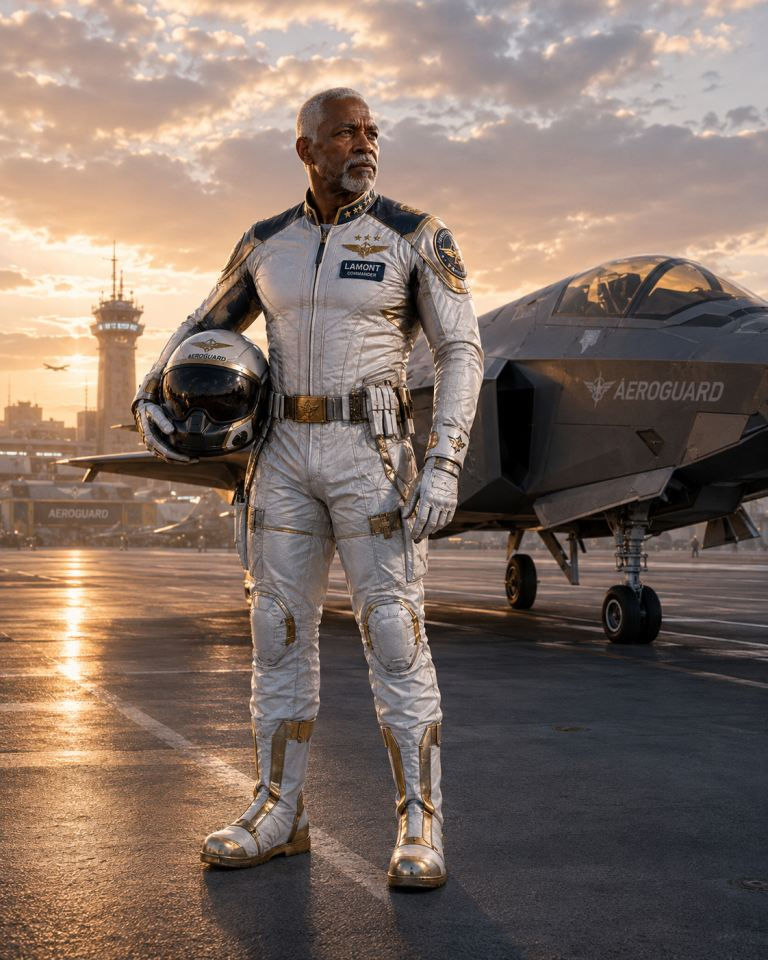
Terrell K. Lamont
Public
USA/Hero
N/A
71
Divorced (x 2)
ALIAS(ES):
CURRENT TEAM:
FIRST APPEARANCE:
APPEARANCE DATE:
CREATED BY:
CREATION DATE:
RELATIONS:
-
Two ex-wives
-
Five children
-
Two grandchildren


HISTORY
Terrell K. Lamont rose through the ranks of the United States Air Force during an era when pilots were still expected to be both warriors and leaders. Over a 35-year military career, he distinguished himself in combat aviation, operational planning, command leadership, and high-level defense politics. He earned a reputation as a fearless flyer, a demanding commander, and a man whose instincts in aerial warfare were almost always ahead of the curve.
By the latter part of his Air Force career, Lamont had reached the service’s highest levels of leadership, eventually becoming Chief of Staff of the United States Air Force. Yet while he was widely respected, he was also increasingly regarded as difficult by bureaucratic and political circles. Lamont was not content to preserve old systems. He pushed aggressively for next-generation aircraft concepts, new aerial combat doctrines, and a sweeping vision for what he called Skyports: autonomous, self-powered, perpetual airborne or elevated aviation platforms capable of serving as forward-operating airfields and rapid-response logistics hubs. To some, his ideas represented the future of global aviation. To others, they sounded impossibly expensive and dangerously idealistic.
In 2000, during a period of severe budget cuts and political retrenchment, Lamont was pressured into retirement. Officially, it was framed as a transition in leadership. Unofficially, he was forced out to make room for a safer, more politically compliant successor. Lamont left the Air Force with honors, but not with peace.
That changed when the Soltan Empire Invasion struck Earth.
With global air forces suddenly facing an existential extraterrestrial threat, Lamont was called back into operational service. In the chaos of the invasion, he became one of the most important air commanders on the planet. Drawing on decades of experience, unconventional tactics, and sheer nerve, he directed Air Force assets in conditions no military planner had ever prepared for. Under his leadership, American airpower executed some of the most daring and effective strikes of the conflict, inflicting heavy damage on Soltan forces and helping keep vital regions and populations from total collapse. For his wartime leadership and personal actions during the crisis, Lamont was awarded the Congressional Medal of Honor.
Even that was not enough to protect him from politics.
Soon after the invasion, Lamont was again displaced and effectively retired. This time, however, his story did not end in bitterness or exile. Director Hart of GUARD recognized Lamont’s value and invited him into the organization, initially to support Operations Division. It did not take long for Lamont to identify one of GUARD’s greatest weaknesses: while it possessed wide-ranging global authority and advanced assets, it lacked a dedicated aviation arm capable of dominating the skies, sustaining worldwide rapid response, and projecting force or rescue capability wherever needed.
Lamont’s answer was AEROGUARD.
Working within GUARD, and later in close partnership with Aaron Armstrong of SAR Inc., Lamont finally found both the resources and the like-minded technical imagination he had lacked in government service. Together, the two men pushed aerial warfare, search-and-rescue mobility, aviation infrastructure, and flight systems design decades beyond conventional limits. Lamont provided the strategic vision and command doctrine; Armstrong provided engineering innovation, applied science, and industrial execution. Their collaboration became one of the most important partnerships in modern defense and rescue history.
Within three years, AEROGUARD emerged as the world’s premier aerial-response and aviation-power organization. Its aircraft were faster, more adaptive, and more versatile than anything fielded by conventional militaries. Its pilots were trained not only for combat, but also for rescue, interdiction, disaster response, and rapid deployment under extreme conditions. Most significantly, Lamont saw the realization of one of his life’s grandest dreams: the creation of nearly fifty Skyports worldwide. Built with advanced composite materials, self-replicating power systems, and V/STOL capability, these installations revolutionized global aviation support. They became symbols of technological progress, emergency readiness, and international reach.
They also became targets.
As AEROGUARD’s influence grew, rival governments, criminal syndicates, rogue corporations, and super-villains all sought access to its technology. Skyports, in particular, became coveted strategic prizes. Time and again, Lamont and AEROGUARD repelled attacks, defended installations, and demonstrated that their command of the skies could not be easily challenged. Yet the scale and nature of those threats continued to evolve. Eventually, repeated super-powered assaults on AEROGUARD assets made one reality unavoidable: conventional forces, even advanced ones, would not always be enough.
That need led to the creation of the Aeroguardians.
Aaron Armstrong spearheaded the formation of the super-powered aerial team, but Lamont took a strong personal interest in them from the start. In many ways, the Aeroguardians represented the culmination of everything he had fought to build: elite airborne capability, tactical independence, and lifesaving reach on a superhuman scale. Lamont would have joined or led such a unit himself without hesitation if he had been younger. But age and health restrictions prevented him from entering the field in that capacity. It remains one of the great frustrations of his life that he came so close to seeing his idealized aerial-response doctrine embodied in hero form, only to be physically barred from standing at the front of it himself.
Today, Lamont remains the commanding force behind AEROGUARD and one of the most formidable strategic aviation leaders in the world. Under his leadership, AEROGUARD and the Aeroguardians together provide unmatched air-policing, strategic interception, disaster support, and search-and-rescue coverage across the globe. Their work has saved countless lives and redefined what aviation can mean in a superhuman age. Aaron Armstrong received global acclaim and even a Nobel Prize for the humanitarian dimension of their efforts. Lamont, true to form, is proud of what they built—but still cannot help wishing he were twenty years younger and still personally flying into the storm.
POWERS
None.
Lamont possesses no innate superhuman abilities.
EQUIPMENT
Though he is no longer an active frontline superhuman operative, Lamont remains fully qualified to use advanced GUARD and AEROGUARD flight systems when necessary.
Standard Equipment
-
Standard AEROGUARD bodysuit
-
Standard AEROGUARD flight pack
-
Standard AEROGUARD sidearms and mission weapons
-
Advanced command-and-control access systems
-
High-level communications and operations interface equipment
-
Secure GUARD tactical authorization credentials
Equipment Notes
Lamont’s equipment is less important than his authority. His real power lies in access, command reach, air-tasking control, and the ability to direct some of the most advanced aerial assets on Earth.
TALENTS
Primary Talents
-
Aerial Combat – Master
-
Military Leadership – Master
-
Command Strategy – Master
-
Tactics – Master
-
Aircraft Operations – Master
-
Pilot – Master
-
Air Superiority Doctrine – Master
-
Search and Rescue Coordination – Expert
-
Operations Management – Master
-
Logistics and Force Deployment – Expert
-
Weapons Systems Familiarity – Expert
-
Training and Personnel Development – Expert
-
Political Navigation – Expert
-
Aviation Systems Development – Expert
-
Crisis Response Command – Master
Secondary Talents
-
Public Leadership / Institutional Presence – Expert
-
Engineering Concepts – Skilled
-
Intelligence Assessment – Expert
-
Interagency Coordination – Expert
-
Negotiation – Skilled
-
Administration – Expert