
A Universe of Pure Imagination

TM




Info
REAL NAME:
IDENTITY:
AFFILIATION:
REGISTERED?:
RELATIVE AGE:
MARITAL STATUS:
Nikolaos “Nikos” Vassilis
Hardly known
Greek/Hero
Only with US Army
34
Single
ALIAS(ES):
CURRENT TEAM:
FIRST APPEARANCE:
APPEARANCE DATE:
CREATED BY:
CREATION DATE:


History
Early Life and Maritime Origins
Little is definitively recorded about the man who would become known as the Sargasso Sailor. Allied records suggest he was a Greek national, born in the early 1910s and raised in a coastal region where maritime life was not a profession, but a way of existence. From an early age, he demonstrated an unusual comfort with the sea—long-duration dives, salvage work, and an instinctive understanding of currents and submerged terrain.
By the late 1930s, he had become a skilled maritime operative—part fisherman, part salvager, and part diver—eventually finding his way into Allied-aligned resistance and naval support roles following the Axis expansion into the Mediterranean.
The SMEE Encounter (1942)
The defining moment of his life—and the origin of the legend—occurred during a classified underwater operation in 1942.
While conducting a deep-sea reconnaissance and recovery mission in a region believed to be within or near the boundaries of the Sargasso Sea, he encountered an unidentified organic entity described in fragmented reports only as “seaweed… but alive.”
This entity—later designated SMEE in Allied intelligence shorthand—did not behave as passive marine life. Instead, it exhibited reactive movement, environmental awareness, and, most notably, a capacity to bond.
Following the encounter:
-
The operative survived conditions that should have been fatal
-
His physical endurance and underwater capabilities increased dramatically
-
A symbiotic relationship formed between the man and the entity
From that point forward, he was no longer operating alone.
Transformation into the Sargasso Sailor
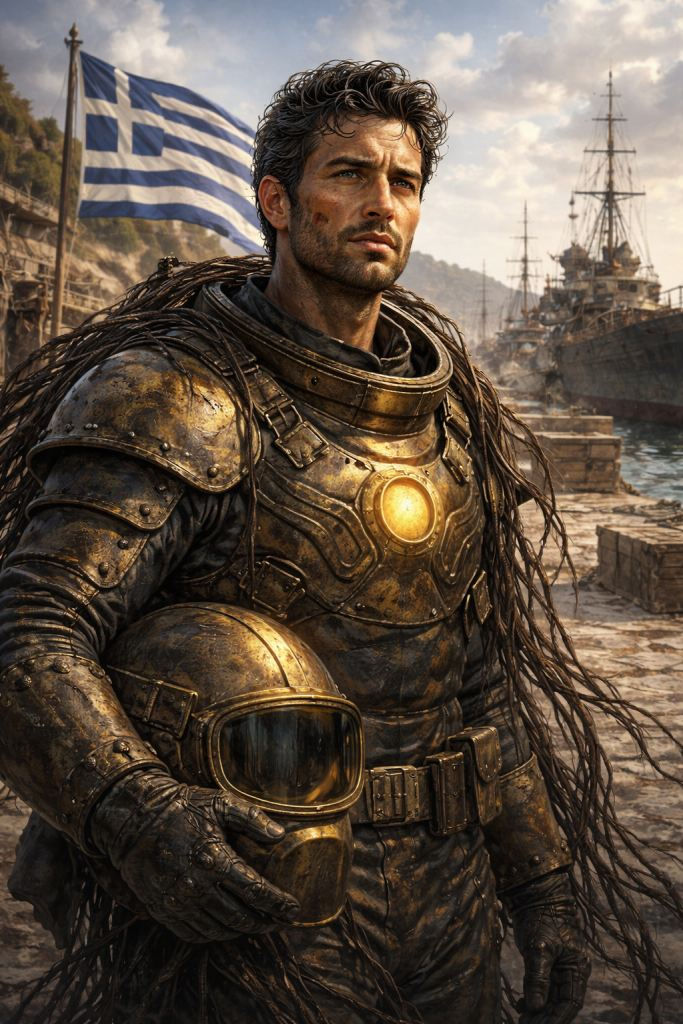
Outfitted in a reinforced deep-sea suit of mottled brass and steel—modified to withstand extreme pressure and prolonged submersion—the operative became something entirely new.
The presence of SMEE manifested as:
-
Dark, tendril-like extensions along his suit and body
-
A faint, shifting aura—black with brown undertones
-
Subtle behavioral influence, particularly in high-stress environments
Despite concerns from Allied command, the enhancements could not be ignored:
-
Extended underwater operation times far beyond human limits
-
High-speed aquatic movement and interception capability
-
Precision sabotage of enemy vessels and infrastructure
It was during this phase that he was given the operational designation:
“Sargasso Sailor”
Allied Fighters Integration
By 1943, Sargasso Sailor was operating in coordination with the Allied Fighters, under the leadership of Captain Invader.
While his effectiveness was unquestioned, integration into the team proved challenging:
-
Language Barrier: Limited English proficiency restricted communication
-
Behavioral Variance: The influence of SMEE created moments of detachment and unpredictability
-
Social Isolation: Attempts by team members to connect were often unsuccessful
Captain Invader, however, recognized both the man and the asset. Rather than sidelining him, he adapted command expectations, allowing Sargasso Sailor to operate in ways that maximized his strengths while minimizing interpersonal friction.
Within the team, he became:
-
A specialist asset for underwater and maritime missions
-
A last-resort operative for high-risk scenarios
-
A figure both respected and quietly misunderstood
Escalation of Operations (1943–1945)
As the war intensified, so too did the scale of Sargasso Sailor’s missions.
Initially deployed for:
-
Harbor reconnaissance
-
Mine and sabotage placement
-
Covert underwater infiltration
He was later entrusted with:
-
Solo interdiction of enemy shipping routes
-
Deep-water demolition operations
-
Direct engagement with naval convoys
Reports from this period describe operations that bordered on the impossible:
-
Ships disabled without visible attackers
-
Hull breaches appearing from below with no warning
-
Survivors recounting “dark shapes” moving beneath the water before impact
By 1944, he was no longer just a specialist—he was a strategic weapon.
Final Mission – Disappearance (1945)
In 1945, Sargasso Sailor was deployed on what would become his final recorded mission: a high-risk assault on a Japanese naval convoy under cover of night.
Mission outcome:
-
Multiple enemy vessels critically damaged or destroyed
-
Confirmed success of underwater sabotage operations
However, in the aftermath:
-
No recovery of the operative
-
No confirmed visual of extraction
-
No body, signal, or wreckage
Eyewitness accounts—fragmented and inconsistent—suggest:
-
A final descent beneath the surface following the attack
-
Movement into deeper waters beyond recovery range
-
The presence of “shadow-like tendrils” withdrawing with him into the depths
Status and Legacy
Status: Unconfirmed – Missing in Action
No official declaration of death was ever made.
Within Allied and later intelligence circles, three prevailing theories remain:
-
Killed in Action – lost during the mission following catastrophic engagement
-
Survival at Depth – sustained indefinitely through SMEE symbiosis
-
Transformation – no longer entirely human, existing within the deep ocean environment

POWERS
Nikos himself possessed no superhuman powers. All abilities derived from the entity later known as SMEE.
(SMEE-BASED – WWII LEVEL)
Underwater Propulsion (Primary)
-
Speeds exceeding torpedoes
-
Rapid acceleration bursts
-
Enabled ship interception and hull impact strikes
Enhanced Durability
-
Withstood:
-
extreme pressure
-
explosions
-
high-speed impact
-
Dark Tendril Manifestation (Limited WWII Use)
-
Short-range entanglement
-
Used for:
-
immobilizing divers
-
anchoring to vessels
-
tearing structural components
-
Energy Drain (Instinctive, Not Understood)
-
Occasional weakening of enemies in close proximity
-
Believed at the time to be “shock or fear response”

Equipment
Modified Naval Dive Suit
-
Brass/steel hybrid construction
-
Reinforced plating for pressure and combat
-
Gold-tinted visor/mask
Integrated SMEE Overlay
-
Bonded to suit and body
-
Provided:
-
mobility
-
defense
-
offensive capability
-
Minimal Conventional Weaponry
-
Combat knife
-
Occasional demolition charges (rarely needed)

Talents
Maritime Expertise
-
Master seaman
-
Expert navigator (sea-based)
-
Deep-water survival specialist
Underwater Combat
-
Ship hull targeting
-
Sabotage placement
-
Silent aquatic engagement
Demolitions (Naval)
-
Placement of charges on moving vessels
-
Structural weak-point identification
Tactical Instinct
-
Not formally trained strategist
-
Operated on:
-
instinct
-
environmental awareness
-
reaction speed
-
Endurance
-
Extreme physical resilience
-
High tolerance for:
-
cold
-
pressure
-
fatigue
-
Limited Multilingual Communication
-
Greek (primary)
-
Basic English (broken but functional)
Symbiotic Adaptation
-
Gradual behavioral alignment with SMEE
-
Improved reaction timing and combat efficiency