
A Universe of Pure Imagination

TM


Info
REAL NAME:
IDENTITY:
AFFILIATION:
REGISTERED?:
RELATIVE AGE:
MARITAL STATUS:
Te-E'-Ous
Known
USA/Apache/Hero
Yes
mid 20s (WWII)
Single
ALIAS(ES):
CURRENT TEAM:
FIRST APPEARANCE:
APPEARANCE DATE:
CREATED BY:
CREATION DATE:
RELATIONS:
None mentioned

History
Overview
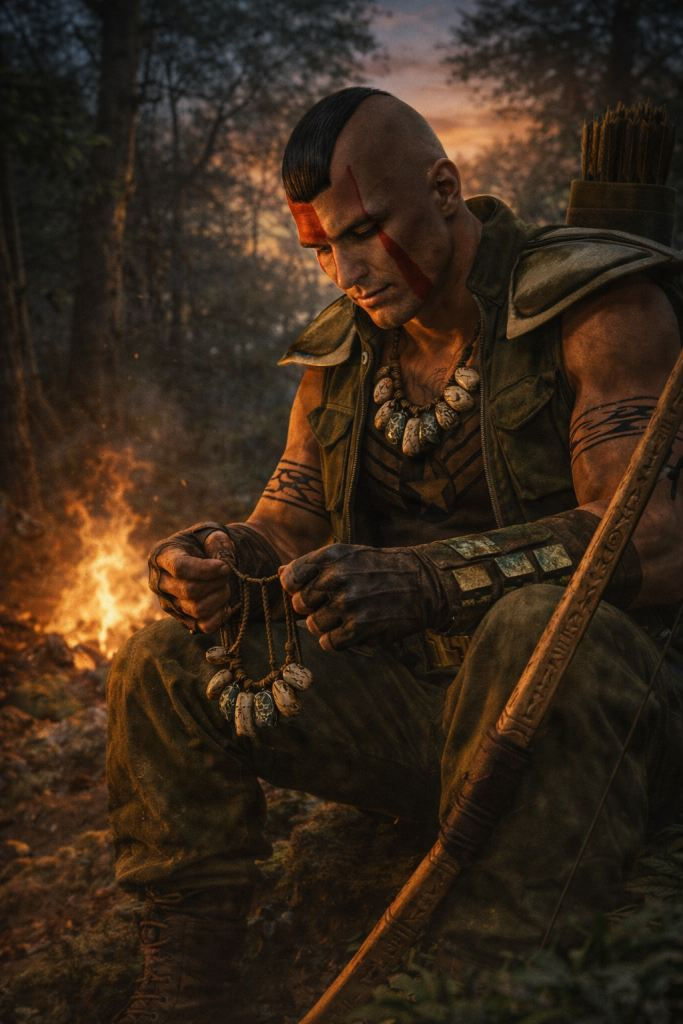
Te-E'-Ous, known in military files as Teh E. Ows and in the field as Apache, was a Tonto Apache warrior who became one of the Allied Fighters’ most formidable close-combat and wilderness-operating heroes during World War II. Raised between Apache tradition and white American schooling, he grew into a man shaped by two worlds and never fully at peace with either of them.
Empowered by a set of sacred Apache Totems of Power, Apache combined spiritual strength, natural athletic ability, deadly fieldcraft, and professional military training into a combat style that made him one of the most feared Allied Fighters in the Pacific Theater. Though quiet and often distant outside battle, he earned a reputation as a relentless warrior, a patient hunter, and a man whose loyalty to the mission did not erase his mistrust of the society he was fighting for.
He died in combat in 1945 during the Battle of Okinawa, leaving behind not only the legacy of a heroic warrior, but also the tragedy of sacred totems lost on a foreign battlefield.
Eary Life
Te-E'-Ous was born and raised on the Tonto Apache Reservation near Payson, Arizona. From a young age, he was raised with a blend of Apache upbringing and western-style education. This combination often created tension in his youth. He got into frequent fights with other Apache children and adolescents who saw him as being shaped too much by white schooling and outside ways.
A local medicine man intervened in his upbringing with a lesson that would define Te-E'-Ous for the rest of his life: he was taught that strength would come not from rejecting one world for the other, but from mastering both. From that point on, Te-E'-Ous committed himself to becoming exceptional in both Apache tradition and the outside world.
By adolescence, he had already undergone the trials and rituals of Apache manhood. In those rites, he did more than simply succeed. He outperformed not only boys his own age, but many grown Apache warriors as well. He constantly pushed himself through daily tests of endurance, patience, awareness, and discipline. Above all, he trained himself to listen — not only to people, but to wind, land, movement, and silence. This sharpened him into an extraordinary tracker, hunter, and warrior long before the war claimed him.
The Vision Quest and the Totems of Power
Before Te-E'-Ous left for military service, a profound spiritual event changed the course of his life. A sweathouse vision quest was conducted for him by the local medicine man along with several other respected Apache elders and medicine men from other reservations. During the ceremony, all of the elders reportedly witnessed the same vision: Te-E'-Ous standing empowered by sacred magical stones known as the Apache Totems of Power.
After the vision, the elders revealed to him the ancient tradition of these totems.
According to their account, more than three dozen totems had existed since the earliest Apache generations. Each contained mystical power associated with physical and spiritual qualities such as speed, agility, strength, vitality, awareness, and endurance. There had once also been stories of an ancient necklace capable of bearing all the totems together, but that item had long since been lost in antiquity.
Because the totems were considered too powerful for any single Apache and too dangerous to ever fall into white hands, they had historically been separated among different warriors and guardians. In times of need, the elders could gather them and distribute them singly or in groups to protect the Apache people.
Much of that system was shattered over generations. Due to violent oppression, displacement, forced relocation, killings, and cultural destruction inflicted upon Native communities, many of the warriors who possessed or hid the totems were murdered, sometimes while openly wearing them. Over time, most of the totems were lost and nearly forgotten.
That changed in the 1930s, when four medicine men and one chief developed a long-term plan to recover the totems. They understood that to find them, Apache people would have to move more freely through white society, blending into it when needed to search for what had been stolen, hidden, or lost. By 1940, they had successfully recovered 27 of the 36 known totems.
The plan had been to gather all the totems and pass them to one of the Apache’s greatest warriors, a leader meant to restore honor and strength to the people. Instead, the world was overtaken by war. When Te-E'-Ous came of age and World War II began, the elders chose him as the bearer of a number of these sacred totems, believing he was the warrior from their vision.
ENTRY INTO WAR
At age eighteen, Te-E'-Ous was drafted into the United States military as America entered World War II. Though he served under the U.S. flag, his deeper charge came from his people and their elders, who had entrusted him with sacred power for a dangerous time.
He entered the United States Marines in May 1942 and was sent into the Pacific Theater against Imperial Japan. There he quickly distinguished himself as an exceptional combatant, one whose movements, reflexes, endurance, and battlefield awareness far surpassed those of ordinary soldiers.
Guadalcanal and Recruitment into the Allied Fighters
During the Battle of Guadalcanal in August 1942, Te-E'-Ous proved himself a devastating warrior. He killed Japanese soldiers with rifle fire, blade work, and bare-handed combat, while moving with such speed, agility, and leaping power that eyewitnesses described his actions as nearly superhuman. In truth, they were superhuman, aided by the mystical force of the totems he wore.
Word of his battlefield performance spread quickly through military and intelligence channels. Within days, he was brought before Captain John Brown, later known as Captain Invader. After demonstrating his abilities, Te-E'-Ous was transferred into Brown’s special multinational superhuman combat unit, the Allied Fighters.
Though he had little love for white authority, he recognized strength when he saw it. He respected Brown’s leadership even if he did not trust the world that had placed either of them in uniform.
SERVICE WIHT THE ALLIED FIGHTERS
For the next several years, Apache fought with the Allied Fighters, especially in operations against Imperial Japanese forces. He became one of the team’s most dangerous battlefield hunters, excelling in stealth, infiltration, ambush, reconnaissance, jungle warfare, close combat, and rapid assault.
He was not talkative and did not socialize easily. Outside battle, he remained withdrawn and disciplined, often keeping to himself. Among the few teammates with whom he formed any warm association was Bullet, with whom he shared a degree of mutual respect and friendship.
Apache was known to have respected Captain Invader, but he also made clear that the end of the war would not mean the same thing for both men. Brown would go back to his America as a decorated hero; Te-E'-Ous would return to a world in which his people still carried the burden of dispossession and injustice. That awareness never left him.
DEATH AT OKINAWA
Apache was killed in 1945 during the Battle of Okinawa.
During one of the battle’s brutal engagements, Apache reportedly assaulted a fortified hill position nearly by himself, destroying multiple Japanese machine-gun nests and killing numerous infantry as he advanced. In the midst of that assault, the last major active Japanese artillery gun on the position targeted him directly.
The blast struck with overwhelming force, killing him instantly and violently. His body was torn apart, and the sacred totems he wore were scattered over nearly half a mile of terrain.
No one in the Allied Fighters fully understood the spiritual importance of the totems, nor did they grasp the necessity of recovering every one of them and returning them, along with Apache’s remains and weapons, to his people. This failure became one of the most painful unfinished matters associated with his death.
FUNERAL AND LEGACY
A traditional funeral was later conducted for Apache, attended by Bullet and Captain Invader. During the ceremony, Captain Invader presented seven recovered totems found near the site of Apache’s death, though he admitted that he did not know where the remaining totems had gone, nor the whereabouts of some of Apache’s weapons and gear.
The recovered totems were preserved by the elders for decades thereafter.
Apache came to be remembered as both a war hero and a cultural guardian — a man chosen by his people, entrusted with sacred power, and sent into a global war that could never fully understand what he carried. Among the Allied Fighters, he remained one of the fiercest warriors ever to serve on the team.
Powers
Powers: None, he was a normal human.
The Totems of Power are what empowered him.
Equipment
Apache’s powers came from the Apache Totems of Power, ancient mystical stones entrusted to him by Apache elders. His abilities should stay in the Excellent to Remarkable range overall, making him dangerous but not absurdly overpowered.
-
Totemic Power Set
While wearing his totems, Apache possessed the following enhanced abilities:
-
Enhanced Strength — Excellent
-
Apache could strike harder than a normal man, overpower trained soldiers, break light obstacles, and use melee weapons with exceptional force.
-
-
Enhanced Agility — Remarkable
-
His balance, reflexes, flexibility, and body control were extraordinary. This made him highly effective in dodging, climbing, rolling, leaping, and close-quarters fighting.
-
-
Enhanced Speed — Excellent
-
Apache could sprint, reposition, and close distance far faster than an ordinary human, especially across rough terrain, jungle paths, hillsides, and battlefield obstacles.
-
-
Enhanced Endurance / Vitality — Remarkable
-
He could fight for long periods under punishing conditions, shrug off exhaustion longer than most men, and survive battlefield stress that would incapacitate others.
-
-
Leaping Ability — Remarkable
-
Apache could leap extraordinary distances and heights, enough to seem almost superhuman to observers in battle.
-
-
Heightened Awareness — Excellent
-
His senses, intuition, and battlefield perception were unusually sharp. He was especially dangerous as a tracker, ambusher, and hunter.
-
-
Limited Spiritual Resilience — Excellent
-
The totems seemed to harden his will and stabilize his body under stress, giving him unusual resistance to fear, pain, and battlefield shock.
-
-
Apache Longbow
-
A self-made traditional Apache longbow used with great skill in both stealth operations and battlefield engagements.
-
-
Apache-made Arrows and Quiver
-
Handcrafted arrows suited for silent elimination, hunting, and precision shots.
-
-
Standard U.S. Military Weapons and Gear
-
Apache also carried and used standard World War II combat equipment as needed, including:
-
service rifle
-
sidearm
-
combat knife
-
ammunition and web gear
-
standard field kit
-
-
Power Limits:
-
His powers depended on possession of the totems.
-
The full historic power of all Apache totems was greater than what he personally wielded.
-
Loss or destruction of individual totems may have reduced certain attributes.
-
He was still mortal and vulnerable to sufficient force, as shown by his death at Okinawa.
Talents
-
Wilderness tracking _master
-
Stealth and stalking - expert
-
Ambush tactics - expert
-
Knife fighting _Professional
-
Bow and arrow use - Professional
-
Hand-to-hand combat - Professional
-
Marksmanship with military firearms _Proficient
-
Jungle and rough-terrain movement Professional
-
Scouting and reconnaissance - Professional
-
Survival skills - Professional
-
Observation and situational awareness - Professional
-
Traditional Apache warrior training - Professional
-
Ritual endurance and self-discipline
-
Vision-quest and spiritual trial experience
-
Deep patience and environmental listening
-
U.S. Marine combat training - Professional
-
Small-unit battlefield tactics - Proficient
-
Pacific-theater combat operations - Proficient
-
Field discipline and assault coordination - Professional