
A Universe of Pure Imagination

TM



INFO
ORIGINAL NAME:
IDENTITY:
AFFILIATION:
REGISTERED?:
RELATIVE AGE:
MARITAL STATUS:
Amara Okonkwo
Public
Nigerian / Hero
N/A
47
Married
ALIAS(ES):
CURRENT TEAM:
FIRST APPEARANCE:
APPEARANCE DATE:
CREATED BY:
CREATION DATE:
RELATIONS:
-
Dr. Chidi Okonkwo (husband)
-
Nneka Okonkwo (daughter)(@ college)
-
Tobe Okonkwo (son)(teen)
Personality:
Amara Okonkwo is calm, commanding, practical, compassionate, relentless, and quietly intimidating when supplies are mishandled. She is warm with people but severe with systems. She believes hunger, exposure, medical shortages, broken equipment, and delayed relief are not “logistics problems” to the people suffering from them. They are life-or-death failures.
Amara has a disciplined presence. She does not panic, even when supplies are trapped, routes collapse, vehicles fail, warehouses burn, officials argue, or field teams scream for support. She listens, calculates, prioritizes, and moves. She is not theatrical. She is not flashy. She is the person in the room who already knows which shipment is late, which warehouse is understocked, which route is compromised, which hospital is about to run out of plasma, and which commander is pretending the supply report is better than it is.
She is deeply humanitarian, but she does not confuse compassion with softness. Amara will fight bureaucrats, smugglers, hoarders, warlords, corrupt contractors, and even GUARD commanders if they interfere with getting life-sustaining supplies where they are needed.
Her usual manner is professional and steady. Her anger is rare, controlled, and memorable.
Character Short Summary:
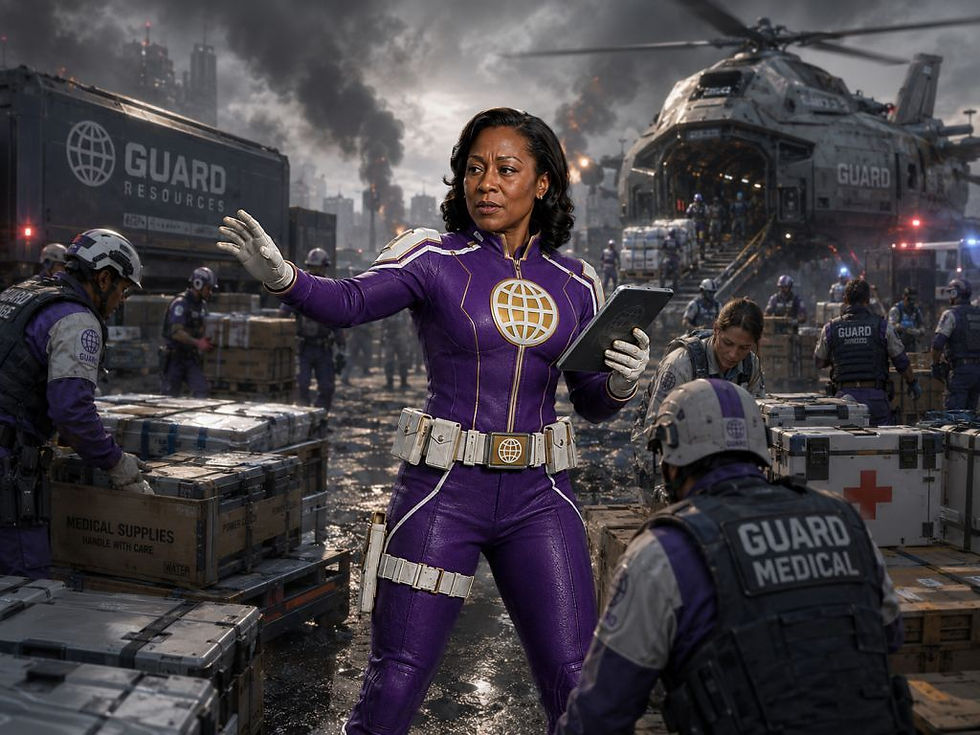
Amara Okonkwo is the Commander of GUARD Logistics & Supply Chain Command / LOGCOM and the woman responsible for keeping GUARD supplied across Earth, orbit, the Moon, seabases, air stations, disaster zones, classified facilities, humanitarian corridors, and active crisis theaters.
Born in Lagos, Nigeria, Amara built her career in humanitarian logistics, emergency supply corridors, anti-diversion inventory systems, and crisis stockpile management. She learned early that food, medicine, fuel, water, spare parts, batteries, shelter material, and transport timing can decide who lives long enough for rescue to matter.
Known by the codename “Lifeline,” Amara believes logistics is not background support. It is survival infrastructure. Her command philosophy is direct:
A supply that arrives late is not support. It is an apology.
Under her leadership, LOGCOM manages strategic warehousing, emergency reserves, field resupply, humanitarian stockpiles, classified logistics, medical supply coordination, lunar and orbital sustainment support, seabase logistics, air station supply flow, crisis surge inventory, inventory accountability, and disaster-response distribution.
If Terry McCormick moves GUARD, Amara Okonkwo makes sure there is something worth moving — fuel in the tanks, food in the crates, medicine in the field hospitals, parts in the repair bays, and supplies in the hands of the people who need them before the window closes.

HISTORY
Amara Okonkwo was born in Lagos, Nigeria, one of the busiest and most complex cities in the world. Lagos taught her early that movement, supply, scarcity, and survival are connected. Food moved through markets. Fuel moved through ports and depots. Medicine moved through clinics and pharmacies. Water moved through trucks, pipes, and emergency vendors. People moved constantly, trying to work, trade, flee, build, and endure.
As a child, Amara noticed patterns adults often ignored.
A shipment delayed at the port could raise food prices days later. A flooded road could isolate families before officials even called it an emergency. A hospital without generator fuel could become more dangerous than the disease it was treating. A warehouse full of supplies meant nothing if no one could move them. A promise of aid meant nothing if the truck never arrived.
She grew up understanding a brutal truth:
Resources are not real until they reach the person who needs them.
Amara excelled in school and developed a talent for organization that went far beyond neat lists and schedules. She understood flow. She could see how supplies moved, where they jammed, who controlled them, who stole them, who wasted them, and who suffered when the system broke. Her education took her into logistics, supply-chain management, humanitarian operations, international development, and emergency response planning.
She could have built a comfortable corporate career.
Instead, Amara chose crisis work.
In her early career, she worked with disaster-relief organizations, public-health campaigns, emergency medical networks, and regional supply coordinators across West Africa. She helped move food, water, medicine, shelter materials, and medical supplies into areas affected by floods, disease outbreaks, displacement, infrastructure failure, and political unrest.
She became known for doing what others said could not be done. When road networks failed, she found alternate routes. When local storage was unsafe, she created distributed stockpiles. When fuel supplies ran short, she prioritized movement by survival impact rather than political pressure. When officials wanted photo opportunities, she wanted loading manifests. When powerful figures tried to redirect aid for profit or influence, Amara documented everything and forced the issue into the open.
That made her effective.
It also made her enemies.
Amara saw the ugly side of logistics. Relief supplies stolen before they reached camps. Medicine sold on black markets while clinics ran dry. Fuel diverted from ambulances to private compounds. Food hoarded for political leverage. Contractors paid to deliver goods that never arrived. Children dying within sight of warehouses that were full but locked behind corruption, fear, or incompetence.
Those experiences hardened her.
Not into cynicism, but into discipline.
Amara stopped believing in good intentions without proof of delivery. She stopped accepting statements like “supplies have been allocated” or “support is on the way” as meaningful by themselves. Allocation was not arrival. Dispatch was not delivery. Procurement was not relief. A warehouse inventory was not a saved life.
She developed a reputation for ruthless tracking, moral clarity, and practical compassion. She could be gentle with exhausted field workers and merciless with dishonest officials in the same hour. Her teams trusted her because she never forgot that logistics was ultimately about people, not pallets.
Her breakthrough came during a major regional crisis involving flooding, disease risk, and displaced populations spread across several vulnerable corridors. Multiple agencies were failing to coordinate. Supplies existed, but the flow was collapsing. Routes were flooded, fuel was short, clinics were overwhelmed, and field teams were receiving contradictory instructions.
Amara built a crisis logistics map overnight.
She prioritized medical cold-chain movement, water purification supplies, fuel routes, emergency shelter, food staples, and mobile clinic support. She identified which routes could support heavy vehicles, which required boats, which communities needed air drop coordination, and which warehouses were being manipulated by local power brokers. Her plan did not satisfy everyone, because it refused to prioritize influence over need.
It worked.
People who would have been cut off received supplies in time. Clinics stayed open. Disease spread was slowed. Relief teams began using her model as a template for future crisis corridors.
GUARD noticed.
At first, Amara resisted recruitment. She respected GUARD’s mission, but she had no interest in becoming part of a large institution if that meant drowning in bureaucracy. She had already seen enough organizations where reports mattered more than hungry people.
GUARD Resources approached her carefully. What finally drew her attention was not rank, salary, or prestige. It was scale. GUARD had global reach, transport capacity, classified infrastructure, emergency authority, air stations, seabases, space assets, medical divisions, Academy pipelines, and field commands that operated in disasters before many governments had finished meeting about them.
If Amara could reshape GUARD logistics, the number of lives affected would be enormous.
She joined.
Inside GUARD, Amara found a supply system with extraordinary capability but uneven discipline. GUARD had warehouses, vehicles, airlift, sealift, medical stocks, spare parts, emergency stores, fuel systems, field kits, classified materials, lunar and orbital supply requirements, and humanitarian response caches. But the scale was so large that even small inefficiencies could become dangerous. Some inventory systems were excellent. Others were too dependent on local habits. Some emergency reserves were overstocked in the wrong places and understocked in the right ones. Some field commanders requested supplies they did not need, while quieter units absorbed shortages without complaint.
Amara began correcting the flow.
She reorganized strategic stockpiles around risk, not convenience. She built tiered emergency reserves. She pushed for better shelf-life tracking, supply rotation, automated alerts, cold-chain protection, disaster-zone prepositioning, and route redundancy. She worked with Terry McCormick’s TRANSCOM teams to align supply movement with vehicle readiness and route reality. She worked with Achmel Abdhulla’s FACOM teams to build better warehouses, hardened supply hubs, and emergency distribution points. She worked with GUARD Medical to strengthen field hospital resupply, trauma supply kits, blood product movement, vaccine cold-chain reliability, and refugee medical support logistics. She worked with Hank Heinkel’s WEPSCOM on strict chain-of-custody protocols for weapons, power packs, and mission-sensitive equipment.
Akemi Tokiwa recognized Amara’s value immediately.
Both women understood the moral side of resource control. Akemi’s life had been shaped by stolen shipments, criminal diversion, and corrupted supply systems. Amara’s career had been shaped by delayed aid, stolen relief, and people dying because supplies existed but did not arrive. Their philosophies aligned easily.
Akemi believed honor was operational.
Amara believed delivery was proof.
Together, those ideas became central to LOGCOM’s culture.
Eventually, Amara became Commander of Logistics & Supply Chain Command. Under her, LOGCOM became the command responsible for strategic warehousing, supply-chain security, emergency reserves, field resupply, humanitarian logistics, classified support flow, medical supply coordination, air station supply chains, seabase logistics, space and lunar support material, inventory accountability, and crisis surge logistics.
Her codename, “Lifeline,” came from field teams before it became official. They used it because when Amara was in the loop, supplies arrived. Maybe late by her standards, maybe ugly, maybe through a route no one wanted to use, but they arrived.
Amara does not romanticize logistics. She knows it is spreadsheets, warehouse dust, fuel stink, spoiled food, broken pallets, armed escorts, sleepless dispatchers, customs fights, routing arguments, missing parts, burned roads, and hard decisions about who gets the next shipment first.
But she also knows what it means when a truck reaches a village before the water runs out. When a field hospital gets plasma before the next wave of casualties. When a stranded unit receives batteries, filters, and spare parts before nightfall. When a refugee camp gets shelter materials before the storm hits. When lunar supplies arrive before oxygen margins become lethal.
That is why Amara Okonkwo serves.
Not for the glory.
For the arrival.
POWERS
Power Origin: Natural
Amara Okonkwo is a non-powered human. She has no metahuman, magical, alien, cybernetic, or supernatural abilities. Her capabilities come from intelligence, experience, logistics mastery, humanitarian crisis work, systems thinking, command discipline, and GUARD training.
EQUIPMENT
GUARD Resources / WEPSCOM Uniform
Amara wears the official GUARD Resources Division uniform appropriate to her role. It provides standard GUARD uniform physical, temperate, radiation, and toxic/toxin protection.
LOGCOM Command Tablet
A secure command tablet linked to GUARD supply-chain systems, strategic warehouses, emergency reserves, medical stockpiles, classified logistics, transport routing, inventory alerts, and field resupply dashboards.
The tablet allows Amara to monitor:
-
Stock levels
-
Warehouse status
-
Field requests
-
Shipment location
-
Fuel availability
-
Emergency reserves
-
Medical supply status
-
Cold-chain integrity
-
Route conditions
-
Delivery priorities
-
Classified cargo movement
-
Crisis surge requests
-
Spoilage and expiration risks
-
Supply diversion warnings
Supplyline Logistics Interface
Amara uses a specialized LOGCOM holographic interface nicknamed the 'Supplyline Board' by her staff. It visualizes the entire supply network as living routes, nodes, risk zones, and demand points.
The Supplyline Board can display:
-
Active supply corridors
-
Broken or compromised routes
-
Humanitarian demand clusters
-
Medical urgency zones
-
Fuel and power supply levels
-
Emergency stockpile status
-
Airlift/sealift options
-
Convoy routing
-
Lunar/orbital supply margins
-
Weather and disaster overlays
-
Security-risk layers
-
Supply theft or diversion indicators
Secure GUARD Communicator
Encrypted communicator tied to LOGCOM command channels, Resources leadership, TRANSCOM dispatch, FACOM warehouse operations, GUARD Medical logistics, WEPSCOM controlled shipments, field commanders, humanitarian-response teams, and emergency operations centers.
Strategic Warehouse Credentials
High-level credentials allowing Amara access to GUARD warehouses, emergency supply reserves, classified storage sites, medical stockpile facilities, field distribution hubs, cold-chain storage, fuel depots, and crisis-response caches.
Inventory Authentication Scanner
A handheld scanner used to verify crates, pallets, serial tags, medical stock labels, seals, chain-of-custody records, cold-chain exposure, and shipment authenticity.
It can detect:
-
Broken seals
-
Repacked crates
-
Temperature exposure
-
Expired goods
-
False manifests
-
Duplicate tags
-
Missing items
-
Unauthorized substitutions
-
Counterfeit supplies
-
Restricted cargo discrepancies
Crisis Routing Kit
For field deployments, Amara may carry or assign a compact routing kit containing:
-
Portable route-mapping device
-
Satellite uplink module
-
Emergency manifest scanner
-
Power bank
-
Cold-chain monitor
-
Field inventory tags
-
Water-resistant logistics cards
-
Convoy priority markers
-
Emergency translation modules
-
Field distribution templates
Personal Defense Equipment
Amara is not primarily a combatant, but she may carry:
-
Compact GUARD-approved sidearm when required by crisis deployment status
-
Personal locator beacon
-
Emergency signal device
-
Field survival kit
-
Basic protective gear for disaster zones
She does not define herself through weapons. Her tools are routes, stockpiles, manifests, and delivery timing.
Key Systems Under Her Authority
Amara does not personally carry these systems, but they fall under LOGCOM authority:
-
GUARD strategic warehouse network
-
Emergency supply reserves
-
Humanitarian response stockpiles
-
Medical supply coordination pipelines
-
Food, water, fuel, uniform, parts, and field-supply inventories
-
Air station supply chains
-
Seabase logistics support
-
Lunar and orbital supply support
-
Classified logistics routes
-
Cold-chain medical transport
-
Crisis surge inventory systems
-
Field resupply networks
-
Inventory accountability databases
-
Anti-diversion monitoring systems
-
Emergency distribution hubs
-
Disaster-response supply corridors
TALENTS
Legendary-Level
Crisis Logistics Doctrine
Amara’s defining talent is building logistics systems that function under crisis conditions. She understands that supply chains must be designed for disaster, not merely for normal operations.
Humanitarian Supply Lifeline Design
Amara is legendary at creating supply lifelines that keep civilians, field teams, medical units, and isolated facilities alive during emergencies. Her doctrine treats logistics as survival infrastructure.
Master-Level
Global Supply-Chain Management
Amara can oversee supply flow across nations, oceans, air corridors, field bases, seabases, air stations, classified sites, and extra-terrestrial support systems.
Strategic Warehousing
She is a master of stockpile placement, inventory rotation, reserve planning, facility coordination, and emergency supply positioning.
Emergency Resupply Operations
Amara can organize urgent delivery of supplies into disaster zones, active conflict areas, field hospitals, evacuation corridors, and isolated facilities.
Anti-Diversion Logistics
She is highly skilled at preventing theft, hoarding, black-market leakage, false reporting, politically motivated rerouting, and criminal exploitation of supply systems.
Medical Supply Coordination
Amara understands medical logistics, including trauma supplies, blood products, pharmaceuticals, vaccines, cold-chain requirements, field hospital resupply, and refugee medical support.
Multi-Domain Sustainment
She can support GUARD missions across land, sea, air, orbital, lunar, underground, classified, and humanitarian environments.
Professional-Level
Inventory Accountability
Amara is an expert at tracking supplies, verifying manifests, monitoring shelf life, identifying gaps, and ensuring stock records match physical reality.
Fuel and Parts Logistics
She understands the importance of fuel, batteries, power cells, spare parts, repair kits, filters, tools, and maintenance supplies in sustaining operations.
Humanitarian Operations Planning
She can plan supply flow for refugees, displaced populations, disaster victims, field clinics, emergency shelters, and relief corridors.
Transportation Coordination
She works closely with TRANSCOM to align cargo requirements with vehicle availability, airlift capacity, convoy routing, sealift support, and emergency deployment assets.
Warehouse and Distribution Hub Design Input
She works with FACOM to ensure warehouses, depots, and distribution hubs are built for real crisis flow rather than theoretical storage capacity.
Controlled Shipment Oversight
She coordinates with WEPSCOM and other commands on sensitive cargo, classified material, weapons, power packs, and mission-critical equipment.
Advanced-Level
Route Risk Analysis
Amara can evaluate roads, ports, airfields, seaways, weather, conflict zones, political barriers, customs risks, and infrastructure damage.
Field Distribution Management
She can organize supply distribution under chaotic conditions while reducing crowding, conflict, waste, and duplication.
Cold-Chain Logistics
She understands temperature-sensitive transport for vaccines, medicines, blood products, biological samples, and specialized medical supplies.
Crisis Negotiation
Amara can negotiate passage, delivery access, warehouse release, customs priority, security escort, and interagency cooperation during emergencies.
Data-Driven Logistics
She uses predictive models, inventory systems, and demand forecasting, but she does not allow data dashboards to replace field truth.
Team Leadership Under Pressure
Amara can lead exhausted logisticians, dispatchers, drivers, warehouse crews, field officers, and humanitarian responders during long crisis operations.
Proficient-Level
Basic Self-Defense
Amara has GUARD-standard self-defense training suitable for crisis deployment and emergency travel.
Firearms Familiarity
She has basic firearms safety and handling knowledge but does not prefer weapons-focused roles.
Public Speaking
Amara can brief commanders, humanitarian partners, government officials, field teams, and international agencies.
Multilingual Coordination
She is experienced working across languages, cultures, agencies, and national systems.
Administrative Systems
She is proficient with logistics software, inventory databases, shipping systems, warehouse records, and emergency supply platforms.
Moral Triage Communication
Amara can explain hard supply-priority decisions clearly, honestly, and without hiding behind bureaucracy.