
A Universe of Pure Imagination

TM



STATISTICS


AIR STATION DECK LAYOUTS


OPERATIONS
Overview
A GUARD Air Station is more than an airborne base. It is a fully mobile emergency-response platform designed to bring aviation, medical care, disaster relief, logistics, rescue coordination, and GUARD command capability directly above the point of need.
Operated by AEROGUARD, each Air Station functions as a high-altitude mobile airbase, search-and-rescue hub, emergency hospital, logistics depot, temporary shelter, command center, and neutral humanitarian operations platform. Whether hovering above a hurricane zone, staging aircraft over a collapsed city, coordinating wildfire evacuations, or supporting GUARD teams during a metahuman crisis, the Air Station exists for one purpose:
When the ground fails, help can still arrive from above.
Core Operational Roles
Search and Rescue Operations
Search and rescue is the Air Station’s defining mission. From its flight deck and hangar systems, AEROGUARD can launch aircraft, rescue teams, medevac craft, drones, and specialized response units into disaster areas where roads, airports, hospitals, and local infrastructure have failed.
Search and rescue operations may include:
-
Urban disaster rescue
-
Wilderness search operations
-
Flood and hurricane evacuation
-
Maritime rescue support
-
Mountain and arctic recovery
-
Fire-zone extraction
-
Battlefield casualty recovery
-
Metahuman incident evacuation
-
Airborne medical rescue
-
Civilian relocation during crisis events
AEROGUARD flight crews, rescue specialists, medical teams, drone operators, and mission coordinators work together from the Operations Center, Flight Deck, Rescue Drone Control, Medic Chopper Bay, and Medical Center to locate victims, stabilize them, and move them to safety.
GUARD Mission Staging
Air Stations serve as forward staging bases for GUARD operations. When a regional crisis requires a rapid multi-division response, the Air Station can deploy as a neutral command and logistics platform without depending on local runways, ports, or government basing permissions.
A deployed Air Station can support:
-
AEROGUARD flight and rescue operations
-
Guardian Corps deployment
-
GUARD tactical response teams
-
Medical and humanitarian operations
-
Intelligence and communications support
-
Emergency logistics distribution
-
Command coordination with the United Nations
-
Regional and national emergency-service liaison
-
Metahuman threat response
-
Disaster-zone aviation control
Because the Air Station can remain airborne, land when required, or station-keep above a crisis region, it gives GUARD a flexible operational platform that can move where fixed bases cannot.
Flight Operations
Air Traffic Control and Flight Safety
The Air Station’s Air Traffic Control Tower and superstructure mast systems manage the platform’s aviation environment. ATC oversees launch, recovery, routing, deck movement, weather monitoring, emergency landing clearance, regional airspace coordination, and aircraft safety.
ATC functions include:
-
Flight deck launch and recovery control
-
Fighter, Osprey, Medic Chopper, and eVTOL routing
-
Drone and rescue aircraft coordination
-
Weather and turbulence monitoring
-
Radar and sensor tracking
-
Emergency aviation command
-
Regional air control operations
-
Deck safety management
-
Crash and fire response coordination
When operating over a disaster zone, the Air Station may become the dominant regional aviation control point, especially if local airports, towers, or radar systems are damaged or offline.
Flight Deck Operations
The upper flight deck is the Air Station’s primary aviation surface. It supports fighter launch and recovery, VTOL operations, aircraft staging, emergency recovery, and rapid dispatch of rescue assets.
The flight deck includes:
-
Central runway strip
-
Fighter launch and recovery lanes
-
VTOL pads
-
eVTOL and drone operations areas
-
Aircraft tie-down zones
-
Emergency recovery areas
-
Deck elevators
-
Fire and crash stations
-
Aircraft staging lanes
-
Refueling and servicing areas
-
Pop-up defense and safety systems
The flight deck is most active when the Air Station is hovering, station-keeping, or moving slowly. During high-speed transit, exposed deck operations are restricted unless emergency conditions require otherwise.
Hangar and Aircraft Operations
Beneath the flight deck, the Air Station contains three primary aviation hangar decks.
Hangar Deck #1 — F-35 Deck houses the station’s fighter complement, including rapid launch bays for emergency defense. These bays keep ready-alert F-35s fueled, armed, and prepared for immediate launch.
Hangar Deck #2 — CV-22 Osprey Deck supports transport, rescue, cargo, module deployment, and heavier VTOL operations.
Hangar Deck #3 — Medic Chopper / eVTOL / Rescue Drone Control / MEDEVAC Center supports emergency medical aviation, rescue drone operations, rapid recharge systems, eVTOL transport, medevac coordination, and open triage staging.
Together, these hangar decks allow the Air Station to operate like an airborne airport, rescue base, and emergency logistics hub.
Rescue and MEDEVAC Process
Standard Rescue Flow
A typical Air Station rescue operation follows a coordinated sequence:
1. Detection and Tasking
The Operations Center, Intelligence/Mission Planning teams, ATC, drone operators, local authorities, or GUARD field units identify a rescue need.
This may come from:
Distress beacons
Civilian emergency calls
Satellite or drone surveillance
Local emergency-service requests
GUARD patrols
Weather disaster alerts
Metahuman incident reports
Refugee movement tracking
Medical evacuation requests
2. Mission Assignment
The Operations Center assigns the mission to the appropriate response asset. This may include Medic Choppers, CV-22 Ospreys, eVTOL transports, rescue drones, AEROGUARD teams, Guardian Corps personnel, or specialized medical units.
3. Launch Preparation
Aircraft are fueled, armed if necessary, loaded with supplies, assigned medical or rescue personnel, and cleared by ATC.
Medic Choppers may be loaded with:
Removable gurneys
Emergency oxygen
Trauma kits
Crash cart equipment
Defibrillator systems
Neck collars and stabilization gear
Patient monitors
Field medical packs
4. Deployment
Aircraft launch from the flight deck or hangar-adjacent lift systems. ATC manages clearance, route safety, weather, and airspace separation.
5. Field Rescue
Rescue teams locate, stabilize, and extract victims. Rescue drones may scout hazards, mark landing zones, deliver supplies, or identify survivors before crews arrive.
6. Medical Transfer
Casualties are transported back to Hangar Deck #3 or directly routed to the Medical Center through emergency medical elevators.
7. Triage and Treatment
Patients move through triage receiving, decontamination if needed, trauma surgery, ICU, burn care, isolation, pharmacy, imaging, or general treatment.
8. Shelter or Evacuation
Once stabilized, survivors may be transferred to civilian processing, temporary housing, refugee support, or scheduled for ground transfer to regional hospitals, shelters, or safe zones.
Medical Operations
The Air Station’s Medical Center functions as an airborne emergency hospital. It is designed for trauma response, mass casualty support, medevac intake, infectious hazard control, and ongoing treatment during major crises.
Medical Center functions include:
-
Triage receiving
-
Decontamination
-
Trauma surgery
-
ICU care
-
Burn care
-
General treatment ward
-
Isolation rooms
-
Medical imaging
-
Pharmacy
-
Sterile processing
-
Biomedical equipment support
-
Family consultation
-
Morgue and sensitive holding
-
Medical logistics
-
Staff and break areas
The Medical Center is directly supported by the Medic Chopper Bay and MEDEVAC Center above it, allowing injured personnel to move quickly from aircraft to treatment.
DISASTER RELIEF & SUPPORT
Disaster Relief & Displaced Civilians
Deck 10 serves as the primary civilian intake and processing center during disaster operations. It is designed for organized, high-volume, humane processing of civilians brought aboard the Air Station.
Civilian processing includes:
-
Registration
-
Identity confirmation
-
Initial medical screening
-
Triage referral
-
Family reunification
-
Child-safe intake
-
Clothing issue
-
Food and water distribution
-
Hygiene support
-
Translation and communication assistance
-
Psychological first aid
-
Transport scheduling
-
Transfer to temporary housing or refugee support
-
The goal is not just to move people through quickly. The goal is to restore order, dignity, safety, and direction during the worst day of someone’s life.
Temporary Housing and Refugee Support
Deck 11 provides temporary housing and refugee support for disaster victims, evacuees, and displaced civilians. These spaces are not designed as permanent housing, but as safe, clean, short-term shelter during emergency transition.
Temporary housing includes:
-
Shelter pods
-
Bunks
-
Sanitation
-
Showers
-
Quiet rooms
-
Meal point
-
Elder support
-
Child support
-
Medical observation
-
Counseling and social services
-
Family support areas
The Air Station can support up to 400 disaster victims or refugees in temporary civilian shelter capacity, with emergency surge procedures available during transition events.
Emergency Escape Stations (EES)
EES System Overview
Emergency Escape Stations, or EES units, are distributed throughout the Air Station as last-resort survival systems. They are designed for catastrophic emergencies where personnel may need to evacuate from altitude.
Developed by SAR Inc., the EES system is designed around one principle:
No one should die because they were too frightened, injured, or untrained to save themselves.
Each EES unit includes:
-
High-altitude parachute harness
-
Emergency helmet
-
Oxygen mask
-
Short-duration oxygen supply
-
Automated deployable parachute
-
Thermal survival layer
-
Biosensor package
-
AI-guided support interface
-
Navigation and steering assistance
-
Locator beacon
-
Emergency strobe
-
Impact-dampening landing assist
EES AI Guidance
The EES AI provides calm, direct assistance during evacuation. It talks users through donning, locking, oxygen activation, launch, descent, steering, and landing.
Example EES prompts include:
-
“Harness lock confirmed.”
-
“Oxygen flow confirmed.”
-
“Your breathing is elevated. Slow your breathing before you pass out.”
-
“Safe landing zone selected.”
-
“Parachute deployment in three… two… one.”
-
“Steering correction applied.”
-
“Ground contact in five… four… three… two… one.”
-
“Remain still. Recovery beacon active. GUARD rescue is being notified.”
The EES system is especially important because many people aboard during disaster operations may be civilians, injured personnel, children, elderly evacuees, or untrained emergency passengers.
Embedded Air Station AI
Each Air Station contains an independent station-centric GUARD AI system. This AI does not replace the crew, but it allows the Air Station to operate safely under extreme conditions, especially during damage, reduced staffing, system failures, mass casualty events, or emergency landings.
The embedded AI supports:
-
Station-keeping
-
Navigation
-
Propulsion balancing
-
Engine diagnostics
-
Power routing
-
Life-support monitoring
-
Fire and smoke detection
-
Damage control
-
Flight deck safety alerts
-
Medical routing
-
Civilian flow control
-
EES coordination
-
Emergency landing assistance
-
Maintenance prioritization
-
Communications support
In emergency conditions, the embedded AI allows the Air Station to survive with only 10 trained personnel managing core survival functions such as landing, navigation, life support, propulsion balancing, communications, medical triage, and evacuation coordination.
This does not replace the normal crew complement. It simply means the station can stay alive long enough to land, stabilize, or await rescue.
Readiness Conditions
Air Stations operate using a readiness condition system that allows crews to shift quickly from normal operations to full emergency response.
Condition Green — Normal Operations
Routine flight, maintenance, training, logistics, medical readiness, and regional monitoring.
Condition Blue — Humanitarian Monitoring
Elevated monitoring due to weather events, regional instability, disease outbreaks, refugee movement, or disaster potential.
Condition Yellow — Regional Emergency Readiness
The Air Station prepares for probable deployment. Aircraft are fueled, supplies are staged, crews are briefed, and civilian intake systems are prepared.
Condition Orange — Active Disaster Response
The Air Station is deployed into an active disaster environment. Rescue, medevac, logistics, civilian intake, and temporary housing operations are active.
Condition Red — Hostile or Mass Casualty Crisis
The station operates under combat, terrorist, invasion, hostile metahuman, or mass casualty conditions. Security, medical surge, flight defense, and emergency command systems are fully activated.
Condition Alpha — Full GUARD / AEROGUARD Super-Powered Emergency Response
Maximum operational posture. Guardian Corps, AEROGUARD, medical, intelligence, security, and command assets are fully integrated for extreme crisis response.
Station-Keeping and Movement Operations
Air Stations normally operate at approximately 10,000 feet ASL, with a standard operational range of 10,000 to 15,000 feet ASL. They can reach a maximum ceiling of 25,000 feet ASL for short periods, but only for emergency or special-purpose operations due to human acclimatization and exposure concerns.
Station movement includes:
-
Precision hover
-
Fixed-location station-keeping
-
Slow drift
-
Regional repositioning
-
Emergency relocation
-
Ground landing
-
High-altitude transit
Maximum transit speed is approximately 200 mph, but open-deck aviation operations are restricted above 80 mph unless emergency procedures apply.
Ground Operations
Although designed for long-duration airborne operations, an Air Station can land when required. Ground mode is used for major maintenance, high-volume logistics transfer, disaster staging, civilian evacuation, aircraft servicing, or emergency repairs.
Ground operations may include:
-
Landing pad deployment
-
Hydraulic strut extension
-
Lower ramp deployment
-
Cargo lift operations
-
Vehicle loading and unloading
-
Aircraft transfer
-
Medical evacuation
-
Refugee processing
-
Supply staging
-
External maintenance
-
Landing gear diagnostics
-
Structural inspection
When landed, the Air Station becomes a massive ground-based emergency city, capable of supporting aircraft, vehicles, medical operations, command functions, logistics, and civilian care from one integrated platform.
Logistics and Sustainment Operations
The Air Station carries large stores of food, water, medical supplies, aircraft parts, emergency shelter kits, rescue tools, portable power systems, clothing, communications equipment, and disaster relief materials.
Logistics operations support:
-
Food distribution
-
Water supply
-
Aircraft repair
-
Medical resupply
-
Disaster relief staging
-
Emergency shelter deployment
-
Cargo transfer
-
Fuel and power support
-
Mission pallet loading
-
Supply drops
-
Regional distribution flights
Logistics decks are designed with wide equipment corridors, cargo elevators, forklifts, pallet jacks, lifting beams, chain hoists, secure vaults, and controlled-access storage.
Water and Environmental Operations
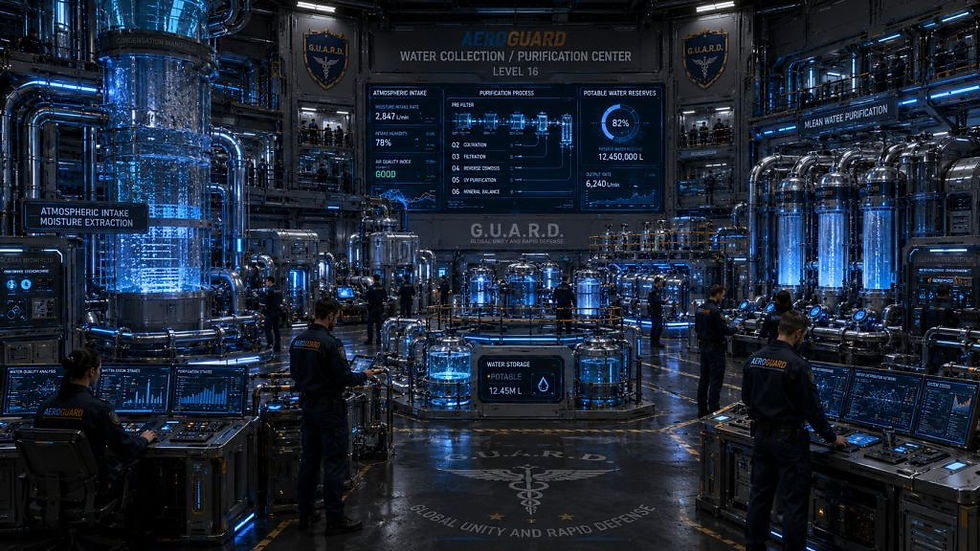
The Air Station uses atmospheric moisture collection, purification systems, water storage, wastewater recycling, air filtration, pressure management, and climate control to support long-duration operations.
Water systems support:
-
Drinking water
-
Medical operations
-
Food service
-
Sanitation
-
Decontamination
-
Fire suppression
-
Civilian sheltering
-
Aircraft and equipment support
-
Emergency field distribution
The Water Collection / Purification / Environmental Systems Deck is designed to process large volumes of water and maintain reserve storage for the station’s crew, civilians, patients, and mission operations.
Security and Defense Operations
The Air Station is not primarily a warship, but it must defend itself because it carries civilians, medical personnel, strategic equipment, GUARD teams, and critical humanitarian infrastructure.
Security operations include:
-
Access control
-
Internal patrols
-
Armory operations
-
Detention processing
-
Boarding defense
-
Drone countermeasures
-
Internal emergency response
-
Sensitive-area protection
-
Classified material security
-
Emergency response team staging
-
Perimeter monitoring
-
Crisis lockdown procedures
Defensive systems may include point-defense lasers, anti-missile systems, electronic countermeasures, decoy emitters, anti-boarding systems, armored command spaces, and compartmentalized fire/blast protection.
Maintenance and Engineering Operations
Engineering crews keep the Air Station alive. They manage propulsion, power distribution, structural monitoring, damage control, environmental systems, hydraulic systems, landing systems, and emergency repairs.
Engineering operations include:
-
Power distribution
-
Ionic engine monitoring
-
Structural integrity analysis
-
Damage control
-
Emergency battery systems
-
AI interface support
-
Environmental system coordination
-
Hydraulic system maintenance
-
Landing system diagnostics
-
Engine overhaul planning
-
Utility tunnel and trunk inspection
The Ionic Engine Maintenance Ring supports service and overhaul of the station’s engine systems. Engines are cycled for maintenance so the station can remain operational while individual systems are serviced.
Civilian Support Philosophy
The Air Station is designed around controlled movement, clear direction, and human dignity. Civilians arriving aboard may be frightened, injured, separated from family, exposed to trauma, or unsure where to go.
Civilian support spaces are designed to provide:
-
Safety
-
Calm
-
Medical screening
-
Food and water
-
Clean clothing
-
Sanitation
-
Family reunification
-
Child protection
-
Elder care
-
Rest areas
-
Translation support
-
Transport coordination
-
Temporary shelter
The station’s layout moves civilians from intake to screening, then to medical care, reunification, temporary housing, or evacuation. The process is designed to prevent panic, reduce confusion, and keep families and vulnerable people protected.