
A Universe of Pure Imagination

TM


Info
REAL NAMES:
IDENTITY:
AFFILIATION:
REGISTERED?:
RELATIVE AGE:
MARITAL STATUS:
Thomas "Tom" Patterson,
Richard "Dick" Shepard,
Henry/Hank Henderson
Known
Americans/Hero
Yes
20, 26, 33
Single, Married, Divorced
ALIAS(ES):
CURRENT TEAM:
FIRST APPEARANCE:
APPEARANCE DATE:
CREATED BY:
CREATION DATE:
(Tom)
Robert "Bobby" Patterson (brother)
(Dick)
Karen Shepard (wife)
(Hank)
Lisa Henderson (ex-wife)
Tonya Henderson (daughter)
Brief Character Summary
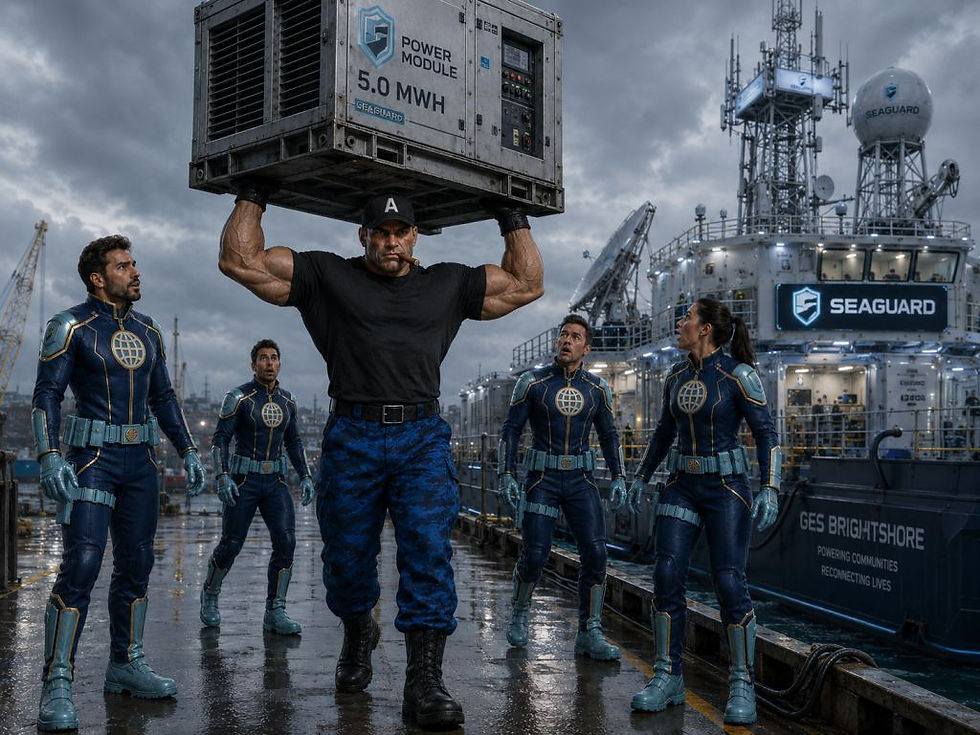
A-Ganger is the combined identity of three U.S. Navy submarine mechanics — Thomas “Tom” Patterson, Richard “Dick” Shepard, and Henry “Hank” Henderson — who were fused into one powerful body during the catastrophic USS New Hampshire collision with New Poseidon’s teleporter bay. Once ordinary submarine A-Gang mechanics, they became a single super-powered Seaguardian with three independent minds, immense strength, extreme endurance, reinforced durability, and unmatched submarine mechanical skill.
Now serving aboard the GSS Paragon City, A-Ganger is the Seaguardians’ heavy-duty mechanic, damage-control powerhouse, and close-quarters bruiser. Armed with a massive titanium wrench that functions as both tool and weapon, A-Ganger is as valuable in a flooded engine room as he is in a fight against undersea threats.
At their core, A-Ganger is not a monster or a freak — they are three sailors who survived the impossible and found a new purpose through GUARD.
Personality Overview
A-Ganger’s personality is a rough but loyal fusion of three submarine mechanics: blunt, sarcastic, loud, stubborn, practical, and deeply protective of the crew. They carry the classic A-Gang attitude: salty humor, mechanical pride, intolerance for nonsense, and absolute confidence around machinery.
Because Tom, Dick, and Hank still exist as separate minds inside one body, A-Ganger’s personality shifts depending on who is “on watch.” Tom brings the younger, more emotional, eager-to-prove-himself side. Dick contributes technical discipline, caution, and a working-man sense of responsibility. Hank brings the hard-edged veteran attitude: gruff, impatient, fearless, and brutally direct.
Together, they are stronger than any one of them was alone, but not always peaceful inside their own head. They argue, joke, compete, and sometimes irritate each other constantly. Even so, when the crew is in danger, all three minds align instantly.
Publicly, A-Ganger often comes across as intimidating, rowdy, and almost impossible to embarrass. Privately, they carry deep grief over their lost lives, broken families, and stolen individuality. They cope through work, humor, drinking, brawling, and devotion to the Seaguardians.
Their greatest strength is not just physical power — it is loyalty. A-Ganger will complain, curse, mock the problem, and then walk straight into flooding, fire, or enemy attack to save the boat and the people aboard it.

History
Fireman Apprentice Thomas “Tom” Patterson, Machinist’s Mate Nuclear Third Class Richard “Dick” Shepard, and Machinist’s Mate Auxiliary First Class Henry “Hank” Henderson served together aboard the USS New Hampshire (SSN-778) in 2013. All three belonged to the submarine’s mechanical and auxiliary departments, with the Auxiliary Division carrying its well-known submarine-community nickname: A-Gang.
Tom was the youngest of the three, only twenty years old and still proving himself. Dick was twenty-six, married, technically trained, and already carrying the weight of a demanding naval life. Hank, thirty-three, divorced, experienced, and hard-edged, had a daughter he rarely saw enough of and a reputation for being exactly what most submarine A-Gangers were expected to be: loud, blunt, mechanically gifted, and nearly impossible to intimidate.
The three men were not famous. They were not polished. They were not superheroes. They were sailors, mechanics, and problem-solvers — the kind of men who kept a submarine alive in places where mistakes killed everyone aboard.
That became the only thing that mattered during a classified special operation near the Atlantic Kingdom.
The USS New Hampshire had been operating five miles outside New Poseidon, one of the Atlantic Kingdom’s most heavily defended military strongholds. The mission was dangerous from the beginning. When an Atlantic Kingdom undersea cruiser discovered and attacked the American submarine, the New Hampshire was badly damaged. Her propulsion system was crippled. Catastrophic flooding began to spread through the boat. Worse, damage around the reactor compartment and core created a lethal situation that left the submarine sinking, wounded, and still under attack.
The control room’s remote emergency blow controls failed.
That meant the only way to save the ship was to open the emergency blow valves manually. It was a brutal task under normal conditions. Under combat damage, flooding, pressure, alarms, and the force of 4,500 psi air systems, it became almost impossible. But Tom, Dick, and Hank moved anyway. One by one, they fought their way through the damaged sections of the submarine and forced the valves open by hand, using every ounce of strength, training, anger, and stubbornness they had.
The New Hampshire stopped sinking.
But she was still moving.
Damaged, flooding, and unable to properly maneuver, the submarine surged forward at flank speed on a collision course with one of New Poseidon’s most important strategic facilities: the city’s teleporter bay. The bay was used to move troops, equipment, food, and critical resources between major Atlantic Kingdom cities. It was not merely a transit site. It was a vital piece of the kingdom’s military infrastructure.
Tom, Dick, and Hank opened the final emergency blow valve just before the New Hampshire slammed into the New Poseidon teleporter bay.
The impact triggered a massive interdimensional power surge. For several seconds, the collision zone warped and phased. Solid matter became ghostlike. Metal passed through stone. Bodies passed through bulkheads. Submarine systems intersected with teleporter machinery. Atlantic Kingdom troops, equipment, and sections of the crashed submarine fused together in impossible ways.
When the surge collapsed, everything became solid again.
The result was catastrophic.
Submarine components were embedded in teleporter equipment. Atlantic Kingdom personnel had fused into wreckage. The crash site became a scene of death, twisted metal, and impossible physical horror. No one at the immediate point of impact survived in any recognizable form.
Except Tom Patterson, Dick Shepard, and Hank Henderson.
They survived — but not separately.
The three mechanics had been fused into one enormous body.
The nuclear exposure, dimensional surge, teleporter energies, and physical collision had combined into a singular event that no scientist could cleanly explain. Tom, Dick, and Hank remained alive, but their bodies had been merged into one massive, muscular form. Their minds were still separate. Their memories, instincts, skills, tempers, grief, and fear all remained. But the three men now shared one body.
To the Atlantic Kingdom, that did not matter.
The Atlantic Guard immediately blamed the United States for the disaster, publicly accusing the New Hampshire and her crew of espionage, sabotage, and war crimes. The fused mechanics were displayed across international media as proof of American aggression. King Dolphin demanded compensation, apologies, and political concessions. Eventually, the Atlantic Kingdom demanded a prisoner exchange: the fused sailors in return for several incarcerated Atlantic Guard villains.
The trade was made.
Four Atlantic Guard villains were released, and Tom, Dick, and Hank were returned home.
But home did not feel like home anymore.
Their return became another kind of punishment. The public reaction was cruel, confused, and often vicious. Many people resented that four dangerous villains had been released in exchange for what the media mockingly called “one fused freak.” WNN and other outlets ran constant stories about the incident, digging into the men’s backgrounds, exaggerating their flaws, and portraying their rough submarine attitudes as evidence that they were unstable, dangerous, or somehow responsible for what had happened.
Their families suffered too — and in many ways, that pain cut deeper than the accident.
Tom’s parents refused to accept the fused body as their son. They held a funeral for him even though he was still alive. Only his younger brother, Robert “Bobby” Patterson, continued to speak to him. Bobby considered Tom, Dick, and Hank heroes for what they had tried to do aboard the New Hampshire.
Dick’s wife, Karen Shepard, was overwhelmed by the horror and impossibility of what had happened. She moved back in with her parents. Though still technically married to Dick, she stopped speaking with him, and rumors soon circulated that she had begun seeing someone else.
Hank’s ex-wife, Lisa Henderson, reacted with rage and terror. She called the fused body a monster and attempted to kill him with a gun. She later took their daughter, Tonya, and sued the U.S. Navy for what she described as the destruction of her life.
Tom, Dick, and Hank had saved their submarine from sinking, survived an impossible disaster, endured captivity, and returned home only to lose nearly everything that had once made their lives human.
Then Captain Seawolf found them.
GUARD’s Seaguardians did what the media had not bothered to do: they treated the three men as people. Medical, neurological, and metahuman specialists examined them properly. The results were extraordinary.
Their fused body possessed roughly triple the physical strength expected from their combined baseline. Their endurance had increased even further. Their skin had become far tougher than normal human tissue, closer in resilience to a thick sheet of aluminum. Their reflexes, mechanical instincts, and problem-solving capacity had also changed because the body now contained three trained submarine mechanics operating with three independent minds.
The condition was not simple. Tom, Dick, and Hank could each think independently, and each could control the shared body. At first, that made rest almost impossible. None of them could simply “turn off.” Sleep required specialized psycho-neural assistance to dampen all three brainwave patterns at once. For the first time in months, after GUARD’s intervention, they were finally able to sleep.
That changed everything.
With rest came better judgment. With better judgment came cooperation. The three men began treating the body like a submarine watchbill, taking shifts to control it while the others rested. Sometimes Tom would take the watch. Sometimes Dick. Sometimes Hank. In emergencies, combat, or complex repair situations, all three would wake and operate together.
The arrangement was strange, imperfect, and painful — but it worked.
GUARD offered them a place aboard the advanced Seaguardians submarine GSS Paragon City. The role was exactly what they understood best: mechanical systems, emergency repairs, damage control, submarine operations, and hard work under pressure. For the first time since the accident, all three men agreed on something instantly.
They joined the Seaguardians.
They chose a new name: A-Ganger.
The name was more than a joke and more than a reference to their old division. It was a declaration that Tom, Dick, and Hank had not vanished. They had changed, but they were still sailors. Still mechanics. Still A-Gang.
A-Ganger soon became one of the Seaguardians’ strongest and most reliable field assets. Their power made them formidable in combat, but their real value went far beyond brute force. They could tear open jammed hatches, brace failing bulkheads, fight flooding, repair machinery under impossible conditions, and think through mechanical problems with the combined experience of three submarine-trained minds.
To make a point about who they were, A-Ganger had a massive titanium wrench forged for them. Ordinary tools snapped in their hands. The titanium wrench became both a functional repair tool and a mace-like weapon, equally useful for emergency maintenance and close-quarters combat.
Among the Seaguardians, A-Ganger became a strange kind of legend: a rough, loud, loyal, salt-of-the-earth powerhouse who could drink nearly anyone under the table, brawl with sea monsters, repair a submarine system by instinct, and still crack a joke with the crew afterward.
But beneath the humor and strength, the pain remains.
Tom Patterson, Dick Shepard, and Hank Henderson did not ask to become A-Ganger. They did not seek power, fame, or pity. They lost their individual bodies, much of their privacy, and nearly all of their former personal lives. Their families remain fractured. Their legal and emotional identities are complicated. The world still struggles to understand whether A-Ganger is one person, three people, or something entirely new.
The answer, to them, is simple enough.
They are Tom.
They are Dick.
They are Hank.
They are A-Ganger.
And aboard the GSS Paragon City, they have found what they thought they had lost forever: a crew, a purpose, and a brotherhood strong enough to survive the impossible.
Powers
Power Origin: Science
Three Minds/One Body
-
Physical Enhancements
-
Remarkable level of strength
-
Incredible level of endurance
-
Excellent agility
-
-
Mental Enhancements
-
Amazing mental protection against psychic attacks
-
When all three minds are 'online' and working:
-
Reason increases to remarkable levels
-
Intuition increases to remarkable levels
-
Psyche is at amazing level; only an individual's self doubt or distress can lower this
-
-
-
Durable skin
-
Skin provides excellent protection against physical, energy, electrical and temperate damage
-
Provides amazing protection against radiation damage
-
Hearing and vision are also protected, but only to typical levels
-
Equipment
-
Titanium Combat Wrench ("Thor")
-
Fantastic material strength
-
When used at full strength, can inflict incredible physical damage
-
Can also be used as an actual wrench...or a vice, if applied that way
-
-
Psycho Sleep Stimulator
-
Pocket-sized device
-
Amazing material outer shell for physical, temperate, EMP, energy, electrical protection
-
Operates to allows remarkable level of manual or automated sleep cycles or awakening of sleeping mind of the three minds in the body.
-
In combat, can be 'turned off' to prevent energy/electrical damage
-
-
Earwig
-
Communications encrypted transceiver with 250 mile range; unlimited range when used in range of cellular towers and/or GUARD/commercial communications satellites
-
Amazing material
-
Power can be charged for 2 days of operation
-
Talents
-
Tom, Dick and Hank Common Skills:
-
US Navy (Professional)
-
Submarines (Professional)
-
GUARD (Proficient)
-
Mechanical Engineering (Professional)
-
Beer (Proficient)
-
Bars/Pubs/Naval Bases/Liberty Ports (Proficient)
-
Damage Control/Firefighting (Professional)
-
-
Tom:
-
Video games (Professional)
-
Internet/Computer Engineering (Professional)
-
Lock-picking (Proficient)
-
Hot-wiring cars (Proficient)
-
Access Control systems (Proficient)
-
Stealth (Proficient)
-
Legal System/Family Court (Proficient)
-
Marksmanship (Proficient)
-
-
Dick:
-
Submarine Engineering (Professional)
-
Nuclear Engineering/Power (Professional)
-
Nuclear Power Plant Operations (Professional)
-
Radiation (Professional)
-
Physics/Chemistry (Proficient)
-
Chess (Proficient)
-
Puzzles (Proficient)
-
Quality Assurance Process (Proficient)
-
-
Hank:
-
Hydraulic systems (Professional)
-
High Pressure Pneumatic Systems (Professional)
-
Atmosphere Control Equipment (Professional)
-
Ballasting/Pump Systems (Professional)
-
Plumbing (Professional)
-
Ventilation Systems (Proficient)
-
Diesel Engines (Professional)
-
Refrigeration systems (Professional)
-
Submarine Engineering (Professional)
-
Metallurgy (Professional)
-
Quality Assurance Inspections/Officer (Professional)
-
Submarine Control/Diving Officer (Professional)
-
Leadership (Professional)
-
Mechanical/System Drawing (professional)
-
Children's TV shows (proficient)
-
Administration (proficient)
-
Finance/budgeting (proficient)
-