
A Universe of Pure Imagination

TM


INFO
REAL NAME:
IDENTITY:
AFFILIATION:
REGISTERED?:
RELATIVE AGE:
MARITAL STATUS:
ALIAS(ES):
CURRENT TEAM:
FIRST APPEARANCE:
APPEARANCE DATE:
CREATED BY:
CREATION DATE:
Dr. Amara Elise Voss
Public
Ghanaian-British/Hero
N/A
46
Divorced
RELATIONS:
-
Elias Voss-Amoako (son)
-
Veronica Amoako (ex-wife)
-
Kojo Voss (older brother)
CHARACTER SUMMARY
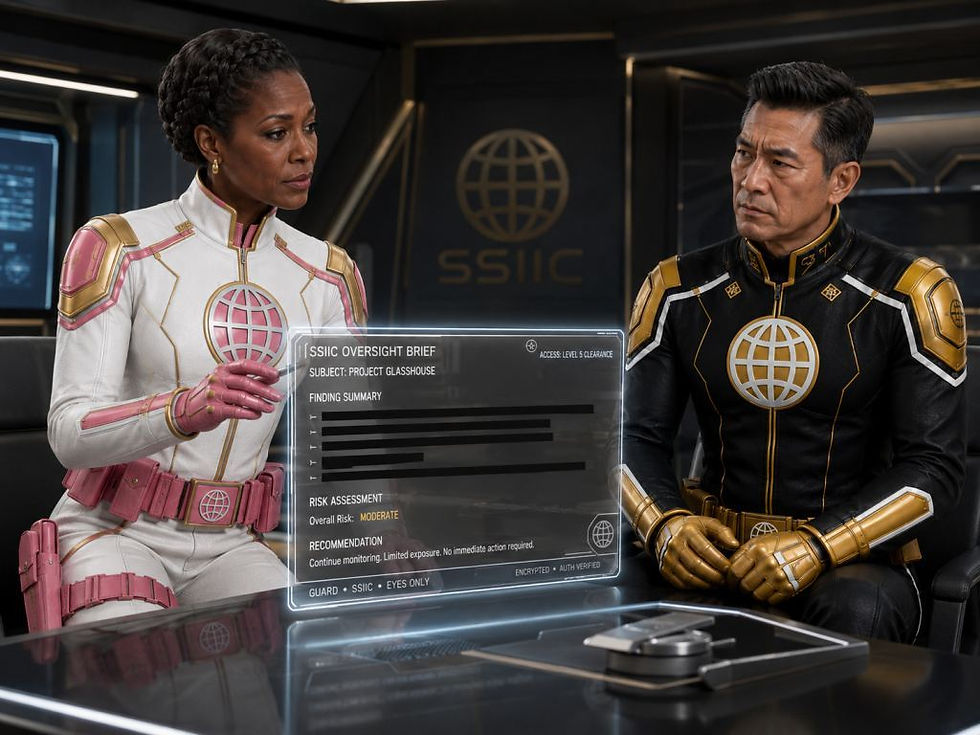
Dr. Amara Voss, callsign Mindglass, is the modern commander of GUARD’s PSIGUARD, the restricted cognitive-security and psychic-intelligence command operating under SSIIC. She is not the most powerful psychic in GUARD. That is exactly why she is trusted to command PSIGUARD.
Voss represents the mature evolution of PSIGUARD: capability under restraint, access under law, and psychic power under constant review. She believes that the mind is not simply a battlefield, a vault, or a security object. It is the last private place a person has. For that reason, she treats every scan, every psychic review, and every cognitive-security finding as a moral event as much as an operational one.
Her codename, Mindglass, refers to her central doctrine: the mind may sometimes need to be examined for signs of compromise, but the examination must be clear, limited, documented, and never distorted by fear, ambition, or convenience.
Voss is the kind of leader who can stand between a frightened recruit and an impatient security board, between a hostile telepath and a compromised command staff, or between SSIIC and a PSIGUARD officer who has crossed the line.
She does not raise her voice often.
She rarely has to.
PERSONALITY
Dr. Amara Voss is calm, careful, and difficult to rush. She speaks with precision and dislikes dramatic certainty. She has seen too many people use fear as an excuse to violate boundaries, and too many idealists pretend dangerous powers are safe because their intentions are good.
She is not soft. She is humane.
That distinction defines her.
Voss can be warm in private, especially with junior personnel who are frightened by their own abilities. She is protective of ethical psychics because she understands how easily the world can turn them into weapons, monsters, or tools. But she is equally hard on psychic arrogance. Anyone who treats another person’s mind as available terrain quickly learns that Voss is not gentle when drawing a line.
Her leadership style is controlled, transparent, and audit-friendly. She does not fear oversight. She considers it proof that the system is still alive.

HISTORY
Early Life
Amara Elise Voss was born in Accra, Ghana, to a Ghanaian mother, Dr. Efua Amoako, and a British-German father, Malcolm Voss. Her mother was a physician involved in refugee health programs, while her father worked in international communications infrastructure. Amara’s childhood moved between Ghana, the United Kingdom, and Switzerland, exposing her early to diplomacy, crisis response, displacement, and the uneasy relationship between aid and power.
She was a quiet child, but not shy. Adults learned that when Amara was silent, she was not absent. She was watching.
Her mother used to say:
“Amara does not ask what happened first. She asks who was not allowed to say what happened.”
That instinct followed her into adulthood.
Discovery of Her Psi-Sensitivity
Voss is not a traditional telepath. She cannot freely read minds, seize memories, or invade thoughts at will. Her ability is more limited and, in some ways, more useful for command.
She is a cognitive resonance sensitive.
This means she can detect pressure around thought rather than thought itself. She senses distortion, coercion, psychic residue, emotional suppression, implanted behavioral tension, and artificial incongruity between stated intent and cognitive stress patterning.
She cannot automatically know what someone is hiding.
She can often tell when something has been hidden badly, forcibly, or unnaturally.
Her ability first manifested during adolescence. She could tell when people were speaking under fear, when a room had been emotionally “staged,” or when someone’s calmness was artificial. At first, adults dismissed her as perceptive. Later, after post-Soltan psi-testing became more common, her sensitivity was formally identified.
Voss refused recruitment into several intelligence-linked psionic programs. She believed most of them were more interested in usefulness than ethics.
That decision shaped the rest of her career.
Academic and Legal Formation
Voss pursued neuropsychology, cognitive systems security, international law, and post-Soltan civil rights policy. Her doctoral work focused on cognitive consent under extraordinary security conditions, a controversial field that emerged after the Soltan Invasion exposed humanity to telepathy, psychic coercion, alien memory manipulation, and psionic warfare.
Her early academic work argued that psychic screening could be justified in limited security contexts, but only if the process included:
-
informed consent wherever possible
-
narrow scan boundaries
-
independent review
-
audit trails
-
minimal data retention
-
separation between scanner and final authority
-
explicit protection against political misuse
At the time, many security officials considered her too restrictive.
Civil rights groups considered her too permissive.
Voss considered both criticisms useful.
United Nations Cognitive Rights Work
Voss eventually joined a United Nations working group focused on cognitive rights, psychic crime, alien-contact ethics, and extraordinary interrogation standards. Her role was to help define how governments and international organizations could respond to mental-threat risks without normalizing thought invasion.
She became known for a phrase that still follows her:
“The emergency does not erase the person.”
This phrase made her unpopular in some security circles. She was often accused of being naive about infiltration, sabotage, and hostile psionics. She answered those accusations bluntly: ignoring rights did not make security stronger; it made security easier to manipulate.
Her work became foundational in several international protocols later adopted, adapted, or quietly borrowed by GUARD.
Work With GUARD Medical and MCARE
Before joining PSIGUARD, Voss worked as an external consultant to GUARD Medical and what later became MCARE. Her focus was not therapy, but the boundary line between medical recovery and security inquiry.
After psionic attacks, alien contact incidents, or memory-tampering events, survivors often needed medical support. Security teams also wanted information. Voss became one of the people called in when the question was:
“What can we ask without harming them further?”
She helped design handoff rules between medical care and security review, including:
-
trauma-first evaluation
-
delayed security questioning when medically necessary
-
scan deferral protocols
-
patient advocate presence
-
redacted security summaries
-
restrictions on using therapy disclosures as intelligence
This earned her respect from Medical, suspicion from some Intelligence officers, and eventual attention from SSIIC.
Transition Into GUARD
Voss joined GUARD formally after several cognitive-compromise incidents revealed that the organization’s older PSIGUARD model was no longer sufficient. GUARD had psychic specialists, alien advisors, and psi-tech tools, but its process was inconsistent. Too much depended on who was in the room, who had command authority, and how urgently someone wanted answers.
Some early PSIGUARD personnel operated honorably. Others had grown too comfortable with access.
Voss was brought in to review PSIGUARD’s screening doctrine.
Her conclusion was severe:
“This command has saved lives. It has also survived on trust it did not sufficiently document.”
Commander Kenjiro Masuda reportedly read that line twice, then asked for her full recommendations.
Voss gave him eighty-seven.
Masuda approved seventy-nine.
The other eight became the subject of a six-hour argument that both later described as “productive.”
Rise to PSIGUARD Commander
Voss did not initially seek command. She considered herself a systems designer, ethics officer, and cognitive-security specialist. But as PSIGUARD began restructuring, it became clear that the command needed someone who understood psychic capability without worshiping it.
Voss was promoted to Commander of PSIGUARD after a reform period marked by:
-
replacement of informal psychic-screening practices
-
creation of the Three-Lock Rule
-
formal scan levels
-
separation of screening, interpretation, and authorization
-
records destruction protocols
-
consent officer authority
-
field deployment restrictions
-
alien-psionic advisory limits
-
direct SSIIC oversight
Her appointment was controversial. Some powerful psychics inside and outside GUARD believed PSIGUARD should be led by the strongest telepath available. Voss disagreed.
Her response became part of PSIGUARD culture:
“Power hears power. Command must hear everyone else.”
Relationship With Selgate
Voss respects Selgate deeply, but she would never place Selgate in direct command of PSIGUARD.
Selgate’s history as a Sistarian survivor, alien psychic energy being, Soltan victim, and Terran ally makes her invaluable. It also makes her emotionally connected to certain threat categories in ways that require careful boundaries.
Voss does not view Selgate as a danger. She views her as a living reminder that PSIGUARD must never confuse containment with cruelty.
Selgate, in turn, respects Voss because Voss does not fear her, flatter her, or exploit her. She gives Selgate a defined, honorable role:
Senior Extraterrestrial Psi Advisor
ASTROGUARD / PSIGUARD Liaison for Non-Terran Cognitive Threats
Voss consults Selgate when the problem involves alien mental architecture, Soltan psionic patterns, non-Terran consciousness, or unknown psychic signatures. But she does not use Selgate as a routine scanner.
That distinction matters.
Relationship With Kenjiro Masuda
Voss and Masuda have one of the most disciplined working relationships in SSIIC. They are not warm in public, but they trust each other’s standards.
Masuda watches PSIGUARD closely. Voss welcomes it.
She once told him:
“If you stop watching us, Commander, I will resign.”
Masuda reportedly answered:
“If you ask me to stop, I will remove you.”
Neither smiled.
Both meant it.
Their relationship is built on a shared understanding: PSIGUARD is necessary, but the moment it becomes comfortable with itself, it becomes dangerous.
POWERS
POWER ORIGIN: Mutant
Dr. Amara Voss possesses limited but highly refined psionic sensitivity. She is not a dominant telepath, combat psychic, or mind-controller. Her abilities are subtle, disciplined, and best suited for cognitive-security work.
Cognitive Resonance Sensitivity
Voss can perceive excellent distortions in the cognitive-emotional field around a person, place, or recent interaction. She does not read ordinary thoughts directly. Instead, she senses irregularities such as:
-
coercive pressure
-
psychic residue
-
implanted behavioral tension
-
artificial emotional suppression
-
memory discontinuity
-
hostile psionic interference
-
cognitive shielding stress
-
fear-pattern displacement
-
identity dissonance
This makes her extremely effective at detecting when a person may be compromised, manipulated, or concealing something under unnatural pressure.
Consent-Bound Surface Reading
With consent, Voss can perform excellent limited surface-level cognitive review. This allows her to confirm emotional alignment, detect active coercion, and identify signs of psychic tampering without accessing private memories.
She considers this a clinical-security procedure, not an interrogation tool.
Psychic Pressure Recognition
Voss can often identify when a good psychic presence has influenced a room, group, or individual. She is especially good at distinguishing between natural fear and externally induced compliance.
Cognitive Reflection
Her codename “Mindglass” partly comes from her excellent ability to reflect psychic pressure back into observable form through psi-tech systems. When linked to approved PSIGUARD equipment, she can help translate vague psychic impressions into structured anomaly maps.
This does not make the impression automatically true. It makes it reviewable.
Mental Boundary Reinforcement
Voss can help stabilize a person experiencing good low-to-moderate psychic intrusion, especially if the subject is resisting coercion. She cannot heal psychic trauma by herself and does not replace Medical or MCARE treatment.
Resistance to Mental Intrusion
Voss has excellent mental discipline and unusual resistance to casual psychic probing. Powerful telepaths can affect her, but they rarely find her easy to read.
Her mind is not a fortress.
It is a courtroom.
Everything attempting entry must answer a question.
LIMITATIONS
Voss’s powers are intentionally limited and should stay that way.
She cannot:
-
freely read minds at will
-
extract memories without consent or equipment
-
dominate thoughts
-
control crowds
-
erase memories
-
conduct long-range remote viewing reliably
-
overpower major alien psychics alone
-
replace evidence with psychic impressions
-
heal psychic trauma
-
bypass PSIGUARD’s legal protocols for convenience
Her strength is judgment, not raw power.
EQUIPMENT
PSIGUARD Commander Uniform
Voss wears the official PSIGUARD command uniform in the white, rose-pink, and metallic gold color scheme. It is a standard GUARD uniform for protections, communications and sensors.
Mindglass Interface Circlet
A discreet rose-gold and white psi-tech headband or temple-frame device used during authorized scan review sessions. It helps translate Voss’s cognitive resonance impressions into structured data.
It does not amplify her into a mind-reader. It stabilizes and records what she is already sensing.
Consent Verification Tablet
A secure tablet used to confirm:
-
scan authorization
-
consent status
-
subject rights notification
-
ethics review
-
scan level
-
scope limitation
-
data retention requirements
-
observer and reviewer identities
Voss personally checks this in sensitive cases.
Psi-Tech Review Console
A command-level interface that allows Voss to monitor active PSIGUARD scans, anomaly maps, and cognitive-security flags. It includes emergency halt authority.
Redaction Key
A physical and digital authorization device used to seal, redact, or destroy raw mental scan data. Voss treats this tool as one of the most important objects in PSIGUARD.
Personal Shield Lattice
A compact field device that provides limited protection against good telepathic intrusion or ambient psionic pressure. It is not a full psychic dampener and does not block consent-based review.
Emergency Halt Authority
Voss has command authority to stop a scan, interrogation support session, or cognitive review if she believes the process has exceeded its authorized scope.
Inside PSIGUARD, this is sometimes called:
The Glass Break Order.
INFO
Master-Level Talents
-
Cognitive Security Doctrine
-
Voss is one of GUARD’s foremost experts in protecting institutions from mental compromise while preserving legal and ethical limits.
-
-
Psi-Ethics Governance
-
She is exceptional at designing rules for psychic screening, scan consent, mental privacy, and emergency exceptions.
-
-
PSIGUARD Command Oversight
-
She understands how to manage psychics, psi-tech operators, analysts, and ethics officers without letting any one group dominate the process.
-
-
Compromise Pattern Recognition
-
Voss is highly skilled at detecting signs of coercion, implanted behavior, memory tampering, and hostile cognitive influence.
-
-
Scan Scope Control
-
She can define what a scan is allowed to seek — and stop it from drifting into private, irrelevant mental territory.
-
-
Crisis Boundary Enforcement
-
Even under pressure, Voss can maintain process limits during emergencies, interrogations, or high-stakes security incidents.
-
Expert-Level Talents
-
Neuropsychology
-
Deep understanding of human cognition, trauma response, stress behavior, memory, and perception.
-
-
Psi-Tech Systems Review
-
Expert-level understanding of GUARD’s cognitive anomaly detection systems and their limitations.
-
-
International Cognitive Rights Law
-
Strong knowledge of post-Soltan legal frameworks governing psychic review, mental privacy, and extraordinary screening.
-
-
Counter-Psionic Risk Assessment
-
Skilled at identifying psychic attack vectors, mental influence patterns, and cognitive defense weaknesses.
-
-
Interrogation Oversight
-
Can support lawful threat verification while preventing abusive or unreliable scan practices.
-
-
Personnel Integrity Screening
-
Experienced in recruitment, sensitive assignment, and clearance-related cognitive review.
-
-
Alien-Psionic Consultation Management
-
Knows when to involve advisors like Selgate without over-relying on them.
-
-
High-Level Briefing
-
Can explain complex psychic-security findings to non-psychic commanders without exaggeration or mystification.
-
Professional-Level Talents
-
UN Procedure and International Oversight
-
Understands multinational policy, review boards, mandates, and accountability structures.
-
-
Medical / Security Boundary Management
-
Strong grasp of where Medical/MCARE care ends and PSIGUARD security review begins.
-
-
Leadership Protection Protocols
-
Skilled at designing cognitive-security protections for senior command personnel.
-
-
Classified Records Handling
-
Capable of overseeing sensitive scan data, redaction, sealing, and destruction processes.
-
-
Field Team Coordination
-
Can deploy PSIGUARD support personnel alongside SSIIC, XGUARD, Intelligence, or ASTROGUARD missions.
-
-
Cross-Cultural Communication
-
Strong communication skills across cultures, disciplines, and power structures.
-
-
French and German
-
Professional-level working fluency.
-
-
Arabic and Spanish
-
Functional operational fluency.
-
Advanced-Level Talents
-
Basic Defensive Tactics
-
Trained in GUARD defensive movement and escape tactics, but not a primary combatant.
-
-
Meditative Focus Control
-
Uses disciplined breathing and focus methods to stabilize her psi-sensitivity.
-
-
Secure Interview Technique
-
Skilled at conducting structured interviews without coercive overreach.
-
-
Emergency Psychological Stabilization
-
Can provide short-term stabilization until Medical/MCARE takes over.
-
-
Public Testimony Control
-
Capable of presenting controversial PSIGUARD policies under hostile questioning.
-