
A Universe of Pure Imagination

TM





INFO
REAL NAME:
IDENTITY:
AFFILIATION:
REGISTERED?:
RELATIVE AGE:
MARITAL STATUS:
Nathaniel Elias Stone
Public
USA/Hero
N/A
66
Widower
ALIAS(ES):
CURRENT TEAM:
FIRST APPEARANCE:
APPEARANCE DATE:
CREATED BY:
CREATION DATE:
RELATIONS:
-
Eleanor Stone (Wife, deceased)
-
Colonel Rebecca Stone-Maddox (Daughter)(US Army Logistics)
-
Dr. Samuel “Sam” Stone (Son)(Physician, Disaster Medical)
-
Grace Stone (Granddaughter)(teen)
-
Marcus Maddox (Son-In-Law / Rebecca's Husband)(Civil Engineer)
SUMMARY
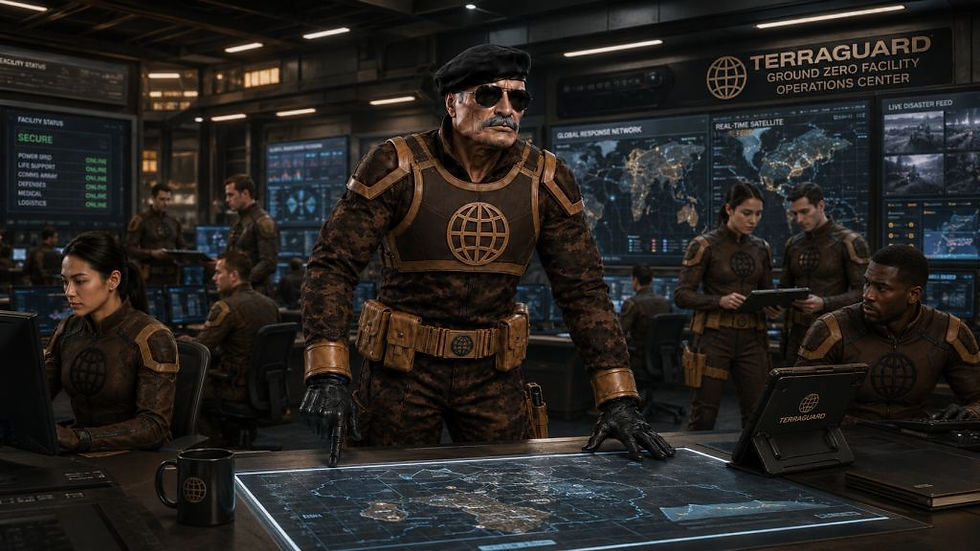
General Nathaniel Elias Stone is the founder and commander of TERRAGUARD, a former thirty-year U.S. Army officer, Soltan Invasion hero, and one of GUARD’s most respected field leaders. Decommissioned after using reserve supplies to save starving post-war civilians, Stone was recruited into GUARD to build the land-based support command no one else believed could succeed.
In five years, he built TERRAGUARD into a global logistics, response, and ground-support powerhouse. His leadership has saved countless lives, disrupted criminal empires, inspired thousands of recruits, and made him one of the most targeted commanders in the GUARD system.
He is stern, mobile, relentless, and deeply principled. He does not fight for territory, medals, or politics.
He fights so people can live after the battle is over.
PERSONALITY
General Stone is disciplined, blunt, intense, and mission-focused. He does not enjoy ceremony, empty praise, or political theater. He respects competence, courage, honesty, and follow-through.
He can appear harsh, especially to those who confuse compassion with softness. Stone is compassionate, but never sentimental. He believes feeding people, sheltering families, restoring roads, and protecting communities are not emotional indulgences. They are obligations.
He has a dry sense of humor that appears unexpectedly, especially around long-serving TERRAGUARD personnel. He rarely laughs loudly, but when he does, it is usually in the field, surrounded by people who have earned his trust.
His anger is controlled and dangerous. He does not explode often. When he does, it is usually because someone has endangered civilians, mistreated personnel, wasted resources, or hidden behind policy to avoid doing the right thing.
Stone does not believe he is a hero. He believes he is a commander with unfinished work.

HISTORY
General Stone: The Commander Who Refused to Leave Anyone Behind
General Nathaniel Elias Stone did not become a legend because he won battles.
He became a legend because he understood what too many commanders forgot: a war is not truly won when the enemy stops firing. It is won when the people can live again.
Long before TERRAGUARD existed, Stone was a career United States Army officer with thirty years of service behind him. A West Point graduate and a master of military science, logistics, civil defense doctrine, and multinational operations, Stone built his reputation as the officer sent into impossible situations when conventional plans had already failed. He was disciplined, blunt, demanding, and relentless. He believed in preparation, structure, and command authority, but he had no patience for leaders who used policy as an excuse to avoid responsibility.
To Stone, logistics was never a secondary battlefield function. Food, fuel, medicine, shelter, roads, water, transportation, and repair crews were not support details. They were the difference between a battle recorded as won and a population actually saved.
That belief would define him during the Soltan Invasion.
When the Soltans struck Earth, the rules of modern warfare collapsed almost overnight. Command networks fractured. Cities fell into chaos. Military units were scattered, supply lines were broken, and millions of civilians were trapped between alien attacks, shattered infrastructure, disease, hunger, and fear. In many regions, civilian care became an afterthought. Some commanders, overwhelmed by the scale of the war, told displaced citizens to fend for themselves because “there was a war on.”
Stone rejected that completely.
He treated civilians as the reason the war was being fought. His defensive lines protected refugee roads, hospitals, water sources, field kitchens, shelters, and evacuation corridors. His command posts became rescue hubs. His supply depots became lifelines. Where others saw chaos, Stone saw routes, load limits, fuel ranges, chokepoints, casualty flow, bridge capacity, shelter requirements, and survival math.
He did not separate combat from rescue. He coordinated them together.
During the invasion, Stone worked alongside national militaries, emergency responders, engineers, local resistance groups, GUARD-aligned forces, and superheroes. He respected heroes who did more than fight the enemy. The ones who lifted rubble, escorted convoys, protected supply roads, carried medicine, and stayed after the explosions ended earned his lasting trust. Stone understood that extraordinary power and disciplined logistics could save people neither could save alone.
His wartime achievements became the kind of stories soldiers repeated long after the smoke cleared. He moved refugees and artillery through corridors declared unusable. He turned abandoned freight lines into evacuation routes. He used construction vehicles, civilian fuel reserves, emergency air drops, and metahuman escorts to keep entire regions alive. More than once, Stone’s ability to move supplies under impossible conditions became as decisive as any weapon on the battlefield.
His greatest wartime distinction came during the final battles in China, where Earth’s remaining forces pushed to destroy one of the last Soltan power towers and bring down a surviving Soltan battleship. Many argued for a purely military strike. Stone refused to ignore the civilians still trapped near the combat zone.
He helped coordinate a campaign that moved assault forces, evacuation convoys, medical teams, engineers, and relief supplies as one operation. While frontline forces advanced, Stone kept evacuation corridors open and emergency support flowing. When the final power tower fell and the Soltan battleship was brought down, Stone stood among the commanders credited with helping end one of the darkest chapters in human history.
The world called him a hero.
But Stone knew victory had not ended the suffering.
After the Soltan Invasion, governments celebrated survival. Leaders gave speeches. Flags were raised. Monuments were planned. Yet across the world, communities remained broken. Families lived in ruins. Children went hungry. Disease spread through damaged cities. Crops failed. Water systems collapsed. Hospitals were overrun. People who had survived alien war were now dying from neglect.
Stone filed requests for relief distribution. Then more requests. Then emergency petitions. Food, tents, generators, water purification systems, medicine, and shelter supplies sat in reserve while officials argued over jurisdiction, funding, political optics, and ownership.
Stone had spent the war saving civilians from the Soltans. He would not watch them die because leaders were afraid to sign paperwork.
So he acted.
He authorized the movement of military reserve food and shelter supplies to devastated communities that had been forgotten. He did not sell the supplies. He did not use them for personal gain. He sent them to starving families, exposed children, damaged hospitals, and broken towns that had waited too long for help.
The public called it mercy.
Certain leaders called it insubordination.
Stone was reprimanded and decommissioned “with honors.” The phrase softened the paperwork, but not the truth. His military career was over. After thirty years of service, after helping defend Earth during the Soltan Invasion, after standing in the final battles in China, Stone would never again hold command in the institution he had served his entire adult life.
His answer was simple.
“If feeding starving people ends my career, then my career ended doing its job.”
What was meant to end him instead made him larger. To ordinary citizens, Stone became proof that moral duty could survive even when institutions failed. His decommissioning exposed a dark truth about post-war leadership: some people were more offended by unauthorized compassion than by preventable suffering.
Months later, GUARD came to him with an offer.
A new land-based support command was being considered. Its mission would be massive: move personnel, supplies, vehicles, field shelters, engineers, medical support, emergency infrastructure, and ground-response teams across every continent. It would need to operate through national politics, disaster zones, hostile terrain, collapsed cities, refugee movements, criminal interference, and post-war instability.
No one wanted the job.
It was too political. Too expensive. Too complicated. Too likely to fail.
The new command was called TERRAGUARD.
Stone was told he was the perfect man to build it.
He accepted, but not quietly and not without conditions. TERRAGUARD would not exist only on paper. It would not become a ceremonial support branch. It would not abandon civilians because of political delay. It would not be used as a dumping ground for unwanted personnel or impossible assignments. It would be active, mobile, disciplined, accountable, global, and built around one unbreakable principle:
Humanitarian support and operational security are one mission.
GUARD agreed.
Stone went to work.
In five years, General Stone built what many experts believed would take twenty. TERRAGUARD became a world-spanning land operations, logistics, disaster-response, engineering, convoy, shelter, supply, and infrastructure-stabilization network. It established hardened depots, mobile relief columns, vehicle maintenance systems, emergency staging bases, ground transport corridors, and multinational coordination practices across the globe.
Recruitment surged. Soldiers, engineers, drivers, medics, mechanics, planners, construction specialists, logisticians, translators, communications experts, emergency managers, and Soltan Invasion survivors joined by the thousands. Businesses rallied to provide vehicles, modular shelters, fuel systems, field equipment, and communications support. Governments that had once hesitated began cooperating when TERRAGUARD convoys restored order faster than politics could debate it.
Stone did not build TERRAGUARD from a distant office.
He stayed on the move.
He inspected motor pools, walked convoy routes, visited disaster zones, negotiated with officials, corrected supply failures, checked on injured personnel, and listened to the mechanics, drivers, cooks, junior officers, and field teams who knew the truth on the ground before the senior briefings did. He was not an easy commander, but he was a trusted one. He demanded discipline because undisciplined relief operations get people killed. He demanded accountability because corruption steals survival from the desperate.
Inside TERRAGUARD, Stone became fiercely respected. Personnel knew that if he sent them into danger, he had already fought to give them the tools, routes, backup, and purpose needed to come home. He remembered names. He stood with field crews. He visited wounded personnel. He never asked anyone under his command to care less about the people they were sworn to help.
TERRAGUARD’s success also made Stone dangerous to the wrong people.
Where he built supply routes, criminal networks lost smuggling corridors. Where TERRAGUARD delivered food, black-market profiteers lost leverage. Where engineering teams restored roads, corrupt local powers lost control over isolated communities. Where Stone tracked missing supplies, hidden empires began bleeding money.
The threats started as warnings. Then came sabotage, ambushes, sniper teams, explosives, compromised contractors, falsified route data, and assassination attempts. Some attacks were linked to professional killers, including assassin networks connected to the Death Legion’s wider criminal ecosystem.
Stone survived through movement, instinct, loyal personnel, and disciplined unpredictability. He changed routes without warning. He used decoy convoys and rotating command posts. He arrived where enemies did not expect him and left before they could act. After one near-fatal attempt, his staff insisted he begin wearing added chest and back armor in the field.
He accepted the armor reluctantly. Not because he feared death, but because his officers reminded him that staying alive was no longer a personal preference.
It was a TERRAGUARD operational requirement.
Today, General Nathaniel Elias Stone remains one of GUARD’s most active commanders. He is still seen at Ground Zero Facility, in operations centers, on convoy roads, inside cargo aircraft, at disaster zones, in underground corridors, and beside the TERRAGUARD personnel who carry his mission forward.
To politicians, he is useful, difficult, and impossible to ignore.
To criminals, he is a threat.
To TERRAGUARD personnel, he is the commander who never asks them to do anything he would not do himself.
To the world’s citizens, especially those who have watched TERRAGUARD vehicles arrive through dust, snow, fire, flood, and ruin, Stone represents something rare: power that shows up after the battle, when the cameras are gone and survival still has to be delivered one crate, one shelter, one road, and one convoy at a time.
General Stone does not fight for medals. He does not fight for ceremony. He does not fight for territory or praise.
He fights because people are worth protecting before, during, and after the war.
And as long as TERRAGUARD moves across the world, his promise moves with it:
We fight to protect people. If they die after the battle because we did nothing, then we protected an idea, not a life.
POWERS
POWER ORIGIN: Natural
General Stone has now powers.
EQUIPMENT
TERRAGUARD Command Uniform
General Stone wears a customized TERRAGUARD command uniform designed for field leadership, movement, protection, and visibility as the founding commander of TERRAGUARD.
-
Armored Chest and Back Piece
-
Remarkable protection
-
-
Armored Shoulder Guards
-
Remarkable protection
-
-
Heavy-Duty Utility Belt
General Stone’s utility belt is larger and more functional than the standard TERRAGUARD personnel belt. It carries the items a mobile commander needs while moving between operations centers, vehicle yards, convoy routes, and field sites.
-
command tools
-
emergency supplies
-
communication gear
-
compact electronics
-
mission documents
-
survival equipment
-
Sidearm and FMR power packs (4)
-
Lockpick Kit
-
Leg Holster and Sidearm ("Zapper")
-
Excellent energy blaster (Amazing material)
-
-
Futuristic Multipurpose Rifle (FMR)
-
Sniper Rifle Mode
-
Rem vision
-
Rem Stun beam damage
-
50 shots/power pack
-
Range 3000 yards
-
-
Mortar Mode
-
Rem explosives
-
12/loadout
-
Range: 200 yards
-
-
Emergency Flare gun
-
Magnesium flares (Ex heat) x 2
-
Range: 200 yards
-
Duration: 6 rounds
-
-
Hidden Blade
-
Located in butt of rifle stock
-
Am material
-
Spring-loaded (1 area launch)
-
-
Smoke grenade (x2)
-
6 area range
-
Rem (-4 visibility) effect
-
Duration: 10 rounds
-
-
-
Aviator Sunglasses
-
Contains the following features:
-
Heads-Up Display with visual TERRAGUARD data system link and limited AI
-
Imaging Modes (tap on side = change modes)
-
Thermal
-
Infra-Red
-
Night Vision
-
Electronics trailing
-
-
-
-
Black Beret
-
Provides Incredible mental/psychic protection
-
Designed by PSIGUARD
-
Contains hidden lockpick kit
-
Contains hidden earwig comms device
-
-
Secure Field Communicator
-
Rem range
-
In Cybersecurity
-
Rem material
-
-
Encrypted Operations Slate
-
In material
-
In cybersecurity
-
TERRAGUARD data system link and limited AI
-
Mission tracking, convoy oversight, personnel status, route planning, supply manifests, disaster-zone maps, engineering reports, and multinational coordination documents
-
-
-
Field Maps and Mission Packets
-
physical maps and hard-copy mission packets
-
-
Personal Survival Kit
-
Compact survival kit
-
water purification tablets
-
emergency rations
-
compact medical packet
-
signal markers
-
micro-light
-
spare communication power
-
thermal protection
-
dust mask
-
utility tool
-
-
TALENTS
Legendary
Humanitarian-Security Integration:
Stone’s defining command talent. He is one of the few commanders alive who can fully merge military security, logistics, disaster relief, civilian evacuation, infrastructure restoration, and survival support into one unified mission. He built TERRAGUARD around the belief that protecting people does not end when the enemy stops firing.
Large-Scale Land Logistics Command:
One of the world’s greatest land-logistics commanders. Stone can move supplies, vehicles, personnel, shelters, fuel, medicine, engineering teams, and communications support through broken roads, hostile terrain, disaster zones, political barriers, and collapsed infrastructure.
Field Command Under Impossible Conditions:
Stone’s reputation was built during the Soltan Invasion by succeeding where conventional warfare logic failed. He can command under collapsing systems, limited supplies, active enemy threat, civilian panic, disrupted communications, and severe terrain restrictions.
Post-War Civilian Survival Doctrine:
Stone transformed the idea of military victory by insisting that food, shelter, water, power, medicine, and infrastructure restoration are part of a warfighter’s responsibility. His doctrine became one of TERRAGUARD’s moral foundations.
Master
Disaster-Response Coordination:
Master-level ability to coordinate relief operations involving food, water, shelter, medicine, security, transportation, engineering, communications, and civilian stabilization under emergency conditions.
Convoy Planning and Protection:
Expert in planning, routing, sequencing, protecting, and sustaining large vehicle convoys through dangerous, damaged, or unstable environments. Stone uses route deception, escort planning, fuel control, repair support, and emergency rerouting to keep aid moving.
Post-War Infrastructure Stabilization:
Master at identifying and restoring the essential systems needed for communities to survive after war or disaster, including roads, bridges, power, water, shelter networks, medical access, and field support hubs.
Multinational Command Negotiation:
Highly effective at coordinating with governments, militaries, emergency agencies, relief groups, businesses, local authorities, GUARD divisions, and allied field teams. Stone dislikes political delay, but he understands how to force practical cooperation.
Personnel Morale and Field Leadership:
Fiercely respected by TERRAGUARD personnel because he remains present in the field. He listens to junior staff, visits injured members, checks on motor crews, remembers names, and never asks personnel to care less about the civilians they serve.
Anti-Corruption Supply-Chain Awareness:
Master-level ability to detect stolen supplies, false manifests, corrupt contractors, manipulated routes, black-market diversion, hidden profiteering, and criminal interference in relief networks.
Tactical Deception and Mobile Command:
Stone survives assassination threats through unpredictable movement, decoy convoys, rotating command posts, sudden route changes, layered field security, and refusal to maintain fixed patterns.
Military-Civilian Evacuation Planning:
Master at designing evacuation corridors that balance security, civilian flow, medical priority, supply access, shelter capacity, and vulnerable population protection.
Expert
TERRAGUARD Global Network Development:
Built TERRAGUARD into a world-spanning land operations, logistics, relief, engineering, convoy, supply, and infrastructure-support network in five years, accomplishing what experts believed would take twenty.
Soltan Invasion Operations:
Played a critical role in coordinated defensive operations, civilian evacuation, supply movement, and final battle support during the Soltan Invasion, including the final battles in China against the last power tower and Soltan battleship.
Emergency Supply Distribution:
Highly skilled at getting food, water, medicine, shelter, generators, field kitchens, fuel, and survival supplies to endangered populations under pressure and hostile conditions.
Ground Vehicle Operations Oversight:
Expert in motor pool inspection, vehicle readiness, repair scheduling, fleet staging, terrain suitability, transport capacity, and support-vehicle deployment.
Crisis Improvisation:
Can rapidly adjust when routes collapse, supplies are delayed, enemy action interferes, politics slow response, or disaster conditions change faster than command plans.
Coordination with Superheroes and Metahuman Teams:
Experienced working with superheroes as practical mission partners. Stone respects heroes who protect supply routes, clear debris, escort civilians, assist rescue teams, and remain after the battle to help restore survival conditions.
Field Leadership Under Threat:
Comfortable leading from forward areas, convoy routes, disaster zones, aircraft ramps, underground corridors, and unstable environments when his presence improves mission tempo and personnel confidence.
Operational Ethics:
Deeply committed to the belief that commanders are responsible for the people affected by their wars. Stone’s ethics are not theoretical; they shape his orders, doctrine, and command decisions.
Professional
Land-Based Operational Command:
Career-level command experience managing ground personnel, vehicles, supplies, security, field support, engineering assets, convoy networks, and crisis operations.
Military Science and Strategic Studies:
West Point-trained officer with advanced education in military science, logistics, civil defense doctrine, strategic studies, emergency logistics, multinational operations, and military infrastructure planning.
Emergency Infrastructure Planning:
Capable of designing temporary shelters, mobile kitchens, emergency power nodes, water points, field medical staging areas, modular relief camps, and ground-support systems.
Business and Industrial Partnership Development:
Effective at rallying businesses, suppliers, industrial partners, vehicle manufacturers, shelter providers, fuel networks, and communications companies in support of TERRAGUARD operations.
Training and Doctrine Development:
Helped shape TERRAGUARD’s culture through field standards, convoy discipline, relief-security doctrine, personnel accountability, operational ethics, and command expectations.
Weapons Systems Knowledge:
Broad working knowledge of military field weapons, defensive sidearms, convoy-defense systems, ground vehicles, support equipment, and TERRAGUARD field technology.
Public Speaking and Moral Persuasion:
Plainspoken and direct speaker whose words carry weight because they are backed by action. Stone is not a polished politician, but his moral clarity often moves personnel, civilians, and officials.
Proficient
Defensive Firearms Use:
Qualified and capable with sidearms and field rifles, especially in defensive situations, convoy attacks, ambush conditions, and hostile-zone movement.
Civilian Trust Building:
Earns public trust through action rather than public relations. Communities remember TERRAGUARD arriving with food, shelter, generators, engineers, medics, vehicles, and protection when others only promised help.
Field Survival:
Capable of surviving short-term isolation, ambush aftermath, vehicle disruption, tunnel emergencies, weather exposure, and field-system failure using personal survival gear and experience.
Command Technology Use:
Proficient with encrypted operations slates, convoy tracking systems, communications networks, relief manifests, route overlays, and digital mission tools.
After-Action Review:
Direct and uncompromising in reviewing mission performance. Stone’s reviews can be uncomfortable, but they usually improve survival, efficiency, accountability, and future mission success.
Personnel Development:
Blunt but effective mentor. Stone develops field leaders by teaching them to think clearly, act responsibly, protect their personnel, and never treat civilians as background damage.