
A Universe of Pure Imagination

TM




Aureate Shipping Company | Global Maritime Transport, Logistics and Emergency Support
Aureate Shipping at a Glance
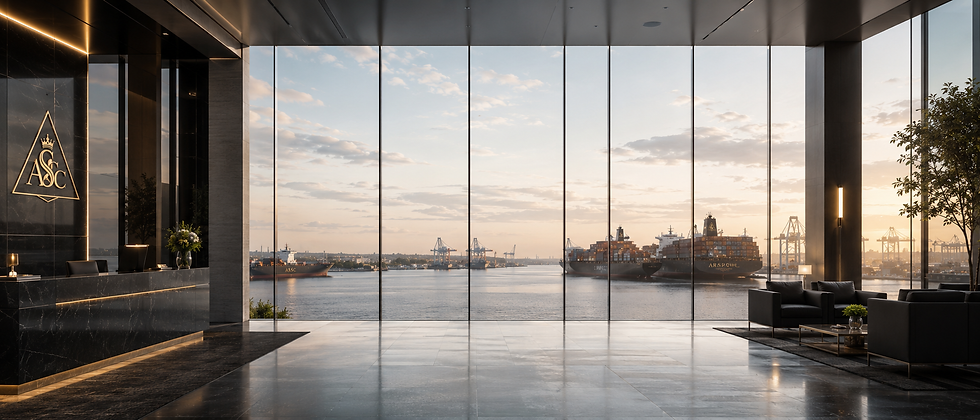
Since 1901, Aureate Shipping Company has provided global container transport, fuel logistics, polar resupply, humanitarian relief, and specialized maritime support from its Global Head Office in Maidenhead, England.
Click on any of the chart images below to see a pop-up/larger version of the image (best using a desktop monitor!)



About Aureate Shipping Company

For more than a century, Aureate Shipping Company has carried the materials, equipment, fuel, and essential supplies that keep nations connected and communities moving. From its Global Head Office in Maidenhead, England, ASC coordinates a far-reaching maritime network serving established commercial ports, remote settlements, scientific stations, and emergency-response zones across some of the world’s most demanding waters.
From Inherited Ships to Aureate Shipping
Aureate’s story began with British tradesman John Aureate; a member of a family long associated with sailing, shipbuilding, and maritime commerce. In 1876, he acquired a small collection of aging sailing vessels from the commercial network left behind by Britain’s former East India trading system. The ships were old, the available capital was limited, and the established shipping firms of the era showed little concern for another minor competitor.
John Aureate nevertheless recognized an opportunity. Independent manufacturers and regional merchants still required reliable access to overseas markets, but many were too small to command the attention of the dominant carriers. Aureate offered those businesses scheduled service, responsible cargo handling, and a promise that every agreement would be honored to the fullest extent possible.
His ships carried textiles, tools, machinery, agricultural goods, preserved food, and manufactured products between Great Britain, continental Europe, and ports formerly served by older trading monopolies. Through disciplined reinvestment, careful route selection, and an ability to succeed in markets abandoned by larger competitors, John Aureate transformed his inherited vessels into a thriving maritime enterprise.
In 1901, those expanding operations were formally incorporated as the Aureate Shipping Company. The new business began replacing wooden sailing vessels with steel-hulled steamships, allowing ASC to carry larger cargoes and operate with far greater schedule reliability. Its growing transatlantic service-connected British businesses with the rapidly industrializing ports of North America.
Long before satellite navigation and computerized logistics, Aureate developed detailed systems for maintenance planning, cargo coordination, crew readiness, and port scheduling. Its ships became known for arriving unusually close to their advertised delivery dates—a distinction that helped turn the Aureate name into a symbol of dependable maritime service.
War, Service and Royal Recognition
When the First World War placed enormous demands upon Britain’s merchant fleet, Aureate vessels were called into national service. ASC crews transported food, ammunition, vehicles, medical supplies, military personnel, and industrial equipment through waters threatened by mines, submarines, and hostile action.
Several vessels were lost, and many more returned damaged. Yet Aureate’s officers and crews continued sailing throughout the conflict and later assisted in bringing troops, equipment, and displaced civilians home. Their service earned the company a Royal Maritime Citation during the reign of King George V, granting Aureate the right to incorporate a crown into its corporate identity.
The Crisis Years
The years between the wars brought expansion into diesel propulsion, refrigerated cargo, Mediterranean routes, and petroleum-related transportation. They also brought one of the darkest decisions in Aureate’s history. In 1938, company leaders approved a commercial shipping agreement involving German industrial interests, believing that legal trade and commercial neutrality could survive Europe’s worsening political crisis.
The decision proved ruinous. When Britain entered the Second World War, Aureate faced public condemnation, regulatory scrutiny, lost customers, and increased insurance costs. German U-boats and other wartime dangers then devastated what remained of the fleet. Although surviving ASC vessels eventually served Allied convoy and supply operations, the company emerged from the war burdened by debt, damaged ships, and a deeply wounded reputation.
In 1947, company president Theodore Aureate, members of his family, and the crew of their aircraft disappeared over the Atlantic Ocean. No confirmed wreckage was recovered, and no one aboard was ever found. The tragedy removed the company’s most immediate family leadership at the very moment ASC was approaching financial collapse.
The Henderson Rescue
With creditors preparing to divide and sell the remaining assets, American industrialist Jefferson Henderson II intervened. He acquired Aureate Shipping in its entirety, retained its British identity, preserved its name, and began a comprehensive reconstruction of the company’s finances, fleet, workforce, and ethical standards.
Henderson believed Aureate’s most valuable assets were not its damaged ships, but its experienced mariners, established trade relationships, and hard-earned place in maritime history. Under his direction, obsolete vessels were retired, surviving ships were repaired, employee wages were stabilized, and politically sensitive contracts were subjected to far stronger review.
A Modern Global Fleet
By the late 1950s, Aureate had returned to profitability. During the decades that followed, ASC embraced containerization, mechanized cargo handling, computerized tracking, and integrated port-to-destination logistics. The company expanded its commercial fleet while developing specialized capabilities in fuel transportation, remote resupply, and cold-weather operations.
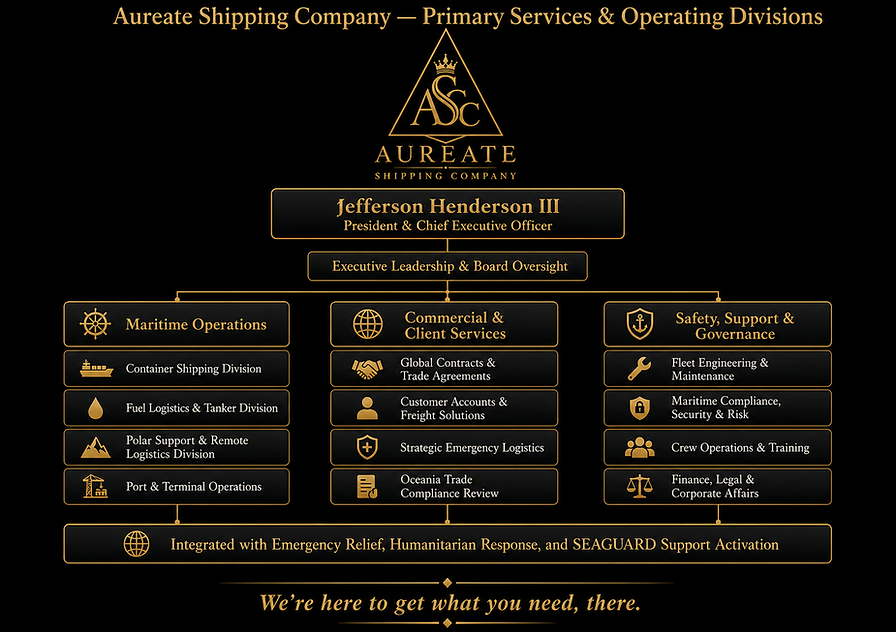
Today, Aureate operates 114 L-Class container ships, 23 S-Class fuel tankers, and 12 ice-capable support and refueling vessels. These ships form a total fleet of 149 vessels supported by thousands of seafarers, engineers, logistics professionals, port personnel, safety specialists, and corporate staff around the world.
The L-Class fleet serves as the backbone of Aureate’s international cargo network, transporting commercial goods, machinery, infrastructure materials, food, and industrial equipment between major global markets. The S-Class tanker fleet provides carefully regulated fuel and liquid-bulk transportation, while Aureate’s ice-capable vessels support polar research stations, isolated communities, remote government missions, and emergency operations in regions beyond the practical reach of conventional ships.
Trade, Responsibility and Emergency Service
Aureate currently supports more than 74 national trade agreements and recognized shipping-rights arrangements. Its operating regions include Great Britain and Europe, North America, the Mediterranean, the Indian Ocean, Arctic and Antarctic routes, the Atlantic Kingdom’s recognized maritime corridors, and the politically sensitive MDU nation of Oceania.
ASC’s relationship with the Atlantic Kingdom is governed by a carefully negotiated passage agreement permitting peaceful commercial transit through designated kingdom-controlled waters. Aureate vessels must comply with strict requirements involving environmental protection, military neutrality, lawful cargo, and respect for Atlantic sovereignty. In return, compliant ships receive recognized passage rights, navigational warnings, and access to emergency maritime assistance.
Aureate also maintains a restricted civilian trade agreement with Oceania, the militant island state occupying Saint Helena, Ascension Island, and Tristan da Cunha. The arrangement remains controversial within Britain and among several international governments, but it permits the transportation of approved civilian food, medicine, machinery, and essential supplies into a nation largely closed to outside contact.
The Oceania contract is governed by heightened cargo inspections, direct executive oversight, restricted crew procedures, and prohibitions against transporting weapons, military technology, surveillance systems, or unapproved dual-use materials. Aureate does not endorse Oceania’s government, and it does not formally conduct intelligence operations. However, its crews remain among the few independent foreign personnel able to lawfully observe conditions inside Oceania-controlled ports.
ASC does not instruct employees to gather intelligence, but it refuses to suppress truthful accounts of conditions they witness during lawful operations. Crew safety reports, navigation warnings, environmental findings, and firsthand testimony have therefore become important sources of information for journalists, regulators, humanitarian organizations, and government agencies seeking to understand events behind Oceania’s defenses.
The company’s willingness to maintain that difficult access has made it both respected and criticized. Supporters argue that Aureate delivers essential supplies, maintains a limited connection to Oceania’s isolated population, and prevents the trade from falling entirely into criminal or regime-controlled hands. Critics argue that any commercial payment strengthens Governor Goldstein’s government. Aureate recognizes that both concerns carry legitimate weight.
Aureate’s most important modern public-service commitment is its standing relationship with GUARD, primarily through SEAGUARD. As a GUARD-Certified Civilian Maritime Logistics Partner, ASC can activate designated ships, crews, port facilities, and logistics personnel in support of large-scale natural disasters, coastal evacuations, humanitarian emergencies, and remote maritime crises.
During joint operations, SEAGUARD provides rescue coordination, ocean-condition intelligence, threat assessment, and maritime security. Aureate retains civilian command of its ships and technical operations. This separation allows both organizations to work together without turning ASC’s commercial fleet into a permanent military resource.
Aureate vessels have transported emergency water, medical supplies, generators, shelter materials, vehicles, engineering equipment, and fuel into ports damaged by storms, earthquakes, tsunamis, volcanic events, and conflict. Its polar vessels can reach scientific stations and isolated communities where conventional relief transportation cannot operate safely.
Under President and Chief Executive Officer Jefferson Henderson III, Aureate continues to invest in fleet renewal, emissions reduction, cybersecurity, crew development, cargo integrity, polar safety, and international emergency readiness. Henderson has maintained the company’s commercial ambition while insisting that Aureate’s long history must never be used as an excuse to avoid modern scrutiny.
ASC openly acknowledges that ocean transportation carries environmental and political consequences. Its responsibility is not to claim perfection, but to improve operations, respond transparently when failures occur, and prevent short-term commercial interests from overriding lawful and ethical judgment.
Aureate has survived the disappearance of its founding family, two world wars, near-bankruptcy, political scandal, technological transformation, and repeated changes in the structure of global trade. Its survival has depended upon a willingness to modernize while preserving the principles that first distinguished John Aureate’s small fleet.
Those principles remain visible in every company division: disciplined preparation, respect for the crew, responsible custody of cargo, and the understanding that the true measure of a voyage is not departure, but safe delivery.
Today, an Aureate shipment may carry commercial goods to a major port, fuel to a remote settlement, scientific equipment to a polar station, or emergency supplies to a community whose infrastructure has been destroyed. Each assignment differs, but the commitment remains the same.
AUREATE SHIPPING
We’re here to get what you need, there.
Jefferson Henderson III
Aureate Shipping Company President & CEO

Jefferson Henderson III is the President and Chief Executive Officer of Aureate Shipping Company, overseeing its global container fleet, tanker operations, polar-support services, international trade relationships, and emergency maritime partnership with GUARD and SEAGUARD.
A British-American maritime executive and accomplished competitive sailor, Henderson combines Aureate’s historic traditions with modern commitments to safety, ethical trade, environmental responsibility, and international crisis response.
“We do not control the sea. We earn the right to cross it.”
Sailing Philosophy
“Money may build the yacht. Trust makes her fast.”
Emergency Partnership Principle
“When lives depend upon what crosses the ocean, delay is not an option.”
Ethical Trade Principle
“Access must never become endorsement. Trade must never become complicity.”
Leadership Principle
“We can operate in dangerous waters. We cannot allow those waters to decide who we become.”
The Steady Hand Behind a Global Fleet
Jefferson Henderson III serves as President and Chief Executive Officer of Aureate Shipping Company, directing its global commercial strategy, fleet-development program, international partnerships, and emergency maritime operations.
A British-American executive with more than two decades of maritime and logistics experience, Henderson represents the third generation of his family to lead the company rescued by his grandfather, Jefferson Henderson II. He views that position not as a hereditary entitlement, but as a responsibility that must be continually earned through performance, judgment, and the confidence of Aureate’s employees and board.
Henderson began his career in route analysis and commercial logistics before advancing through fleet planning, port-development strategy, tanker compliance, international contracting, emergency operations, and polar-fleet development. His leadership style is direct, highly visible, and grounded in practical operating experience aboard Aureate vessels.
He has made crew safety, environmental accountability, digital security, civilian independence, and emergency readiness central to ASC’s modern identity. He also personally oversees the company’s GUARD–SEAGUARD partnership and the annual ethical review of Aureate’s politically sensitive Oceania trade agreement.
Outside the boardroom, Henderson is an accomplished competitive sailor and the owner-captain of the Aureate Sovereign, an elite British racing yacht. His sailing program participated in the British 2024 America’s Cup campaign, which finished second, and he remains committed to returning as an active captain and helmsman in pursuit of victory.
Henderson’s combination of executive leadership, operational discipline, and competitive sailing has made him the public face of modern Aureate Shipping: confident, demanding, approachable, and deeply invested in the people responsible for carrying the company’s name across the world.
ASC Headquarters
Maidenhead, England
